
RADIO CONTROL AEROBATICS
Eric Henderson 303 Shady Ln., Marlton, NJ 08053 E-mail: eric.henderson@home.com
This month's column
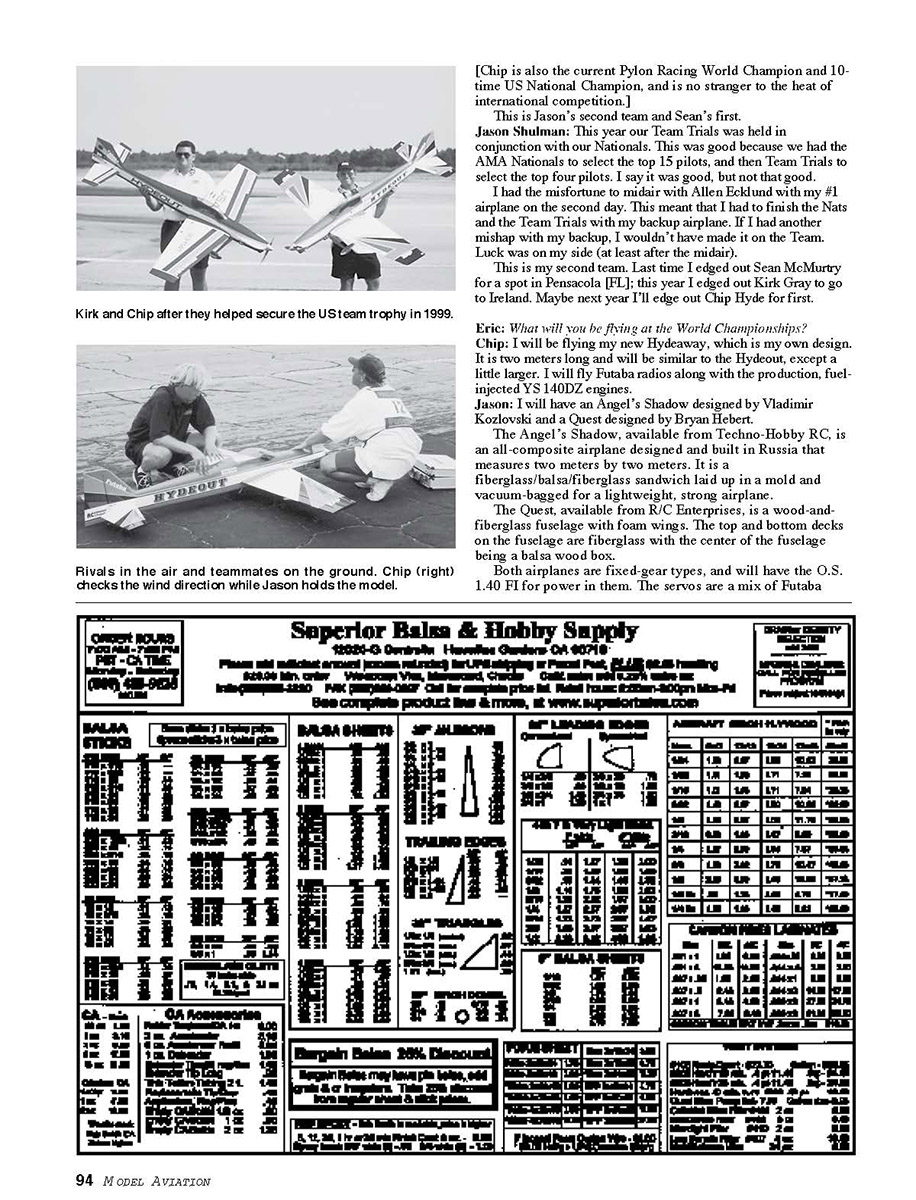
This month's column is dedicated to the US F3A team interviews. The group will be in Ireland this summer, ready to take on the world at the F3A World Championships. Dave Guerin is the team manager. Here are their answers to my questions.
US F3A team
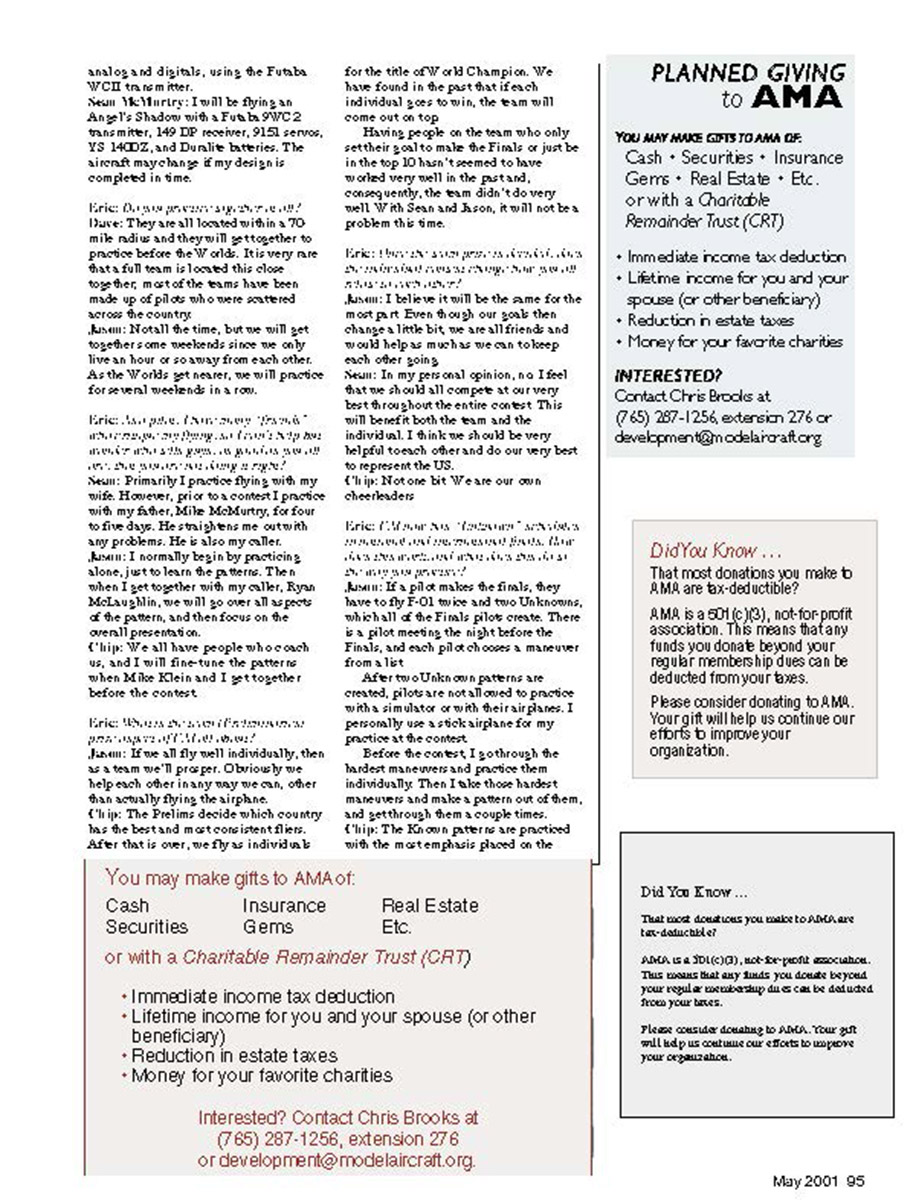
- Chip Hyde
- Sean McMurtry
- Jason Shulman
- Backup pilot: Kirk Gray (if anyone is unavailable). Kirk was a member of the World Championships team at the last Worlds.
What the team manager does
As team leader and spokesperson, Dave Guerin prepares the team for the trip, interfaces with event organizers, ensures the team's needs are met, and supports them with encouragement, guidance, and enthusiasm.
Primary responsibilities and concerns:
- Planning travel, lodging, and rental vehicles to move airplanes and equipment.
- Shipping the models and covering fuel and other consumables.
- Securing funding: the AMA provides only a small portion of the total cost, so the team relies heavily on sponsor contributions and donations from the Pattern community.
- Ensuring reliable call and tail support (a major individual expense).
Contact and donations:
- Contributions can be sent to the AMA Team Manager's Fund.
- Contact Dave Guerin: guerin2@mindspring.com or (336) 538-0440.
How the team members became team members / who has been there before
Chip Hyde:
- This is the sixth time Chip has been on the team. He won the Worlds in 1991, was second in 1993, and third in 1999.
- (Chip is also the current Pylon Racing World Champion and a 10-time US National Champion.)
Jason Shulman:
- This is Jason's second team. He previously edged out Sean McMurtry for a spot in Pensacola; this year he edged out Kirk Gray to go to Ireland.
- Team Trials were held in conjunction with Nationals: the AMA Nationals selected the top 15 pilots, and Team Trials selected the top four.
Sean McMurtry:
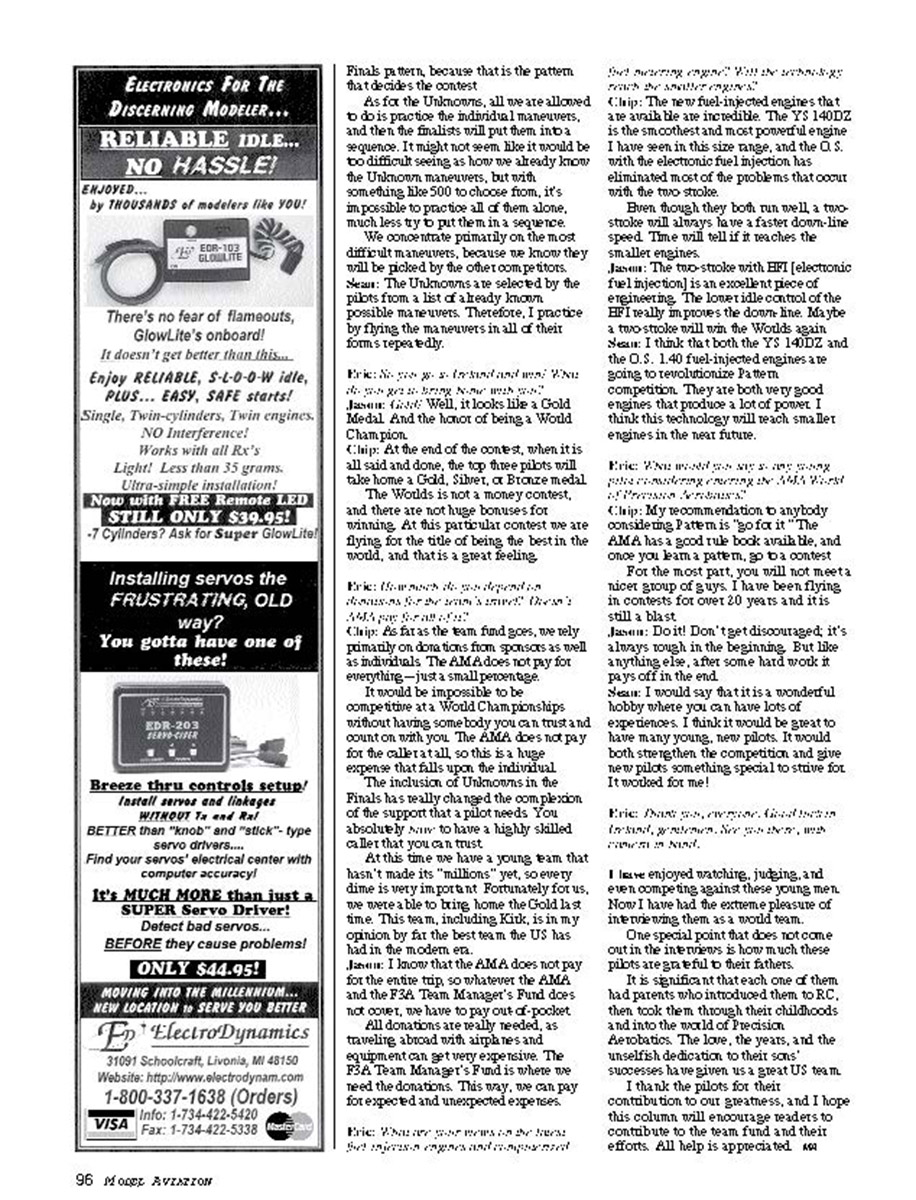
- This is Sean's first time on the World team.
Aircraft and equipment
Chip Hyde
- Airplane: Hydeaway (Chip's own design), two-meter similar to the Hideout but slightly larger.
- Radio: Futaba.
- Engine: production fuel-injected YS 140DZ.
Jason Shulman
- Airplanes: Angel's Shadow (designed by Vladimir Kozlovski) and a Quest (designed by Bryan Hebert).
- Angel's Shadow: all-composite, fiberglass/balsa/fiberglass sandwich, molded and vacuum-bagged; two meters by two meters. Available from Techno-Hobby RC.
- Quest: wood-and-fiberglass fuselage with foam wings; fuselage decks fiberglass, center a balsa wood box. Available from R/C Enterprises.
- Gear: fixed-gear types, O.S. 1.40 F1 engines, mix of Futaba analog and digital servos, Futaba W/C11 transmitter.
Sean McMurtry
- Airplane: Angel's Shadow (may change if his own design is completed in time).
- Radio/electronics: Futaba 9W/C2 transmitter, 149 DP receiver, 9151 servos.
- Engine: YS 140DZ.
- Power: Duralite batteries.
Practice and callers
- The pilots live within a roughly 70-mile radius and will practice together before the Worlds. It is rare for a full team to be so close geographically.
- Practice habits:
- Jason: Primarily practices with his wife; prior to contests he practices four to five days with his father, Mike McMurtry, who also serves as his caller.
- Sean: Begins practicing alone to learn the pattern; then works with his caller, Ryan McLaughlin, to refine presentation.
- Chip: Works with coaches including Mike Klein to fine-tune patterns.
- As the Worlds approach, they will practice multiple weekends in a row.
Team strategy: knowns vs unknowns, finals, and mental preparation
- Prelims determine which country has the best and most consistent fliers. After prelims, individuals compete for the World Champion title.
- Team composition matters: teams made up of pilots who only occasionally make Finals or place in the top 10 have not performed as well historically. The current team members are expected to be competitive individually and as a team.
- Mental preparation:
- Jason: Team members are friends and support each other; they help keep each other going.
- Sean: Believes each pilot should compete at their best throughout the contest; helping teammates benefits both team and individual.
- Chip: The pilots are self-motivated — "we are our own cheerleaders."
The Unknown sequences
- Structure:
- There are three Unknowns overall, with Unknown 2 typically harder than Unknown 1, and Unknown 3 the hardest.
- If a pilot makes the Finals, they fly 10 Known patterns and two Unknowns. The Finals pilots create the Unknowns from a list the night before the Finals.
- Practice rules and strategy:
- Pilots are allowed to practice individual maneuvers before the contest, but after the Unknowns are created they are not allowed to practice the complete Unknown sequences with a simulator or airplane.
- Pilots often practice the hardest maneuvers individually and assemble practice patterns of those maneuvers to work through them repeatedly.
- With roughly 500 possible maneuvers, pilots focus on the most difficult ones, since competitors are likely to select those for the Unknowns.
- Jason: Practices maneuvers in all their forms repeatedly.
- Sean: Uses a stick airplane at contests for practice and concentrates on overall presentation with his caller.
Scoring and prizes
- The top three pilots take home Gold, Silver, or Bronze medals.
- The Worlds is not a money contest; the title "best in the world" is the primary prize.
Team funding and expenses
- Major expenses:
- Travel and lodging.
- Rental vehicles to move airplanes and equipment.
- Shipping models and spare parts.
- Fuel, call and tail support, and miscellaneous contest expenses.
- The AMA provides partial funding only. The team depends heavily on donations from sponsors and individuals via the AMA Team Manager's Fund.
- All donations are needed to cover expected and unexpected expenses; pilots also pay out of pocket for amounts not covered.
Engines and fuel injection
- Fuel-injected four-stroke engines (e.g., YS 140DZ, O.S. 140 with EFI) are highly regarded:
- Chip: Calls the YS 140DZ the smoothest and most powerful in its range; says EFI has eliminated many two-stroke problems. Notes two-strokes still have faster down-line speed, but time will tell if EFI closes that gap.
- Jason: Praises two-stroke engines with EFI; lower idle control improves the down-line.
- Sean: Believes the YS 140DZ and O.S. 140 EFI engines will revolutionize Pattern competition and expects the technology to reach smaller engines soon.
Advice for new pilots
- Eric (columnist): "Go for it." Read the AMA rule book, learn a pattern, go to a contest — the community is welcoming. After 20+ years he still finds contests a blast.
- Jason: Don't get discouraged; progress comes with hard work.
- Sean: It's a wonderful hobby that offers many experiences. More young pilots would strengthen competition and give newcomers something special to strive for.
Closing remarks
- The interviewer has enjoyed watching, judging, and competing against these pilots and appreciated the opportunity to interview them as a world team.
- A special note: each pilot is deeply indebted to his father. Their parents introduced them to RC, supported them through childhood, and made unselfish contributions to their sons' success. That parental support has helped create a great US team.
- The column encourages readers to contribute to the team fund and support the team's efforts. All help is appreciated.
Transcribed from original scans by AI. Minor OCR errors may remain.

