
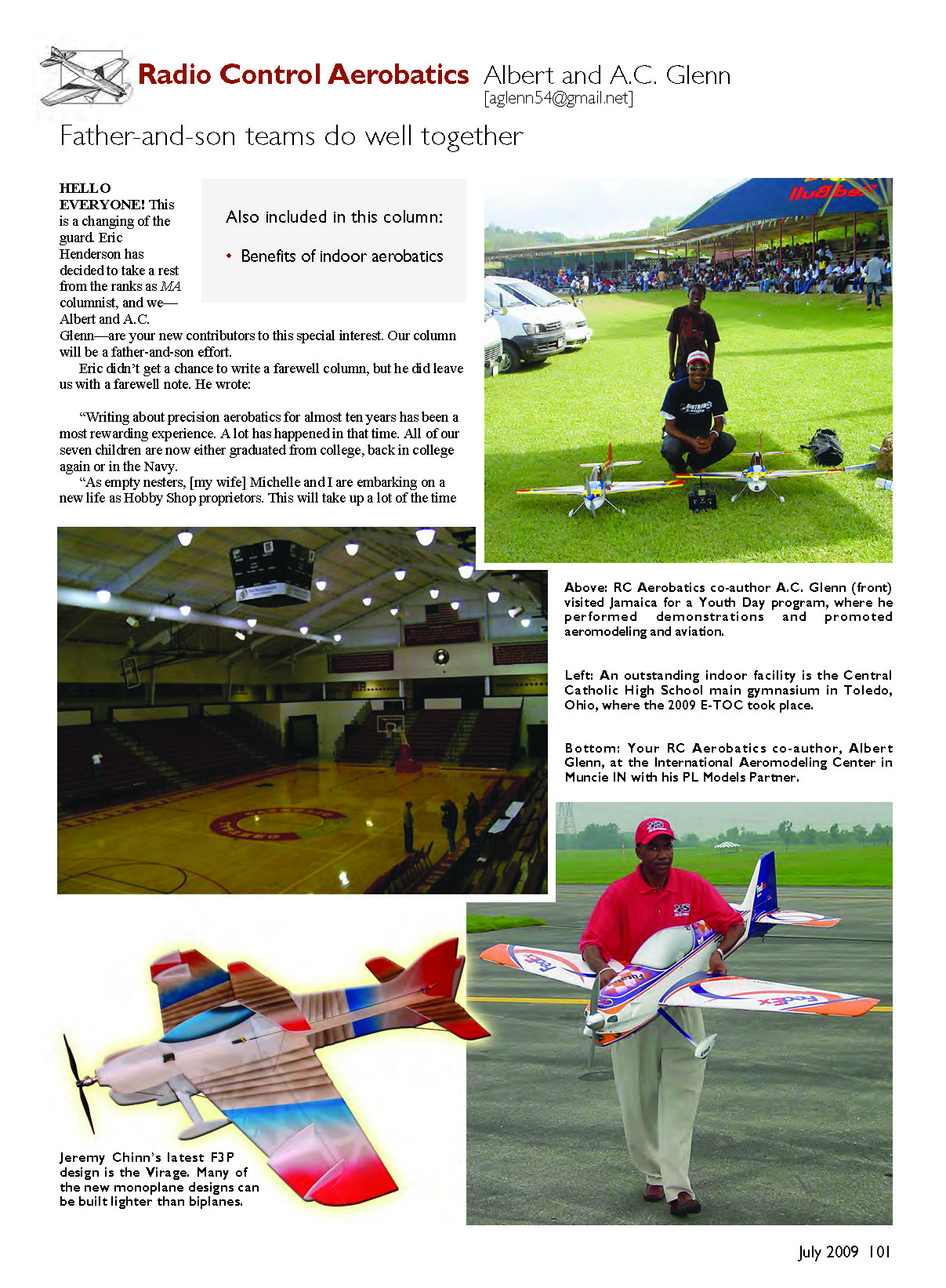
Radio Control Aerobatics
Albert and A.C. Glenn [aglenn54@gmail.net]
Father-and-son teams do well together
Hello, everyone! This is a changing of the guard. Eric Henderson has decided to take a rest from the ranks as an MA columnist, and we—Albert and A.C. Glenn—are your new contributors to this special interest. Our column will be a father-and-son effort.
Eric didn’t get a chance to write a farewell column, but he did leave us with a farewell note. He wrote:
“Writing about precision aerobatics for almost ten years has been a most rewarding experience. A lot has happened in that time. All of our seven children are now either graduated from college, back in college again or in the Navy.
“As empty nesters, [my wife] Michelle and I are embarking on a new life as hobby shop proprietors. This will take up a lot of the time that we used to have to go to competitions and stay current in the world of pattern [RC Aerobatics]. Now is a good time to hand over the reins to a new set of experts who are both younger and much more active in the sport.
“I will miss the 400-plus pattern-related emails a year and the great people that I have met and worked with. I will not miss, however, the deadline for getting the column submitted.
“I would like to wish all pattern column readers the very best of success with their precision flying adventures. It’s a small world and many of us will continue to run into each other. Until then, fly straight and smooth.”
We thank Eric for all he has done as a writer and for RC precision aerobatics.
Background
The two new columnists have almost 50 years of aeromodeling experience between them. Albert Glenn is an MD-11 captain for FedEx Express in Memphis, Tennessee, and is a devoted RC pilot who has been flying model airplanes since he was 11 years old. He is the 2009 U.S. F3A (FAI RC Aerobatics) team manager and has been on hiatus from flying F3A while acting as mechanic, instructor, and caller for his son, A.C., for the last six years. Albert has judged and flown in an assortment of contests, including Pattern, IMAC (International Miniature Aerobatic Club), NPAC, Nats, and Masters. He was also the team manager for the 2007 U.S. F3A team. Albert is known for being tough in practice and patient and calm in competition.
A.C. is a sophomore at Arkansas State University at Jonesboro. He has been flying RC for almost 14 years, starting when he was 5 years old and going to contests with his father and flying on a buddy box. A.C. soloed at 8 years old and competed in his first Pattern contest at 10, flying a Kaos 60 in Sportsman. He has since progressed through the ranks in Pattern, winning the 2005 Nats in the Advanced category and placing fourth in Masters at the 2006 Nats. Since then, A.C. has placed in the top 15 in the FAI semifinals. He flies a lot of both indoor and outdoor aerobatics, with both electric- and gas-powered airplanes. A.C. hopes to provide many insights into the aerobatics world.
Indoor Pattern and F3P
Indoor Pattern has become a way to keep your precision aerobatics skills sharp when it’s virtually impossible to fly 2-meter Pattern models outdoors. The sport has come a long way in the past few years. Now you can buy a competitive RTF F3P airplane for close to $300; a few years ago the motor and speed controller alone would have cost that much. Many new F3P contests are popping up across the U.S. Events are usually set up so that you fly the standard F3P-A sequence and an Unknown, followed by a Freestyle. The F3P-A sequence goes as follows.
Also included in this column:
- Benefits of indoor aerobatics
F3P-A sequence:
- Takeoff
- Reverse Cuban Eight
- 1/4 Roll — Knife-Edge 180° Circle — 1/4 Roll (backside knife-edge 1/2 circle)
- Loop with 1/2 Roll at the Top
- Inverted Stall Turn — 1/2 Roll After Exit
- Triangular Loop with 1/2 Roll at the Top
- Inverted 180° Circle
- Rolling Circle with One Roll
- Top Hat with 1/4 Rolls — Exit Normal
- 2/4 Point Roll
- Push–Pull Humpty Bump (inverted entry, push up, 1/4 roll, pull level inverted, pull downline, 1/4 roll, pull up to level to exit in the opposite direction of the entry)
- Torque Roll
- Landing
Most new F3P models use specially designed airbrakes to slow the airplanes in the small, confined areas in which we fly. In the F3A Pattern world, ounces are a big deal when it comes to weight. In the indoor world, grams are a big deal.
Pilots use the lightest of all equipment to get their airplanes to weigh the least. The lighter the aircraft, the more maneuverable it can be at a lower airspeed. That quality allows the pilot to do maneuvers in the confined area of an indoor facility.
The hot aircraft design this year seems to be a monoplane. In past years, biplanes were the most popular because of the additional drag and flexibility of the two-wing platform. But now, after a lot of testing, there have been several discoveries in airbrake design that seem to put monoplanes and biplanes on an even level—and maybe even give monoplanes an edge because of weight.
We should see those results come from this year's Electric Tournament of Champions (E-TOC), which took place April 3–4. Albert attended the E-TOC — not as a pilot, but as a writer. He will provide a full debrief before the indoor flying season starts this fall.
Finding and using indoor facilities
Finding an indoor facility that is accommodating has become a hard task for most pilots. I have been blessed to find a community center not far from my home to practice in during the early morning hours.
Most gyms will allow you to fly when they are not occupied by morning aerobics, sports, and youth programs. The best time I have found to practice is early in the morning to avoid most conflicts; after winter, it's almost impossible to find time in the gym.
When you are looking for an indoor facility, seek out a room that is at least the size of a standard basketball gym. Anything smaller is much harder to maneuver a model within unless it is specially designed to suit the space.
We have found indoor Pattern to be a lot of fun and a great way to continue to hone your skills and remain active during those long winter months and rainy days. Albert has stated that my flying has improved to a new level because of flying indoors.
As the Pattern sequences I fly become more difficult, practicing inside allows me to learn new skills and break down difficult and complex maneuvers with a less expensive aircraft that is easy to repair and replace. The same goes for 3-D flying.
Competitors come from around the world to participate in indoor Pattern contests, making the sport a great way to network and expand your knowledge base. We encourage you to give it a try!
The year 2009 will be busy for precision aerobatics, with the Nats in July and the F3A World Championships in Pombal, Portugal, in August. We hope to give you full detailed reports on all the new aircraft and interviews with U.S. team members and a few competitors from other countries.
Sources
- National Society of Radio Controlled Aerobatics — www.nsrca.us
Transcribed from original scans by AI. Minor OCR errors may remain.

