
RADIO CONTROL AEROBATICS
Ron Van Putte, 111 Sleepy Oaks Road, Ft. Walton Beach, FL 32548
F3A Team Selection Finals — Corvallis, Oregon
This month's column is a report on the F3A Team Selection Finals prepared by Gene Rodgers of Ft. Worth, Texas, who was one of the competitors. Gene flew well enough to qualify for the finals and finished sixth. When I called to report receipt of his text and matrix, I congratulated him on his placing. He replied, "It just goes to show that even a blind pig can find food once in a while."
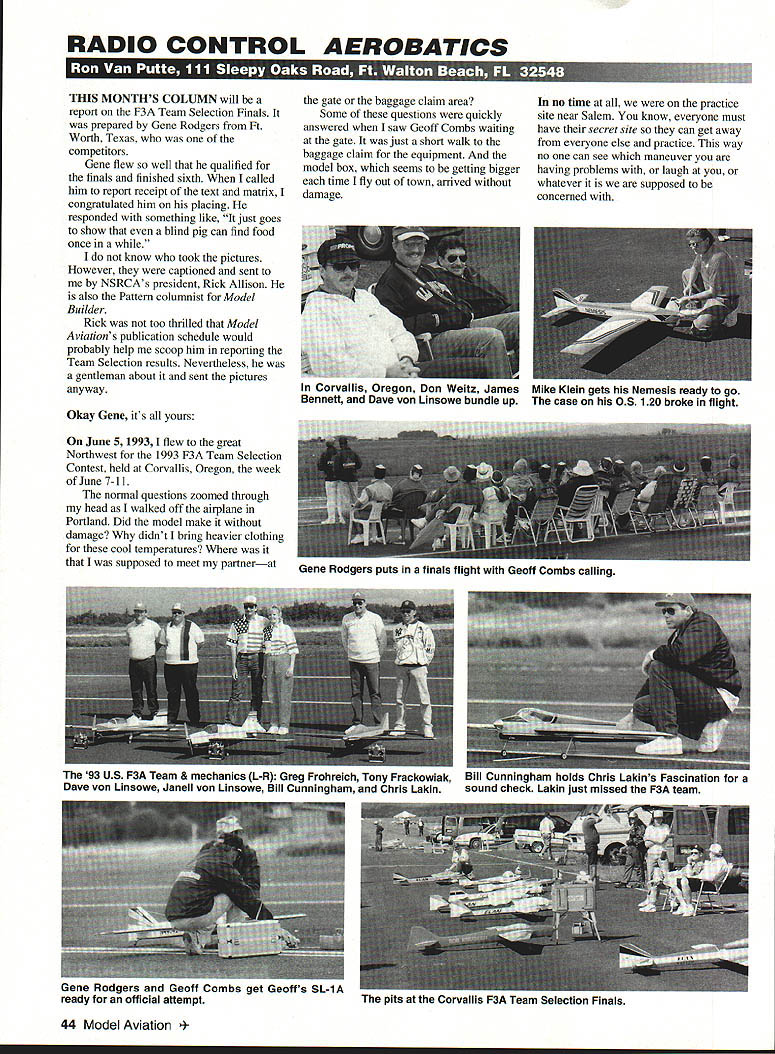
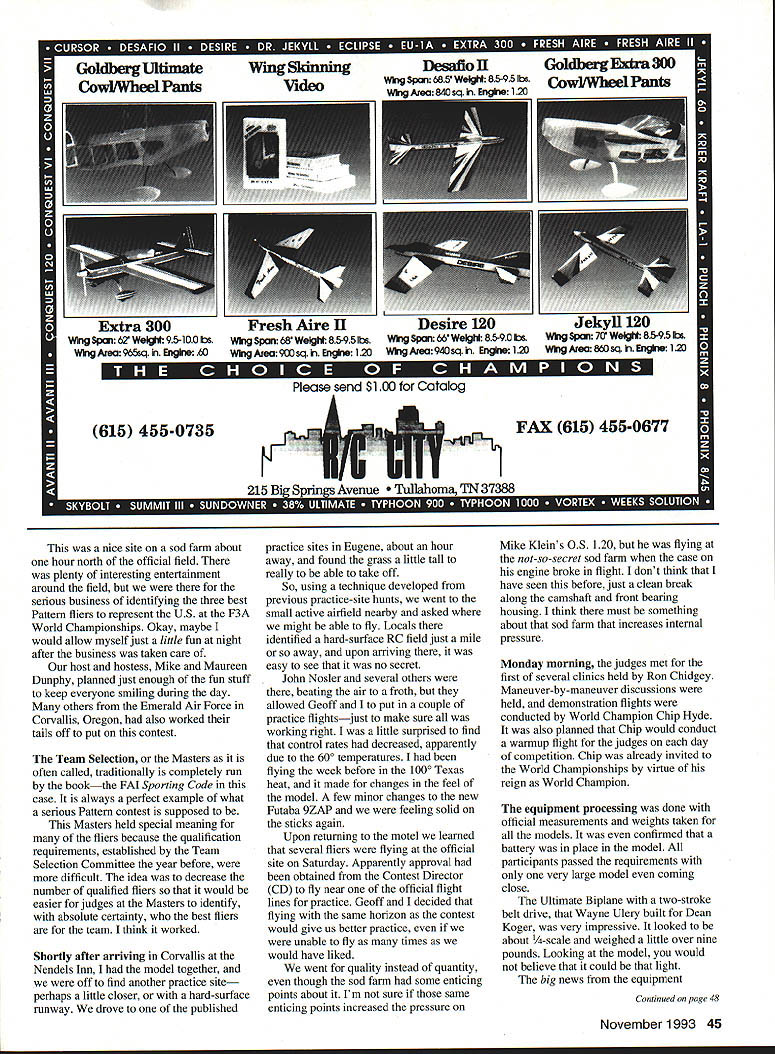
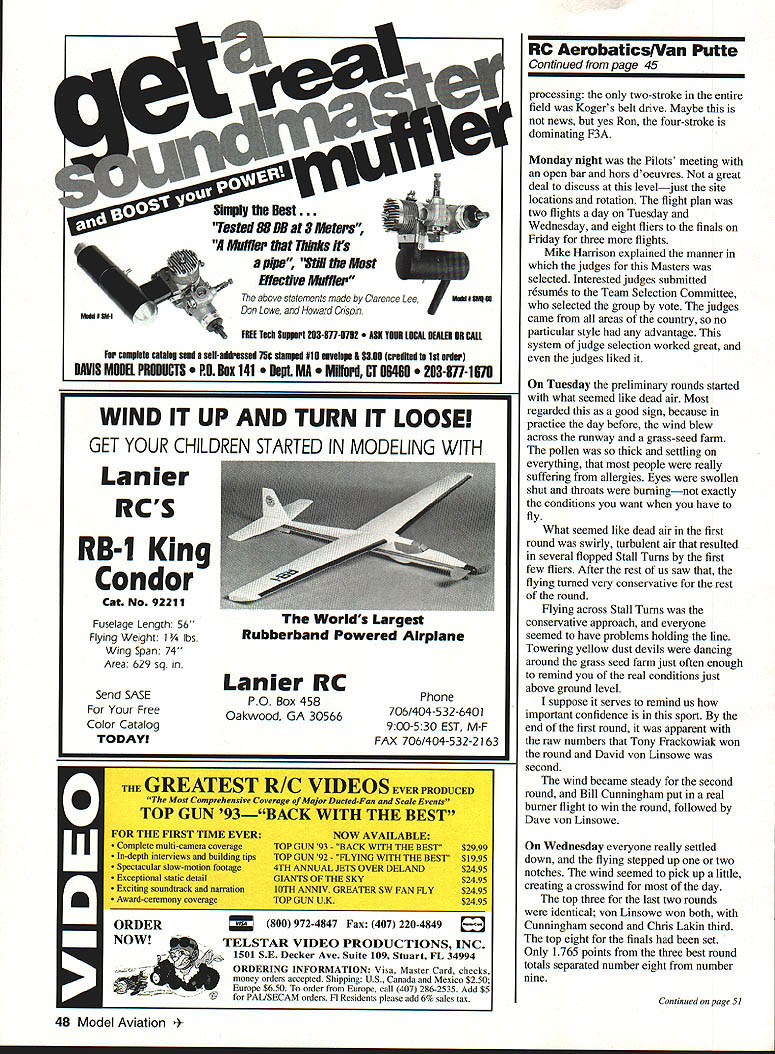
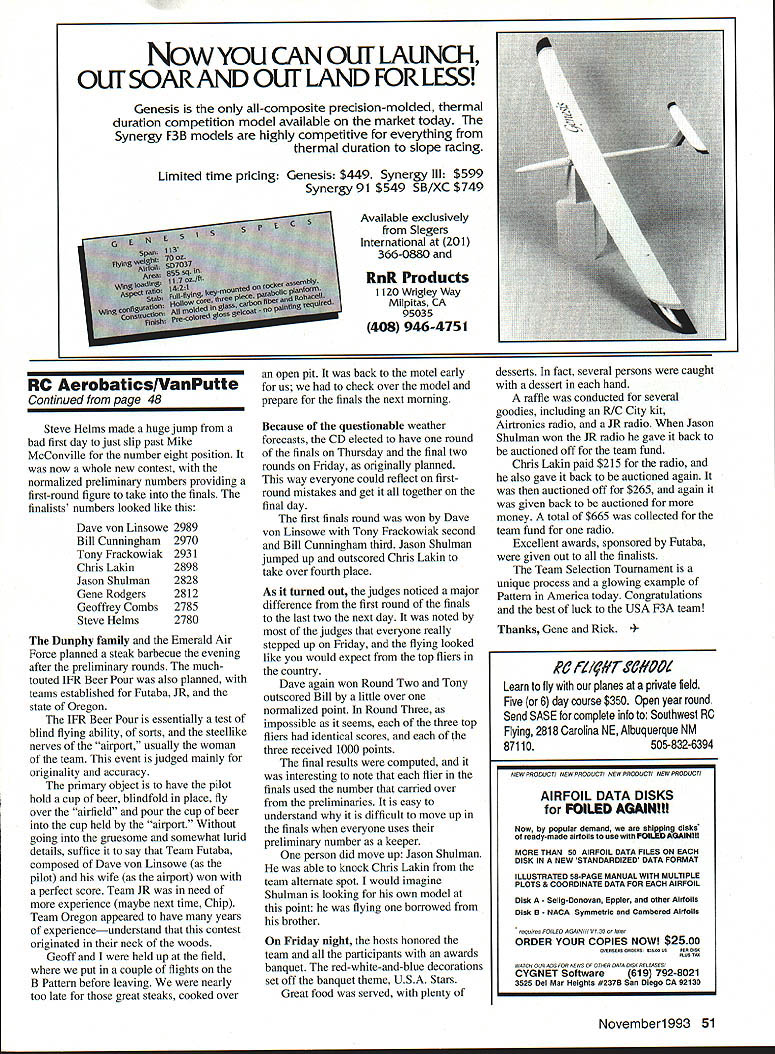
I do not know who took the pictures; they were captioned and sent to me by NSRCA president Rick Allison, who is also the Pattern columnist for Model Builder. Rick was not thrilled that Model Aviation's publication schedule might let me scoop him on the Team Selection results, but he was a gentleman about it and sent the pictures anyway.
Okay Gene, it's all yours.
Arrival and practice
On June 5, 1993, I flew to the great Northwest for the 1993 F3A Team Selection Contest, held in Corvallis the week of June 7–11.
Walking off the airplane in Portland, the usual questions ran through my head: Did the model make it without damage? Why didn't I bring heavier clothing for these cool temperatures? Where should I meet my partner—at the gate or baggage claim? Geoff Combs was waiting at the gate, and it was just a short walk to baggage claim. The increasingly large model box arrived without damage.
The contest site was a nice sod farm about an hour north of the official field. The Emerald Air Force of Corvallis worked hard to put the contest together. Hosts Mike and Maureen Dunphy planned just enough fun to keep everyone smiling during the day.
Shortly after arriving at the Nendels Inn, I got the model together and set off to find a practice site—preferably closer or with a hard-surface runway. We drove to one of the published practice sites in Eugene (about an hour away) but found the grass too tall for reliable takeoffs. Using a technique developed on previous practice hunts, we asked at a small active airfield and were pointed to a hard-surface RC field just a mile away. John Nosler and several others were already flying; they allowed Geoff and me to put in a couple of practice flights.
I was surprised to find my control rates feeling decreased, apparently due to the 60° temperatures. Flying the week before in 100° Texas heat had led me to set the rates differently. A few minor changes to the new Futaba 9ZAP had the model feeling solid again.
Back at the motel I learned several fliers were practicing at the official site on Saturday with CD approval to fly near the contest flight lines. Geoff and I decided that flying the same horizon as the contest would give better practice. Unable to fly as many times as we would have liked, we emphasized quality over quantity.
One cautionary note from practice: Mike Klein's O.S. .120 engine experienced a clean break at the crankshaft and front bearing housing while flying at the sod farm. I had not seen that failure before—must be something about that sod farm.
Contest setup and judges
Monday morning the judges met for the first of several clinics held by Ron Chidgey. Maneuver-by-maneuver discussions were held and demonstration flights were conducted by World Champion Chip Hyde. Chip also planned to do a warmup flight for the judges each competition day; he was already invited to the World Championships by virtue of his world title.
Equipment processing was strict: official measurements and weights were taken for all models, and it was confirmed that batteries were in place. All participants had to show the official logbook and comply with requirements, with only one very large model even coming close to limits.
One notable model was the Ultimate Biplane with a two-stroke belt drive that Wayne Ulery built for Dean Koger. It looked like about 1/4-scale and weighed a little over nine pounds—lighter than it appeared. Incidentally, Koger's model was the only two-stroke in the entire field; four-strokes are clearly dominating F3A.
Monday night was the pilots' meeting with an open bar and hors d'oeuvres. The meeting covered site locations and rotation. The flight plan called for two flights per day on Tuesday and Wednesday, and eight fliers advancing to the finals on Friday for three more flights.
Judge selection was explained by Mike Harrison: interested judges submitted résumés to the Team Selection Committee, which selected the group by vote. The judges came from across the country so no regional style had advantage. This selection system worked very well and was well received by the judges.
Preliminary rounds
On Tuesday the preliminary rounds started with what looked like dead air—yet it proved swirly and turbulent just above ground level. In practice the day before, wind had blown across the runway and a grass-seed farm; pollen was thick and settling on everything, causing many people to suffer from allergies (swollen eyes and burning throats).
The swirly air in the first round produced several flopped stall turns among the early fliers. After seeing that, most pilots flew more conservatively for the rest of the round, often crossing stall turns to avoid problems. Yellow dust devils danced around the grass-seed farm, a reminder of the conditions near the surface.
By the end of the first round Tony Frackowiak had the top raw score and David von Linsowe was second. The wind steadied for the second round; Bill Cunningham put in an outstanding flight to win that round, followed by Dave von Linsowe.
On Wednesday the flying stepped up noticeably. The wind picked up a bit and produced a crosswind for much of the day. Von Linsowe won both of the remaining preliminary rounds, with Cunningham and Chris Lakin alternating high finishes. The top eight for the finals was set; only 1.765 points separated eighth from ninth. Steve Helms made a big jump from a poor first day to slip past Mike McConville into the number eight spot.
The normalized preliminary totals (the numbers that carried into the finals) for the finalists were:
- Dave von Linsowe — 2989
- Bill Cunningham — 2970
- Tony Frackowiak — 2931
- Chris Lakin — 2898
- Jason Shulman — 2828
- Gene Rodgers — 2812
- Geoff Combs — 2785
- Steve Helms — 2780
The Dunphys and the Emerald Air Force hosted a steak barbecue the evening after preliminaries. They also staged the much-touted IFR Beer Pour, with teams for Futaba, JR, and Oregon. The IFR Beer Pour tests a kind of blind-flying ability and the steady nerves of the "airport" (usually a woman on the team). The object is for a blindfolded pilot to hold a cup of beer, fly over the "airfield," and pour into a cup held by the airport. Team Futaba (Dave von Linsowe as pilot and his wife as airport) won with a perfect score. Team JR (with Chip participating) lacked experience, and Team Oregon showed deep local expertise—the event originated in their area.
Geoff and I were delayed at the field putting in a couple of B Pattern practice flights before the barbecue. We were nearly too late for the steaks but made it back to the motel early to prep for the finals the next morning.
Finals and results
Because of questionable weather forecasts, the CD scheduled one finals round on Thursday and two on Friday so pilots could reflect on first-round mistakes and pull everything together for the final day.
Finals Round 1 (Thursday)
- Winner: Dave von Linsowe
- 2nd: Tony Frackowiak
- 3rd: Bill Cunningham
- Jason Shulman moved up past Chris Lakin into fourth for that round.
Judges noted a major difference between Round 1 and the last two rounds: everyone stepped up on Friday and the flying looked like you would expect from the nation's top fliers. Dave won Round 2 as well; Tony outscored Bill by a small normalized margin. In Round 3, remarkably, the top three fliers each had identical scores and each received 1000 points for that round.
Final scoring used the normalized preliminary number as a carryover, which makes moving up in the finals difficult. One person who did move up was Jason Shulman—he knocked Chris Lakin down to alternate. (Jason had been flying a model borrowed from his brother.)
Awards and fundraising
On Friday night the hosts honored the team and all participants with an awards banquet decorated in a red-white-and-blue "U.S.A. Stars" theme. Great food and plenty of desserts were served (several people were spotted with a dessert in each hand).
A raffle offered prizes including an R/C City kit, Airtronics radio, and a JR radio. Jason Shulman won the JR radio but gave it back to be auctioned for the team fund. Chris Lakin bid $215 for the radio and then returned it to be auctioned again; it sold for $265 and was put up a third time. In total, $665 was collected for the team fund from that one radio auction.
Excellent awards, sponsored by Futaba, were given to all the finalists.
Observations and congratulations
The Team Selection Tournament is a unique process and a glowing example of Pattern flying in America today. The tougher qualification rules reduced the field to make it easier for judges to identify the absolute best fliers, and that approach appeared to work well.
Congratulations and the best of luck to the USA F3A team!
Thanks to Gene Rodgers for the report and Rick Allison for the photos.
Transcribed from original scans by AI. Minor OCR errors may remain.

