

RADIO CONTROL AEROBATICS
Ron Van Putte 111 Sleepy Oaks Road, Ft. Walton Beach, FL 32548
Event overview
This was threepeat for a Nats at Lawrenceville, Illinois: the 1990 and 1991 Nats were also held there. In fact, it was the fourth consecutive year that a major RC Pattern contest had been held at Lawrenceville, since the 1992 N-PAC (NSRCA Pan American Championships) were held there too. The site is popular with competitors: the runway is smooth and wide, with no trees for a long distance from the runway.
The original plan was for everyone to get in six rounds, flying from six flight lines. Shortly after I arrived at the AMA Headquarters tent at the Mid‑America Air Center, event director Tony Stillman told me that the control line Stunt fliers had been given two of the RC Pattern flight lines. Their expected site was too rough, so they were moved to what would have been our third site on the main runway. The good news was that everyone still got six rounds because fewer than expected showed up.
Two sites were set up on the east–west runway, with two flight lines available at each site. It was planned that all classes would complete six rounds by Thursday evening, leaving only the FAI Finals on Friday. That is how it worked out.
Schedule and contest format
- Morning sessions (starting at 8 a.m.): Advanced and Masters classes. Morning sessions ended at about noon.
- Afternoon sessions (starting at 1 p.m.): Sportsman and FAI, continuing until last good light.
During the first four rounds, 32 Advanced and 33 Masters fliers were mixed on all four lines, permitting normalization only after the fourth round. During the last two rounds, Masters and Sportsman fliers were split into two lines for each class so scores could be normalized after Round Six.
- Seventeen Sportsman and 49 FAI fliers flew in the afternoon. All Sportsman fliers were on one line; Sportsman scores were normalized after every round.
- The remaining three lines had FAI fliers, so their scores could only be normalized after Rounds Three and Six.
FAI qualification: the top 21 FAI fliers qualified for the Finals. Based on FAI rules there should have been only 10 (the top 20% of 49 fliers), but there is always pressure to have more FAI fliers in the Finals at a Nats, so Contest Director Tony Stillman relented.
Mike Lauman (Jackson, Mississippi) was responsible for scoring. Mike, his wife Vicky, and daughter Mandy worked on the flight line in the heat and handled scoring all day, every day.
Engines, rules and proposals
If there was any question about engine choice, this Nats decided it: in FAI, four‑strokes outnumbered two‑strokes 47 to 2. The other classes did not have quite as high a ratio, but four‑strokes were still overwhelming in every event.
There was much talk about possible 1996–1997 rules change proposals to eliminate the engine displacement limit and replace it with a weight limit, while keeping the noise limit. The current FAI limit is 5 kilograms (11 pounds), but it is likely to be reduced to 4.5 kilograms (9.9 pounds) in the near future. Talk about a potential weight limit generally centered around 4.5 kilograms.
Implications of a weight limit:
- Four‑stroke .120 fliers would likely have to make changes, opening up new design challenges.
- Two‑stroke users would likely gain a horsepower advantage, shifting the balance toward two‑strokes.
- Many four‑stroke users who have said "It's not the engine that wins, it's the pilot" might find the situation reversed if the proposal passes.
There was also discussion about takeoff direction. In prior years co‑chief judges sometimes dictated takeoff direction, but this year Tony Stillman decreed takeoff direction would be the pilots' option. Based on lack of problems with that option, I am confident a proposal to formalize it will pass; I plan to propose the change next year.
Weather and conditions
Heat was a significant factor. Daytime highs were in the mid to upper 90s during the week, except when rains hit on Thursday. We realized what we were in for when John Fuqua (Niceville, Florida), Steve Kessler (Kingwood, Texas), and I helped Tony Stillman put up the turnaround poles the day before competition started — we were pretty well done in when we finished.
Wind was also a factor and varied through the years:
- 1990 Nationals: wind primarily southwest — takeoffs right‑to‑left and maneuvers usually in a quartering crosswind.
- 1991 Nationals: winds mostly northeast — takeoffs left‑to‑right and maneuvers usually in a quartering crosswind.
- N‑PAC 1992: much of the time wind was south, giving pilots opportunity to choose takeoff direction.
This year the wind varied northwest and northeast in the afternoon, so pilots exercised the option to choose takeoff direction. Often a pilot would not decide which way to take off until the engine started.
Rain threatened at times during the week, with some heavy overnight and early‑morning storms. The only rain to fall during competition was during the last 1½ rounds of Masters flights on Thursday, which held up flying for more than three hours. Fortunately Sportsman, Advanced, and FAI fliers had finished their six rounds the previous day.
Quality of flying
The quality of flying was excellent and the spectrum of skill did not appear as broad as in past years. Much of the improvement was probably due to pilots' increasing familiarity with the turnaround style and with the maneuver schedules. Overall, flying quality was high at the 1993 Nats.
Results
Sportsman
There was little suspense about the winner.
- Sean McMurtry (Oklahoma City, Oklahoma) was the leader for three of the six rounds and won.
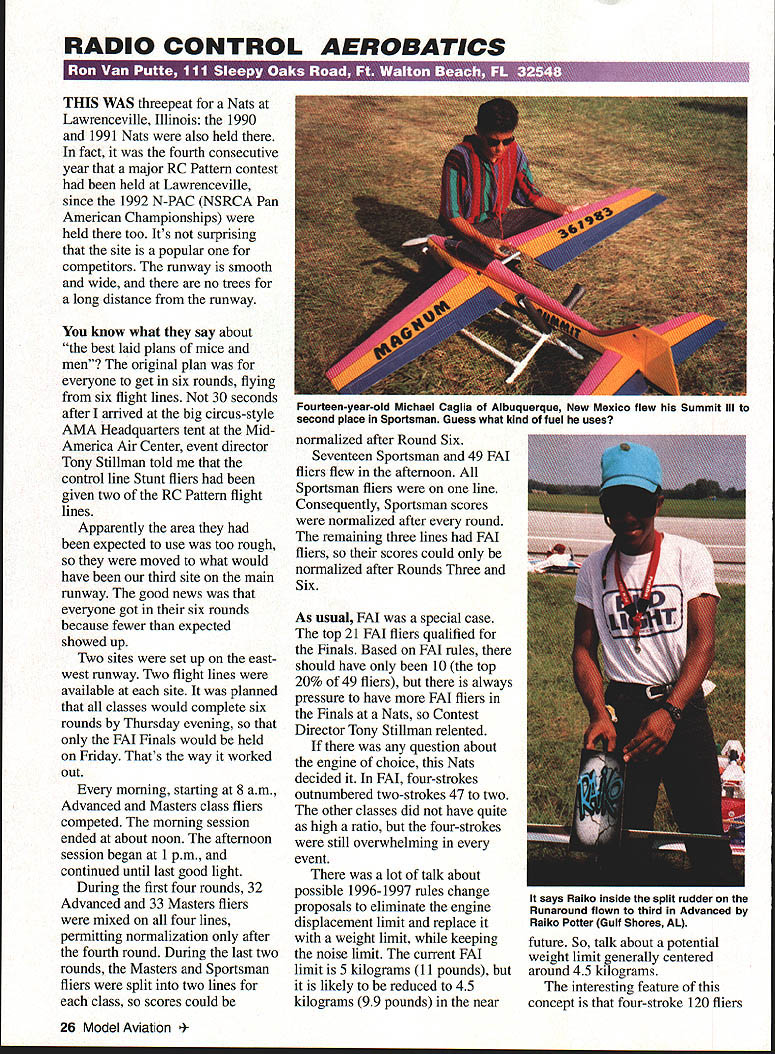
- Michael Caglia (Albuquerque, New Mexico) won two rounds and finished second.
- Rick Helmke (Auburn, Alabama) won one round and finished third.
Surprisingly, there were only 17 contestants in Sportsman—an event usually second in size only to FAI at a Nats. Despite attempts to find a reason, nobody really knows why so few Sportsman fliers showed up.
Advanced
- Robert Caglia (Michael Caglia’s older brother) won three of six rounds and took first place comfortably.
- Craig Buckles (Indianapolis, Indiana) was second. He had placed second in Sportsman at N‑PAC last year.
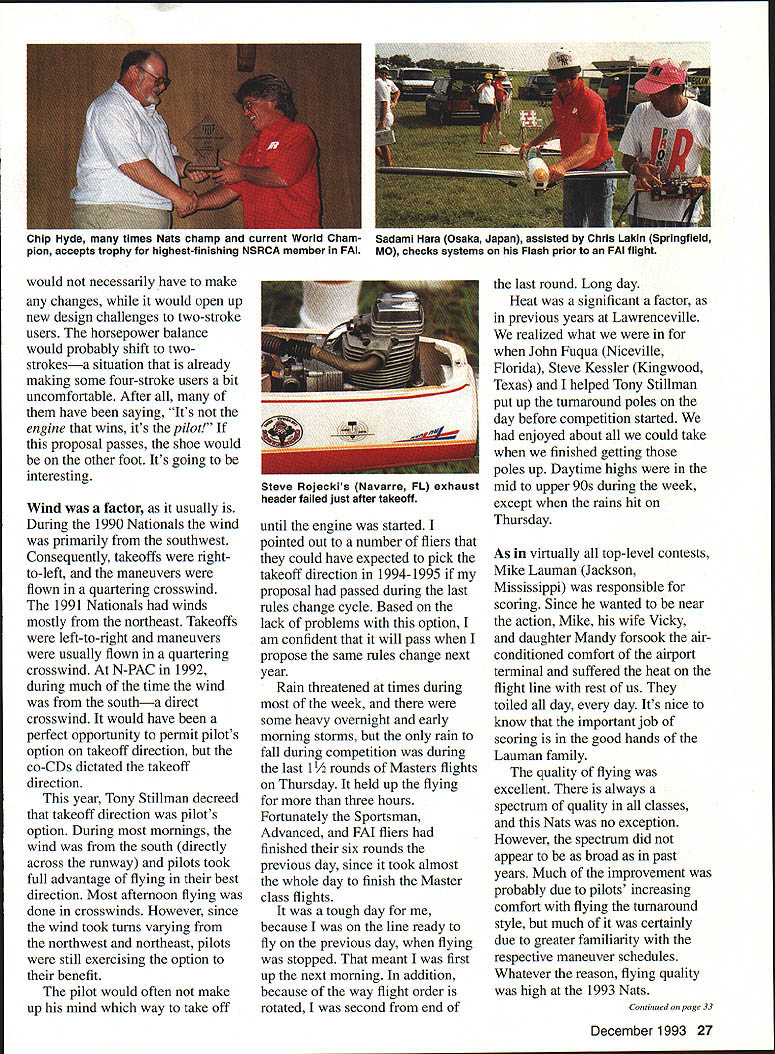
- Raiko Potter (Gulf Shores, Alabama) finished third; both Buckles and Potter won rounds.
- Jonathon Roberts (Friant, California) won the remaining round and finished fifth.
Masters
- Robert Richards (Wake Forest, North Carolina) won three rounds and finished first despite a zero on one flight.
- Robert Smyth (Cincinnati, Ohio) took two rounds and finished second.
- Gene Goldstein (San Antonio, Texas) won one round and finished third.
FAI
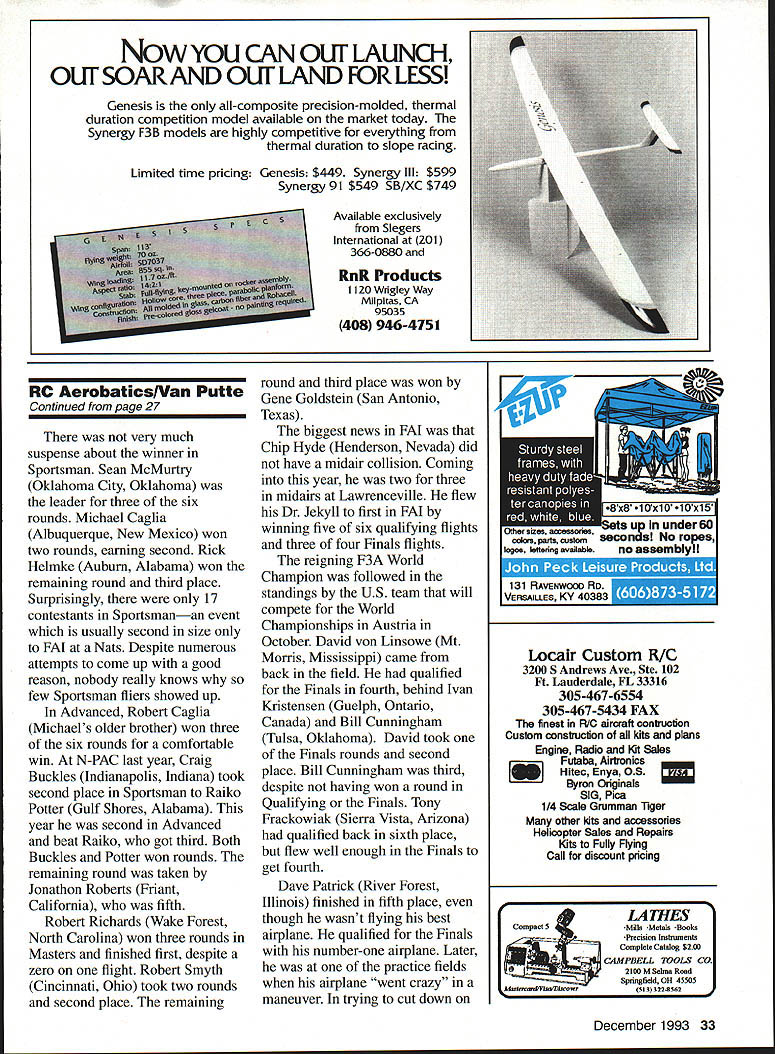
The biggest news in FAI was that Chip Hyde (Henderson, Nevada) did not have a midair collision this year. Coming into this event he was two for three in midairs at Lawrenceville. He flew his Dr. Jekyll to first in FAI by winning five of six qualifying flights and three of four Finals flights.
The U.S. team that will compete at the World Championships in Austria followed Hyde in the standings:
- David von Linsowe (Mt. Morris, Mississippi) came from back in the field. He qualified fourth and took one of the Finals rounds to finish second.
- Bill Cunningham (Tulsa, Oklahoma) finished third, despite not having won a round in Qualifying or the Finals.
- Tony Fraczkowiak (Sierra Vista, Arizona) qualified sixth and flew well enough in the Finals to get fourth.
- Dave Patrick (River Forest, Illinois) finished fifth. He had qualified with his number‑one airplane but later wrecked it at a practice field. He borrowed and then used his backup airplane in the Finals, flying it extremely well to move from eighth to fifth.
An anecdote about Dave Patrick: during pre‑final gyrations his airplane dropped the landing gear and the wings were being pulled back toward the fuselage. He will be able to repair the damage but not at the Nats, so he flew his backup plane in the Finals.
Controversy and judging conduct
There was a controversy concerning zeros given for two snap‑roll maneuvers. A flier who received zeros went to the Contest Director, who took him to one of the co‑Chief Judges. When that Chief Judge went to talk with the judge who gave the zeros, the flier followed and inserted himself into the conversation. This is a violation of FAI rules.
Another flier observed the violation and submitted a protest. While not naming names, the important point is that a pilot should not approach or insert himself into a judge's discussion. If a pilot questions a judge's action, he should go to the Contest Director, who is responsible for ensuring the contest is conducted according to the rules. When an interpretation of judging rules is involved, the CD should let the Chief Judge handle it. The flier should remain out of the loop until the Chief Judge resolves the issue. This is the fairest way and it reduces potential influence a well‑known pilot might have on a judge.
Under AMA rules, similar behavior could be considered unsportsmanlike or discourteous conduct (Paragraph 17, Sanctioned Events section, Competition Regulations) and might form the basis of a protest.
FAI Team Selection Committee
A meeting of the FAI Team Selection Committee was held midweek and I attended most of it. I won't attempt to report specifics because the whole committee has yet to vote on the proposals. Those interested in competing in the F3A Team Selection Finals should watch for the Committee's upcoming proposal; the best place to look is probably the K‑Factor, though I don't know the schedule for presentation.
The reason for the Committee's proposal is that more fliers want to take part in the Team Selection Finals. This year, with fairly tight qualification standards, there were only 27 contestants in the Finals at Corvallis, Oregon. By comparison, two years ago, with relatively relaxed standards, there were 54 contestants at Eglin AFB, Florida. If approved, the new proposal is likely to result in about 40 contestants for the 1995 Finals — a number manageable at most likely host sites.
Volunteers and thanks
As a Nats competitor, I seldom thought much about how much work is done by volunteers until I helped set up the flight lines. All the poles, stakes, guy lines, tape, chairs, tables, tents, paper, clipboards, water coolers, ice, etc., has to come from somewhere. Al Williams and his crew of volunteers were responsible for all those things. During the week I continued to see the same people working happily so that the rest of us could have a good time. Thank you to them — and to everyone who helped.
Transcribed from original scans by AI. Minor OCR errors may remain.

