
RADIO CONTROL AEROBATICS
Ron Van Putte 111 Sleepy Oaks Road, Ft. Walton Beach, FL 32548
Are we ever in for some changes!
Thanks to Tony Stillman, the United States team manager at the 1993 World Championships in Austria, we have the following news: The FAI rule committee met recently and recommended rule changes to the complete FAI body. Since the rules committee recommendations are almost always accepted by the larger body, these probably will be, too. The proposed FAI rules for 1996 through 1999 will be the same as what is in the FAI Sporting Code now, except that there will be a two-meter wingspan limit, a two-meter fuselage length limit, and engine displacement will be unlimited.
That didn't take long to read, did it? Have you had a chance to realize the implications? We will be seeing some very large models in FAI in about three years. Remember that the weight and wing area limits still apply, so they will tend to limit model growth, but typical FAI airplanes will still get much larger. Dave von Linsowe's balsa-overcast airplane will probably be on the small side by comparison.
The other significant change is that the committee also recommended that the box be increased to 75° on either side of the center pole instead of the 60° we have now.
You're probably sitting there thinking, "What's the big deal?" That's all three years away. Well, chew on this: the AMA rules-change cycle requires that rules-change proposals for 1996–1997 be submitted prior to September 1994. That's only about nine months away as you read this. We need to get our act together and decide what course the United States wants to take in response to the rules that will probably be in effect for FAI.
Key questions for the U.S. community
- How do we want to accommodate the relatively small number of fliers who can legitimately compete for the U.S. team?
- First, do we want to eliminate the engine displacement limit? If we do, what weight limit do we want?
- Should we adopt the new FAI aircraft rules or have different ones?
- Second, do we want to increase the size of the box for all classes? If we don't, the AMA classes would have a 60° box while the FAI fliers had a 75° box. This would necessitate two sets of turnaround poles at contests.
There's a lot of thinking to be done, opinions to be aired, and rules-change proposals to be put together over a relatively short period of time, so let's get on with it.
New maneuver: Cuban Key Hole
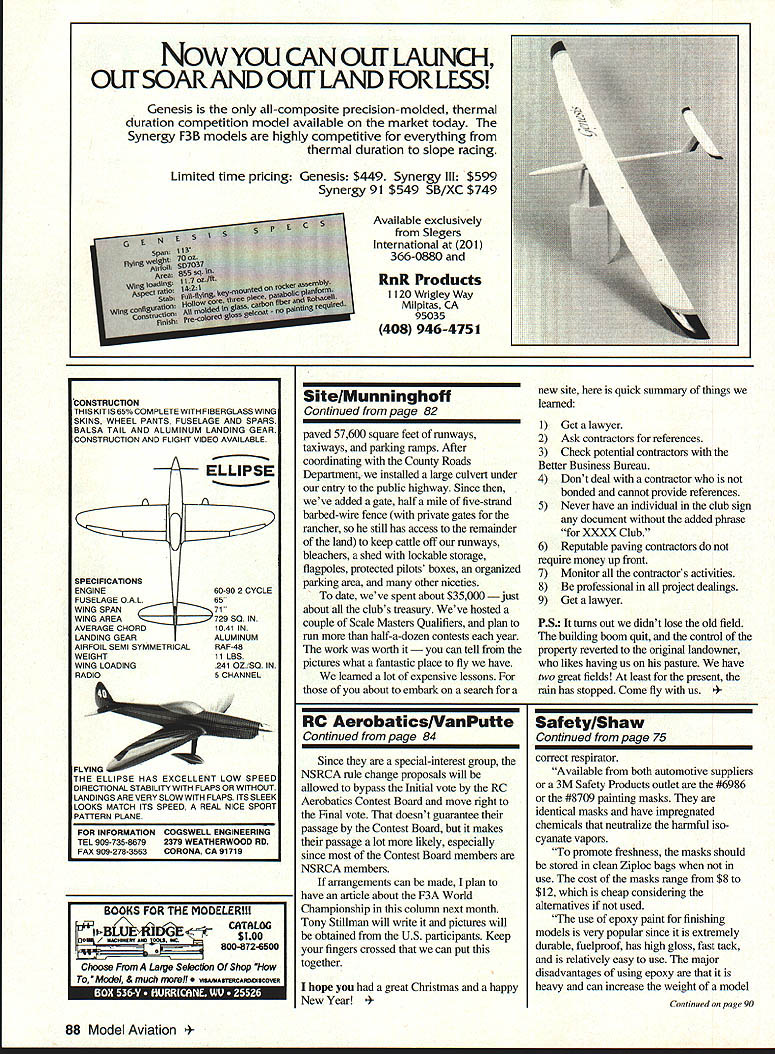
Have you ever dreamed up a new maneuver? Let's face it, there are not many new maneuvers around. However, I received a letter from Todd Sheehan that contained a new maneuver he has been trying to promote. I think it's great. He calls it the Cuban Key Hole.
The figure shows what the basic maneuver looks like. In Todd's words: "In its original form, it is not extremely difficult to do. Fine for Sportsman and Advanced classes. Add a snap roll (at the top, RVP) and it becomes similar to the Avalanche, but with a little more punch than the same old Avalanche. Do the maneuver from the top and it can really get your heart pumping."
Here is how Todd would like to see it published in the rule book:
Model pulls up to a 45° climb, pauses, half rolls, pauses, pushes 270° of outside loop to a 45° dive, pauses, half rolls, pauses, and recovers to level flight.
Downgrades:
- Climb and dive not 45°
- Half rolls not centered in 45° climb and dive segments
- Half rolls not 180°
- Changes in heading
- Wings not level during loop
- Loop not round
What do you think about the Cuban Key Hole? Do you have an idea for a different maneuver? Let me hear from you. It's ideas like this that make the rule book something everybody can feel they had a part in, rather than something "they" came up with.
Letter: On choosing the first Pattern airplane
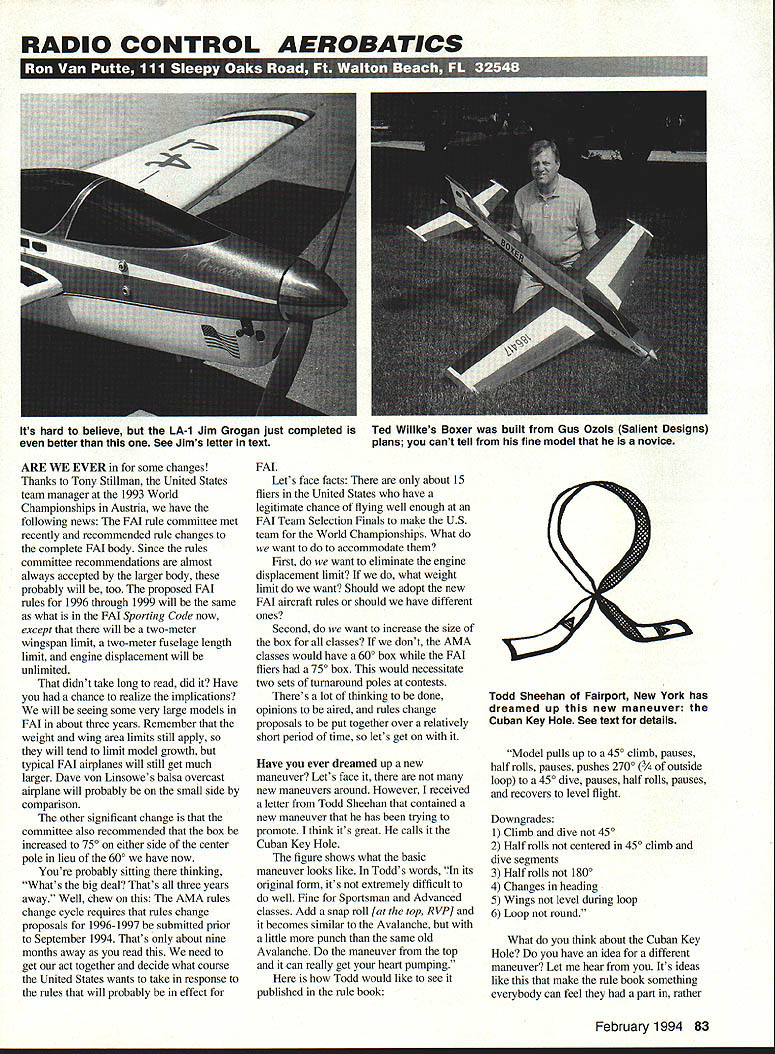
An interesting letter on the subject of the first Pattern airplane came from Jim Grogan of Largo, Florida. Here is an excerpt:
"First of all, let me present an analogy: When I was very young, I had a serious interest in learning to play the guitar, and was in the market to buy one. I had learned a lot of technique and over 180 chords from practicing on a friend's Fender electric guitar. My father didn't want me to go out and buy an expensive guitar to 'learn on.' But I insisted on getting the best... a Fender Stratocaster! Essentially, I progressed with an instrument I would ultimately be good with instead of switching around from acoustic to cheap to better to best.
"The point is this: most people venturing into Pattern are already somewhat accomplished fliers. Therefore, I feel they should select a model that they can progress with, at least from Novice to Sportsman. They should know that there is no comparison in flight characteristics between an Ugly Stik, a Cobra, or most ARFs, with a well-built Pattern ship. So, why bother flying something 'flitty' and unstable, whether practicing or competing, when you could be flying a ship designed for what you are attempting to learn?"
Thanks, Jim. Is there anyone who disagrees with what he said? I certainly don't decide the sport's not for you.
Jim Grogan is not done yet, because his letter also contained the following interesting comments:
"I wanted to add a few lines regarding rules changing which, in my opinion, occurs a little too often. Now, I admit, there is much I don't know or understand about the rules. But what seems to be the case is this: 'If changes are made in a higher class, that justifies making changes in a lower class.' I disagree. I have seen the Expert class completely eliminated, and on the horizon I see entrance classes becoming so complicated that it will guarantee to keep away a lot of potential newcomers... non-existing new-breed of fliers."
Frankly, I don't know if Jim is right or not. We will have to see how the Novice/Sportsman/Advanced maneuver schedules work out. As all this goes on we will be trying to decide what to do during the current rules-change cycle.
NSRCA and the rules-change process
If you are a member of the National Society of Radio Controlled Aerobatics (NSRCA), be sure to get involved with the rules-change survey and make your thoughts known. The NSRCA rules-change committee will digest all the survey results and propose rule changes based on the consensus of opinion.
Since they are a special-interest group, the NSRCA rule-change proposals will be allowed to bypass the initial vote by the RC Aerobatics Contest Board and move right to the final vote. That doesn't guarantee their passage by the Contest Board, but it makes their passage a lot more likely, especially since most of the Contest Board members are NSRCA members.
If arrangements can be made, I plan to have an article about the F3A World Championship in this column next month. Tony Stillman will write it and pictures will be obtained from the U.S. participants. Keep your fingers crossed that we can put this together.
I hope you had a great Christmas and a happy New Year!
Transcribed from original scans by AI. Minor OCR errors may remain.

