
RADIO CONTROL AEROBATICS
Ron Van Putte
111 Sleepy Oaks Road, Ft. Walton Beach, FL 32548
IN MY JANUARY column, I offered to send the article and schematic for the servo tester I use to readers who sent me a SASE. Little did I expect the response that resulted: I mailed almost 50 copies within two weeks of the release of the January issue. The offer still stands, so send a SASE if you would like to receive it.
I also received a sample of a basic servo tester called the Servo Mate from Pete Waters at Kraft Midwest, 115 East Main, Northville, MI 48167; Tel.: (313) 348-0085. It works very much the same as the servo tester I have.
The Servo Mate uses a standard 4.8-volt receiver pack and has a rotary knob on the top that you twist to get servo motion. It works fine and is a viable alternative for anyone who doesn't want to build one from scratch. Check with your local hobby dealer or Kraft Midwest for more information regarding features, availability, and cost.
I called Tony Stillman yesterday at Radio South — 5524 N. Palafox, Pensacola, FL; Tel.: (800) 962-7802. After I had told him about the arrangements I had made with Model Aviation for his coverage of the F3A World Championships, Tony told me about a new servo tester that he will be marketing.
The new device will be made by Charles Merriwether's staff at Hobby Electronics in Ft. Walton Beach, Florida. They are the same people who make the Pro Charger, Pro Driver, Pro Cycler, and all the other RC electronic goodies that Tony markets.
It seems that Dave Patrick asked them to come up with a really good servo tester that would have a digital readout. The prototype units are available, and I should get a peek at one within the week. According to Tony, there will be a digital output display, and you will be able to read the tester output to three decimal places.
In addition to the obvious uses of such a device, you would be able to match servos for precise centering and throw by using the tester with a long pointer on the servos. You could then interchange servos and know exactly what to expect from them.
I don't know what the price will be, but since they will carry a standard lifetime warranty for all Radio South units, you would be set for good once you bought one. Check it out.
By the time you read this, the rule change survey of the National Society of Radio Controlled Aerobatics (NSRCA) will have been published in its newsletter, the K-Factor.
The rules change committee is finalizing the survey as this column is being submitted, and the K-Factor's publication lead time is much shorter than Model Aviation's. So what's the point? Have you filled out and sent in your survey? Please do it.
By filling out this survey, you can make your thoughts known to the committee that will submit the NSRCA rule change proposal to the AMA RC Aerobatics Contest Board in August 1994. The committee would love to be overwhelmed with responses. NSRCA District III is the best way for us on the committee to decide what to include in the NSRCA proposal. If you didn't submit the survey because you haven't joined the NSRCA, now would be a good time.
Send your name, address, AMA number, home and work phone numbers, and the class you're currently flying along with a $20 check made out to Suzi Frohreich/NSRCA, PO Box 41310, Phoenix, AZ 85080.
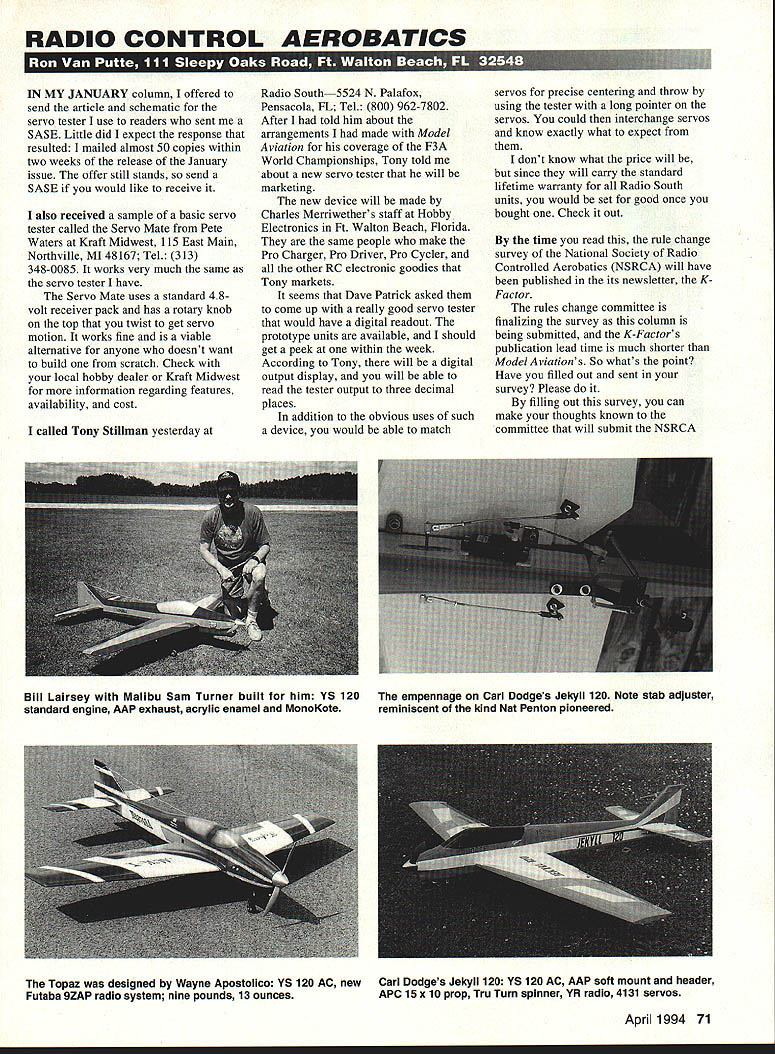
The mail often brings interesting things. One such item was sent by Wayne Apostolico of Arlington, Texas. For those of you not familiar with him, Wayne is always one of the top AMA-class fliers at national competitions. Wayne builds very competitive, beautiful models with names of such rare stones as Topaz, Sapphire, and Diamond.
Wayne has written a manual about correcting wind drift in crosswinds. Not surprisingly, he calls it Crosswind Flying. Wayne's manual answers such questions as:
- Do you roll the wrong way in Cuban 8s?
- Do you apply rudder only in stall turns?
- Do you know how to use elevator in point rolls to correct drift?
- Do you know how to make "Stealth" corrections in competition to obtain maximum points?
- Do you know how to make "undetected" drift corrections in level flight?
- Do you know how to "pull" or "push" your model back on track?
Wayne uses plain pilot talk to assist those aerobatic or sport fliers who want to become safer and more proficient pilots. I consider myself a knowledgeable Pattern flier, and I learned some things that I'd never thought about before. He's done a nice job.
If you're interested in a copy, send $9.95 (which includes shipping and handling) to Gemstone Publications, 3508 Sheffield Court, Arlington, TX 76013. If you're a Texas resident, also include 7.75% sales tax.
I received a nice letter from Brian Brinegar of Fairborn, Ohio who described himself as a J.A.B.O.E. (Just Another Burnt-Out Engineer):
"Many thanks for your timely article on how to locate the AMA rules. I have been interested in competing in Novice Pattern and know several others who might be interested, but I could not lay my hands on the sacred book of rules.
"I've always been pretty good at 'winging' things (sorry, easy pun), but my scores might suffer if I had a caller shouting out the rules to me from the judges' book as I fly.
"In response to the ongoing voting for the best first Pattern model, I highly recommend the Capstone Ultimate Chaos 60. The .60 size is bigger and easier to see, while being only slightly more expensive. Carbon fiber struts, fiberglass wing center reinforcement, and the supplied wing jig make it a rugged, easy-to-build model.
"I agree that it's not the equipment that wins points, but the well-practiced hands of the pilot. I am very fortunate to belong to a club with many veteran fliers who have a lot of patience. The Springfield Model Airplane Club is a great place to meet lots of friendly fliers.
"My mentor, Neil Perkins, has been flying since dirt was invented and is a fountain of practical information, tricks, and tips. My deeper involvement with the club and the sport, as well as my flying skills, can be attributed to his untiring tutelage and good humor."
Brian's testament to his mentor made me think about the person responsible for my involvement in Pattern flying. Back in 1965, I was a member of the Western Ohio Radio Kontrol Society in Dayton, Ohio. A prominent member of the club was Don Lowe.
During the summer, when Don asked if I'd like to accompany him to a contest up in Wyandotte, Michigan, I readily agreed. It wasn't really a Pattern contest as much as it was a fun-fly. However, it was enough to whet my appetite.
Before very long, I was under his watchful eye as I practiced the Class A Pattern maneuvers with a Goldberg Senior Falcon (I know only we geezers remember Class A, but that's okay). Over the next few years, we went to contests in Ohio and Indiana until the Air Force transferred me to Washington, D.C.
The good times we had continue as treasured memories for me; I remember that "groovy" was one of Don's favorite expressions in those days. I have always tried to match Don's smooth style of flying.
We have been fortunate to have Don as our president. Shortly before he first took office, I predicted that he would be the best AMA president ever. It's nice to be right. Thanks for everything, Don.
Transcribed from original scans by AI. Minor OCR errors may remain.

