
Radio Control: Aerobatics
Ron Van Putte
111 Sleepy Oaks Road, Ft. Walton Beach, FL 32548
Several months ago I asked readers for input on the best beginner Pattern model. To get an accurate consensus I gave plenty of response time. The vote is in:
- 1st: Ultra Sport 60
- 2nd: Escape
- 3rd: Ultra Sport 40
- Honorable mentions: Super Kaos 60, Kaos 60, Dirty Birdy, Ultimate Chaos
Frankly, I was surprised at the results. A number of respondents didn’t state their reasons, so it’s hard to analyze beyond the totals. You’ll notice that names such as Jekyll, Desire, Malibu, Meridian, Typhoon, Summit, and Finesse didn’t appear. I suspect economics is a factor: many current Pattern “hot‑shot” designs are inherently more complex — and therefore more expensive — than the winners. With the possible exception of the Escape, the top choices are straightforward, practical designs.
All of the winning models can be used for purposes other than Pattern competition. The Ultra Sport series are sport models with good aerobatic ability. The Escape, while not a typical fun‑fly plane, can be flown in a Pattern contest one week and just “bore holes in the sky” the next. It suits the Novice event: capable of performing the required maneuvers without costing an arm and a leg. It’s nice to see practicality winning out over ego.
New maneuver schedules and early reports
As this is written, it’s still early to judge how the new maneuver schedules are working nationwide. I did receive a report from Apopka, Florida, about glitches at the Tangerine contest — surprisingly, the problems were in the Sportsman event.
The only changes from the 1992–93 Sportsman maneuver schedule were the addition of a 1/2 Cuban Eight and a Square Loop after the Three Horizontal Rolls. The rule change was proposed to lengthen the schedule and to have four sets of three maneuvers done in the “box” instead of three sets plus the Rolls. From what I understand, the confusion was cleared up after a round or two, but I didn’t expect so much uncertainty about the intended sequence.
I heard that some contestants thought they couldn’t keep models in the box during the 1/2 Cuban Eight because the Three Horizontal Rolls didn’t allow enough room. Apparently it hadn’t occurred to them that the Rolls were no longer “on the clock.”
Roll timing
In past years, Rolls were nominally given five seconds, but most fliers set a roll rate so three rolls would take six or seven seconds. Rolls generally look better when strung out, which is why fliers prefer rolls downwind rather than upwind. Since the roll timing requirement was removed, many fliers continued to perform the Rolls from horizon to horizon, which eats up more space. If you shorten the timing on the Three Horizontal Rolls to five seconds or less, you shouldn’t have trouble keeping the model in the box during the 1/2 Cuban Eight.
My sources don’t fly Advanced, so they had nothing to report on that class beyond some initial confusion. I’m sure things will settle down and we’ll be able to make objective evaluations of the new schedules.
Duane Gall: “Voodoo Magic Trick Stuff — A Competition Pilot Finally Comes Clean”
Duane Gall of Lakewood, Colorado — author of the January piece “Voodoo Magic Trick Stuff — A Competition Pilot Finally Comes Clean” — does exist. I had wondered if the name was a pseudonym; a few weeks ago Duane wrote to confirm: he is real, and he thanks me for printing his piece. He said the article was written several years ago and was once rejected by Model Aviation as “too inflammatory,” but he’s glad it found a home in local club newsletters.
Duane’s story is worth sharing for anyone who likes to encourage beginners. He wrote, in part, about his own modest start:
- In 1973 he was in high school, newly soloed, doing smooth touch‑and‑goes and ragged aerobatics in an oil‑soaked Trainermaster.
- He wasn’t confident enough to try Limbo and Carrier Landing at club fun‑flys, and real contest flying felt out of reach.
- An older club member thought he was “bored” and dragged him to a local Quarter Midget race.
- Although the race action seemed chaotic at first, his mentor insisted he build a Sig Doubler and install a SuperTigre .15 engine.
- His first contest outings were rocky — landing short, tearing off the gear, spending early rounds on repairs — but persistence paid off.
- After more practice he began placing, and after a few years and a few models he won his first trophy.
Duane’s point: there’s nothing mystical about winning a contest. It takes a reasonably good model and the ability to start it, steer it, and land it consistently in front of demanding judges. Striving for that consistency has made him a better, safer pilot and builder. “Voodoo Magic” was his attempt to give others the same benevolent kick in the butt he received two decades ago.
Duane H. Gall RC Racing Contest Board, District IX
Isn’t it great how things sometimes work out?
Boxer update — Gus Ozols of Sailent Designs
My February column included a photograph of Ted Wilke (Rolling Meadows, Illinois) with his Boxer, designed by Gus Ozols of Sailent Designs. Gus recently sent me a letter along with a set of Boxer plans and a construction manual.
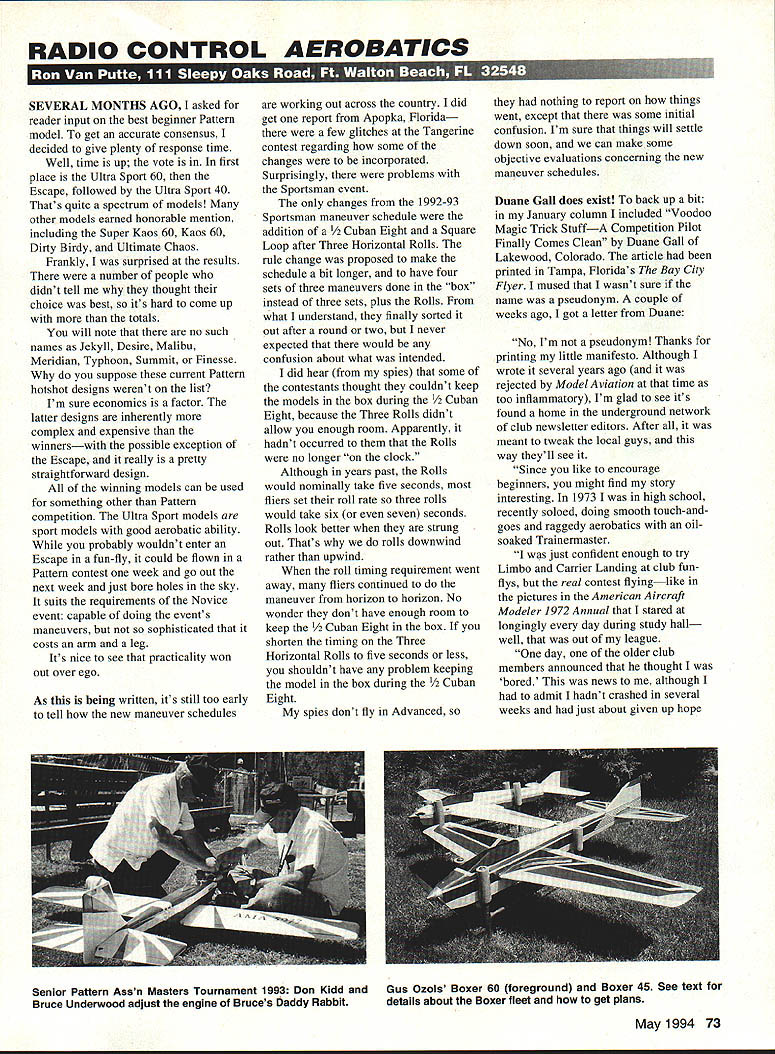
I didn’t know much about the Boxer beyond Ted’s photograph and one contest sighting. Gus filled me in: the original Boxer 60 was derived from Rick Allison’s Cursor. The concept began at a Pattern contest where there was perceived need for an affordable, entry‑level Pattern model — specifically aimed at Sportsman and Advanced classes where pilots are still developing skills and are reluctant to spend much on expensive fiberglass kits and hardware.
The goal was to develop a fixed‑gear model that would outperform the Kaos and Escape, with a completed model costing less than $150. Obviously, that price target was ambitious. I’ll study the plans and construction manual and report more when I’ve had a chance to build or fly one.
Transcribed from original scans by AI. Minor OCR errors may remain.

