
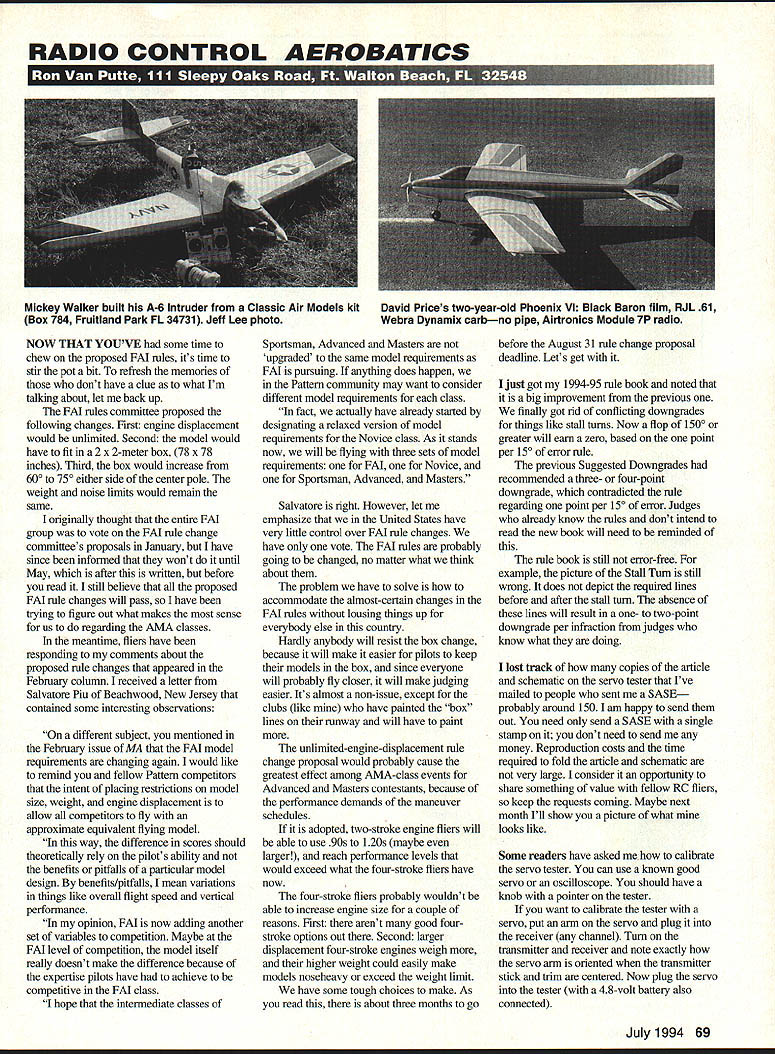
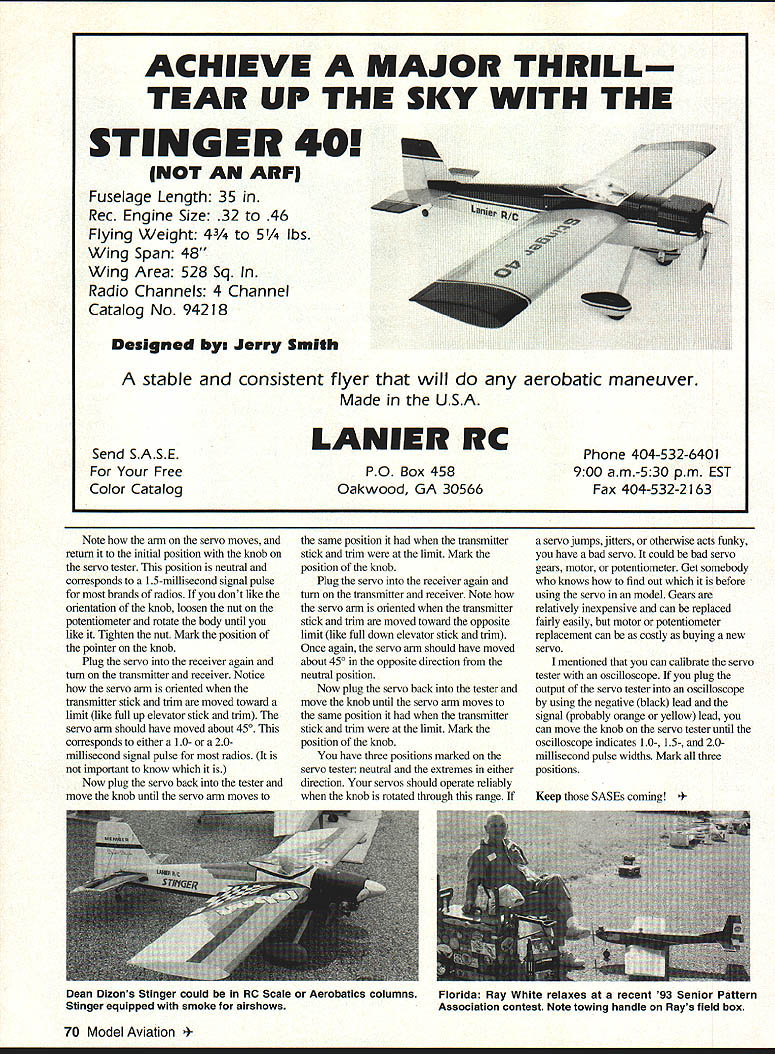
RADIO CONTROL AEROBATICS
Ron Van Putte 111 Sleepy Oaks Road, Ft. Walton Beach, FL 32548
Introduction
Now that you've had some time to chew on the proposed FAI rules, it's time to stir the pot a bit. To refresh the memories of those who don't have a clue as to what I'm talking about, let me back up.
Proposed FAI Rule Changes
The FAI rules committee proposed the following changes:
- Engine displacement would be unlimited.
- Models would have to fit in a 2 × 2 meter box (approximately 78 × 78 inches).
- The box angle would increase from 60° to 75° on either side of the center pole.
- Weight and noise limits would remain the same.
I originally thought the entire FAI group would vote on the committee's proposals in January, but I was later informed the vote would be in May. I still believe the proposed changes will pass, so we need to consider what makes sense for AMA classes.
Community Response and Class Implications
I received a thoughtful letter from Salvatore Piu of Beachwood, New Jersey. His main point: restrictions on model size, weight, and engine displacement are intended to ensure competitors fly roughly equivalent models so scores reflect pilot ability rather than model advantages (speed, vertical performance, etc.). He warned that the proposed FAI changes could add another set of variables to competition.
Salvatore is right. We in the United States have very little control over FAI rule changes—we get only one vote. FAI rules are likely to change regardless of our opinions. The challenge is to accommodate those changes without fouling things up for everybody in this country.
In fact, we've already started designating a relaxed version of model requirements for the Novice class. As things stand, we'll be flying with multiple sets of model requirements:
- FAI
- Novice
- Sportsman, Advanced, and Masters (combined)
Hardly anyone will resist the box change—it should make it easier to keep models in the box and will likely improve judging since pilots will fly closer. The main inconvenience is that clubs with painted box lines on runways will have to repaint.
The unlimited-engine-displacement proposal would likely have the greatest effect on AMA Advanced and Masters contestants because of the performance demands of those schedules. If adopted, two-stroke fliers could use .90 to 1.20 engines (or larger) and reach performance levels that would exceed typical four-stroke performance. Four-stroke fliers will have a harder time increasing displacement because:
- There are relatively few good large-displacement four-stroke options.
- Larger four-stroke engines weigh more, which can make models nose-heavy or push them over weight limits.
We have some tough choices to make. As I write, there are about three months before the August 31 rule-change proposal deadline.
Rule Book Notes
I just got the 1994–95 rule book and noted a big improvement over the previous edition. Conflicting downgrades for things like stall turns have been resolved. The rule is now consistent: one point per 15° of error; a flop of 150° or greater will earn a zero.
The rule book is still not error-free. For example, the picture for the Stall Turn is incorrect—it does not depict the required lines before and after the stall turn. The absence of those lines can result in a one- to two-point downgrade per infraction from judges who know what they're doing. Judges familiar with the rules will need to be reminded of the clarified penalties.
Servo Tester: Distribution and Calibration
I lost track of how many copies of the article and schematic on the servo tester I've mailed—probably around 150. I'm happy to continue sending them. Send a self-addressed stamped envelope (SASE) with a single stamp; you don't need to send money. Reproduction and folding costs are minimal, and it's an opportunity to share something useful with fellow RC fliers. Keep the requests coming.
Some readers have asked how to calibrate the servo tester. You can use a known-good servo or an oscilloscope. Also be aware that receiver voltages can vary by unit. Below are calibration steps using a known-good servo:
- Put an arm on the servo and plug it into the receiver (any channel). Turn on transmitter and receiver and note the servo-arm orientation when the transmitter stick and trim are centered.
- Plug the servo into the tester (with a 4.8 V battery connected). Note how the arm moves and return it to the initial position using the tester knob. This position is neutral and corresponds to a 1.5 ms signal pulse for most radios.
- If you prefer a different knob orientation, loosen the potentiometer nut, rotate the body until you like it, then tighten the nut and mark the pointer position.
- Plug the servo into the receiver again and move the transmitter stick and trim toward a limit (e.g., full up). The servo arm should move about 45°. This corresponds to either 1.0 or 2.0 ms for most radios (it's not critical to know which).
- Plug the servo back into the tester and move the knob until the servo arm matches the position it had at the transmitter limit. Mark that knob position.
- Repeat for the opposite limit (full down): note the servo arm position with the transmitter, then match it with the tester and mark the knob position.
You should now have three marks on the tester: neutral and the two extremes. Servos should operate reliably through this range. If a servo jumps, jitters, or behaves poorly, it's likely faulty—gears, motor, or potentiometer may be the cause. Gears are inexpensive to replace; motor or potentiometer repairs can approach the cost of a new servo. Have an experienced person diagnose the problem before installing the servo in a model.
If you have an oscilloscope:
- Plug the tester output into the oscilloscope using the negative (black) lead and the signal lead (usually orange or yellow).
- Rotate the tester knob until the oscilloscope shows 1.0, 1.5, and 2.0 ms pulse widths, and mark those positions on the tester.
Keep those SASEs coming!
Transcribed from original scans by AI. Minor OCR errors may remain.

