
RADIO CONTROL AEROBATICS
Ron Van Putte 111 Sleepy Oaks Road, Ft. Walton Beach, FL 32548
FAI box rule proposal
There's been an interesting new wrinkle in the FAI rule change proposal to increase the box to 75° that may prevent its acceptance by the FAI as a whole. It had been assumed that the change would cause everyone to fly closer in, since increasing the box angle from 60° to 75° would permit fliers to fly closer in and still stay in the box.
Apparently several fliers have been saying that they would not fly closer in. The increased box would allow them to fly a faster airplane out at 150 meters and still stay in the box. The distance from the center pole to an end pole is 260 meters with a 60° box, but it's 560 meters with a 75° box. That means a 75° box could be more than twice as wide as the 60° box, nullifying one of the intents of the rule proposal: to reduce the footprint of the FAI maneuvering area. As I said, time for second thoughts. Don't be surprised if this one doesn't pass the May FAI vote.
Letter from Dave von Linsowe (excerpts)
I received a letter from Dave von Linsowe that he wrote to NSRCA rules committee chairman Paul Salverda. Since I'm a committee member, he sent me a copy:
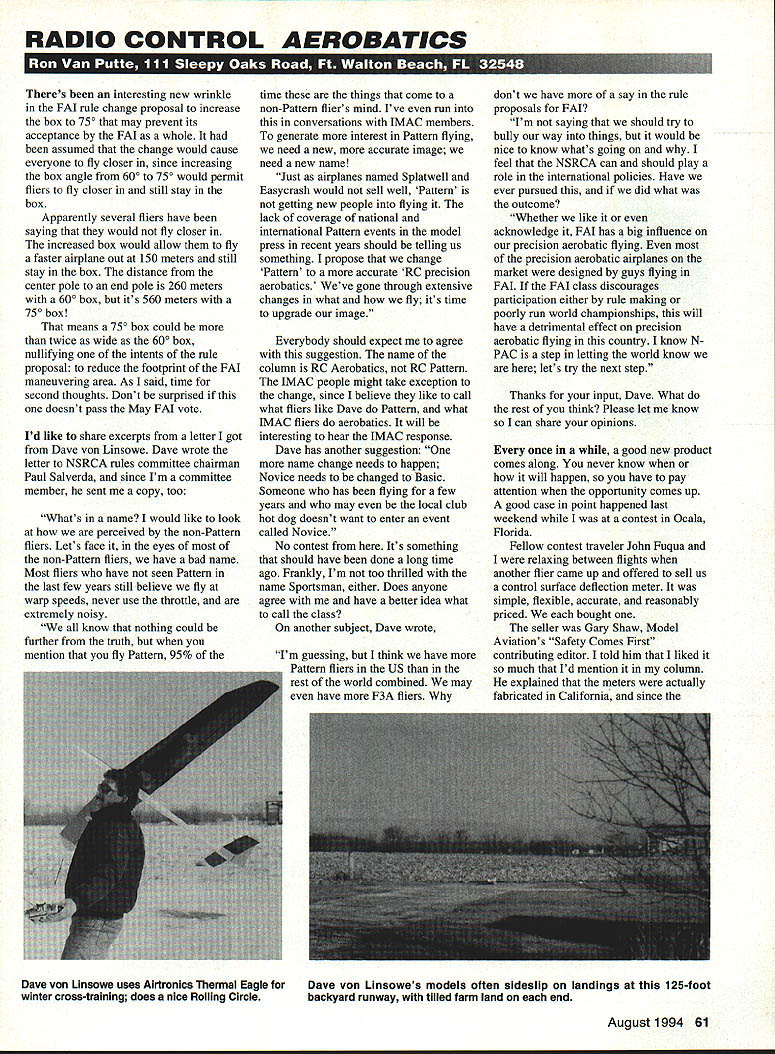
"What's in a name? I would like to look at how we are perceived by the non-Pattern fliers. Let's face it, in the eyes of most of the non-Pattern fliers, we have a bad name. Most fliers who have not seen Pattern in the last few years still believe we fly at warp speeds, never use the throttle, and are extremely noisy.
"We all know that nothing could be further from the truth, but when you mention that you fly Pattern, that image comes to 95% of the non-Pattern flier's mind. I've even run into this in conversations with IMAC members. To generate more interest in Pattern flying, we need a new, more accurate image; we need a new name!
"Just as airplanes named Splatwell and Easycrash would not sell well, 'Pattern' is not getting new people into flying it. The lack of coverage of national and international Pattern events in the model press in recent years should be telling us something. I propose that we change 'Pattern' to a more accurate 'RC precision aerobatics.' We've gone through extensive changes in what and how we fly; it's time to upgrade our image.
"Everybody should expect me to agree with this suggestion. The name of the column is RC Aerobatics, not RC Pattern. The IMAC people might take exception to the change, since I believe they like to call what fliers like Dave do Pattern, and what IMAC fliers do aerobatics. It will be interesting to hear the IMAC response.
"Dave has another suggestion: 'One more name change needs to happen: Novice needs to be changed to Basic. Someone who has been flying for a few years and who may even be the local club hot dog doesn't want to enter an event called Novice.' No contest from here. It's something that should have been done a long time ago. Frankly, I'm not too thrilled with the name Sportsman, either. Does anyone agree with me and have a better idea what to call the class?
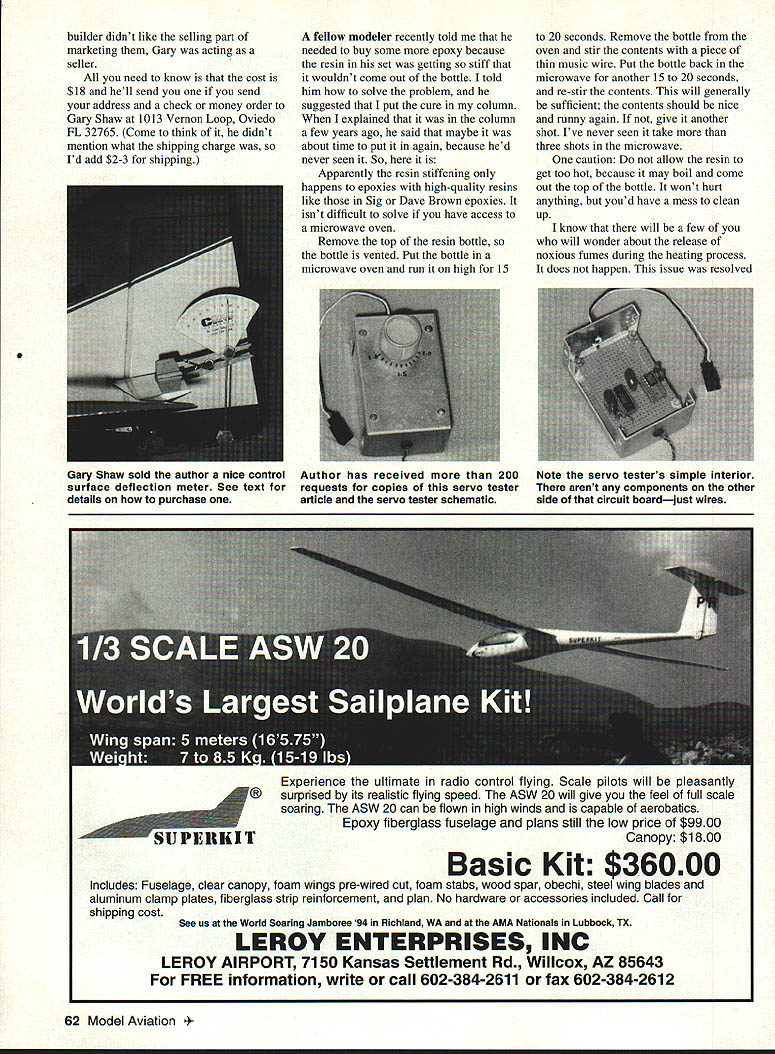
"On another subject, Dave wrote, 'I'm guessing, but I think we have more Pattern fliers in the US than in the rest of the world combined. We may even have more F3A fliers. Why don't we have more of a say in the rule proposals for FAI?'
"'I'm not saying that we should try to bully our way into things, but it would be nice to know what's going on and why. I feel that the NSRCA can and should play a role in the international policies. Have we ever pursued this, and if we did what was the outcome?'
"'Whether we like it or even acknowledge it, FAI has a big influence on our precision aerobatic flying. Even most of the precision aerobatic airplanes on the market were designed by guys flying in FAI. If the FAI class discourages participation either by rule making or poorly run world championships, this will have a detrimental effect on precision aerobatic flying in this country. I know N-PAC is a step in letting the world know we are here; let's try the next step.'"
Thanks for your input, Dave. What do the rest of you think? Please let me know so I can share your opinions.
New product: control-surface deflection meter
Every once in a while a good new product comes along. A good case in point happened last weekend while I was at a contest in Ocala, Florida. Fellow contest traveler John Fuqua and I were relaxing between flights when another flier came up and offered to sell us a control-surface deflection meter. It was simple, flexible, accurate, and reasonably priced. We each bought one.
The seller was Gary Shaw, Model Aviation's "Safety Comes First" contributing editor. I told him that I liked it so much that I'd mention it in my column. He explained that the meters were actually fabricated in California, and since the builder didn't like the selling part of marketing them, Gary was acting as a seller.
Cost is $18. He will send one if you send your address and a check or money order to:
- Gary Shaw
- 1013 Vernon Loop
- Oviedo, FL 32765
(He didn't mention shipping, so add $2–3 for shipping.)
Epoxy resin tip: restoring runniness
A fellow modeler recently told me that he needed to buy more epoxy because the resin in his set was getting so stiff that it wouldn't come out of the bottle. I told him how to solve the problem, and he suggested I put the cure in my column. I had printed it a few years ago, but here's the procedure again for those who haven't seen it.
Note: manufacturers had previously recommended heating to restore runny resin when resin stiffening occurs in high-quality epoxies (such as Sig or Dave Brown).
Steps:
- Remove the top of the resin bottle so the bottle is vented.
- Put the bottle in a microwave oven and run it on high for 15–20 seconds.
- Remove the bottle and stir the contents with a piece of thin music wire.
- If needed, return the bottle to the microwave for another 15–20 seconds and re-stir.
- Repeat once more if necessary. I've never seen it take more than three heating cycles.
One caution: do not allow the resin to get too hot, because it may boil and spill out the top of the bottle. It won't hurt anything, but you'd have a mess to clean up. I know some will worry about noxious fumes during heating. That does not happen; this issue has been resolved.
Contest organization — a pet peeve
Please bear with me while I yammer about one of the pet peeves John Fuqua (RC Aerobatics Contest Board member, AMA District III) and I share. How many times have you gone to a contest, paid a $20–$30 entry fee, served as contestant judge, paid $2.50 for hot dogs at the concession stand, and gotten nothing back but a trophy, if you placed? I think that contest was run to make money for the club.
Compare that with another contest, where the entry fee was $25:
- You got a T-shirt or a hat.
- Trained club judges were used.
- Manufacturer's goodies were distributed to all contestants.
- The concession stand's prices were reasonable.
- Saturday night supper was provided.
- Trophies were club-made to reduce costs.
- Contest profits were contributed to a local charity.
I think that contest was run to benefit the fliers and the local community. Which kind of contest would you prefer to attend?
Farewell to George Myers
I was very sorry to hear that George Myers will no longer be a contributing editor to Model Aviation. George will be sorely missed. He contributed enormous amounts of his time, energy, and personal resources to his columns and got the job done, in the face of personal and physical obstacles he had to overcome. His columns always had a freshness that demonstrated the same enthusiasm he brought to the job many years ago. He won't be forgotten.
George and I had been the last two contributing editors who were with Model Aviation since the first issue in July 1975. Now I'm the last one. Nineteen years is a long time.
Transcribed from original scans by AI. Minor OCR errors may remain.

