
RADIO CONTROL AEROBATICS
Ron Van Putte
111 Sleepy Oaks Road, Ft. Walton Beach, FL 32548
Since this is the youth issue, all of the columnists will be focusing on that aspect. The approach I am taking is probably not quite what you might expect, but it is pertinent to the future of RC precision aerobatics in this country. Participants in our phase of the hobby really do have a youth issue. By that I mean: Where are the youth?
If you look around the flight line at almost any pattern contest, you'll see many gray or bald heads. Unless youngsters are getting gray or bald prematurely, we don't have many young pattern fliers. This doesn't bode well for the future.
Many observers remember when the most popular event was Sportsman. There used to be twice as many contestants in Sportsman as in any other event. Nowadays, the number of Sportsman and Advanced fliers are about equal, and both have fewer fliers than the Masters competitors.
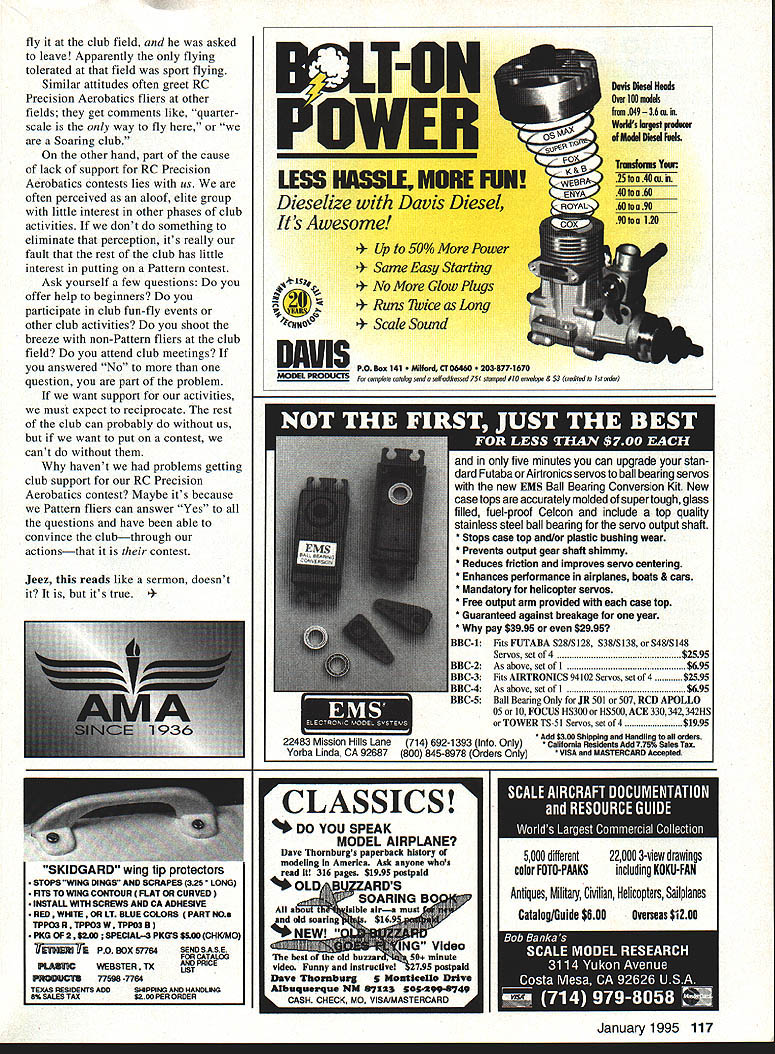
Since the total number of fliers seems to be about the same, you can argue that the reason is primarily a reduction in the number of Sportsman fliers rather than an increase of fliers in other classes. The Novice and Sportsman classes are usually made up of young fliers and a few older fliers who just took up the hobby.
Since the future of RC precision aerobatics is in our youth, we must make a sincere effort to learn how to promote interest in it among young people. Our sport costs more up front, and we don't have the instant availability that home and mall video games do. (By the way, it's not a coincidence that it takes the same talent to do well at video games as it does for success in RC precision aerobatics.)
I don't claim to know what it will take to interest more young fliers in flying RC precision aerobatics, but I'd be glad to hear from readers who have ideas. Let's hear from you.
RC Aerobatics / Van Putte
More on the servo tester: Several readers asked about using six-volt battery packs with the servo tester. I wasn't able to answer them immediately because I needed to do some research. (I didn't design it, and I am an aeronautical engineer. My electronics knowledge is strictly of a "plumber's variety," and I didn't want to just plug a six-volt battery into it and watch for smoke.) After consulting with an electronics expert, I can report that the tester will easily handle six volts. In fact, it will handle much higher voltage, but the servo won't.
Rule change proposals for 1996/1997 are now being considered by the AMA RC Aerobatics Contest Board. The National Society of Radio Controlled Aerobatics (NSRCA) submitted a set of rule change proposals that were the results of a survey of all NSRCA members. This set of proposals will probably make up the bulk of the proposals submitted. Because the NSRCA is an AMA Special Interest Group, the NSRCA proposals will bypass the initial vote by the Contest Board and go immediately to the final vote.
There will probably be several rule change proposals that will have to go through the entire process. I know of at least one additional rule change that was proposed—that's because I submitted it. I won't spend a lot of space on the proposal here, but since the text of the proposals does not appear in "Focus on Competition" in its entirety, I feel it's a good idea to clarify the intent of my proposal here. An abbreviated version is all that will appear there, and the proposer has no control over how his proposal is abbreviated.
My proposal would be inserted in the section on Suggested Field Procedures. The proposal says that a contestant should not be penalized for refusing to fly when the sun is in the maneuvering area. It also says that a round would not be complete until all fliers had an opportunity to fly without interference from the sun.
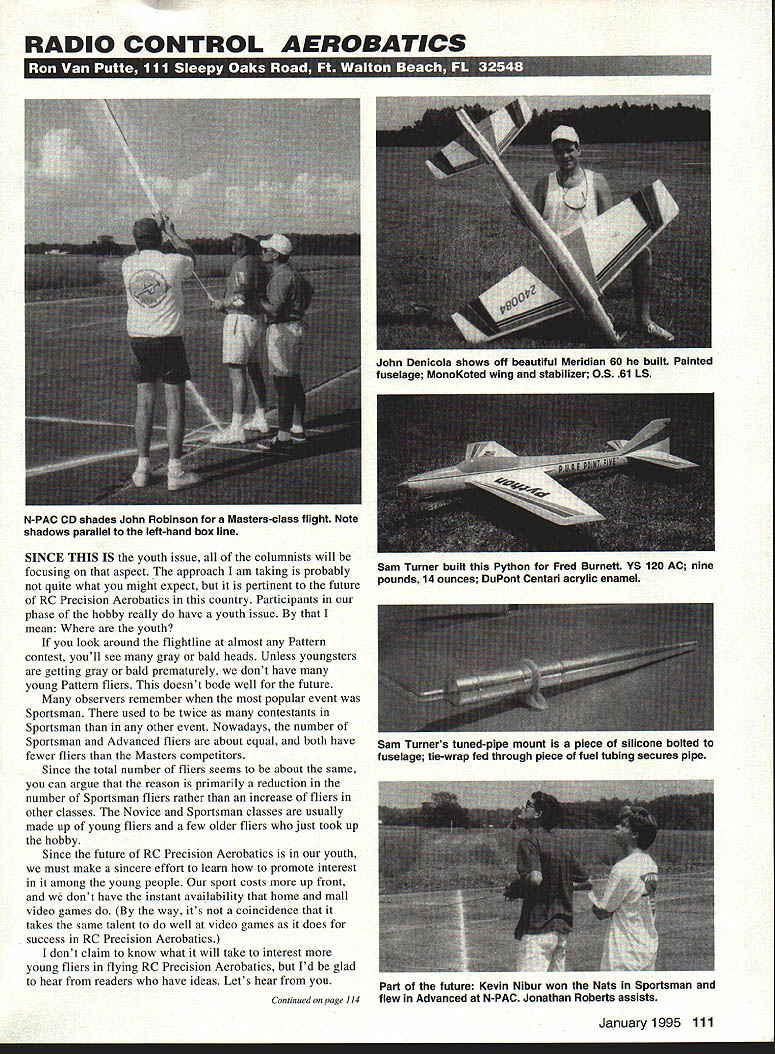
I don't think it is safe or fair to require a flier to fly when the sun is in the maneuvering area. A good example of what I mean happened at the NSRCA Pan American Championships (N-PAC). One day, several Masters class fliers were required to fly in the late afternoon, when the sun was in the left-hand turnaround area. It was virtually impossible to fly without severely curtailing the model's flight left of center.
I am sensitive to the situation because I was one of the fliers. I would have been quite upset had I been contending for a trophy, because I couldn't fly competitively under the conditions. As it was, I considered aborting my flight for safety reasons.
I proposed that my rule change be inserted in the section on Suggested Field Procedures so that it would not be mandatory for all contests. The introduction to this section states that field conditions might preclude following all the field procedures that are listed.
For example, if a field was laid out so that the runway was north–south and fliers were on the west side of the runway, the early morning sun would be in the center of the maneuvering area. The Contest Director could decide that he didn't want to delay starting the contest until late in the morning when the sun was out of the maneuvering area, and announce that he was not going to use this suggested field procedure at his contest. In that case, fliers would have to decide if they wanted to take their chances with the sun or scratch the contest. Of course, they could also decide whether they wanted to come back to that contest.
In the August 1994 column, I sounded off about one of my pet peeves: clubs who gouge contestants so they can make big profits on their contests. I received some responses from readers who attempted to explain why little value was received for a $25 entry fee; hot dogs were $2.50, Cokes were $1, etc.
The gist of the responses was that pattern fliers were a small minority in their club, and the rest of the club only grudgingly allowed them to use the field for a contest. The sole inducement for the club to support the contest was the profit that could be made.
Because I was the sole RC precision aerobatics flier in my club for many years, I can understand the situation. However, during those years the annual contest always had wonderful support from the rest of the club. Even now (20 years later), there are only six RC precision aerobatics fliers in the club (which has more than 100 members), and we still enjoy great club support for our contest.
There are probably several good reasons why there are wide variations regarding pattern contest support. Certain personalities can greatly affect a club. There's usually a small group that decides what the club will do, and the rest go along.
One flier told me that he was warmly greeted by a club until he brought out a pattern airplane. He was not welcome to fly it at the club field, and he was asked to leave! Apparently the only flying tolerated at that field was sport flying.
Similar attitudes often greet RC precision aerobatics fliers at other fields; they get comments like, "quarter-scale is the only way to fly here," or "we are a soaring club."
On the other hand, part of the cause of lack of support for RC precision aerobatics contests lies with us. We are often perceived as an aloof, elite group with little interest in other phases of club activities. If we don't do something to eliminate that perception, it's really our fault that the rest of the club has little interest in putting on a pattern contest.
Ask yourself a few questions:
- Do you offer help to beginners?
- Do you participate in club fun-fly events or other club activities?
- Do you shoot the breeze with non-pattern fliers at the club field?
- Do you attend club meetings?
If you answered "No" to more than one question, you are part of the problem.
If we want support for our activities, we must expect to reciprocate. The rest of the club can probably do without us, but if we want to put on a contest, we can't do without them.
Why haven't we had problems getting club support for our RC precision aerobatics contest? Maybe it's because we pattern fliers can answer "Yes" to all the questions and have been able to convince the club—through our actions—that it is their contest.
Jeez, this reads like a sermon, doesn't it? It is, but it's true.
Transcribed from original scans by AI. Minor OCR errors may remain.

