
RADIO CONTROL AEROBATICS
Ron Van Putte, 111 Sleepy Oaks Road, Ft. Walton Beach, FL 32548
The big news is that the 1995 Nats will not be a single, all-combined event as in years past. Apparently the event organizers in the state of Washington had trouble getting all the necessary use agreements for the various venues in time, and AMA officials were forced to look for other solutions.
The RC Aerobatics and Racing events will be held at Lawrenceville, Illinois, July 9–15. Some of the other events will be held at the originally intended site in Washington, and the remaining events will be at the AMA site in Muncie.
I look forward to going back to Lawrenceville; I enjoyed all the previous Nats and N-PAC events held there. It should be an interesting effort to arrange for all the necessary AMA equipment to be in the right place at the right time. AMA and National Society of Radio Controlled Aerobatics (NSRCA) officials are working together to make sure it's done right. The NSRCA will be running the RC Aerobatics portion of the Nats and the other Special Interest Groups will handle their events.
Are you a member of NSRCA? If you fly RC precision aerobatics, you should be. At this point I should be telling you the address to mail your membership application to, but the NSRCA will elect a new secretary/treasurer between the time this was written and when it appears in print, and I don't know the correct mailing address. I promise the address will be in next month's column.
More on the servo tester
I keep getting requests from readers for the servo tester article and schematic, and that's great. However, some are sending their request plus a dollar rather than a SASE. I don't mind putting the article and schematic in a SASE and mailing it, but please send the SASE instead of money with your request, as the printing cost is minimal.
By the way, some readers have written to tell me they've had difficulty finding one of the two integrated circuits (ICs), the 74121. The IC is still available, but you may have to look around a bit.
When you've been involved with something as long as I've been in RC aerobatics, you tend to do things the way you've discovered are best and forget that many people are still trying to learn that "right" way. This was brought home to me in a letter from Dave Slimmer (Aurora, IL):
"After about seven years of boring holes in the sky, I decided to try the Novice pattern. Even though I have helped a couple of guys earn their wings, I found practicing the pattern very humbling. After fighting with my Sig Four Star most of the summer, I was about to give up, thinking that the plane, I, or both, were not up to the task.
Every maneuver that involved an inverted attitude resulted in a change of heading. After checking incidence and balances several times, I found the probable cause of the trouble: a loose fit of the rod that connects the elevator halves. On the control side it was tight, but on the other 'slaved' half it had a small amount of play. I now see the wisdom of a split control rod! Perhaps some other novices trying to learn with sport planes have had this problem too. Now there's some useful information. Thanks, Dave."
One of the things that startled me at the Tournament of Champions was something you don't normally give too much thought to: the length of the wire between the receiver and the servos.
Chris Lakin was telling me about the radio installation in his huge Sukhoi. He had servos in the tail and long leads going back to the receiver. Note that I didn't say he had long extensions. Chris had his servos wired with long leads rather than use long extensions to eliminate one set of connections. The leads on his servos were 85 inches long!
Is the lead length a potential problem? Maybe. Recently I received a copy of the Siloam Springs Fly-er, newsletter of the Siloam Springs Modelers (Bentonville, AR — edited by Al MacKenzie), which contained the following tech tips:
- Long servo leads can act like antennas and pick up radio frequency interference (RFI). Twisting the leads several times reduces the chance of RFI.
- When I was a teenager and heavily involved in ham radio, building our own equipment taught us to twist leads and use capacitors to eliminate picking up radio waves that cause interference. Think of long leads as possible antennae.
- Most modern radios are very good and problems are only occasional. For larger aircraft where I install servos with long leads, I make my own extensions using color-coded #22 wire (available at Radio Shack in 100-foot rolls).
- I usually twist each extension a different number of turns. This further reduces the chance of coupling between two extensions of similar length.
- In one case of "servo jitters" the aileron extensions were within one-half inch of the same length as the receiver antenna. Replacing these leads with twisted cables and adding an extra couple of inches of slack completely eliminated the jitters.
- If the above doesn't solve it, adding a small capacitor (0.1 microfarad) from the signal wire to ground near the servo will usually clean up the problem.
- If you aren't comfortable doing wiring or soldering yourself, get help. There are also various filters and "glitch" devices sold for the purpose.
Thanks to Al MacKenzie for publishing these tips — it's a great example of useful information that experienced modelers sometimes take for granted.
Recipe: "Ski" Polish
This was borrowed from the Bay City Flyer (Tampa, FL), originally from Prop Talk (Riverside, CA, edited by Jim "Ski" Bronoski). It's a versatile cleaner that works well on models and around the shop.
- 10 parts water
- 2 parts alcohol
- 1 part ammonia
- 1/4 part liquid dish detergent
Make at least a gallon — it'll come in handy.
Why fly a "Pattern airplane"?
A letter from Tom Cooperider (Cameron, MO) asked why one must fly a "Pattern airplane." The rules state the objective is to "control by radio a model airplane so that various planned maneuvers may be accomplished," and the criterion is the quality of execution compared to defined geometric descriptions and procedures. If a J-3 Cub or Tiger Moth can execute the maneuvers perfectly, why require a modern pattern design?
Short answer: you don't have to have a modern "Pattern airplane" if an older design like a J-3 or Tiger Moth can execute the maneuvers as described. The problem is that most sport airplanes can't quite perform all required maneuvers. I have yet to see a J-3 do an axial roll, and other aircraft limitations often preclude sport planes from matching the rulebook descriptions.
Pattern aircraft are generally designed with close-to-neutral stability so they will remain in selected flight attitudes longer and require smaller control inputs to change attitude. They also have less cross-coupling between axes. For example, some sport airplanes will roll with rudder input only. A pattern airplane should yaw with rudder input only — no unwanted pitch or roll should occur. If a sport airplane can perform all the maneuvers in a particular class, by all means use it. If a sport airplane flies like a pattern airplane, it's a pattern airplane.
Notes and captions
- Have you ever wondered how Sam Turner gets pictures of his airplanes published in this column? He sends pictures — and very few other people do — so he gets his pictures in the column.
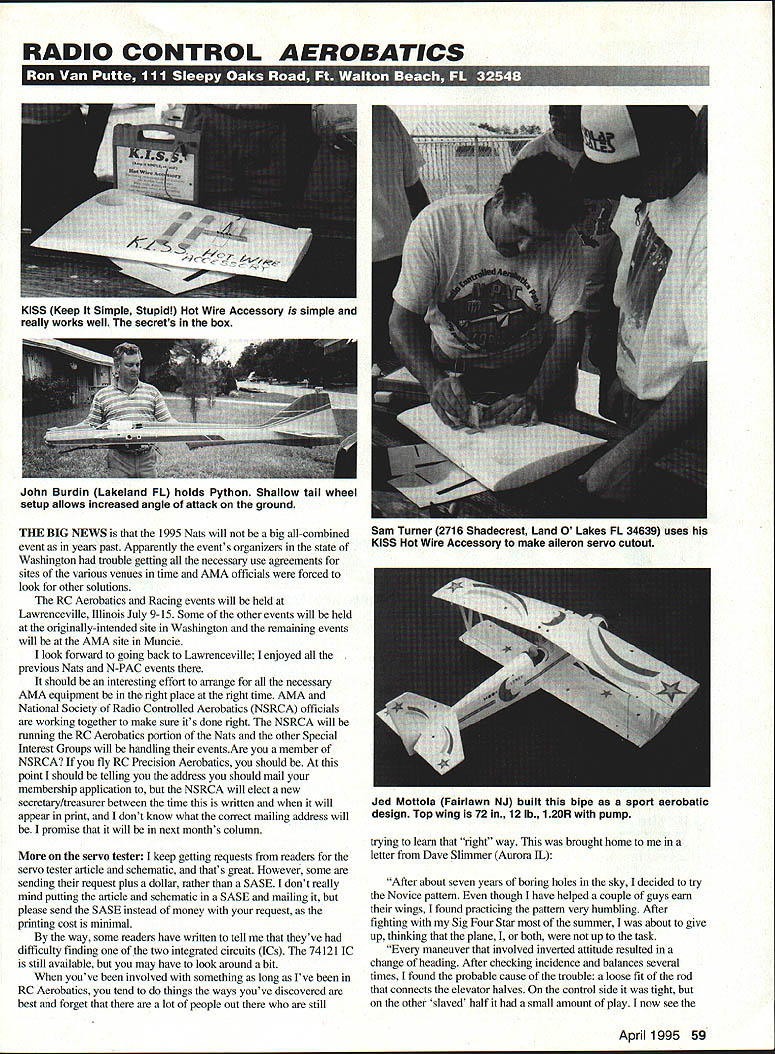
- KISS — Keep It Simple, Stupid.
- Hot Wire Accessory — simple, really works well.
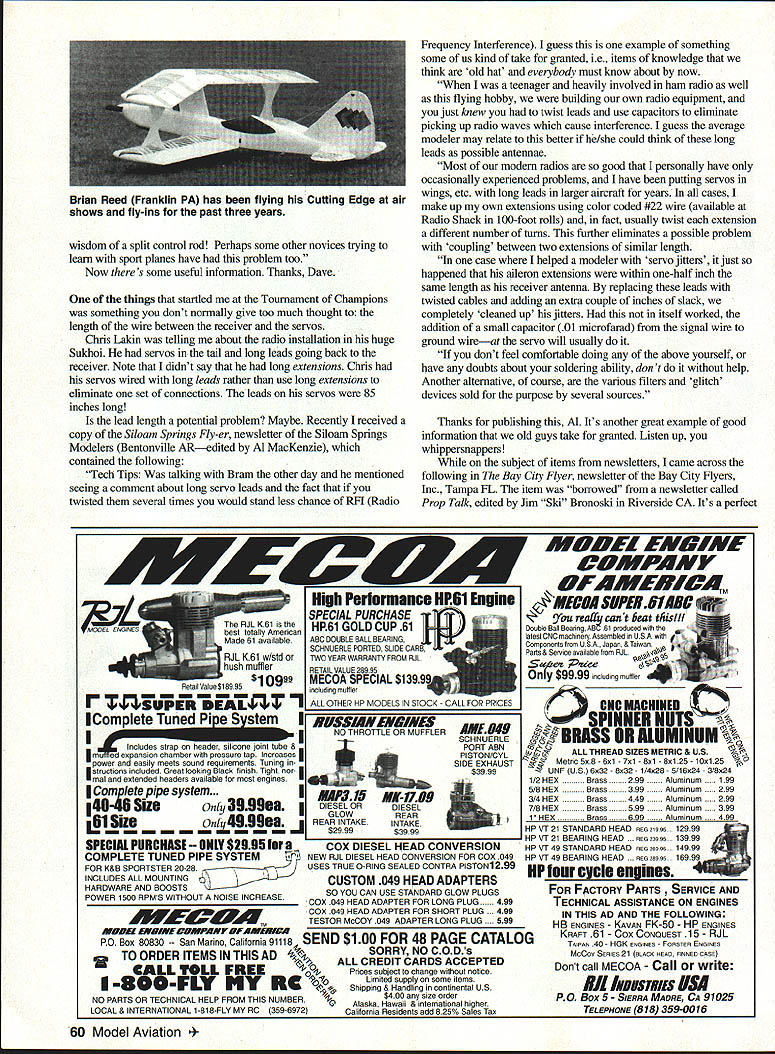
- John Burdin, Lakeland, FL, holds Python.
- Shallow tailwheel setup allows increased angle of attack on the ground.
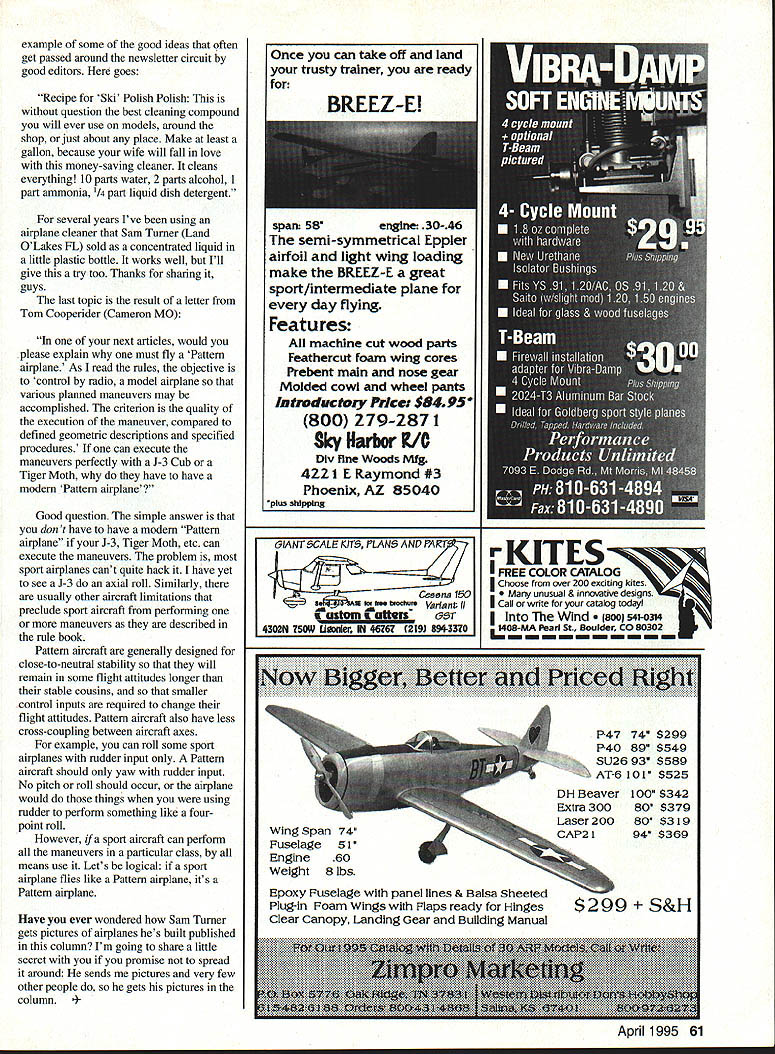
- Sam Turner, 2716 Shadecrest Lane, Land O' Lakes, FL 34639, uses KISS Hot Wire Accessory to make aileron servo cutouts.
- Jed Mottola, Fairlawn, NJ, built a biplane sport aerobatic design (top wing 72", 12 lb, .120R).
- Wisdom: split control rod — a helpful tip for novices and sport flyers experiencing control play or heading changes during inverted flight.
Transcribed from original scans by AI. Minor OCR errors may remain.

