
RADIO CONTROL: AEROBATICS
Ron Van Putte, 111 Sleepy Oaks Road, Ft. Walton Beach, FL 32548
Tournament of Champions and Videos
Did you enjoy the Tournament of Champions (TOC) coverage last month? I hope so. It was my first time at the event, and I thoroughly enjoyed it. I hope it won't be the last.
The reason the TOC's future is uncertain is that, although all past TOC events were sponsored by Circus-Circus Enterprises, that will not be the case in the future. The event's sparkplug, William G. (Mr. Bill) Bennett, stepped down from heading Circus-Circus Enterprises; as a result, their sponsorship ended. However, at the awards banquet Mr. Bill made reference to future TOC events. Only time will tell.
If you enjoyed the written coverage of the event, you'll love the video. Propwash Video Productions (2973 Berman, Las Vegas, NV 89109; Tel: 1-800-355-7333) has produced a five-hour-and-forty-minute video. It was recorded in Super Long Play, so some loss in color and image quality resulted, but it still looks great. Available for only $19.95 plus $3.25 handling, it's a real bargain.
I also received a copy of another TOC video by Gene McMahan (933 Homestake Drive, Golden, CO 80401). Gene produced his one-hour, 33-minute video as a second hobby (airplanes come first), and although I'm not even sure that it is for sale, it is a very professional job. Some of Gene's video work is also in the Propwash Video Productions product.
F3A World Championships and US Team
The F3A World Championships will be held in Osaka, Japan, August 25–September 2. Tony Stillman will be the team manager. I am honored to have been chosen as the United States judge.
What we need now is a team. The F3A Team Selection Finals will be held in June (probably June 22–25) at a site not yet finalized (but probably Memphis, TN). For some reason (or probably several) things are late this time. This is being written in early January, and I can remember that I was already hard at work making preparations when I was contest director of the 1991 event.
You can support the US team and get something good out of it for yourself. Tony Stillman is making available US Team hats, shirts and jackets:
- Hats: white (one size) with the WC emblem on the front — $15.
- Shirts: white golf-style (S, M, L, XL, XXL, XXXL) with USA-FAI logo on the back — $35.
- Jackets: red or blue (S, M, L, XL, XXL, XXXL) with USA-FAI logo on back, WC emblem on the front, and supporter's name embroidered on the front — $100.
- Package (hat, shirt, jacket): $135.
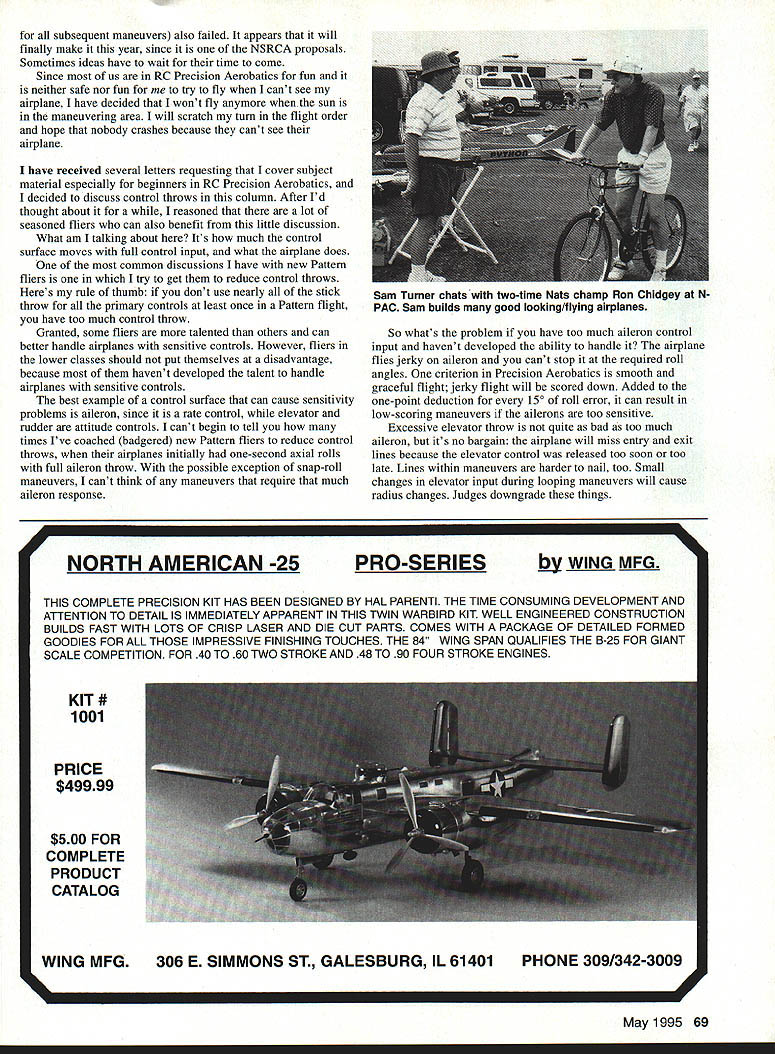
I have not seen the hats or shirts yet, but the jackets are really nice. Send check or money order (payable to USA Team Fund) to Radio South, Inc., 3702 North Pace Blvd., Pensacola, FL 32505. The team and its supporters do not get all the money they need from AMA to pay their expenses. Consequently, private fundraising like this is necessary. So be a part of the US Team's quest to regain the World F3A individual and team championships. Get your hat, shirt, jacket, or all three and help send the US team to Japan.
Rules Proposals and Voting
The results of the Initial Vote on the 1996–97 rules change proposals should be out soon. The members of the Radio Control Aerobatics Contest Board were to have had their votes in to the board chairman, Ron Hesselbrock, by the beginning of January. Since a Special Interest Group's proposals bypass the Initial vote, the proposals submitted by the National Society of Radio Controlled Aerobatics (NSRCA) got a bye on that vote and will only have to pass the Final vote. The NSRCA's proposals made up a big chunk of the proposals, so there's still a lot of voting to do.
I got an early indication of how the vote was going on my proposal to suggest that pilots not be required to fly when the sun is in the maneuvering area. Apparently it failed miserably; I'm not really surprised.
In 1991 and 1993, my proposals to permit the pilot to announce takeoff direction (thus specifying the upwind direction for all subsequent maneuvers) also failed. It appears that it will finally make it this year, since it is one of the NSRCA proposals. Sometimes ideas have to wait for their time to come.
Since most of us are in RC Precision Aerobatics for fun and it is neither safe nor fun for me to try to fly when I can't see my airplane, I have decided that I won't fly anymore when the sun is in the maneuvering area. I will scratch my turn in the flight order and hope that nobody crashes because they can't see their airplane.
Control Throws
I have received several letters requesting that I cover subject material especially for beginners in RC Precision Aerobatics, and I decided to discuss control throws in this column. After I'd thought about it for a while, I reasoned that there are a lot of seasoned fliers who can also benefit from this little discussion.
What am I talking about here? It's how much the control surface moves with full control input, and what the airplane does.
One of the most common discussions I have with new Pattern fliers is one in which I try to get them to reduce control throws. Here's my rule of thumb: if you don't use nearly all of the stick throw for all the primary controls at least once in a Pattern flight, you have too much control throw.
Granted, some fliers are more talented than others and can better handle airplanes with sensitive controls. However, fliers in the lower classes should not put themselves at a disadvantage, because most of them haven't developed the talent to handle airplanes with sensitive controls.
The best example of a control surface that can cause sensitivity problems is aileron, since it is a rate control, while elevator and rudder are attitude controls. I can't begin to tell you how many times I've coached (badgered) new Pattern fliers to reduce control throws when their airplanes initially had one-second axial rolls with full aileron throw. With the possible exception of snap-roll maneuvers, I can't think of any maneuvers that require that much aileron response.
So what's the problem if you have too much aileron control input and haven't developed the ability to handle it? The airplane flies jerky on aileron and you can't stop it at the required roll angles. One criterion in Precision Aerobatics is smooth and graceful flight; jerky flight will be scored down. Added to the one-point deduction for every 15° of roll error, it can result in low-scoring maneuvers if the ailerons are too sensitive.
Excessive elevator throw is not quite as bad as too much aileron, but it's no bargain: the airplane will miss entry and exit lines because the elevator control was released too soon or too late. Lines within maneuvers are harder to nail, too. Small changes in elevator input during looping maneuvers will cause radius changes. Judges downgrade these things.
Time was, you could never get enough rudder throw. That was before the days when the airplanes could climb in knife edge. Now you can put in too much rudder, and those slow rolls and four-point rolls will get very sloppy if you use all the transmitter rudder stick input on an improperly set-up airplane.
So tone down your control throws. If you don't have a feel for how much control input you actually use, have a buddy watch to see the inputs you use on all the transmitter controls; cut back the throw on the lightly used ones. I'll bet your flying quality will improve.
Joining NSRCA
Last month I promised to put something in the column on how to join the NSRCA. The reason I delayed was because the NSRCA was in the middle of elections, and I was not certain who the new Secretary/Treasurer would be. It's now official: Maureen Dunphy (hardworking N-PAC scorer and wife of N-PAC and 1993 Team Selection CD Mike Dunphy) is the new NSRCA Secretary/Treasurer. NSRCA dues are $20 per year, with the year starting when your money arrives. This spreads out the renewals and is easier on the Secretary/Treasurer. From what I understand, CPA Charles Castaing (New Iberia, LA — the N-PAC Registrar) will handle the books. Nice to have a professional working for free.
To join NSRCA you must be a member of AMA. Send your name, address, AMA number, home phone (optional), work phone (optional), class presently flying, and indicate whether you want $1 of your dues to go to the FAI Aerobatics Fund, with a $20 check or money order made out to NSRCA, to: Maureen Dunphy, NSRCA Secretary/Treasurer 2571 Rosewood Medford, OR 97504
You'll become part of AMA's fastest growing Special Interest Group, and you will receive the best Precision Aerobatics newsletter in the world, The K-Factor.
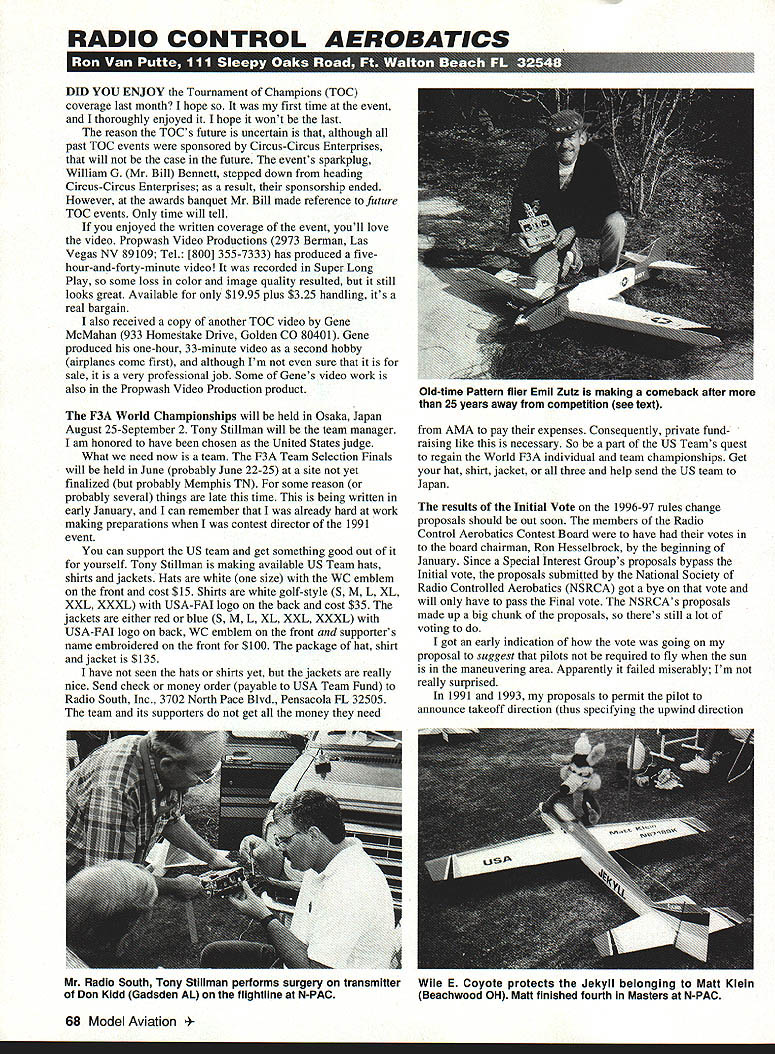
Emil Zutz Comeback
Have you ever heard of Emil Zutz? In the 1960s and early 1970s, Emil's name appeared in contest results throughout the Midwest. Just ask old Pattern warriors now (like AMA's president, Don Lowe) about his reputation. Now, about twenty years later, he has apparently decided to make a comeback. From what I understand, he will be using the latest technology in his effort: kits like Kraft KP-72 radio, Super Tigre G60 BBL engine, and KDH retracts. Look for this fearsome competitor on the contest trail.
Transcribed from original scans by AI. Minor OCR errors may remain.

