


RADIO CONTROL AEROBATICS
Ron Van Putte 111 Sleepy Oaks Road, Ft. Walton Beach, FL 32548
Corrections to Tournament of Champions coverage
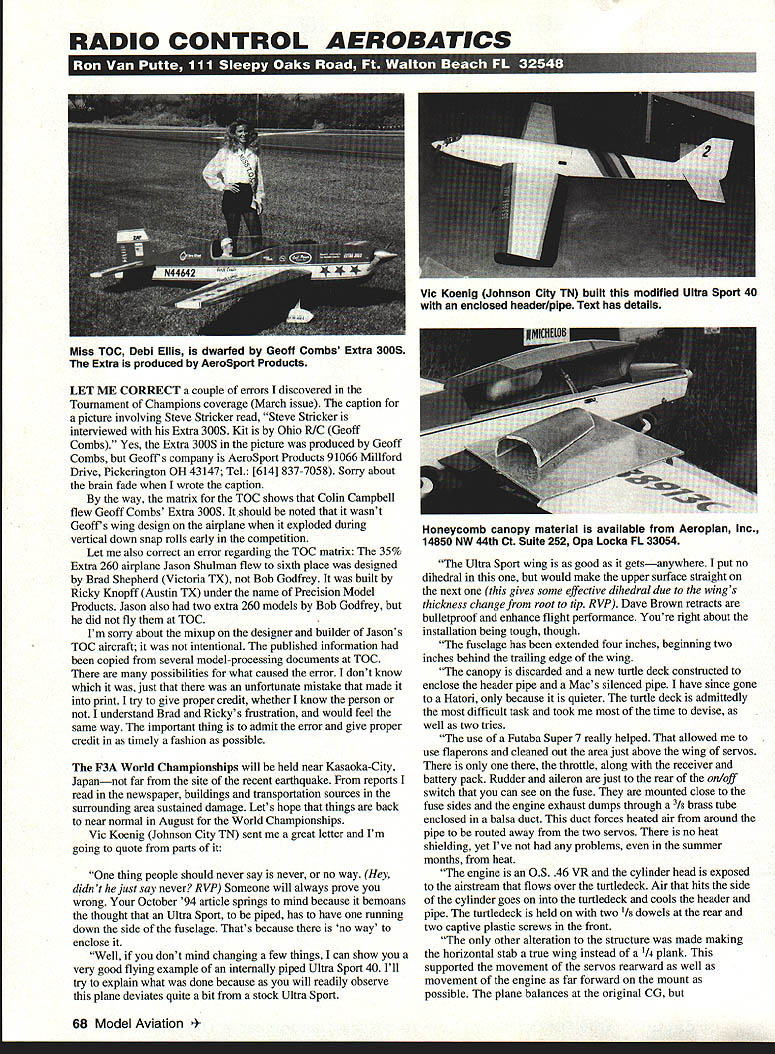
- The caption for the picture with Steve Stricker read that his Extra 300S kit was by Ohio R/C (Geoff Combs). The Extra 300S pictured was produced by Geoff Combs, but Geoff's company is AeroSport Products, 91066 Milford Drive, Pickerington, OH 43147; Tel: (614) 837-7058. Apologies for the error in the original caption.
- The TOC matrix shows that Colin Campbell flew Geoff Combs' Extra 300S. It should be noted that it was not Geoff's wing design on the airplane when it exploded during vertical down snap rolls early in the competition.
- Correction regarding Jason Shulman's 35% Extra 260 (sixth place): the airplane was designed by Brad Shepherd (Victoria, TX) and built by Ricky Knopf (Austin, TX) under the name Precision Model Products. Jason also had two Extra 260 models by Bob Godfrey, but he did not fly them at the TOC.
I regret the mixup on designer and builder credit. The published information was compiled from several model-processing documents at the TOC, and an unfortunate mistake made it into print. I try to give proper credit and understand Brad and Ricky's frustration.
F3A World Championships
The F3A World Championships will be held near Kasaoka-City, Japan — not far from the site of the recent earthquake. Newspaper reports indicated buildings and transportation infrastructure in the surrounding area sustained damage. Let's hope conditions are back to near normal by the August World Championships.
Vic Koenig — Internally Piped Ultra Sport 40 (excerpt and comments)
Vic Koenig (Johnson City, TN) sent a detailed letter describing an internally piped Ultra Sport 40. Excerpts and consolidated notes:
- General approach: Vic demonstrates that with some modification you can internally pipe an Ultra Sport instead of routing the exhaust down the side. The airplane deviates considerably from a stock Ultra Sport.
- Wing and retracts:
- The Ultra Sport wing is excellent; Vic left off dihedral on his example and suggests making the upper surface straighter next time (which produces some effective dihedral from wing thickness change).
- Dave Brown retracts are described as very reliable and improving performance; installation is difficult.
- Fuselage and turtledeck:
- Fuselage extended 4 inches, starting 2 inches behind the wing trailing edge.
- Canopy discarded and a new turtledeck built to enclose the header pipe and silencer (originally a Mac's, later replaced with a quieter Hatori).
- The turtledeck was the most difficult part and required two attempts to get right.
- Turtledeck attachment: held on with dowels in the rear and captive screws in front.
- Radio, servos, and cooling:
- Using a Futaba Super 7 allowed flaperon use and consolidation of servos.
- Only the throttle servo is directly above the wing, along with the receiver and battery pack; rudder and aileron servos are just behind the on/off switch, mounted close to the fuselage sides.
- Exhaust routing: engine exhaust dumps through a 3/8" brass tube enclosed in a balsa duct; this forces heated air around the pipe and routes it away from servos. No additional heat shielding was used and no problems were reported, even in summer.
- Engine and cooling detail:
- Engine: O.S. .46 VR; the cylinder head is exposed to the airstream flowing over the turtledeck. Air hitting the cylinder side flows into the turtledeck and helps cool the header and pipe.
- Tailplane and balance:
- Horizontal stab was changed from a 1/4" plank to a true airfoil to support moving servos rearward and shifting the engine as far forward as possible.
- The airplane balances at the original CG but will fly slower than a standard Ultra Sport.
- Future plans:
- Vic is building a new .60-size Ultra Sport: plans include inverting the engine, increasing the delta at the main wing leading edge with a straighter trailing edge, and using oversize tapered ailerons.
Thanks to Vic for the letter. It’s a good example of what can be accomplished with inventiveness. However, I would not recommend a beginning RC builder/ flyer attempt such significant changes without technical assistance from someone experienced in aerodynamics and CG effects. Extending fuselages and increasing wing sweep can materially change stability and controllability.
Letters from readers
#### Jay Crowley (Lake Tapawingo, FL)
- Jay responded to a January column about difficulties Pattern fliers encounter at club fields. He suggests that friction between Pattern fliers and other club members can stem from differences in skill level and speed of maneuvers; what is “tame” for a Pattern pilot can be too fast for a novice to follow.
- He notes novices often fly cautiously to avoid other fliers' expensive airplanes, and that pilots who haven’t flown in weeks may want the center of the field to resharpen skills.
- Jay suggests allocating flying time for special interests (e.g., gliders, electrics, beginner nights) and wonders whether partitioning zones by skill level could help.
- He asks for a description of basic Pattern maneuvers (for example, what a Cuban Eight is and how to make a trainer or sport airplane perform it).
My response: The separation by skill level is real. After suffering several midair collisions, I shifted my flying to afternoons to avoid the busier mornings. That virtually eliminated midairs but caused me to lose touch with many club members — it’s a tradeoff.
#### Robert Afflerback (Willingboro, NJ)
- Robert stopped flying Pattern around 1989 because of politics, but returned to modeling when his seven-year-old son showed interest. He attended a local contest in 1994 and was shocked at the small turnout in Novice and Sportsman classes.
- He contacted former competitors; many said they dropped out because the expense and the perception they could not be competitive against large, professionally built four-cycle airplanes. Some pilots felt a .40-sized model wouldn't be competitive, so they quit competing.
- Concern: if unlimited-displacement or very large engines become common (and filter down in price and availability), lower classes may be pushed out and Pattern could become an elite-only activity.
My response: The unlimited-displacement proposal has not yet passed, though it may. We’ve yet to see how large two-stroke engines perform against four-stroke .120s; four-strokes may retain an advantage via torque. Trial airplanes with larger two-strokes (for example, Webra 1.20) may appear as contestants prepare for upcoming seasons. I share the concern about rule changes that would allow Novice fliers to fly any airplane — I don’t look forward to a Novice showing up with a huge, difficult-to-see airplane powered by a chainsaw motor.
---
If you have specific requests (for example, a brief primer on basic Pattern maneuvers such as the Cuban Eight), I can prepare a clear, step-by-step guide aimed at trainers and sport airplanes.
Transcribed from original scans by AI. Minor OCR errors may remain.

