

Radio Control: Aerobatics
Rick Allison 15618 NE 56th Way, Redmond WA 98052
Introduction
First efforts by new Model Aviation columnists are traditionally autobiographical. I suspect this ritual chest-thumping may have something to do with establishing the bona fide credentials of the new scribe, so that following solemn pronouncements are taken seriously. A psychologist might observe a slight similarity to some of the noisier territorial and dominance strategies used by our hairy cousins, the great apes.
On the other hand, maybe it's just that you've got to start somewhere.
I'll start with this: Ron Van Putte just got off the horse, and I'm climbing on. I'm sure Ron has been properly thanked elsewhere by MA staff for his two decades of service, and I add my appreciation. Twenty years adds up to about 240 columns; that's a lot of deadlines made, and enough words to fill just about five complete standard-sized novels. If ever there was a well-earned rest, it belongs to Ron.
Some of you might recognize my name from Model Builder magazine, where I wrote the Precision Aerobatics column for most of the last five years. Some of you know me from the contest circuit or the pages of the K-Factor, the newsletter of the National Society of Radio Controlled Aerobatics (NSRCA).
My modeling experience reaches back to the 1950s, and includes rubber and gas free flight, control line Combat and Stunt, and a dabble or two of RC Scale. I've been active in RC Aerobatics since the early 1980s. For the last six or seven years I've competed in FAI F3A Aerobatics. I serve on the AMA RC Aerobatics Contest Board as the representative from AMA District XI. In my spare time, I do a little Scale Aerobatics, in the Unlimited class.
The breast-beating ends here, due to coughing and sore knuckles.
A New Voice
To get a feel for this new assignment, I went back and read a lot of the old Model Aviation activity columns; not just Ron's Aerobatics columns, but across the board. I found that a standard MA column format doesn't really exist, and the job is being done in many ways. I think I like that. A choir of distinct voices gives the magazine flavor and vitality, and presents the diversity of our hobby well. I appreciate the opportunity to be part of that.
In keeping with that spirit, things in this space will change. That doesn't mean that I disapprove of what Ron was doing; it just means that I'm not Ron Van Putte, and I can't bring Ron's ideas, perspective, and sensibilities to the job. I can and will bring my own.
One area where things might change a little is the focus of the column. In the past, this space has been almost totally devoted to Pattern-style aerobatics. I'll certainly keep the primary emphasis there, but since I also fly Scale Aerobatics, you'll see a little of that as well.
The division between the two forms is presently much deeper than it needs to be. Years ago, the gulf was very wide, but changes in the rules structure and maneuver schedules have brought the two events much closer in form, pace, and presentation. The equipment still differs in size and type, but the skills required of the pilot are now virtually the same. With the exception of several easily remembered differences, the judging criteria are the same.
Those with the talent and skill to succeed in one event can certainly succeed in the other. Aerobatics are aerobatics, and large or small, Scale or Pattern, we are all one family, as the Tournament of Champions has proven over the years.
It is unfortunate that there are those active in both forms of RC Aerobatics who would like to see the gulf between them remain wide. This likely has as much to do with those dominance and territorial behaviors I mentioned a few paragraphs ago as with anything else. I can't cause that attitude to disappear, but I can wish out loud that it would. I can certainly try to create a different attitude in these pages.
Opinions and Ideas
You should expect to read a few opinions under this byline. We live in a world of opinions, and it won't be possible to keep them out of this space. They are simply too closely related to ideas, and ideas are the bread and soul of modeling.
Because our hobby is full of stubborn individualists who average about 87 ideas per walking minute, it's especially hip-deep in opinions. It's the nature of opinions to differ, and over the years I've seen honest differences of opinion lead to anger and resentment. Differences can be stated and aired, which often leads to resolution or compromise. Then they can be debated, and many times an honest and friendly debate stimulates growth or leads to a technical advance.
Differences can be celebrated, enjoyed, and respected. They don't have to be sharpened and thrown with intent to do damage. In this column, I'll try to keep the opinions labeled as opinions, separated from the facts, and safely stapled to the table.
That doesn't mean that ideas and opinions are going to be sacred cattle around here. Ideas range from brilliant to silly, and part of this job is finding and providing the information to help you decide which is which.
I may attack an idea on occasion, or print a letter which does as much. Ideas and opinions are fair game. The people who advance them are not; they deserve respect just for having enough conviction and initiative to provide a point of view. Personal attacks are out of bounds. We are family, and we should handle each other with care.
As far as what else you might expect to read here, I have no idea. I'll have to write a few columns, and you'll have to read them and let me know what you'd like added or subtracted. The address is on the column header, and my mailman is a surly sort who deserves a hernia.
Photos are more than welcome. Color prints work fine. Do tell me about the subject, but please don't write on the back of the print! Action photos are great.
Vacuum-Formed Canopies and Plastic Parts
A recent trend in Pattern aircraft detailing has been the greater realism afforded by clear canopies. Availability has been a problem; few kit producers offer a clear canopy option. With larger Scale aerobatic aircraft, the availability is good but the quality is not always high. Finally, scratch builders and designers are often at a loss to find a source that can provide a suitable part at all, let alone at a reasonable price.
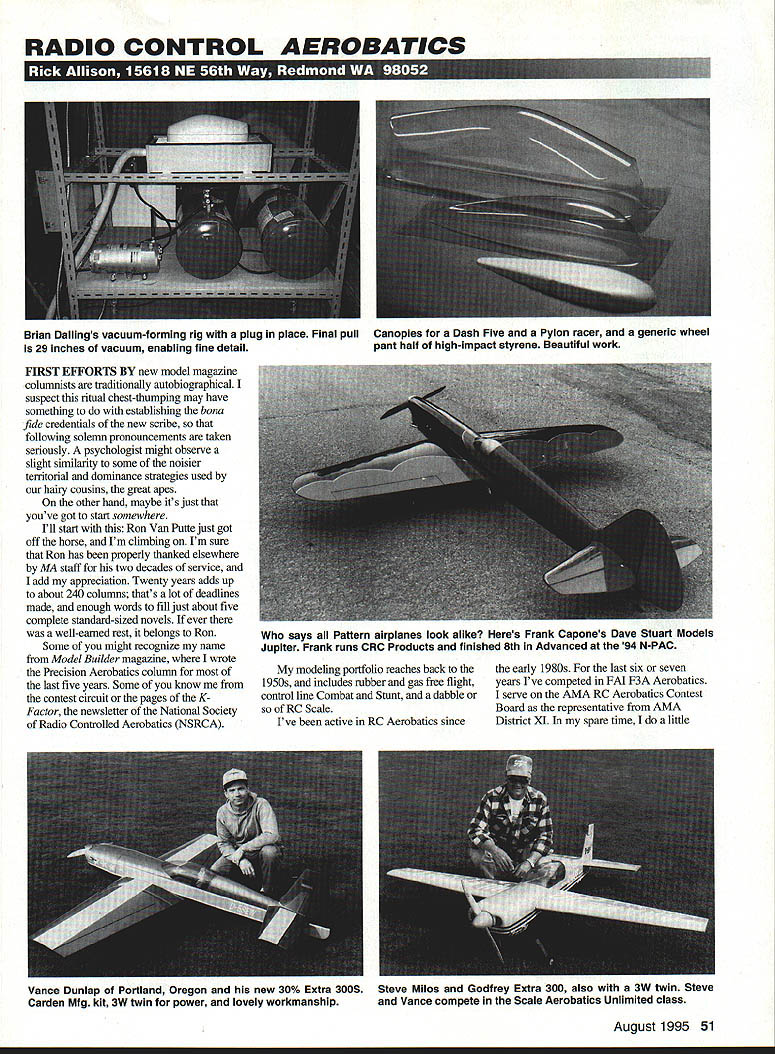
All of these problems may now be short-lived, because a new source for high-quality vacuum-formed plastic parts has surfaced. Brian Dalling of Vancouver, B.C. ran into some of the problems I mentioned in the course of a scratch-building project, and being an engineering type, he decided to do something about them.
He had vacuum-forming equipment and an improved oven built to his own design, and is now set up to pull high-quality clear plastic canopies and other plastic parts of any size up to 2 x 3 feet. You may specify thickness up to about 3/16" (nominal for pattern sizes is .030). The common canopy material he uses is PET, the soft-drink-bottle plastic, but Lucite or Lexan may also be used.
Brian mentioned that he thought his products were as good as anything he'd seen in a kit, but the samples he sent are better than that; they're the best I've seen in years — crystal clear, and since he uses electrostatic equipment, almost totally free of the dust problems that can mar the best commercial efforts.
He can supply kit manufacturers or individuals with single orders. You will need to provide a plug that Brian can use to construct a pulling plug — he uses a commercial tooling plaster that dries to a ceramic hardness.
The prices will vary depending on size, plug labor, number of units, etc., but Brian's stated goal is to provide fellow modelers with top-quality parts at reasonable prices. I believe canopies for Henry Piorun's Meridian and Python kits are available now. Contact Brian for further details:
- Address: 4214 West 15th Ave., Vancouver, B.C. V6R 3A6, Canada
- Tel.: (604) 222-1005
Transcribed from original scans by AI. Minor OCR errors may remain.

