
Radio Control: Aerobatics
Rick Allison, 15618 NE 56th Way, Redmond WA 98052
ONE OF THE BENEFITS of this job is that nothing in your modeling experience is wasted. The occasional triumph can be shared, and the trials and troubles recycled. It's like bleeding in public so that everybody else remembers to buy Band-Aids. A lesson learned (or re-learned, in this case) can be a lesson shared. If you smell a small tale in the offing, you're right. But first, I think we'll start with the lesson.
"Straight and light" has been a righteous litany with Pattern pilots and builders for many years now, with good reason. Straight, light airplanes simply fly better. The straighter an airplane is, the easier it is to trim. The lighter it is, the better the power-to-weight ratio, which means more vertical and better acceleration.
As a general rule, a lighter aircraft also exhibits better aerodynamic damping in roll, pitch, and yaw, and faster deceleration when the throttle is closed. Because of these lovely attributes, "straight and light" is muttered like a medieval incantation over the bare bones of new models in workshops across the land.
If you think I'm going to tell you "straight and light don't count anymore," you couldn't be more wrong. I chant the same mantra you do; go blind squinting at stab/wing alignments; and drive myself just as crazy measuring every conceivable trammeling dimension 47 times. I buy new brands of various components just to weigh them, and carry digital scales into hobby shops to weigh balsa. I regard an extra hour's building time to rid my airplane of a single ounce as a major return on investment.
However, there is something else to go along with straight and light; something just about as important.
Back in the era of excessive optimism and giant tail fins, I served an apprenticeship in Control Line Aerobatics. The "straight and light" dictum was an article of faith back then as well, but it was more of a trinity, as in "straight, light, and rigid." Stiffness was highly regarded, and most practitioners of Stunt had a better-than-nodding acquaintance with structural mechanics.
Those circle-pattern guys knew (and know!) that airframe rigidity preserves all of that cherished rigging accuracy under load. A stiff, strong airframe that doesn't deform under flight loads is predictable and honest under all conditions. A stiff airplane holds trim and goes through the maneuvers on rails, and doesn't bounce off-line as badly in turbulence. Highly loaded maneuvers start and stop positively. The force arrangement designed into the model and all the trim adjustments are operating properly as one under six Gs.
A flexible flyer can turn all of that upside down. A wing, stab, or fuselage that twists or flexes under aerobatic loads is bad news. Sudden stops and starts (as in snap rolls, for instance) are "mushy." The airplane pops out of the groove easily in turbulence. High-G corners are unpredictable. Rolls tend to wander. The model won't hold trim, and seems to want constant retuning like a newly strung guitar.
Worst pilots never realize what's behind either; they regard the unfortunate behavior as entirely normal and put it down to their own lack of skill. This is especially true in the onset of an insidious case where the airframe has gradually loosened up due to age, stress cracking, or vibration-induced wear.
That brings the story. During the latter part of last season I dimly noticed my favorite airplane, Piorun Models Meridian 900, becoming a little difficult to fly — slow rolls had smaller-radius corners, maneuvers like the Square and Vertical Eight were an adventure, and the airplane also seemed to be wandering a little in pitch. When the weather got a bit bouncy and breezy in the fall, I put the Meridian down and salted it away for the winter.
Spring blessed us with several uncommonly calm, beautiful weekends — ideal trimming weather. After the long layoff, the previous season's trim troubles were instantly and glaringly apparent. My wife Joan's Meridian 900, a sister ship to my own, was flying superbly, so there was no doubt something was wrong with mine.
Shopping for answers, I noticed the adjustable plug-in stab's tips were a vibrating blur at idle. The offending unit was quickly pulled for inspection, and I found multiple hairline cracks in the phenolic sockets of both stab halves where they are permanently mounted to the center section.
Standard construction procedure for adjustable units involves sawing the completed, joined stab into three sections, the phenolic sockets already installed, installing 1/32" plywood facings on the raw butt ends, and epoxying the joint between the plywood facings. The joint between the tube ends had failed in shear from vibration. The glue joint between tube and socket had opened, and the foam core was loose. To say that the stab was flexible would be an understatement; I had a wildcat with a wet noodle for a tail.
Several hours of head-scratching later, the fix was doped out. I did a bit of minor surgery, cutting out a one-inch square of facing around the tube ends. The tubes were supported in the cracked areas with carbon-fiber splints and injected slow-set epoxy, and the tube ends got a 3/32" plywood doughnut installed to increase the gluing area to the removed surface of facing, which was carefully reinstalled in the original hole.
The repaired stab gained about seven grams of weight. More important, it was stiffer than new, and in fact was as stiff as a one-piece unit.
The airplane instantly flew better, and what seemed to be an order of magnitude. A small amount of retrimming was required, but once that was done, it was as if I had switched from a rusty '55 pickup with bad kingpins to a new Ferrari. In particular, the rolling maneuvers were improved, and slow rolls that were a problem before were now effortless. This makes sense, because in a slow roll the model passes through flight conditions where the stab loads are constantly changing, from full level-flight load to fully unloaded, and back again.
The moral of this little tale is that stiffness counts—probably more than we think. The support-doughnut fix will be installed on all new adjustable stabs I build, and I'll be looking for other new ways to tighten up my airframes.
I already do things like:
- Supporting the wing tube with a carry-through socket in the fuselage (a standard feature on many kits, including all from Piorun Models).
- Making servo trays and tank mounts do double-duty as fuselage stiffeners.
- Installing top and bottom half-formers on a 45° angle as stab center-section supports in the aft fuselage.
Still, I'm certain there's room for improvement. Any more ideas out there? Here's the deal: you send them in, and I'll publicly steal them. If you've remembered to sign your name, I'll even give you credit.
Of course, for the ultimate in stiffness, we could all go back to one-piece wings and stabs, and all-wood fuselages. I just might do that, if I had the space to transport and store them.
We pay a price in inherent rigidity and vibration resistance for our modern plug-in convenience. That's OK, but we need to do it with our eyes open to the consequences, and do our best to pay the smallest price possible. That probably means more reliance on modern materials and some innovative re-thinking about structures and building methods.
- Carbon fiber and Kevlar for reinforcement.
- Reworked joint details (doughnuts, splints, increased glue area).
- Structural members designed to serve multiple functions (stiffening plus mounting).
This is the way of progress—we are constantly presented new opportunities to solve the same old problems on a more sophisticated level!
Y.S. UPDATE:
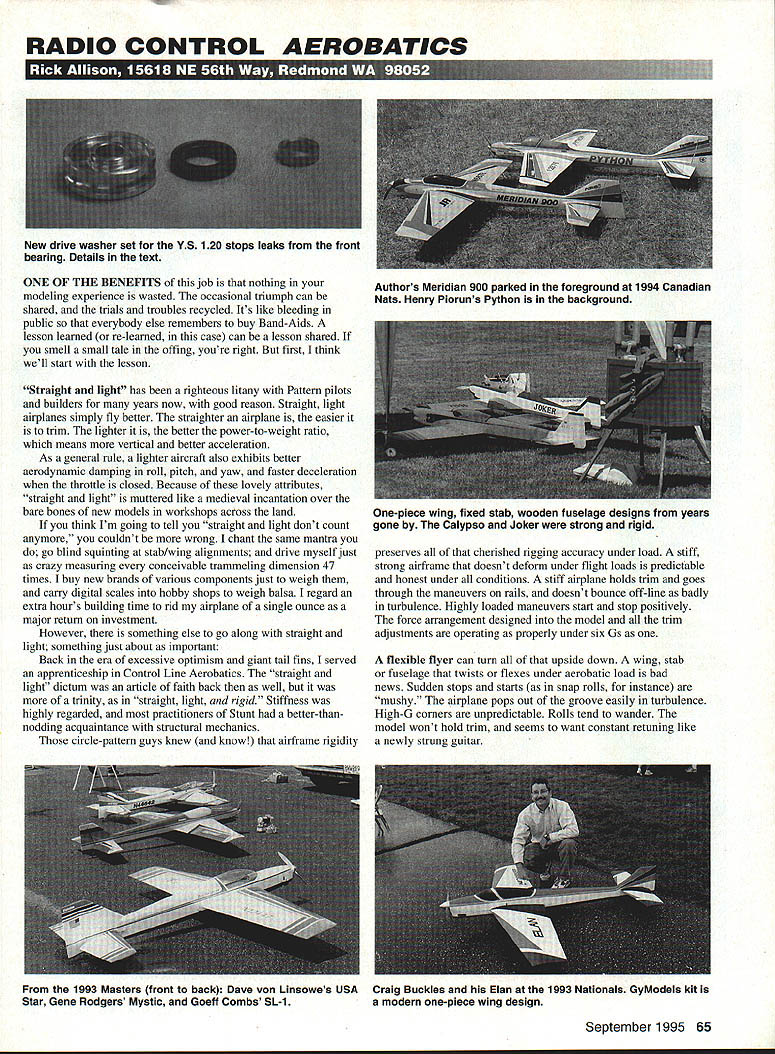
The Y.S. 1.20 and 1.20AC are two of the best model airplane engines ever devised: powerful, reliable, and easy to start and adjust. They do almost everything well, but some of them (OK, most of them) are a little messy—they tend to spray fuel out of the front bearing housing like a tomcat marking its territory. This is caused by the drive washer wearing on the front bearing, and can be disconcerting to an aeromodeling fussybug like myself.
Y.S. Futaba now has a fix in hand. The part number is YSO692, and it's a new drive washer/front seal set that purports to solve the problem once and for all. I have ordered up a set or two of these and will install them shortly. I'm not sure what average retail will be, but it's probably somewhere around $30. They certainly look like they'll work. I'll let you know.
Transcribed from original scans by AI. Minor OCR errors may remain.

