
RADIO CONTROL AEROBATICS
Rick Allison, 15618 NE 56th Way, Redmond WA 98052
Editor's note
Ron van Putte submitted this report.
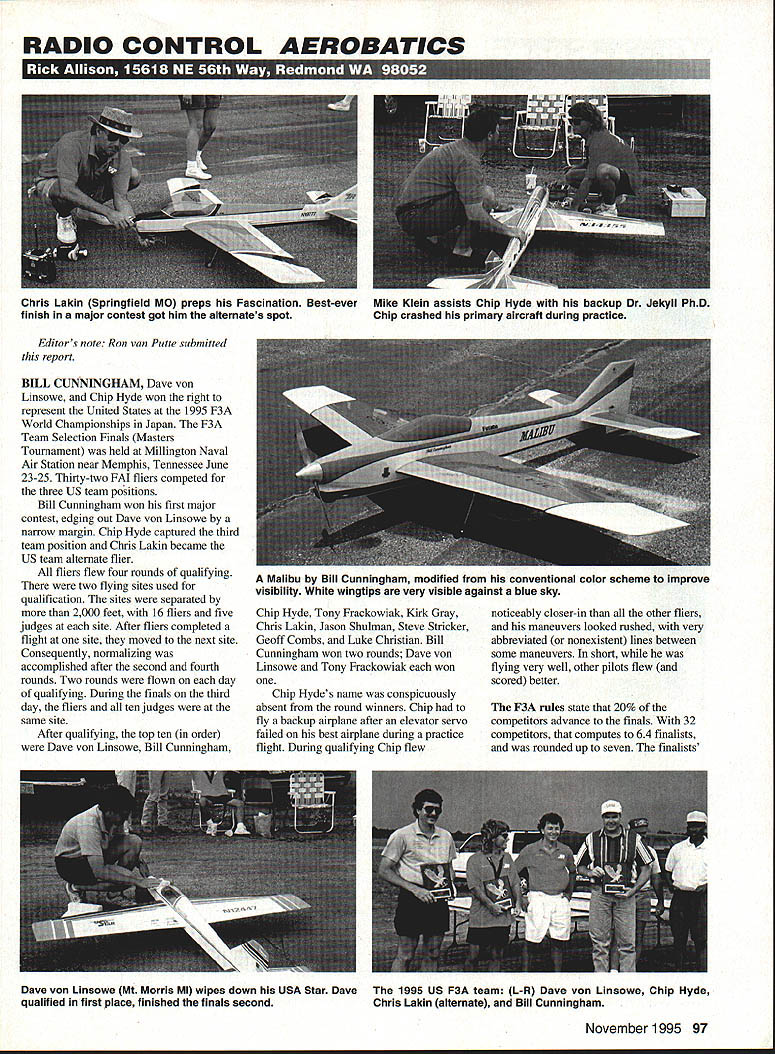
Bill Cunningham, Dave von Linsowe, and Chip Hyde won the right to represent the United States at the 1995 F3A World Championships in Japan. The F3A Team Selection Finals (Masters Tournament) were held at Millington Naval Air Station near Memphis, Tennessee, June 23–25. Thirty-two FAI fliers competed for the three U.S. team positions.
Bill Cunningham won his first major contest, edging out Dave von Linsowe by a narrow margin. Chip Hyde captured the third team position and Chris Lakin became the U.S. team alternate pilot.
All fliers flew four rounds of qualifying. There were two flying sites used for qualification, separated by more than 2,000 feet, with 16 fliers and five judges at each site. After a flier completed a flight at one site, that site moved to the next location. Consequently, normalizing was accomplished after the second and fourth rounds. Two rounds were flown on each day of qualifying. During the finals on the third day, the fliers and all ten judges were at the same site.
After qualifying, the top ten (in order) were:
- Dave von Linsowe
- Bill Cunningham
- Chip Hyde
- Tony Frackowiak
- Kirk Gray
- Chris Lakin
- Jason Shulman
- Steve Stricker
- Geoff Combs
- Luke Christian
Bill Cunningham won two rounds; Dave von Linsowe and Tony Frackowiak each won one.
Chip Hyde's name was conspicuously absent from the round winners. Chip had to fly a backup airplane after an elevator servo failed on his best airplane during a practice flight. During qualifying Chip flew noticeably closer in than the other fliers, and his maneuvers looked rushed, with very abbreviated (or nonexistent) lines between some maneuvers. In short, while he was flying very well, other pilots flew (and scored) better.
The F3A rules state that 20% of the competitors advance to the finals. With 32 competitors, that computes to 6.4 finalists and was rounded up to seven. The finalists' scores were renormalized, giving 1000 points to the highest score carried into the finals. The three finals flights were worth 1000 normalized points each; winners were determined on the basis of the three best of the four scores.
After the finals flights Bill Cunningham and Dave von Linsowe swapped first and second places. In qualifying Bill had won two rounds; Dave had two as well. Since Dave carried two 1000-point rounds into the finals, the final positions were determined by the next-highest scores. Bill finished ahead of Dave. Chip Hyde held third. Chris Lakin moved up to fourth; Tony Frackowiak dropped to fifth; Jason Shulman moved up to sixth; and Kirk Gray, who qualified fifth, finished the finals seventh — proving his high placing at the 1994 N-PAC contest was not a fluke. Watch Kirk and Jason — they'll be on the national scene for a long time.
The Naval Air Station at Millington is in the process of closing. The runway used for the competition is no longer used by the base and had to be tended before the competition could be held. Some waist-high grass and weeds had sprouted from seams and cracks in the runway; they were removed by Navy personnel. After the clean-up it was a very nice site for the competition.
Weather is always a factor in competition; contestants, judges, and administrators had wind, heat, humidity, and rain to contend with. The wind ranged from nonexistent to about 15 knots from all directions. Heat and humidity were constant factors; daytime high temperatures were about 90°F. Rain threatened for a long time, but it only rained once (briefly) during competition—during the last flight of the finals, a light shower came down. After the awards ceremony photo opportunities were shortened by pelting rain.
Did anything really unusual happen? Yes — three things:
- Someone flew an airplane with a two-stroke engine. Jacksonville, Florida's Gary Kirby used a YS .61 AR. The rest of the competitors flew YS and O.S. four-stroke engines.
- Dean Koger didn't fly an airplane with a belt-drive engine. Dean used a YS 1.20 AC, like most of the competitors. Dean was competing in his fourteenth Masters Tournament.
- Someone used a radio that wasn't a Futaba or JR. Geoff Combs was very pleased with the performance of his Airtronics Stylus. He extolled the features to anyone who would listen; he claims it has the same solid feel as his Futaba radio.
Everyone used APC props; however, some of the fliers selected unusual sizes. On the four-stroke 1.20s, 14-, 15-, and even 16-inch props were expected, but Chip Hyde, Chris Lakin, and Don Weitz used 13.5-inch props on their O.S. 1.20s. A lot of YS .91 AC owners share that prop size.
Tru-Turn spinners were used by all of the competitors. Romco and its owner, Bob Obensberger, still deserve mention. Bob started production of these quality items only about ten years ago, although it seems like much longer.
Power Master, Magnum, and Cool Power fuels were used almost equally by fliers; the average nitromethane percentage was just over 25%. One notable exception was Jason Shulman, who used only 15% nitro fuel in his YS 1.20 AC.
This was the first major contest I've attended recently where there was no controversy. A good part of the credit for this must go to the people who handled contest management. Mike Dunphy of Medford, Oregon was the Contest Director. Mike was also the Contest Director for the 1993 event. He was assisted by Al Glenn, Bob Dillon, and Mike Pedrone. Al, Bob, and Mike are all from Memphis, Tennessee.
Judges were:
- John Britt
- Rusty Fried
- John Fuqua
- Fred Johnson
- Charlie Reed
- Dick Smith
- David Snow
- Jim Williams
- Cheryl Williamson
- Rick Allison
Contest judge Fred Johnson is an airline pilot who lives in Memphis. He owns and competes with a full-scale racing T-6, as well as an aerobatic Christen Eagle. Before the first day of qualifying, Fred thrilled the crowd by flying his T-6 into Millington. John Fuqua was his passenger. Fred left the aircraft on display all afternoon.
On the second day he flew in his Christen Eagle for display. After seeing the two aircraft, most spectators were amazed that the T-6 was so big — and the Christen Eagle so small. The wingspan of the T-6 is about twice that of the Eagle. At the banquet on Saturday evening Fred auctioned off three rides in the Christen Eagle to eager bidders, with the proceeds going to the U.S. team.
Maureen Dunphy handled all the scorekeeping. She's the one who helps Mike remember all the little things that can make or break a contest. They even brought frequency pins all the way from Oregon! Mike and Maureen are a great team. They'll be working their magic at this year's Nats. Rick Allison will be covering it for Model Aviation.
I warned you in my last column (in the July issue) that you might see me covering a major event if I was available and Rick was unable to attend — I just didn't expect it to be so soon! Rick phoned me about three weeks before the Masters Tournament and opened the conversation with, "How'd you like to come out of retirement?" Could this have been due to my back — I thought he wanted to quit the column! Then he explained that he couldn't attend both the Masters Tournament and the Nats, and wanted me to cover the tournament. It was fun; one deadline a year is a piece of cake.
Transcribed from original scans by AI. Minor OCR errors may remain.

