
RADIO CONTROL AEROBATICS
Rick Allison, 15618 NE 56th Way, Redmond WA 98052
Overview
Like all of Caesar's Gaul, the 1995 AMA Nationals was divided into three parts. And like Gaul, the division may become a lasting one.
The Pattern and Pylon portion of the meet took place at the Mid-American Air Center in Lawrenceville, Illinois, July 8–16. The 1990, ’91, and ’93 Pattern Nats and the ’92 N‑PAC were run at Lawrenceville for two simple reasons:
- For now, the Mid‑American Air Center is the premier Pattern site in the country.
- It is centrally located in regard to population density.
The ’95 Nats was originally scheduled as a Tri‑Cities, Washington State affair — a repeat of the successful ’89 Nats in that area. In the fall of ’94, very late in the site‑approval process, it became apparent that major problems with the proposed Pattern, Pylon, and Free Flight sites would not allow those portions of the Nats to run successfully in the Tri‑Cities.
With only a few short weeks left, a complete change of venue to another location was impractical. A number of solutions were proposed, including canceling the entire event and restructuring it for Muncie in ’96. The Tripartite Solution — placing Control Line, Scale, and Indoor in the Tri‑Cities; Free Flight, Electric, Helicopter, and Soaring in Muncie; and Pattern and Pylon in Lawrenceville — was a late AMA Executive Council compromise.
Organization and staffing
To make the new concept of a spread‑out and disconnected Nats work, new AMA Competitions Director Steve Kaluf and new/old volunteer Nats Manager Ron Morgan solicited the cooperation of the competition Special Interest Groups. A new Nats "command structure" and a new way of budgeting and allocating Nats funds were rapidly developed and put into operation.
Under the new system, the National Society of Radio Controlled Aerobatics (NSRCA), fresh from running two very successful N‑PAC meets in ’92 and ’94, drew responsibility for the ’95 Nats Pattern events. NSRCA was fortunate to almost immediately secure the services of the "core team" that ran the successful ’94 N‑PAC: Mike Dunphy as Event Director; Maureen Dunphy and Tim Langlinais as the scorekeeping crew; and Charlie Castaing as comptroller. Mike and Maureen Dunphy took this on despite obligations to run the FAI/F3A Team Selection Tournament scheduled just three weeks before the Nats. Without this core group, the Pattern Nats would have been in serious trouble.
Still, with so much "newness," problems were expected — and they came in bunches. The main logistical difficulty was an incredible shortage of full‑time dedicated help. It wasn't possible to advertise for or solicit help to any great extent because of the limited time available.
Despite this, word filtered out and several volunteers stepped up:
- John and Joan Ferrell (Julian, NC) ran two lines.
- Experienced Nats volunteer Denny Rypkema (Smyrna, GA) volunteered as a Site Director.
- Dorothy Speights judged full‑time.
- Cheryl Williamson (Chula Vista, CA) flew in to serve as Chief Judge.
- Sue Asteris gave up calling her husband George and worked all week running the FAI site.
The remainder of the help — judges, scribes, site directors, line directors, impound people, setup crew, and sound checkers — came from the ranks of the competitors.
Turnout and entries
Adding to the difficulty was a lighter‑than‑anticipated turnout, the late site move, and some delays getting Nats entry forms mailed out from HQ soon enough. Although 125 pilots registered in the classes, 114 made the trip to Lawrenceville. Most fliers worked three full or half days; some flew a backbreaking load, especially given the conditions.
Perhaps the most oppressive problem of the week was the weather. A giant heat wave passed over the Midwest: temperatures soared above 100°F, winds were light to zero most days, humidity hovered near 90%, and the heat index reached a blistering 110°F.
Format adjustments
The light turnout and the need for contestant manpower persuaded Event Director Mike Dunphy to adopt a two‑site, four‑line contest format, flying split days. In the mornings, Masters flew from three of the four lines while Sportsman used the remaining line. In the afternoons, FAI flew from two lines at a single site, while Advanced flew from both lines at the remaining site.
To ensure equal exposure to all judge panels:
- Sportsman normalized scores after each round.
- FAI and Advanced normalization was done every second round.
- Masters could only normalize after the third and sixth rounds.
To get the traditional six rounds for the AMA classes, classes doubled up on rounds on certain days:
- Masters split rounds, flying a round‑and‑a‑half on Monday and Tuesday.
- Sportsman flew two rounds on Monday.
- Advanced flew two rounds on Wednesday.
- FAI flew one prelim round per day, leading to finals on Friday.
The Mid‑American Air Center had previously provided crosswinds on each visit. The ’90 and ’91 Nats were flown in stiff quartering winds; the ’92 N‑PAC in a brisk direct crosswind; and the ’93 Nats featured shifting direct crosswinds. This year began similarly to ’93, but after the first day the winds became so light and variable they were essentially a non‑factor. With the Pilot’s Option rule for flight direction in effect, the main problem was deciding which direction to fly.
With an eye on the thermometer, Event Director Dunphy had pilots start each morning at 8 a.m. sharp. Even with long days and extra rounds, the site was cleared by 3:30 or 4 p.m. most days. Considering the weather, most competitors headed for swimming pools and air conditioning rather than practice fields.
Results and highlights
Sportsman
Turnout was especially light in Sportsman, with only 13 pilots participating. Quality more than made up for quantity: pilots were well prepared, well coached, and well equipped. Eleven of the 13 pilots had at least one normalized round over 900 points.
Top results:
- Rick Sweeny (Northville, MI) — won by a scant four points.
- Jon Magnuson (Pace, FL)
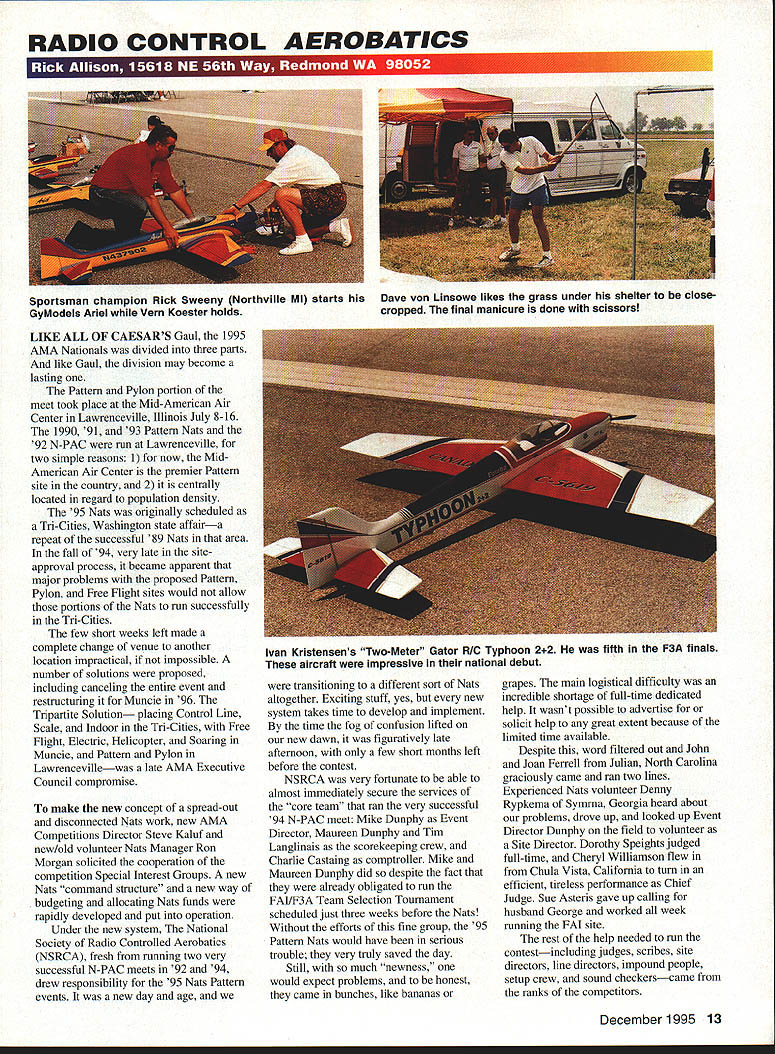
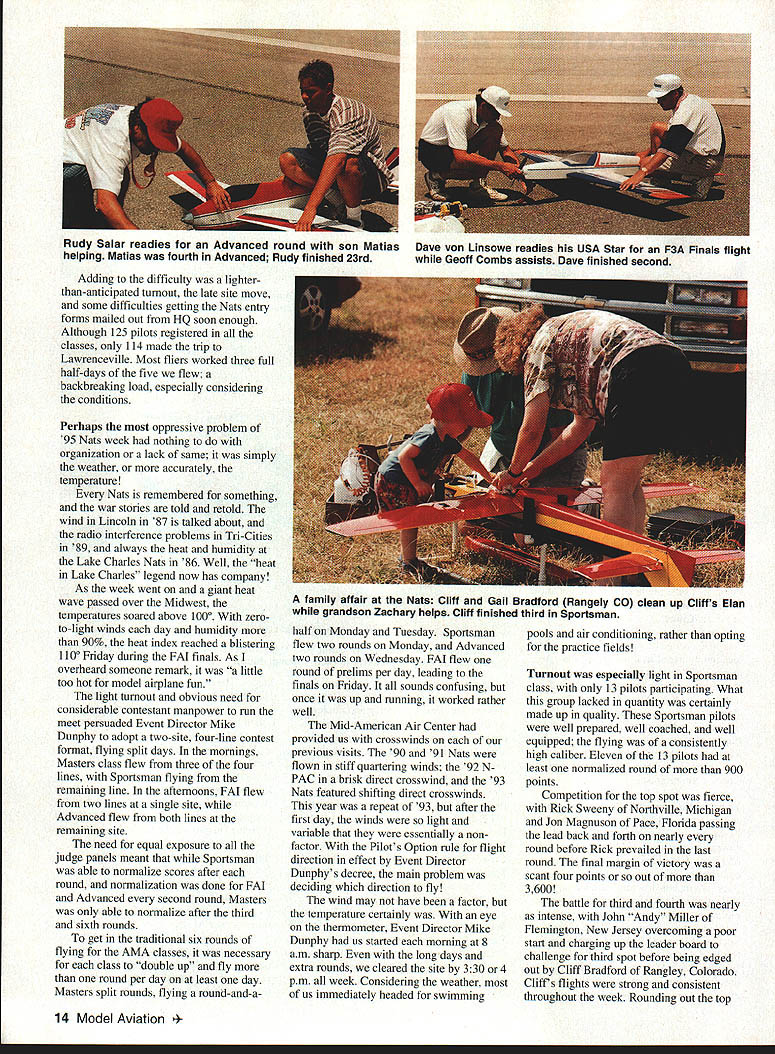
3–4. Cliff Bradford (Rangely, CO) and John "Andy" Miller (Flemington, NJ) fought for third and fourth, with Bradford edging Miller. Other strong finishes included Geoff Combs, Dave von Linsowe, Tom Jarvis, and Matias Koester.
Also notable was Chris Danserau of Johnston, RI, who flew well early but faded late in the week.
Advanced
Twenty‑six fliers competed in Advanced. Notable results:
- Kevin Nibuor (Clovis, CA) — a convincing wire‑to‑wire victory, winning four of six rounds.
- Bob Hartwig (Edgar, WI) — slow start but finished strong, winning two of the last three rounds.
- Jeff Aranyos (St. Charles, IL) — consistent performance for third.
- Matias Koester (Northridge, CA)
- Ken Schultz (Temple, TX) — several good flights.
The Advanced group showed solid flying throughout the finishing order.
Masters
Masters continued to be the fastest‑growing class with 39 pilots flying officially. Jonathan Roberts (listed as Fraint, CA) and Sean McMurtry (Oklahoma City, OK) renewed their rivalry from the ’94 Nats, but this time Jonathan Roberts prevailed.
Jonathan won the first four rounds before a midair with Sportsman flier Dave Gould (Kamloops, BC) forced him to a backup aircraft. Gould repaired his Zeus and continued, eventually finishing seventh in Sportsman. The aircraft Roberts had been sharing with friend and FAI flier Luke Christof (Rohnert Park, CA) was destroyed in the midair.
Sean McMurtry finished a respectable second, coming close several times but never winning a round. David Snow (Palatine, IL) was third. Fourth place went to Bruce Thompson (Denver, CO), who won one round but lacked consistency. Dave Lockhart (Absecon, NJ) won a late round and finished fifth.
FAI F3A
Headline news: former Nats, TOC, N‑PAC, and World Champion Chip Hyde failed to make the finals, finishing a disappointing 11th. Chip was involved with Pylon Racing in the mornings, and his flying appeared rushed and less polished than usual.
Prelims highlights:
- Dave von Linsowe dominated the prelims, winning three of four rounds.
- With 41 registered (36 actually flew), Event Director Dunphy advanced a rounded‑up 20% to the finals — nine pilots.
The nine finalists, in order, were:
- Dave von Linsowe (Mt. Morris, MI)
- Tony Frackowiak (Sierra Vista, AZ)
- Jason Shulman (Windermere, FL)
- Ivan Kristensen (Guelph, ON)
- Chris Lakin (Springfield, MO)
- Kirk Gray (Florence, SC)
- Mike Klein (Bedford, OH)
- Geoff Combs (Pickerington, OH)
- Mike Harrison (Hot Springs, AR)
Tony took Round Two of the prelims, dropping Dave to second.
Finals format: the averaged normalized preliminary score is taken into a three‑round finals. The pilots fly one‑at‑a‑time from a single flight line in front of all judges. The finals pattern changes from prelims to present less‑familiar schedules and help judges discriminate among top flyers.
Finals summary:
- Round One of the finals featured sloppy flying from many of the finalists, with poor geometry and hurried entries.
- Tony Frackowiak moved to the front with good shapes and moderate pacing and won Round One decisively.
- Flying tightened in subsequent rounds as pilots corrected their presentations.
- Chris Lakin moved up strongly after Round One, finishing third overall.
- Tony Frackowiak sealed the win with another strong, clean performance in Round Three.
- Final top placements:
- Tony Frackowiak
- Dave von Linsowe
- Chris Lakin
- Jason Shulman
- Ivan Kristensen
- Kirk Gray
- Mike Klein
- Geoff Combs
- Mike Harrison
Trends, equipment, and judging
Flying quality and trends
The overall quality of flying in all classes was the highest the author had seen since the advent of the turnaround style in ’84. Possible reasons:
- Maneuver schedules have been stable for several years.
- Equipment has improved.
- Practice yields significant gains.
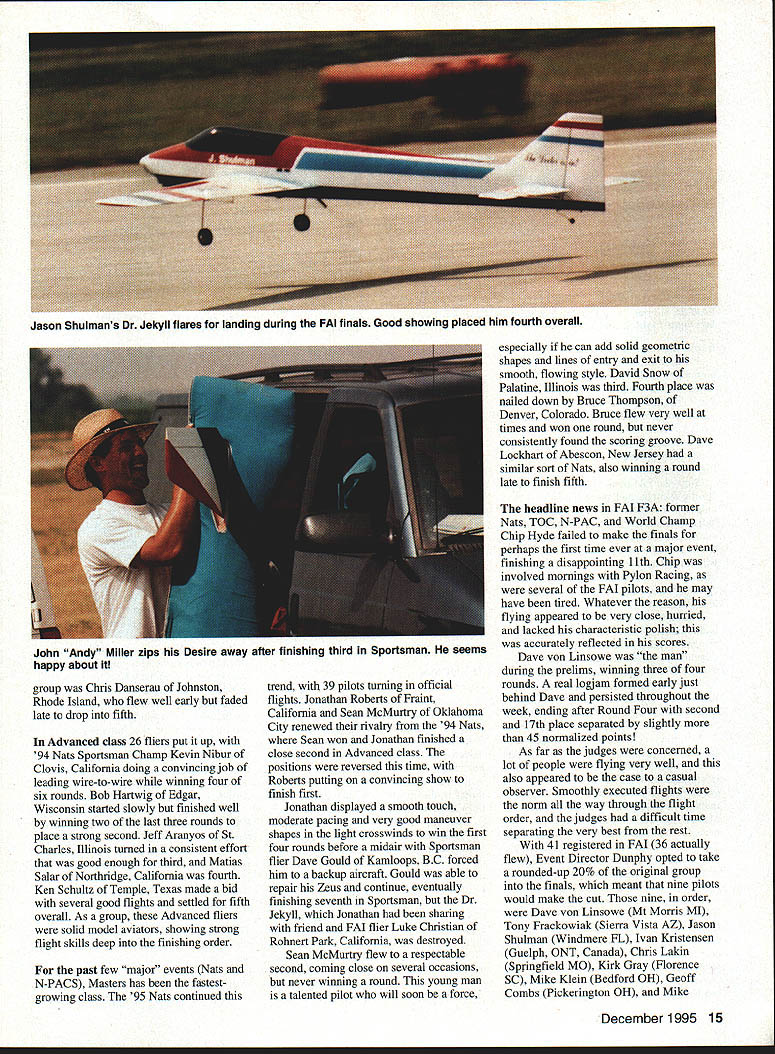
The first of the "two‑meter" behemoths made a splash: the 2+2 Typhoon from Gator RC placed first and fifth in FAI with Tony Frackowiak and Ivan Kristensen respectively.
The new YS 1.20SC engine (replacing the older 1.20AC Air Chamber engine) made its first appearance powering the FAI aircraft of Steve Helms and Tony Stillman. Reports from the flightline indicated roughly a 30% power increase over the old airbox, with prop sizes such as 16 x 13 likely to become popular and landing‑gear struts possibly lengthening as a result.
Geoff Combs flew the new Airtronics Stylus radio to a respectable eighth place in FAI, signaling a new choice in Pattern radios.
Two‑stroke engines at national competition are now rare, though smaller one‑cylinder two‑strokes were still seen and did well.
Sportsman participation concern
Sportsman participation at national events continues to shrink and may eventually mean the class won't run at future Nats. This is puzzling because Sportsman remains the largest class at most local contests, yet competitors apparently don't travel to nationals in the same numbers.
Judging and contestant‑run event
Like the ’94 N‑PAC, the ’95 Nats was almost entirely contestant judged. On the whole, judging could have been better in all classes. This was attributed not to contestant judging per se but to a poorly attended, hurriedly advertised judging school. Almost none of the contestant judges attended, and judging lacked the coherence seen at N‑PAC ’94. This will be corrected in future events.
This was the most contestant‑run major Pattern contest ever held. The load on pilots was far too great — not by design but by lack of design. Steps are being taken to remedy this. While pilots may still be expected to help, five‑day workweeks and excessive burdens are undue.
Conclusion and outlook
This was a Nationals in transition. It didn't feel like a traditional, all‑in‑one Nats to many veterans. The era of the super combined Nats appears to be ending, and future Pattern Nats will likely be standalone events run primarily by NSRCA with less AMA involvement. If future Pattern Nats feel like N‑PACs, that's viewed positively: N‑PACs have had strong Pattern community pride and togetherness that was lacking at recent Nats.
Plainly, not everything went as planned. Some things didn't happen simply because they were never planned. Still, despite limited time, scarce help, and confusion from major operating changes, most tasks were completed successfully. Credit goes to the core crew for a truly heroic effort.
A little adversity brought people together in Lawrenceville. From the pilots’ meeting on Sunday evening through the awards ceremony on Friday evening, the attitude was one of cooperation and determination to make things work. If that cooperative attitude continues between AMA HQ and NSRCA, lessons learned here should yield better results in Muncie in ’96.
The Nats has always been a phoenix — reborn each year and constantly reinventing itself. The format, organization, and people may change, but the contest endures. See you at Muncie in ’96!
Transcribed from original scans by AI. Minor OCR errors may remain.

