
RADIO CONTROL AEROBATICS
Rick Allison, 15618 NE 56th Way, Redmond WA 98052
It is early September as I write this, and the US FAI/F3A team is already in Japan for the 1995 World Championships. What they do there will soon be duly recorded, analyzed, published, enjoyed or agonized over, and then consigned to the dusty stacks of Pattern history. (Editor's note: Full report next month.)
This is a tale pulled from those same stacks; partly a story of other World Champs 30 summers and more past, but mostly the story of one Pattern modeler: Ralph C. "Doc" Brooke. Some of you noted his recent selection to the AMA Model Aviation Hall of Fame. A few others still active may have flown with him. Most who will read this are likely unfamiliar with his name, and that situation deserves correction.
Doc Brooke — a Pattern pioneer
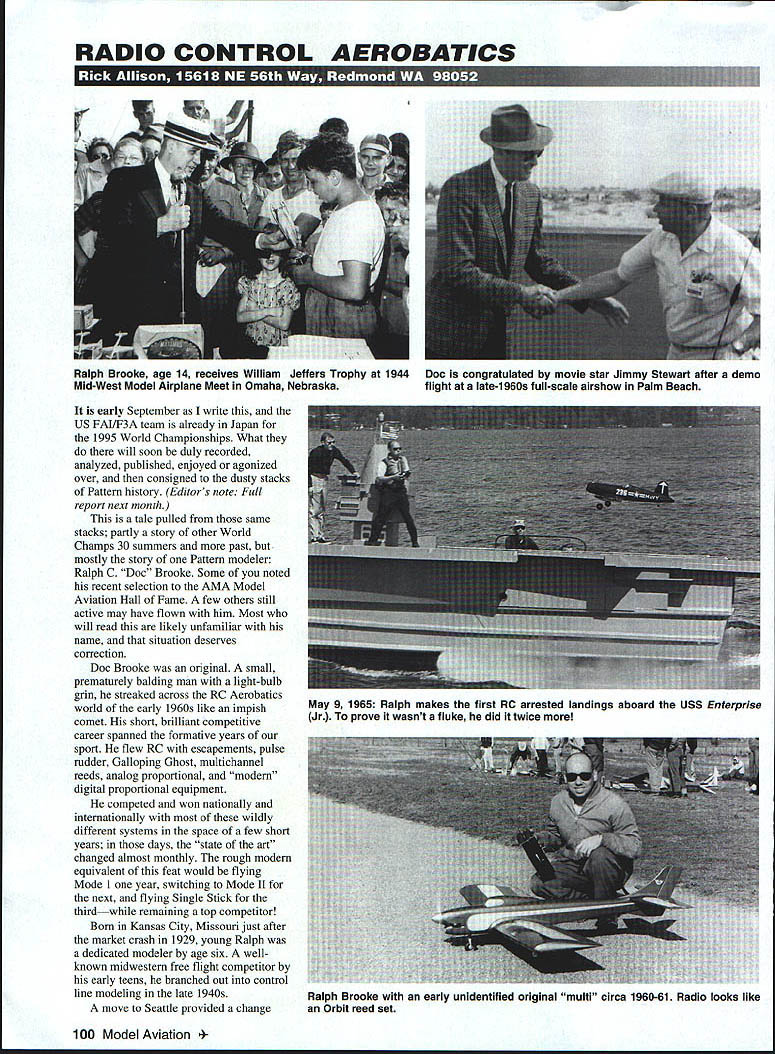
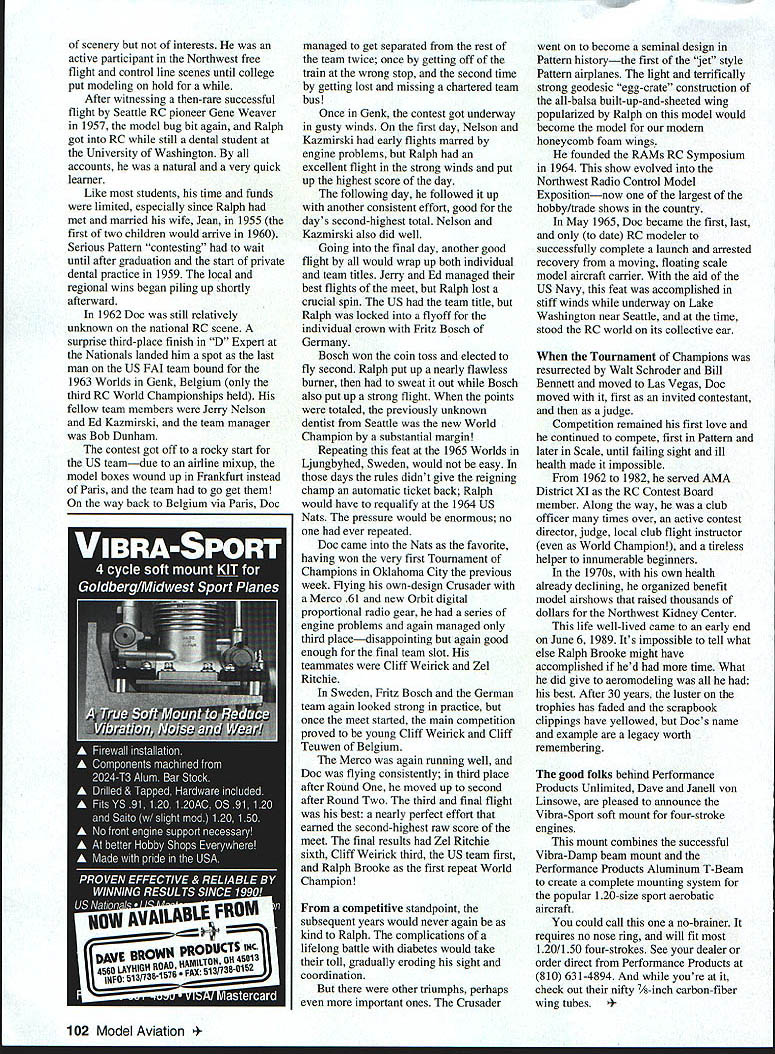
Doc Brooke was an original. A small, prematurely balding man with a light‑bulb grin, he streaked across the RC aerobatics world of the early 1960s like an impish comet. His short, brilliant competitive career spanned the formative years of our sport. He flew RC with escapements, pulse‑rudder Galloping Ghosts, multichannel reeds, analog proportional, and the early digital proportional systems.
He competed and won nationally and internationally with most of these wildly different systems in a few short years; in those days the "state of the art" changed almost monthly. A modern rough equivalent would be switching radio modes and control systems from year to year and remaining a top competitor.
Early life and entry into modeling
Born in Kansas City, Missouri just after the market crash in 1929, Ralph was a dedicated modeler by age six. A well‑known Midwestern free‑flight competitor by his early teens, he branched into control‑line modeling in the late 1940s. A move to Seattle provided new opportunities: he was active in the Northwest free‑flight and control‑line scenes until college put modeling on hold.
After witnessing a then‑rare successful RC flight by Seattle pioneer Gene Weaver in 1957, the model bug bit again. Ralph got into RC while still a dental student at the University of Washington and was a very quick learner. Funds were limited—he met and married Jean in 1955 and their first two children arrived in 1960—so serious Pattern contesting waited until after his graduation and the start of his private dental practice in 1959. Local and regional wins began to pile up shortly afterward.
1963 World Championships — Genk, Belgium
By 1962 Doc, still relatively unknown on the national RC scene, surprised many with a third‑place finish in the Expert Nationals, which landed him the last spot on the US FAI team bound for the 1963 Worlds in Genk, Belgium. Fellow team members were Jerry Nelson, Ed Kazmirski, and team manager Bob Dunham.
The trip got off to a rocky start: the US team's model boxes were routed to Frankfurt instead of Paris due to an airline mixup, and the team had to retrieve them and make their way back to Belgium via Paris. Doc managed to get separated from the rest of the team twice—once getting off the train at the wrong stop, and another time getting lost and missing the chartered team bus.
Once the Genk contest got underway, gusty winds on the first day and engine problems for some competitors tested everyone. Nelson and Kazmirski had early flights marred by engine trouble, while Ralph produced an excellent flight in strong winds and posted the highest score of the day. The following day he followed with another consistent effort that was the day's second‑highest total. Going into the final day, the US team was in contention for the team title and Ralph was in the running for the individual crown.
Ralph lost a crucial spin in one flight, but the US team captured the team title. Ralph was locked into a flyoff for the individual championship with Fritz Bosch of Germany. Bosch won the coin toss and elected to fly second. Ralph put up a nearly flawless flight and then waited while Bosch flew; when the points were tallied, the previously little‑known dentist from Seattle was the new World Champion by a substantial margin.
1965 World Championship — Ljungbyhed, Sweden
Repeating in 1965 would not be easy. The rules did not give the reigning champion an automatic berth; Ralph had to requalify at the 1964 US Nationals. The pressure was enormous—no one had ever repeated.
Doc entered the Nats as favorite, having won the very first Tournament of Champions in Oklahoma City the previous week. Flying his own‑designed Crusader with a Merco .61 engine and new Orbit digital proportional radio gear, he suffered a series of engine problems and managed only third place—disappointing, but good enough for the final team slot. His teammates were Cliff Weirick and Zel Ritchie.
In Sweden, Fritz Bosch and the German team looked strong in practice, but the main competition turned out to be the young Cliff Weirick and Belgium's Cliff Teuwen. The Merco engine ran well and Doc flew consistently: third after Round One, second after Round Two, and then a nearly perfect final flight that earned the second‑highest raw score of the meet. The final standings placed Zel Ritchie sixth, Cliff Weirick third, the US team first, and Ralph Brooke as the first repeat World Champion.
Contributions and legacy
From a competitive standpoint the subsequent years were less kind to Ralph; a lifelong battle with diabetes gradually eroded his sight and coordination. But his contributions to the hobby went far beyond contest results.
- The Crusader became a seminal Pattern design—the first of the "jet"–style Pattern airplanes. Ralph's light, strong geodesic "egg‑crate" construction for the all‑balsa built‑up‑and‑sheeted wing helped popularize techniques that evolved into modern honeycomb foam wings.
- He founded the RAMs RC Symposium in 1964, which evolved into the Northwest Radio Control Model Exposition—now one of the largest hobby/trade shows in the country.
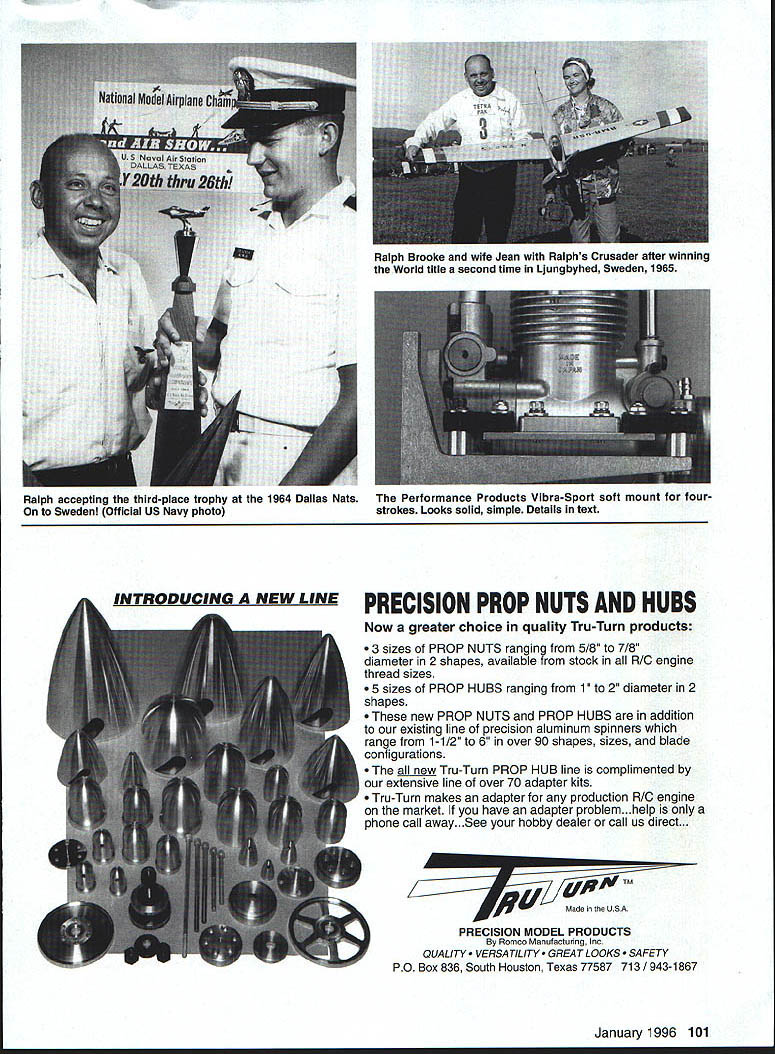
- In May 1965, with the aid of the US Navy, Doc became the first (and to date only) RC modeler to successfully complete a launch and arrested recovery from a moving, floating scale aircraft carrier. The demonstration aboard the USS Enterprise Jr. on Lake Washington was accomplished in stiff winds and made a major splash in the RC world.
- He helped resurrect the Tournament of Champions when Walt Schroder and Bill Bennett moved it to Las Vegas, participating first as a contestant and later as a judge.
Service and later years
From 1962 to 1982, Ralph served AMA District XI as the RC Contest Board member. He was a club officer many times over, an active contest director and judge, a local club instructor (even while he was World Champion), and a tireless helper to innumerable beginners. In the 1970s, as his health declined, he organized benefit model airshows that raised thousands of dollars for the Northwest Kidney Center.
Competition remained his first love and he continued to compete—first in Pattern and later in Scale—until failing sight and ill health made it impossible.
This life well lived came to an early end on June 6, 1989. It's impossible to tell what else Ralph Brooke might have accomplished with more time. What he gave aeromodelling was all he had: his best. After 30 years the luster on the trophies has faded and the scrapbooks and newspaper clippings have yellowed, but Doc's name and example remain a legacy worth remembering.
Transcribed from original scans by AI. Minor OCR errors may remain.

