
RADIO CONTROL AEROBATICS
Rick Allison, 15618 NE 56th Way, Redmond WA 98052
In the course of writing for one publication or another, I've regurgitated 99% of everything I ever learned about Pattern. I've covered building, designing, flying, practicing, trimming, judging, engines, props, visibility, radio installation, and coaching, plus numerous subsets and sub-subsets of these topics. I've just about run out of new stuff.
However, there is one aspect of competitive RC Aerobatics that I've never covered, and to my chagrin, I was recently reminded of it. The really embarrassing thing is that it isn't a minor, easily overlooked item; it's a major spoke in the wheel. It's something all of us do for each other, something we depend on, something we do in practice and something we do at contests. It can win or lose contests for us, yet we treat it as an afterthought and almost never talk about it. It's calling.
There is little doubt that a good caller can aid a pilot, and there is no doubt that a bad caller can literally trash one. So why are we so casual about it? Why is it the last thing I could think of to write about, and why didn't other writers cover the subject more often than they do?
Good questions all, and I really don't have the answers. Guessing, I'd say that a good caller is something every pilot wants, but not something every pilot feels is important to be. This is obviously a very shortsighted attitude, because in this case, what goes around definitely comes around—often on the very next round!
Part of my personal reason for overlooking the subject might be simple unconscious avoidance. This is a difficult subject for me, because I'm renowned as the crown prince of callers. I really have to concentrate to do a decent job.
I am fortunate in that my wife Joan is a world-class caller, as well as being a better-than-decent Pattern pilot in her own right. I admit to some bias in the matter, but not much. My opinion is confirmed by the number of requests she is besieged with at every contest we attend.
What makes her so good isn't difficult to analyze: Her maneuver call comes calmly and distinctly at the exact moment you need it; it's complete but contains no extraneous information requiring thought or response; and she never, ever (well, almost never) makes a mistake.
She has none of the bad tendencies I have to sit on, such as calling late because I was caught up in watching the maneuver, or coaching, or getting excited because my pilot has either a very good or a very bad round going.
From her good and my bad habits, plus a few observations I've made over the years, I have derived some general principles:
- Calmness is good.
- The pilot is excited enough. A person who is already vibrating like a tuning fork doesn't need an extra whack on the tines. The caller should be an anchor, not a flapping sail.
- Timing is very important.
- The "perfect" time to call the next maneuver will vary from pilot to pilot, but will usually fall in the last one-third of the previous maneuver. With the pace of today's turnaround style, waiting until the exit to call is usually far too late.
- Discuss timing and style before the flight.
- The proper time to discuss this with the pilot is before the flight. I prefer to practice with a pilot several times before we tee it up in front of the judges.
- The right data is important.
- Adopt a "just the facts" approach. The call should be short, concise, and unambiguous. You might not have time for "Figure M with 3/4 rolls up and down" but you will have time for "Figure M, 3/4 rolls." Don't leave out essential information, such as "inverted exit" or "full roll up." Your pilot may have flown the sequence 500 times in practice, but will still be perfectly capable of forgetting minor details under pressure.
- Concentration on the task at hand is important.
- Ideally, the caller concentrates as hard as the pilot or a judge. Call the maneuver, then fix the next maneuver firmly in mind. Check it again, then call. Watching the airplane has only one purpose: to allow you to properly time the next call.
The list of don'ts is longer, but just as important. This isn't an attempt to be funny; I've seen everything on the list, and most have been done more than once by different people. And yes, every bad habit I have is on the list:
- Don't coach.
- The time for coaching is long past. Imagine being in the batter's box facing Randy Johnson at his best, and the batting coach is standing right behind telling you to square up your shoulders, spread your stance, stay back on the ball, etc. Some pilots, especially inexperienced ones, may want a little help out there. If they do, they should ask. Even then, keep it to a minimum. Never, never coach a pilot who hasn't asked. This is a huge concentration-breaker.
- Don't criticize.
- You know when you've screwed up, and so do most pilots. After a bad maneuver the pilot needs to forget it and get back on track as quickly as possible. Pointing out the mistake while the man is still trying to fly will only distract him.
- Respect — don't cheerlead.
- In the old days judges and callers used the obnoxious tactic of attempting to influence scores by cheering or otherwise making their opinion known. Your pilot certainly doesn't need to listen to (or respond to) your humble (and perhaps wrong) opinion—at least until after the flight. Confidence is often a fragile thing. Respect it.
- Don't touch the pilot.
- Save the pat on the back for afterwards. I saw a really good Sportsman pilot ruin a great flight and almost crash because his caller slapped him on the back after a near-perfect maneuver. Crowding the pilot comes under this heading as well; it's hard to fly with someone practically helping you wear your clothes. Remember that touching the pilot's transmitter under any circumstances is a zero for the flight.
- Don't lose your cool.
- This is an extension of the calmness dictum, but while calmness is a baseline attitude, this is about poise under pressure. Strange things tend to happen on the line while the judges are watching; don't make them stranger. Your pilot might be involved in a near-miss, a pass through the sun may cause disorientation, or nervousness may result in a maneuver "bailout." Screaming at a pilot who is already confused and very busy usually doesn't help—even if the advice is correct when shouted, it may be wrong by the time the pilot reacts. Help if you can, but stay low-key and matter-of-fact about things. Like coaching, the time for flight instruction has also passed.
Pilots who constantly practice and fly with the same caller definitely have a sizable advantage. It becomes a team relationship out on the line, and one or two words can come to take the place of whole sentences. Picking up a new caller at each contest is exactly like Forrest Gump's box of chocolates. It comes down to a personal decision; some people like comfortable shoes and a warm place to fly, and some like surprises and meeting new people. I'm kind of a solid, traditional, "dinner and a show first" kind of guy, who favors long-term relationships.
New Products
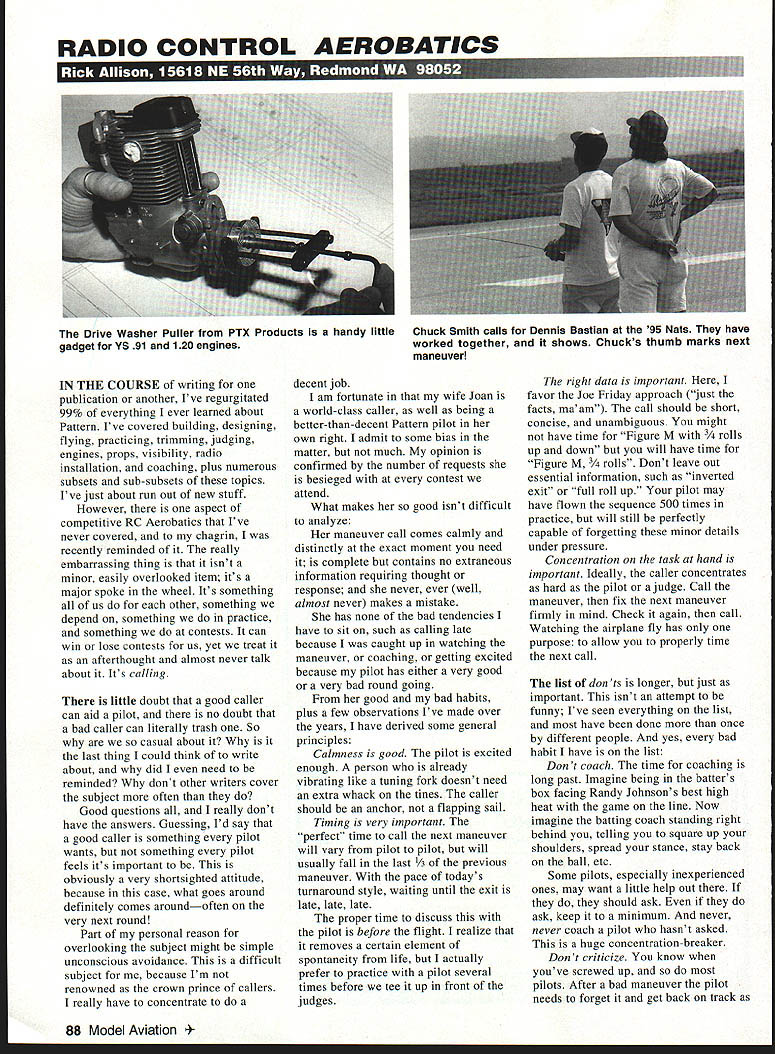
I recently got a look at a neat little gadget manufactured by Canadian Pattern pilot Peter Thanhauser. He calls it the Drive Washer Puller and it is specifically designed for the YS 1.20 and .91 engines, though it looks as if it would work on others as well.
It's available direct from PTX Products, 1190 Ranchview Road, Calgary, Alberta, Canada T3G 1Y2; Tel.: (403) 239-6890; Fax: (403) 547-3246. Or see it at your local hobby store. Price is $21.95 US, plus the usual shipping and handling.
Transcribed from original scans by AI. Minor OCR errors may remain.

