
RADIO CONTROL AEROBATICS
Rick Allison, 15618 NE 56th Way, Redmond WA 98052
Last month I mentioned the ModelNet Forum on CompuServe, and particularly the Pattern/NSRCA section. This month I want to visit a topic that has been drawing some interest there: equipment limitations in Novice-class competition.
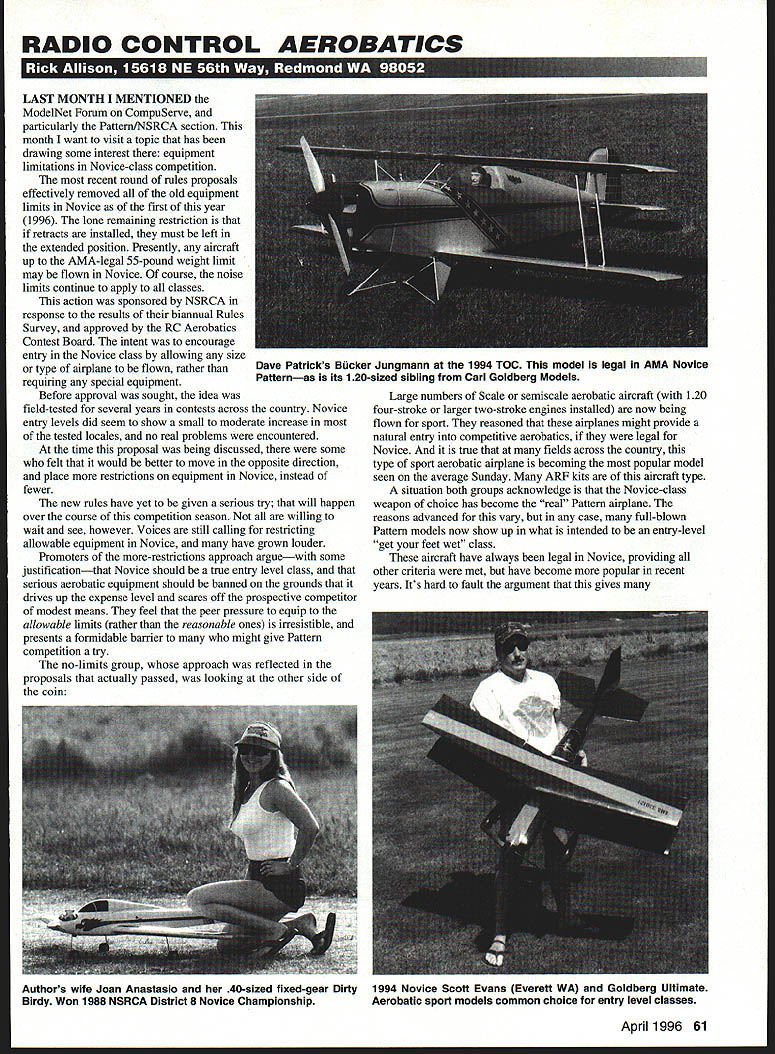
The most recent round of rules proposals effectively removed all of the old equipment limits in Novice as of the first of this year (1996). The lone remaining restriction is that if retracts are installed, they must be left in the extended position. Presently, any aircraft up to the AMA-legal 55-pound weight limit may be flown in Novice. Of course, the noise limits continue to apply to all classes.
This action was sponsored by NSRCA in response to the results of their biannual Rules Survey, and approved by the RC Aerobatics Contest Board. The intent was to encourage entry in the Novice class by allowing any size or type of airplane to be flown, rather than requiring any special equipment.
Before approval was sought, the idea was field-tested for several years in contests across the country. Novice entry levels did seem to show a small to moderate increase in most of the tested locales, and no real problems were encountered.
At the time this proposal was being discussed, some felt that it would be better to move in the opposite direction and place more restrictions on equipment in Novice. Voices calling for restricting allowable equipment in Novice have grown louder.
Promoters of the more-restrictive approach argue — with some justification — that Novice should be a true entry-level class, and that serious aerobatic equipment should be banned on the grounds that it drives up expense and scares off prospective competitors of modest means. They feel that the peer pressure to equip to the allowable limits (rather than reasonable ones) is irresistible, and presents a formidable barrier to many who might give Pattern competition a try.
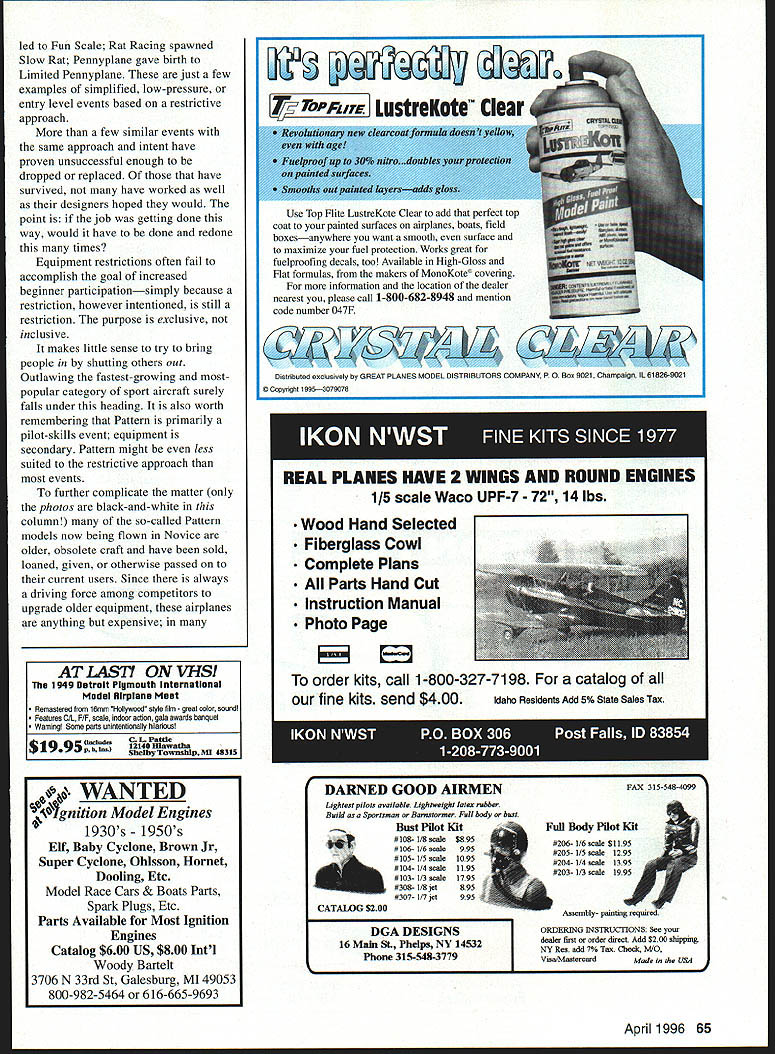
The no-limits group, whose approach was reflected in the proposals that actually passed, looked at the other side of the coin. Large numbers of scale or semi-scale aerobatic aircraft (with .120 four-stroke and larger two-stroke engines installed) are now being flown for sport. They reasoned that these airplanes might provide a natural entry into competitive aerobatics if they were legal for Novice. And it is true that at many fields across the country this type of sport-aerobatic airplane is becoming the most popular model seen on the average Sunday. Many ARF kits are of this aircraft type.
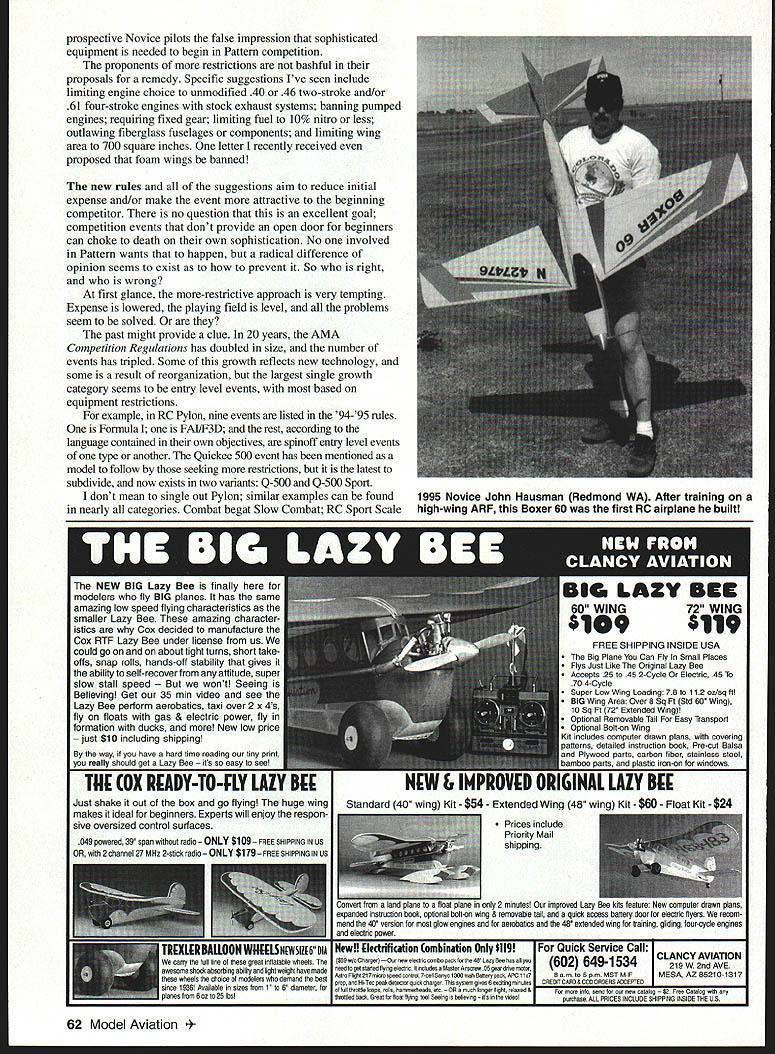
A situation both groups acknowledge is that the Novice-class "weapon of choice" has become the true Pattern airplane. The reasons advanced for this vary, but in any case many full-blown Pattern models now show up in what is intended to be an entry-level "get your feet wet" class. These aircraft have always been legal in Novice, providing all other criteria were met, but have become more popular in recent years. It's hard to fault the argument that this gives many prospective Novice pilots the false impression that sophisticated equipment is needed to begin Pattern competition.
Proponents of the more-restrictive approach have proposed various remedies. Specific suggestions I've seen include:
- Limiting engine choice to unmodified .40–.46 two-stroke and/or .61 four-stroke engines with stock exhaust systems
- Banning pumped engines
- Requiring fixed gear
- Limiting fuel to 10% nitro or less
- Outlawing fiberglass fuselages or components
- Limiting wing area to 700 square inches
- Banning foam wings (a recent letter even proposed this)
These new-rule suggestions aim to reduce initial expense and/or make the event attractive to the beginning competitor. There is no question that this is an excellent goal: competition events that don't provide an open door for beginners can choke to death on their own sophistication. No one involved in Pattern wants that to happen. The radical difference of opinion seems to be how best to prevent it.
At first glance the more-restrictive approach is very tempting. Lower expense and a level playing field seem to solve the problem. The past might provide a clue, however. Over the past 20 years, AMA Competition Regulations have doubled and the number of events has tripled. Some growth reflects new technology; some is the result of reorganization. The largest single growth category seems to be entry-level events based on equipment restrictions. Examples include RC Pylon, Formula F, FAI, F3D, and other spin-off entry-level events. The Quickee 500 event has been mentioned as a model to follow by those seeking more restrictions, but it is the latest to subdivide and now exists in two variants: Q-500 and Q-500 Sport. Similar subdivisions have occurred in Combat, Slow Combat, RC Sport, Scale, and semi-scale events.
More than a few similar entry-level events have proven unsuccessful enough to be dropped or replaced. Of those that have survived, not many have worked as well as their designers hoped. The point is: if the job was getting done this way, would it have to be done and redone this many times?
Equipment restrictions often fail to accomplish the goal of increased beginner participation — simply because a restriction, however well intentioned, is still a restriction. The purpose is exclusive, not inclusive. It makes little sense to try to bring people in by shutting others out. Outlawing the fastest-growing and most-popular category of sport aircraft would surely fall under this heading.
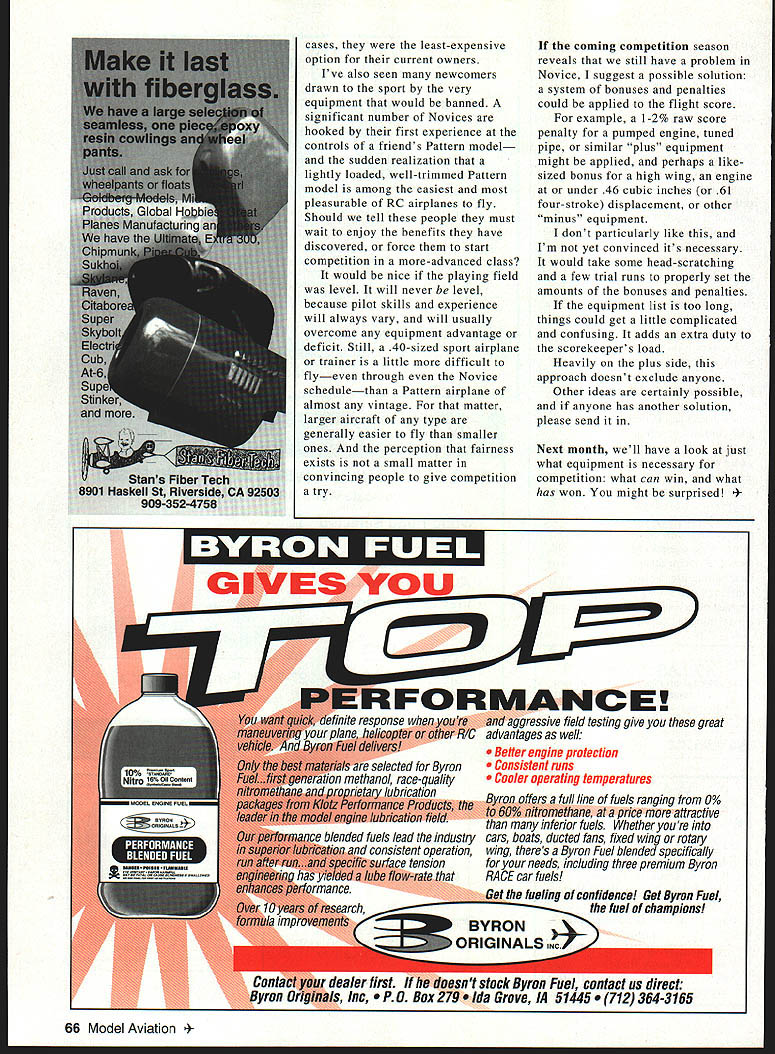
It is also worth remembering that Pattern is primarily a pilot-skills event; equipment is secondary. Pattern might be less suited to the restrictive approach than most events. Many of the so-called Pattern models now being flown in Novice are older, obsolete craft that have been sold, loaned, given, or otherwise passed on to their current users. These airplanes are anything but expensive; in many cases they are very inexpensive. Most of us are loath to see that kind of movement discouraged.
I've also seen many newcomers drawn to the sport by the very equipment that would be banned. A significant number of Novices are hooked by their first experience at the controls of a friend's Pattern model — and the sudden realization that a lightly loaded, well-trimmed Pattern model is among the easiest and most pleasurable of RC airplanes to fly. Should we tell these people they must wait to enjoy the benefits they have discovered, or force them to start competition in a more-advanced class?
It would be nice if the playing field were level. It will never be level, because pilot skills and experience will always vary and will usually overcome any equipment advantage or deficit. Still, a .40-sized sport airplane or trainer is a little more difficult to fly — even through the Novice schedule — than a Pattern airplane of almost any vintage. For that matter, larger aircraft of any type are generally easier to fly than smaller ones. And the perception that fairness exists is not a small matter in convincing people to give competition a try.
If the coming competition season reveals that we still have a problem in Novice, I suggest a possible solution: a system of bonuses and penalties could be applied to the flight score. Heavily on the plus side, this approach doesn't exclude anyone. It would take some head-scratching and a few trial runs to properly set the amounts of the bonuses and penalties. If the equipment list is too long, things could get a little complicated and confusing and it would add an extra duty to the scorekeeper's load.
Possible examples to consider:
- Apply a 1–2% raw score penalty for a pumped engine, tuned pipe, or similar "plus" equipment
- Apply a 1–2% raw score bonus for a high wing, an engine at or under .46 cubic inches (or .61 four-stroke), or other "minus" equipment
I don't particularly like this idea yet, and I'm not convinced it's necessary. Other ideas are certainly possible, and if anyone has another solution, please send it in.
Next month we'll have a look at just what equipment is necessary for competition: what can win, and what has won. You might be surprised!
Transcribed from original scans by AI. Minor OCR errors may remain.

