
RADIO CONTROL AEROBATICS
Rick Allison, 15618 NE 56th Way, Redmond WA 98052
What is a Pattern airplane?
What is a Pattern airplane? A simple question, but the way we answer it defines our event to ourselves and all who might join us.
The simple answer is that a Pattern airplane is any airplane a competitor chooses to fly in Pattern-style aerobatic competition. That answer, however, seems to beg the question. Somewhere there ought to be a definitive description—maybe on an old stone tablet at AMA Headquarters, gathering dust in a museum crate.
The AMA Competition Regulations aren't much help. The rules provide weight limits and restrictions on size, but only one rule—an ancient safety prohibition against "knife-edge wings"—defines shape.
Still, show a photo of a Finesse, Dr. Jekyll, or Python (three current designs that most competitors would agree have very different shapes) to the average Sunday flier, and all will instantly be identified as Pattern models. Ask further, and you will likely be told that "all Pattern models look alike." They may not look alike to you, but they do to Joe Sunday, the sport flier.
Like commercial jetliners, our craft have come to have a certain family resemblance. To most people, a Pattern model is composed of various identifiable elements, such as:
- wing leading-edge sweep
- little or no dihedral
- a symmetrical airfoil
- a forward canopy
- a tapered planform
- a long tail moment
- retractable landing gear
- a fully cowled engine, usually mounted inverted
Any airplane with most of those features is apt to be called a Pattern airplane by old Joe Sunday—whether or not the model is aerobatically capable.
How the Pattern look developed
How much of this sameness is necessary, and how much is simply to say "Pattern airplane" to the world? Each of these elements arrived on the scene with a purpose; each was a designer's response to the rules and needs of the day. Over the years, with modifications, these features have been copied from design to design. Some remain aerodynamically useful, while others hang on like a fiberglass vermiform appendix.
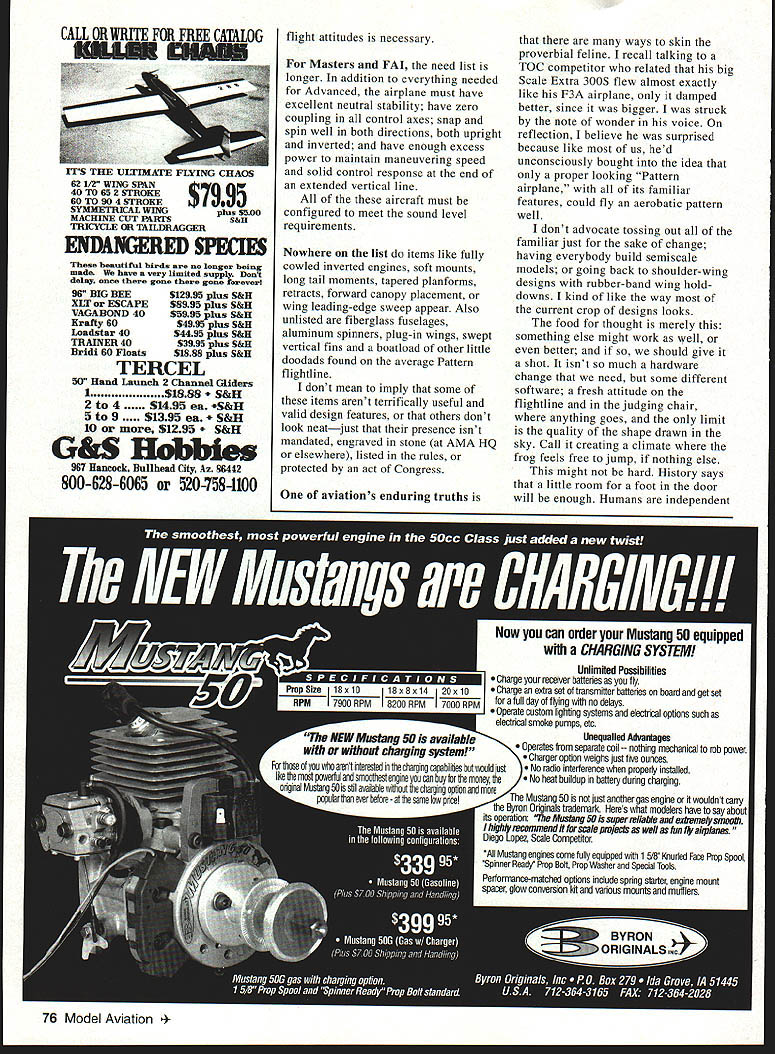
Conformity can be a powerful force. A little can unify a group and provide a feeling of fraternity; too much can stifle new thought and curb free expression. Over the last three decades, we've largely agreed on a common ideal of what a Pattern airplane should look like—and most of them do. But how healthy is that? What is it doing to the event?
This year brought a major shakeup in the rules to grant designers and builders more freedom to experiment. It might be time for a visual check on the true condition of the Emperor's flying clothes.
What do we actually need in a Pattern airplane?
What a Pattern airplane actually needs depends on which set of rules you're talking about—specifically, which class: Novice, Sportsman, Advanced, Masters, or FAI. Airframe capability needed increases with each step up the ladder. The following lists aren't definitive; they are personal opinion.
Novice
Novice-class competitors need an airplane that:
- is predominantly neutrally stable in pitch and roll
- grooves well in level, upright flight
- is capable of a fair axial roll
- tracks well through a series of loops
- has adequate power to perform loops and stall-turns
- stalls and stall-turns reasonably well without significant yaw/roll coupling
Sportsman
Sportsman fliers need everything for Novice, plus:
- good inverted tracking
- capability for multiple axial rolls
- enough additional power to perform a square loop from level flight
Advanced
Advanced competitors need an airplane that:
- has good neutral stability in pitch and roll both upright and inverted
- exhibits little or no pitch, roll, or yaw coupling
- is capable of extended knife-edge flight
- snaps and spins well from upright flight
- has enough excess power to draw an extended vertical up line while rolling
- shows no pitching on up or down vertical lines regardless of airspeed or power on/off
- tracks well "hands off" in the vertical flight mode
- has a fuel system that maintains adequate fuel draw in all necessary flight attitudes
Masters and FAI
For Masters and FAI, the list is longer. In addition to everything needed for Advanced, the airplane must:
- have excellent neutral stability
- have zero coupling in all control axes
- snap and spin well in both directions, upright and inverted
- have sufficient excess power to maintain maneuvering speed and solid control response at the end of an extended vertical line
- be configured to meet sound level requirements
Common features that are not required
Nowhere on the lists above do items like the following appear as absolute requirements:
- fully cowled inverted engines
- soft engine mounts
- long tail moments
- tapered planforms
- retractable landing gear
- forward canopy placement
- wing leading-edge sweep
- fiberglass fuselages, aluminum spinners, plug-in wings, swept vertical fins, and many other little doodads
Some of these items are terrifically useful and valid design features, and some look neat—just their presence isn't mandated by the rules.
Diversity and history
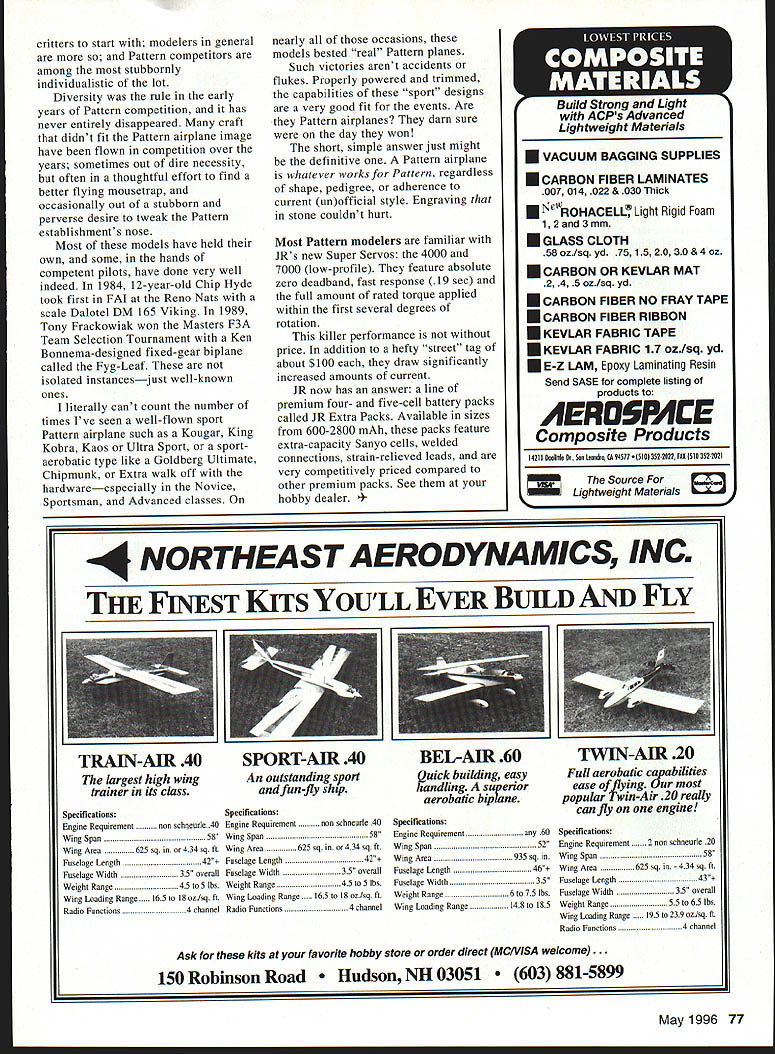
One of aviation's enduring truths is that there are many ways to skin the proverbial feline. Diversity was the rule in the early years of Pattern competition, and it has never entirely disappeared. Many craft that didn't fit the Pattern image have been flown in competition—sometimes out of necessity, often in an effort to find a better flying mousetrap, and occasionally to tweak the Pattern establishment's nose.
Most of these models have held their own, and some, in the hands of competent pilots, have done very well. Examples:
- In 1984, 12‑year‑old Chip Hyde took first in FAI at the Reno Nats with a scale Dalotel DM 165 Viking.
- In 1989, Tony Frackowiak won the Masters F3A Team Selection Tournament with a Ken Bonhoma–designed fixed-gear airplane called the Fyg-Leaf.
I can't count the number of times a well-flown sport Pattern airplane—such as a Kougar, King Kobra, Kaos, Ultra Sport, Goldberg Ultimate, Chipmunk, or Extra—has walked off with the hardware, especially in the Novice, Sportsman, and Advanced classes. Properly powered and trimmed, the capabilities of these "sport" designs are often a very good fit for the events. Are they Pattern airplanes? They darn sure were on the day they won.
Attitude and judging
I don't advocate tossing out all the familiar just for change's sake or forcing everyone into semiscale builds. I like the way many current designs look. The food for thought is this: some different designs might work as well or even better, and if so, we should give them a shot.
It's not so much a hardware change as a change in the judging "chair software": judges need to be willing to accept different airplanes if they fly the same and judge them on the quality of the shape drawn in the sky, whether the plane is modern or oddball. Create a climate where the frog feels free to jump.
History says a little room will be enough. Humans are independent critters; modelers are more so; Pattern competitors are among the most stubbornly individualistic of the lot.
The short, simple, possibly definitive answer: a Pattern airplane is whatever works for Pattern, regardless of shape, pedigree, or adherence to current (un)official style. Engraving that in stone couldn't hurt.
Equipment note
Most Pattern modelers are familiar with JR's new Super Servos: the 4000 and the low-profile 7000. Features include:
- absolute zero deadband
- fast response (~0.19 sec)
- full rated torque applied within the first several degrees of rotation
This performance comes at a price: a street tag of about $100 each and significantly increased current draw.
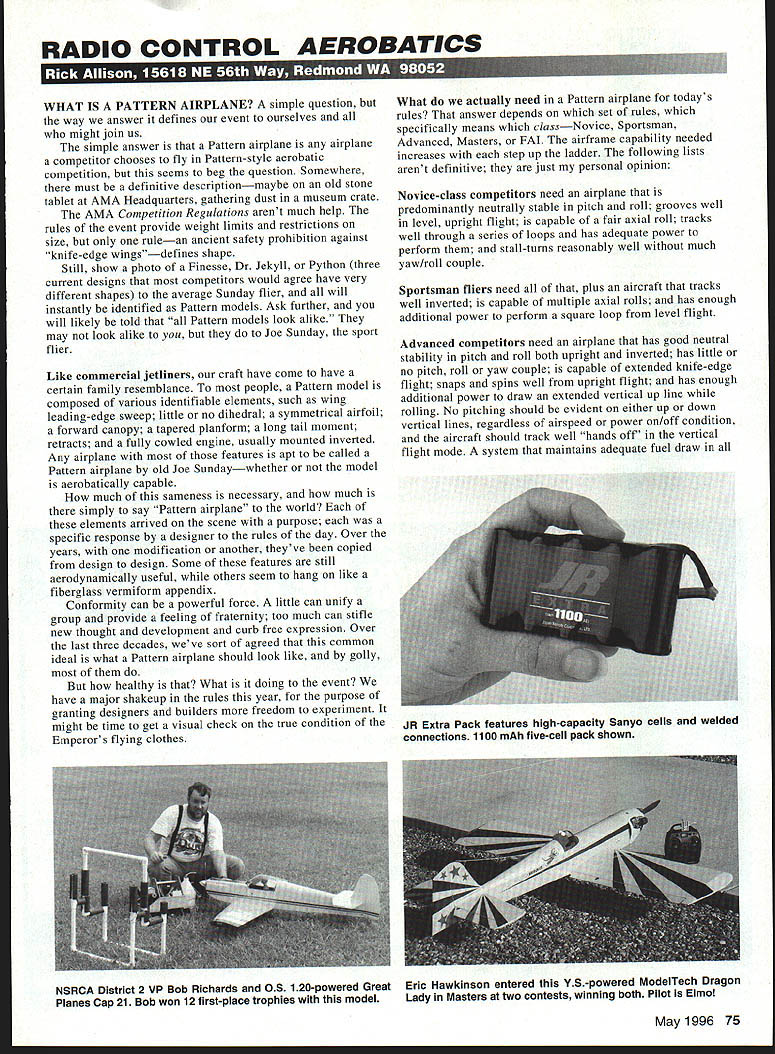
JR offers a response: a line of premium four- and five-cell battery packs called JR Extra Packs. Available sizes: 600–2800 mAh. Features include:
- extra-capacity Sanyo cells
- welded connections
- strain-relieved leads
- competitive pricing compared to other premium packs
See them at your hobby dealer.
Transcribed from original scans by AI. Minor OCR errors may remain.

