
RADIO CONTROL AEROBATICS
Rick Allison
15618 NE 56th Way, Redmond WA 98052
This month we have the Newcomers in Modeling issue, and for this column that means content aimed at newcomers to the entry-level RC Aerobatics events: Novice Pattern and Basic Sport Aerobatics.
For me, it's the third in a column trifecta aimed at the entry end of the aerobatic continuum; the April and May issues dealt with Novice rules and our cast-iron notions of what a Pattern airplane is and isn't.
Now we get to the heart of the matter: just what is necessary to give RC Aerobatics a try? Even more important: why bother?
Why bother?
Formal aerobatic competition is the best, fastest, and most structured way that exists to learn to fly an RC aircraft properly.
Nothing else demands the discipline and practice, forces the study, or polishes and tempers raw piloting talent in quite the same way. By "fly an RC aircraft properly" I mean being able to maintain orientation and total control of the aircraft regardless of flight attitude, speed, or altitude; being able to place the aircraft confidently and precisely where you want it; and being able to use and coordinate every control function at your command in the process.
Can every aerobatics competitor do that? Of course not. Few pilots ever attain that consummate level of skill. The essential difference is that almost all aerobatics competitors keep striving to reach the top of the mountain, while most sports pilots are content to stop about halfway up for an extended lunch break.
I don't mean to denigrate those who are happy and content with a sandwich and a beer. All of us make decisions about what we put into and take out of this hobby/sport, and those decisions are personal and deserve to be respected. Becoming a serious RC aerobat will not guarantee personal happiness, make you rich, or clear up a skin condition. On the other hand, being a carefree Sunday sport pilot won't necessarily accomplish those things either. A choice exists where the trail forks off to the picnic area. I prefer to keep climbing, because I suspect that they are serving prime rib and a fine old Bordeaux for dinner up there on the hill.
Even if you decide at some point that your true interests lie in another competitive arena such as Racing or Scale, time spent in the Aerobatics classroom will be a net plus. Pilot decisions come at a furious rate in the pressure-cooker atmosphere of a Pylon race. Half of the points in an RC scale meet come from the flight score, and a model heavily loaded with scale detail can be a handful to fly smoothly at the "scalelike" speeds needed to score well.
Aerobatics pilots who try their hands at these and other disciplines have historically done very well on the new turf, for good reason: good piloting skills are never a handicap.
The skill progression through the Pattern classes can be looked at as an RC University of the Air. Enter as a freshman in Novice Pattern; graduate from Masters; and do postgraduate work in FAI F3A. Along the way, if you stick with it, you will learn to fly an RC airplane very well. Getting to the banquet on top isn't guaranteed, but you will get high enough to catch a pretty good view of the picnickers and the valley below.
Sport Aerobatics works in a similar fashion but not quite as efficiently; it has fewer classes and larger, more frequent jumps and schedule changes.
Getting started — what you need
What do you need to register for class and get started? The most important piece of equipment to own, as Dorothy's cowardly lion pal found, is a heart. Without the grit to walk up to the registration table and enter that first contest, nothing will happen, and no learning takes place. Simple embarrassment has kept more people from getting started in competition than any other single obstacle.
People are always asking about what equipment to buy, because they don't want to appear foolish by bringing the "wrong" stuff to a place where everybody looks like they know what they're doing. The truth is, there is very little "wrong" stuff.
- Courage: the grit to enter your first contest.
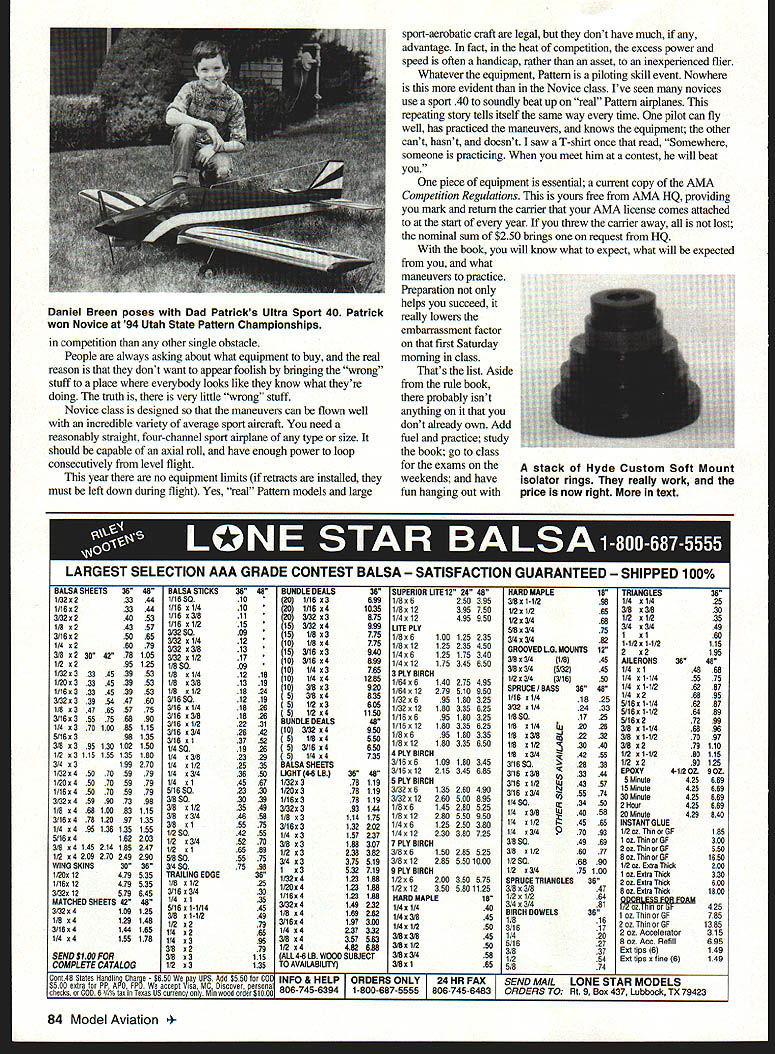
- Aircraft: a reasonably straight, four-channel sport airplane of any type or size. It should be capable of an axial roll and have enough power to loop consecutively from level flight.
- Rulebook: a current copy of the AMA Competition Regulations. This is free from AMA HQ if you mark and return the carrier your AMA license comes attached to each year; otherwise, a copy can be requested from HQ for a nominal $2.50.
- Preparation: fuel and practice; study the book; go to class and take the exams on the weekends; and enjoy hanging out with the other pilots.
Notes:
- This year there are no equipment limits (if retracts are installed, they must be left down during flight).
- "Real" Pattern models and large sport-aerobatic craft are legal, but they don't have much, if any, advantage. In the heat of competition, excess power and speed are often a handicap for an inexperienced flier.
- Pattern is a piloting-skill event. Novice class maneuvers can be flown well with an incredible variety of average sport aircraft. Skill, practice, and knowing your equipment are what make the difference.
I've seen many novices use a sport .40 to soundly beat up on "real" Pattern airplanes. One pilot can fly well, has practiced the maneuvers, and knows the equipment; the other can't, hasn't, and doesn't. I once saw a T-shirt that read, "Somewhere, someone is practicing. When you meet him at a contest, he will beat you."
Aeroguidance Society Annual Pattern Contest
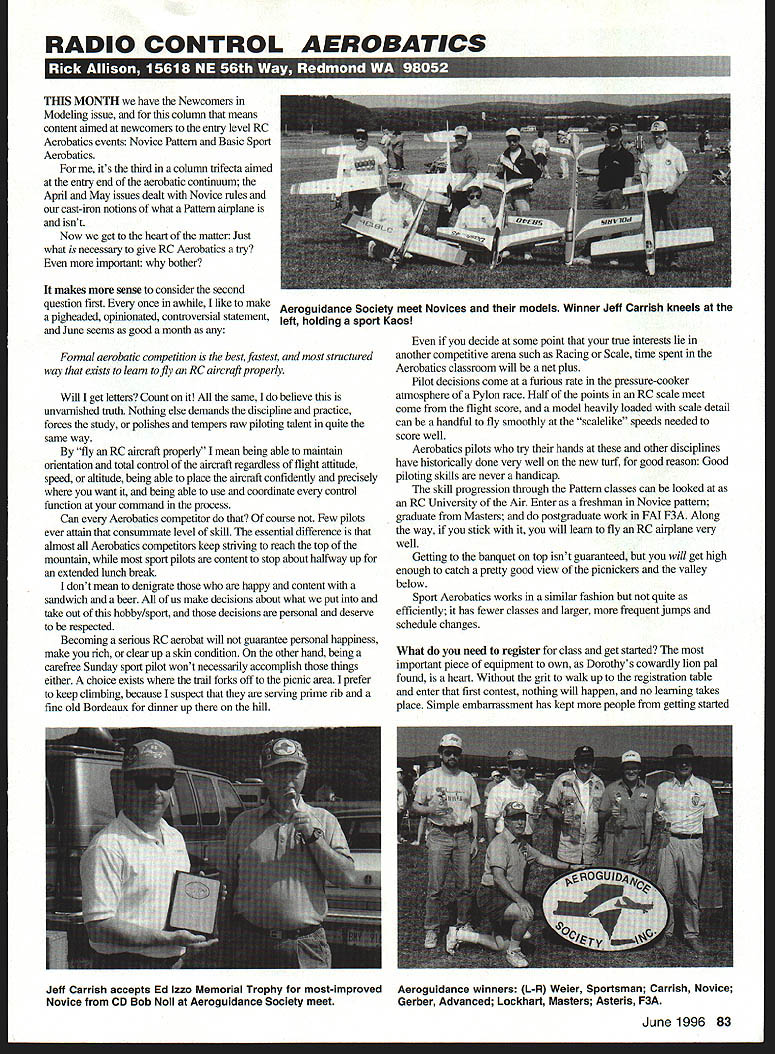
One meet that does an exceptional job of making newcomers feel welcome is the Aeroguidance Society Annual Pattern Contest, held in Sayre, Pennsylvania. This is one of the largest (if not the largest) club contests held each year. Attendance consistently tops the 60-competitor mark; in June 1995, 68 contestants made official flights. That was the 40th annual meet, making it one of the oldest Pattern contests in the country.
Sixty-eight contestants means they're doing something right. The Aeroguidance Society, Inc. boasts a mere 70 members, of whom two are Pattern fliers. Forty-five helped at last year's meet—an incredible 65% of the roster. A judging school is held each year. The contests start promptly and run efficiently.
Most impressive is their progressive attitude toward Novice pilots. Last year, each of their seven Novices was teamed with an experienced FAI or Masters competitor who assisted with advice, coaching, and calling if needed. The Ed Izzo Memorial Trophy was awarded to the Novice whose flight scores improved the most from Saturday to Sunday. This is innovative, above and beyond the call, and deserves mention. Contest directors who want to make Pattern grow, take note!
Product news: Merle Hyde Custom Soft Mounts
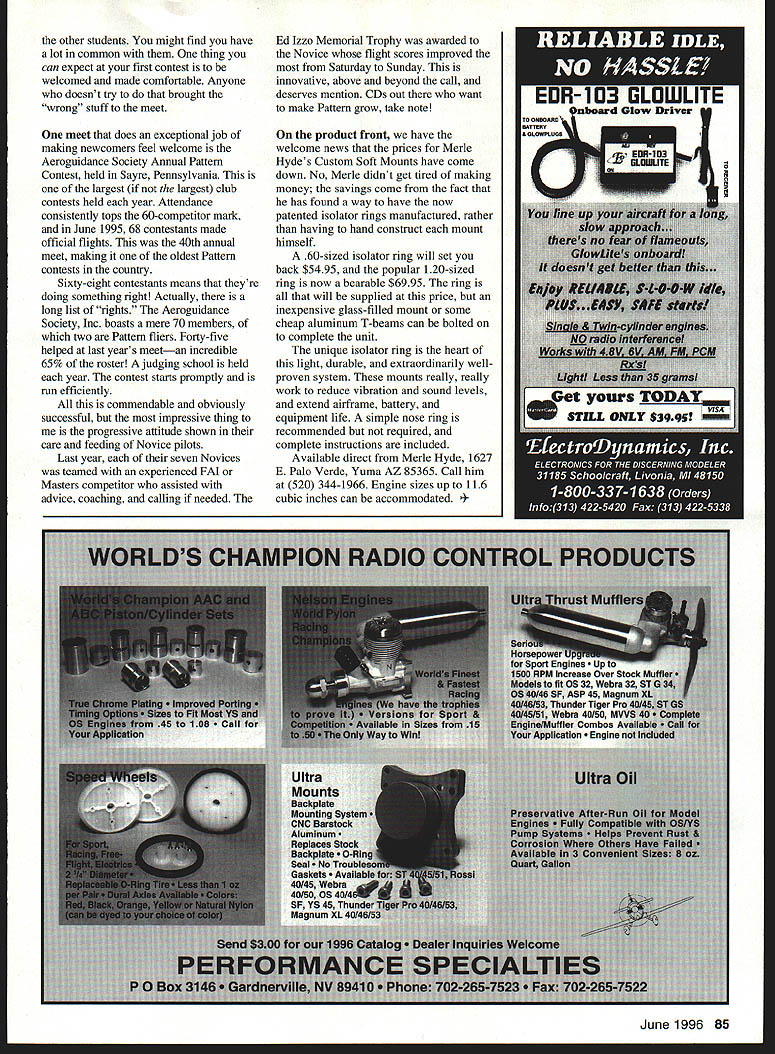
Merle Hyde's Custom Soft Mounts have become more affordable. The savings come from having the now-patented isolator rings manufactured rather than hand-constructing each mount.
- .60-sized isolator ring: $54.95
- 1.20-sized isolator ring: $69.95
- The ring is supplied at these prices; an inexpensive glass-filled mount or some cheap aluminum I-beams can be bolted on to complete the unit.
- The unique isolator ring is the heart of this light, durable, and well-proven system. These mounts significantly reduce vibration and sound levels, and extend airframe, battery, and equipment life. A simple nose ring is recommended but not required, and complete instructions are included.
- Engine sizes up to 11.6 cubic inches can be accommodated.
Available direct from Merle Hyde, 1627 E. Palo Verde, Yuma AZ 85365. Call (520) 344-1966.
Transcribed from original scans by AI. Minor OCR errors may remain.

