
RADIO CONTROL AEROBATICS
Rick Allison
15618 NE 56th Way, Redmond WA 98052
A recent visitor to my basement shop surveyed the various projects underway and remarked, "this sort of building is becoming a lost art." My immediate reaction was protest, but the comment made me pause. Now, after some rumination and research, my thoughts on the subject are mixed.
I'm sure that the average Pattern model is as well-built as ever, but I'm not so sure that the building arts are as alive and well as they once were in Patternland. To cap this ambiguity with ambivalence, I'm not even certain how I feel about that.
A glance at the advertising in any current model magazine shows that we live in the age of the RC Almost Ready To Fly model. More beginning RC pilots now buy ARFs than build traditional kits. A lesser-known fact is that the ARF sport and scale aerobatic models sell about as well as the trainers — and to a far-more-accomplished group of pilots.
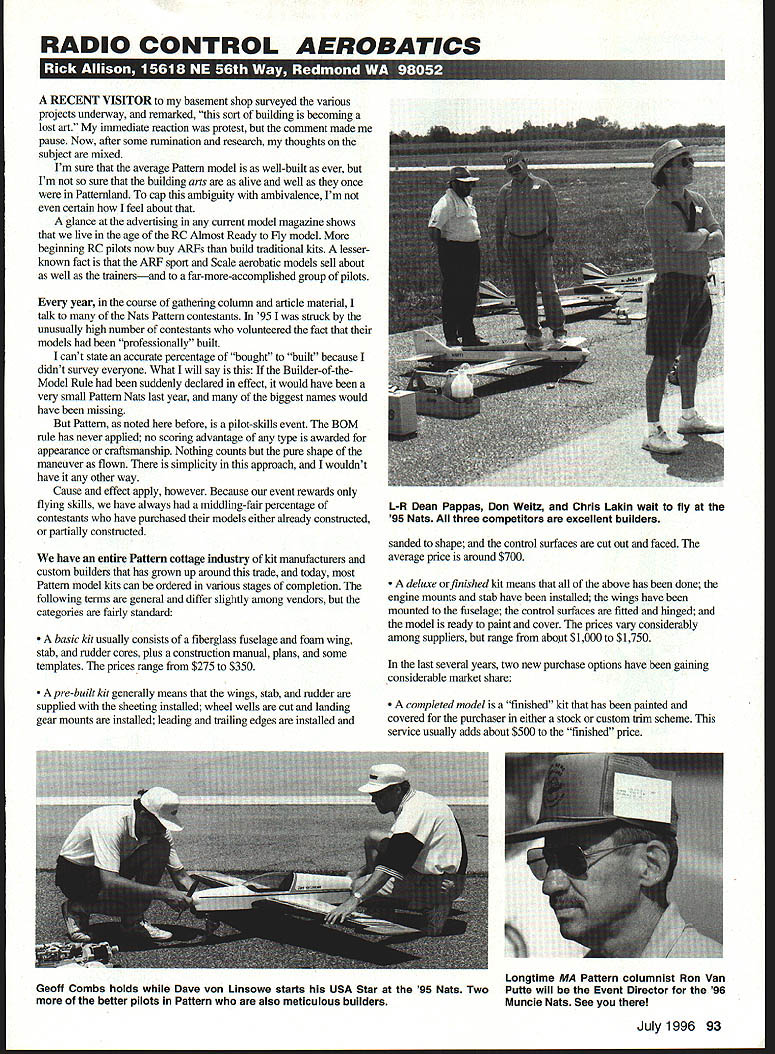
Every year, in the course of gathering column and article material, I talk to many of the Nats Pattern contestants. In '95 I was struck by the unusually high number of contestants who volunteered the fact that their models had been "professionally" built.
I can't state an accurate percentage of "bought" to "built" because I didn't survey everyone. What I will say is this: If the Builder-of-the-Model rule had been suddenly declared in effect, it would have been a very small Pattern Nats last year, and many of the biggest names would have been missing.
But Pattern, as noted here before, is a pilot-skills event. The BOM rule has never applied; no scoring advantage of any type is awarded for appearance or craftsmanship. Nothing counts but the pure shape of the maneuver as flown. There is simplicity in this approach, and I wouldn't have it any other way.
Cause and effect apply, however. Because our event rewards only flying skills, we have always had a middling-fair percentage of contestants who have purchased their models either already constructed or partially constructed.
We have an entire Pattern cottage industry of kit manufacturers and custom builders that has grown up around this trade, and today, most Pattern model kits can be ordered in various stages of completion. The following terms are general and differ slightly among vendors, but the categories are fairly standard:
Kits and completion levels
- A basic kit usually consists of a fiberglass fuselage and foam wing, stab, and rudder cores, plus a construction manual, plans, and some templates. Prices range from $275 to $350.
- A pre-built kit generally means that the wings, stab, and rudder are supplied with the sheeting installed; wheel wells are cut and landing gear mounts are installed; leading and trailing edges are installed and sanded to shape; and the control surfaces are cut out and faced. The average price is around $700.
- A deluxe or finished kit means that all of the above has been done; the engine mounts and stab have been installed; the wings have been mounted to the fuselage; the control surfaces are fitted and hinged; and the model is ready to paint and cover. Prices vary considerably among suppliers, but range from about $1,000 to $1,750.
New purchase options
In the last several years, two new purchase options have been gaining considerable market share:
- A completed model is a "finished" kit that has been painted and covered for the purchaser in either a stock or custom trim scheme. This service usually adds about $500 to the "finished" price.
- At the top-of-the-line, a turn-key model comes complete — engine and radio installed, ready to charge NiCd batteries and fly. Depending on whether the customer or builder supplies the engine, retracts, and radio, price varies between approximately $2,000 and $5,000; an extensive menu is available.
For the Pattern purchaser, the building question becomes the degree to which the model was built by someone else: wing and stab sheeting done, engine installed, it's finished, covered, painted, radio installed — there really isn't a pat answer. Some people have bought covered and punted — didn't build anything — others have had a hole put in the bank account. None of the above is really more worrisome than years past.
The cost of convenience
What does concern me a little is the attitude change: buying a model rather than building becoming fashionable, used as a point of pride by some competitors who roll their own or buy a finished model. The decision is often forced by time, circumstances or attrition, or at least that is what I am told. Times surely must change; they must change in the '90s. Leisure hours are shrinking and an increasing number of activities compete for our attention. Choosing where to spend limited hobby time each month can be a tough call. A growing number of persons find their precious time worth money, and the rapidly increasing popularity of completed turn-key models means ARF culture has definitely come to Pattern.
I'm in favor of the idea in principle, and also subscribe to the notion of balance. To gain time, a price is paid. If we choose to gain time, we also lose the experience of creation, the pride of workmanship, and the sense of accomplishment that used to be part of our hobby. The ARF model we compete with becomes less of a valued partner and more of a disposable tool. The model no longer represents a personal investment of time, but merely money, which (regardless of platitude) is not the same thing.
To pay or not to pay this price of the modeling spirit is a question properly listed under "personal choice." To pay the sometimes-stiff financial penalty involved is more a matter to be settled between pilot and family accountant!
The most troubling aspect of the situation to me is that many of the beginning Pattern pilots I meet don't have any choice at all — they can't build. Choosing not to use the building skills you have is one thing, but choosing to never develop those skills is another.
The advent of the ARF model has brought many into the hobby who have never built a traditional model. They have trained on an ARF, graduated to a low-wing sport ARF, and are now parked on the Pattern doorstep, looking for an ARF to compete with. The idea of building a kit either doesn't occur to them, or is distasteful. Most have no sense of the high and continuing price they are signing up to pay.
A Pattern competitor who can't build is at a serious disadvantage. Without basic building skills, it's impossible to accurately evaluate the quality or condition of a model offered for sale. If you can't build a model, you can't repair one. Most important, instead of getting what you want, you will have to settle for what you can get.
I've said this before, but here it comes again. The Law of the Balsa Jungle is: Those who can't build will always be at the mercy of those who can.
Learn to build. It's cheaper, it's more fun than TV, and it's lots more interactive than the best computer game. It takes a little time, but someone once said that God doesn't deduct the hours you spend building models from your allotted span. As a bonus, you get to trim out the building errors you committed, instead of the building errors someone else committed and sold to you. I'm not sure of the exact physiological mechanism involved, but this is much easier on your blood pressure.
Finding quality ready-built Pattern models
Now that I've gotten all that off my chest, I'll tell you how to find that quality ready-built Pattern model.
The single best source for all Pattern-related advertising, kits, custom builders, and used models is the K-Factor, the newsletter of the National Society of Radio Controlled Aerobatics (NSRCA). Membership is a must for any aspiring Pattern competitor; the monthly newsletter is a mini-magazine full of building and trimming advice. Dues are $30 a year, and you send them to NSRCA Secretary/Treasurer Maureen Dunphy at:
NSRCA 215 Industrial Blvd. Tullahoma, TN 37388 Tel.: (615) 455-0735 Fax: (615) 455-0677
Many of the options that kit manufacturers offer are in the ads. If you can't find what you want, the next step is to order a basic kit of your choice and contact a custom builder (not necessarily in that order). There are quite a few custom builders scattered across the country, but two with impeccable national reputations and iron-clad references are Sam Turner and Bob Noll.
- Sam Turner operates from 2716 Shadelcrest Rd., Land O' Lakes, FL 34639 and can be contacted at (813) 996-6421 (available until midnight Eastern Time every day).
- Bob Noll does business under the name "Pro Built" and can be reached at 2317 Macon Drive, Vestal, NY 13850; Tel.: (607) 754-5279. Contact these gentlemen directly for prices and details.
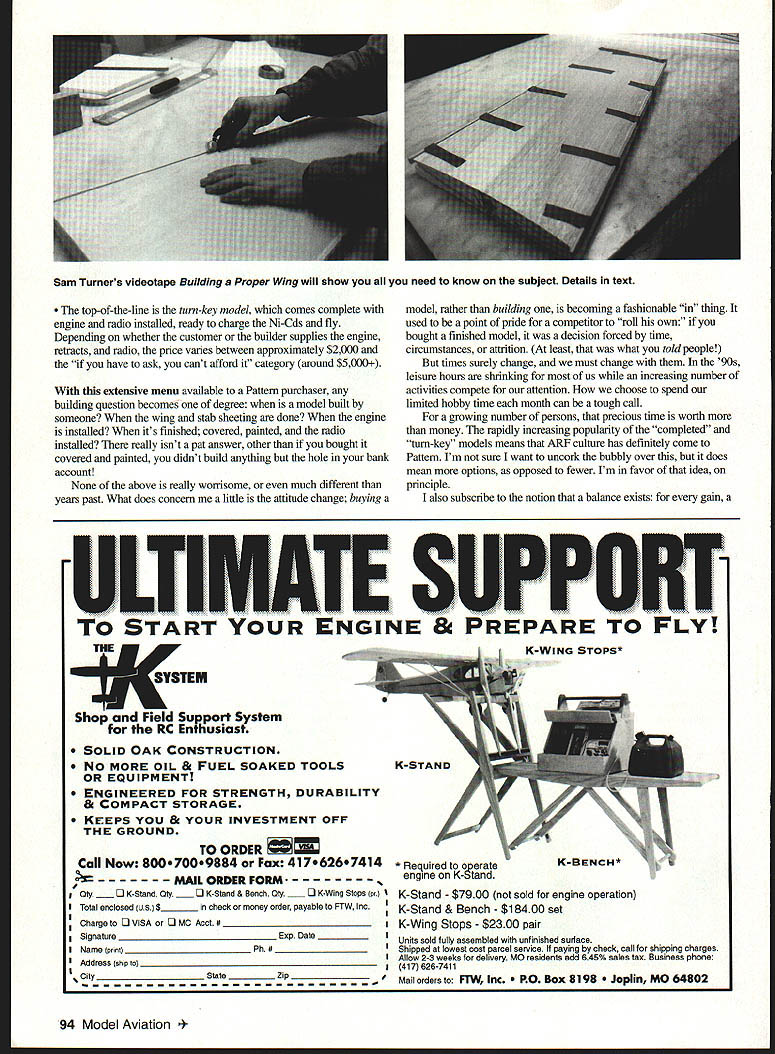
For those of you who believe that the complete Pattern experience still means building the model as well as flying it, Sam Turner also offers a set of videotapes called Building a Proper Wing which will walk you through a complete job of modern Pattern wing assembly. The production values are of the "homespun" variety, but the information is comprehensive and complete, and the methods shown will produce a straight, light wing. The price of the four-hour set is $59.95.
And now, if you'll excuse me, I think I'll go downstairs and build a model airplane.
Transcribed from original scans by AI. Minor OCR errors may remain.

