
RADIO CONTROL AEROBATICS
Rick Allison, 15618 NE 56th Way, Redmond WA 98052
Practice Principles
Practice improves performance. This simple dictum has been an article of faith with competitors through the ages. Before the ancient Olympics, young Greeks strove to perfect their athletic skills in gymnasia erected solely for that purpose. The word gymnasium, the facility so named, and the belief in the practice habit have been passed down to us. The modern version of the Olympics is still with us, and so is the need for practice.
Unfortunately, most of the Pattern "practicing" I see being done is more beneficial to fuel manufacturers than pilots. The typical traditional Pattern practice session amounts to nothing more than numbing repetition of entire maneuver sequences—mistakes included. This can and does eventually work, but the labor-to-results ratio is grossly inefficient—like repainting your entire car every time you fix a door ding.
Few athletes in other sports proceed in such a tail-chasing fashion. A coach is sought, goals are set, and training exercises and routines are devised to reach them. Thousands of years of competition in all sports have contributed to the development of this approach, and as an ex-coach and ex-participant in several sports, I find it reasonable and logical to apply it to Pattern flying.
Most of us already accept the need for a coach, although not all of us are so blessed. Coach or no coach, the principles of coaching remain. If you have to work alone, then you must apply the principles to yourself, as objectively as possible.
A successful coach in any sport will devise, steal, or adopt a system. The type of system is of secondary importance; what counts is the athlete's belief that the system (and coach) can deliver results.
Belief is a necessary component, because as Yogi Berra once said, "Ninety percent of this game is half mental." He wasn't talking about Pattern at the time, but the observation is valid. Without belief and the positive results or progress that confirm and nurture it, enthusiasm wanes, dedication fades, and the game of your choice is over. This is the real reason coaches get fired—not the Xs and Os.
You are welcome to devise the practice system of your choice, should you feel qualified for the work—and many of you who have been around awhile certainly are qualified. Of course, if you've been around that long and are successful, chances are good that you've already done your devising, you believe in what you're doing, and it's working.
For those of you who feel a little lost and are tired of airborne tail-chasing, I offer the following for your adoption. Or call it theft, if it makes you feel better!
Goal Setting and AMA Classes
Goal-setting is the first priority, and that part is easy; most of the work is already done by our AMA system of tiered advancement. The AMA Competition Regulations divide the Pattern event into four classes (a fifth is F3A, the international competition class).
The four AMA classes teach the primary skills or fundamentals in an ascending order of difficulty. It's a good system, and progression through it ultimately produces good pilots. It's unfortunate that the traditional learning process can be so long and haphazard that many more become discouraged and drop out along the way.
There is a great deal of data in the Competition Regulations, but it isn't organized for easy assimilation as it would be in a text. That doesn't mean you shouldn't read and re-read it! The clues for solving the Pattern mystery are all there; some are contained in the event rules, and some are spelled out in the Judges' Guide. Many are repeated time and again in the different sections—a clear indication of their importance.
Fundamental Skill: Straight and Level Flight
The best example of this is the primary, fundamental skill that all competitive RC aerobatic flight is based on: straight and level flight parallel to the flightline. This skill is deceptively difficult to learn and perform properly at all levels and positions in the aerobatic box, and receives due respect by way of early and continuing emphasis.
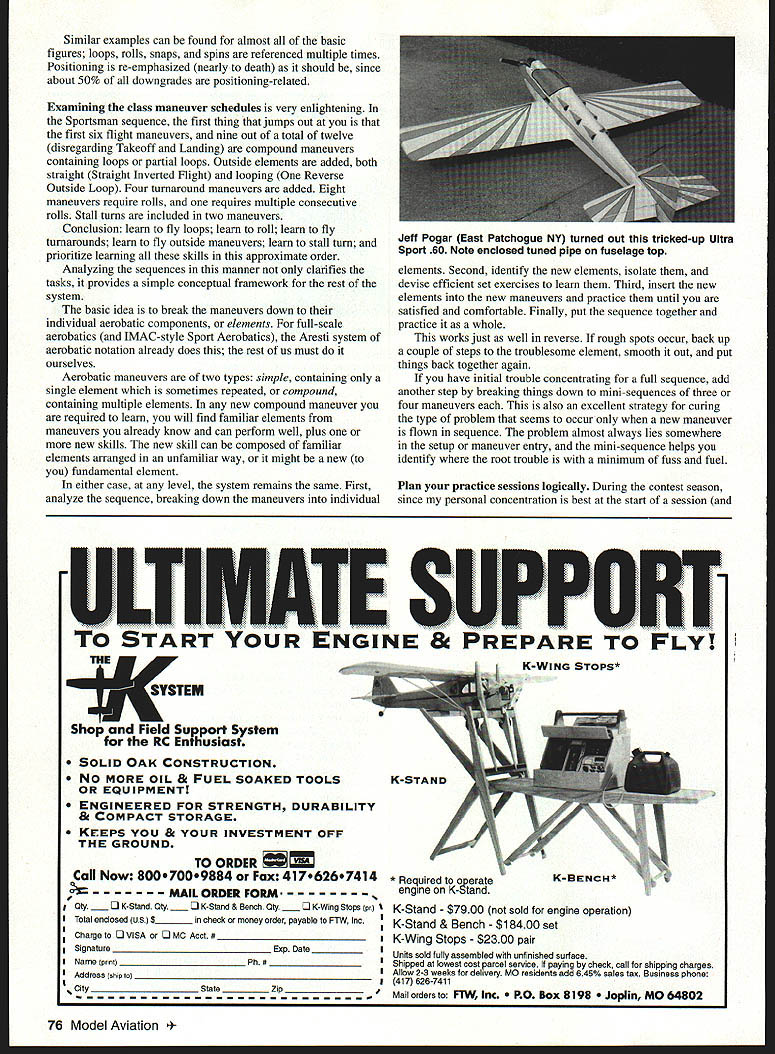
Straight Flight Out is the first maneuver (after Takeoff) called for in the Novice class. Two maneuvers later, it is repeated in the opposite direction. A reference appears again in the AMA RC Pattern Judges' Guide, mandating straight and level entries and exits to all maneuvers. Farther along still, under Lines, we find that all aerobatic maneuvers are "started and ended by a horizontal line." In between, under Positioning, we find references to all (center) maneuvers being performed in a plane "exactly perpendicular" to the judge's line of sight. These and other references form the cumulative implication that straight-and-level flight parallel to the flightline is clearly the first and most important Pattern skill to master, as well as the primary focus of the Novice class schedule.
Similar examples can be found for almost all of the basic figures; loops, rolls, snaps, and spins are referenced multiple times. Positioning is re-emphasized (nearly to death) as it should be, since about 50% of all downgrades are positioning-related.
Analyzing Class Maneuver Schedules
Examining the class maneuver schedules is very enlightening. In the Sportsman sequence, the first thing that jumps out at you is that the first six flight maneuvers, and nine out of a total of twelve (disregarding Takeoff and Landing) are compound maneuvers containing loops or partial loops. Outside elements are added, both straight (Straight Inverted Flight) and looping (One Reverse Outside Loop). Four turnaround maneuvers are added. Eight maneuvers require rolls, and one requires multiple consecutive rolls. Stall turns are included in two maneuvers.
Conclusion: prioritize learning the following skills, in this approximate order:
- Fly loops
- Perform rolls
- Fly turnarounds
- Fly outside maneuvers
- Perform stall turns
Analyzing the sequences in this manner not only clarifies the tasks, it provides a simple conceptual framework for the rest of the system.
Breaking Maneuvers into Elements
The basic idea is to break the maneuvers down to their individual aerobatic components, or elements. For full-scale aerobatics (and IMAC-style Sport Aerobatics), the Aresti system of aerobatic notation already does this; the rest of us must do it ourselves.
Aerobatic maneuvers are of two types: simple, containing only a single element which is sometimes repeated, or compound, containing multiple elements. In any new compound maneuver you are required to learn, you will find familiar elements from other maneuvers you already know and can perform well, plus one or more new skills. The new skill can be composed of familiar elements arranged in an unfamiliar way, or it might be a new (to you) fundamental element.
The system for learning a new compound maneuver:
- Analyze the sequence, breaking down the maneuvers into individual elements.
- Identify the new elements, isolate them, and devise efficient set exercises to learn them.
- Insert the new elements into the new maneuvers and practice them until you are satisfied and comfortable.
- Put the sequence together and practice it as a whole.
This works just as well in reverse. If rough spots occur, back up a couple of steps to the troublesome element, smooth it out, and put things back together again.
Mini-Sequences and Troubleshooting
If you have initial trouble concentrating for a full sequence, add another step by breaking things down to mini-sequences of three or four maneuvers each. This is also an excellent strategy for curing the type of problem that seems to occur only when a new maneuver is flown in sequence. The problem almost always lies somewhere in the setup or maneuver entry, and the mini-sequence helps you identify where the root trouble is with a minimum of fuss and fuel.
Plan your practice sessions logically. During the contest season, since my personal concentration is best at the start of a session (and since somebody has to win that first round!), I usually start with a full sequence done as close to contest conditions as possible. Near the end of a session, I'll work on element fundamentals that are giving me trouble. Before the season starts, in "spring training," I reverse this order—especially if a new sequence must be learned.
You will find that merely thinking about the "complex" maneuvers as combinations of simple and familiar elements makes the tasks of learning and performing them far less intimidating. The mini-sequence routine allows you to identify your weaknesses and turn them into strengths. Organizing your practice gets the most out of your time, effort, and fuel.
Any good practice system should help you build good habits while you avoid imprinting bad ones. I have used and taught this one for years; it works well, and I believe in it. If you decide to use it, you must either believe in it, or change it until you can. A logical, organized approach and the belief that it will help are the most important components. The rest is yours to alter!
Simulator
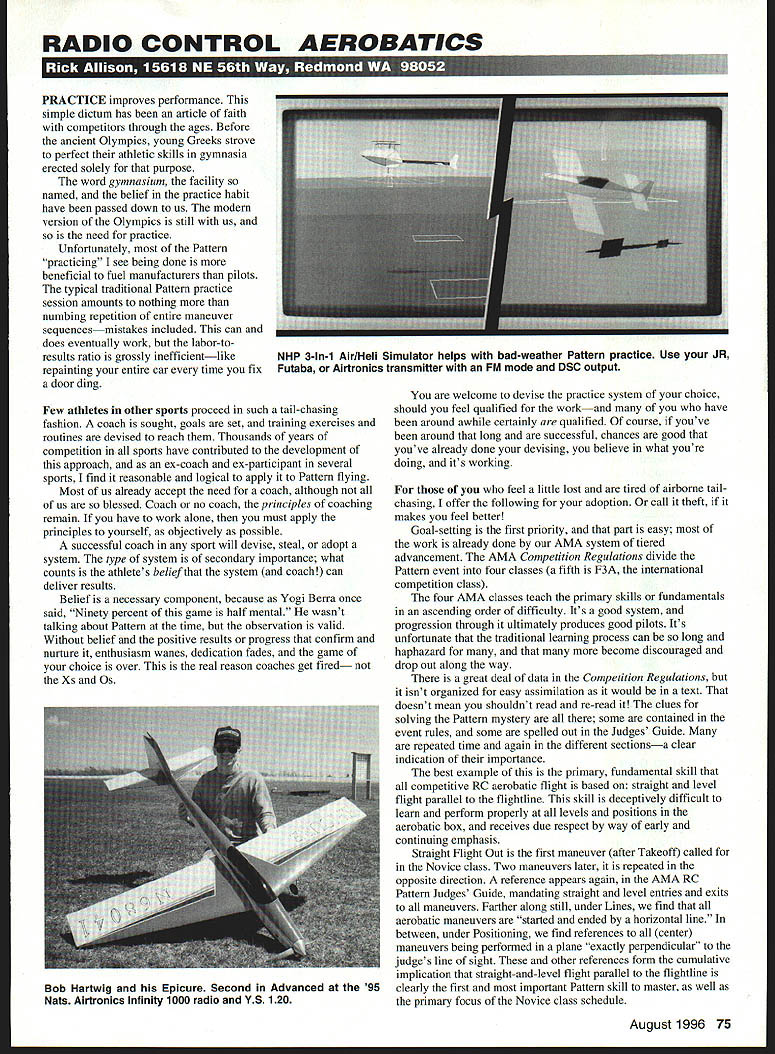
On the product front, there is a new RC flight simulator that can certainly help with rainy-day practice. The NHP 3-In-1 Air/Heli Simulator from Horizon Hobby Distributors allows you to use your own transmitter with its programming and switches active, and input aircraft performance specs that closely parallel the real thing—you can literally design your own airplane!
This simulator has a control "feel" that is astonishingly close to real, with realistic snaps, spins, and stall turns all possible with correct setup. The sound and background graphics could be a touch better, but the computing power has obviously been focused on the flight simulation routines.
Requirements and notes:
- Transmitter: JR, Futaba, or Airtronics with FM mode and a DSC output
- Computer: IBM-compatible PC with a 486 processor, 1 MB of RAM, MS-DOS 3.1 or better, and a 3.5-inch floppy drive
- Price: approximately $200 at hobby dealers
Transcribed from original scans by AI. Minor OCR errors may remain.

