
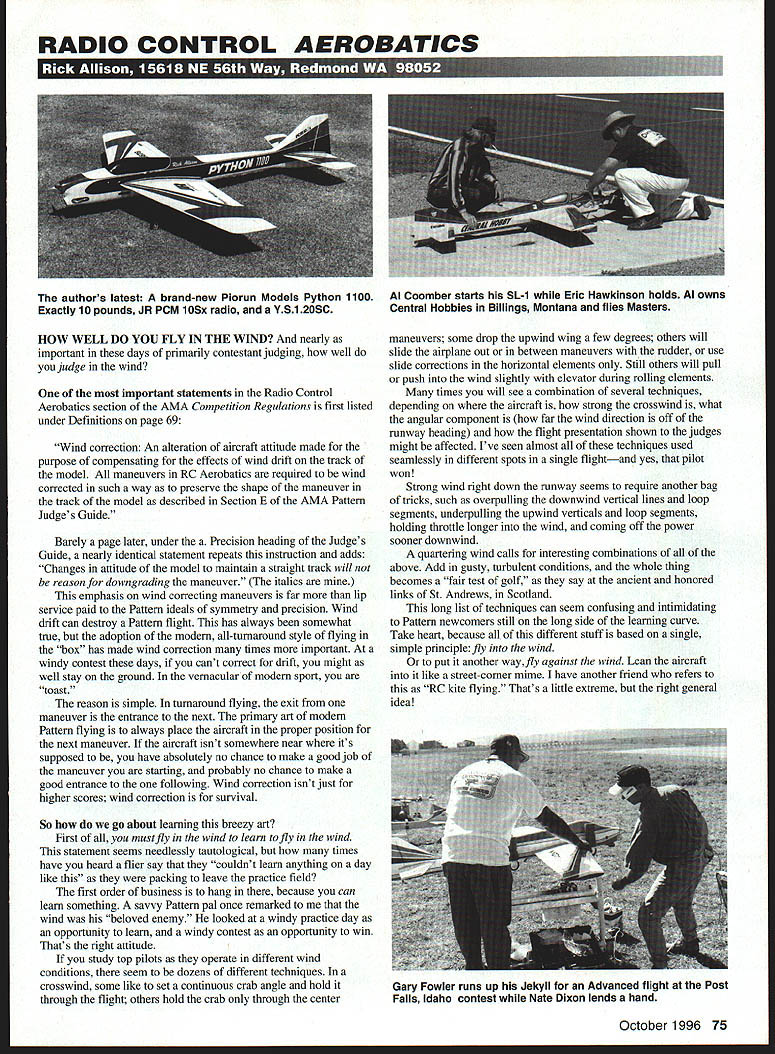
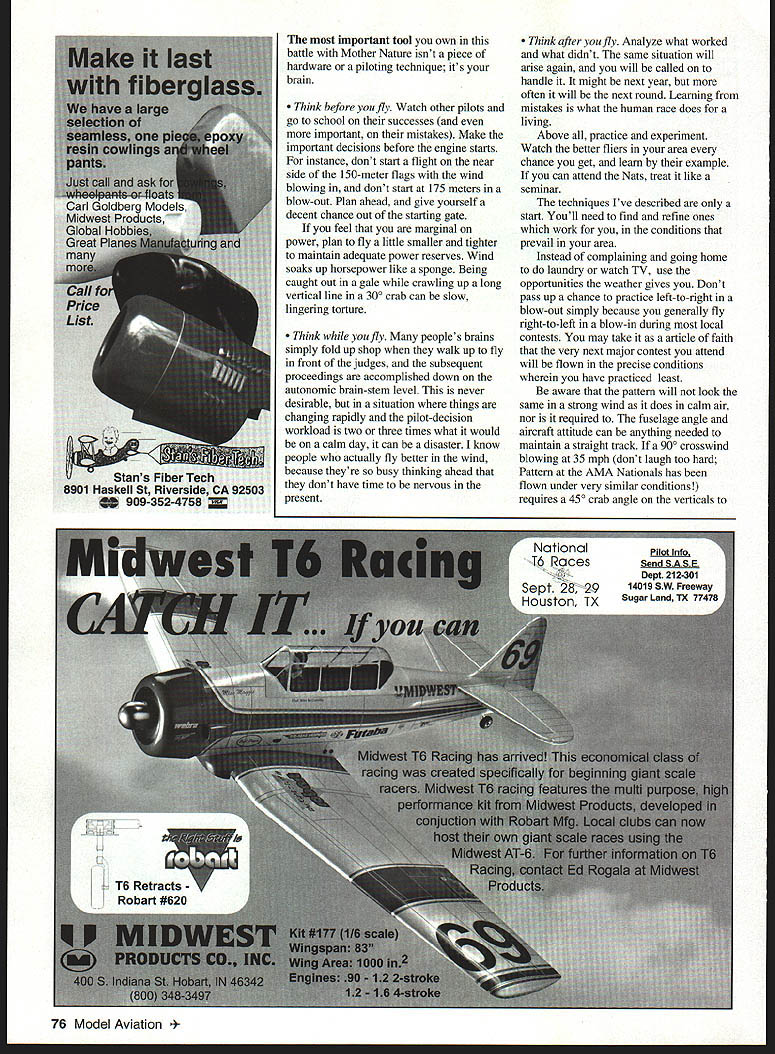
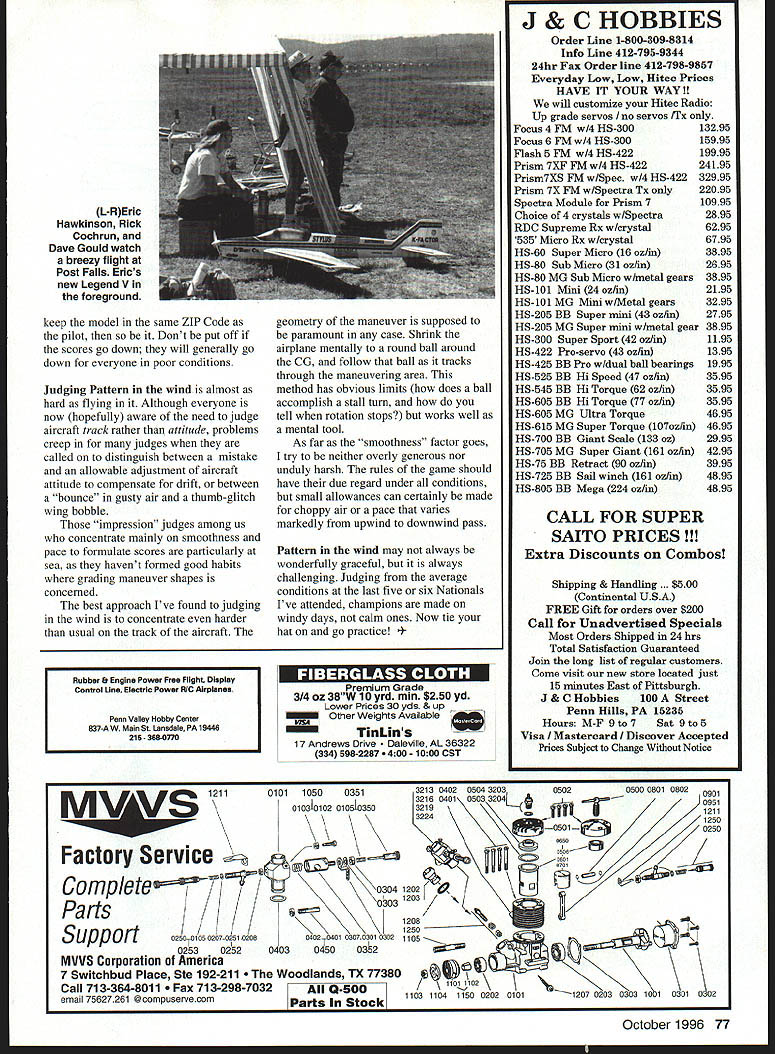
RADIO CONTROL: AEROBATICS
Rick Allison, 15618 NE 56th Way, Redmond WA 98052
How well do you fly in the wind?
How well do you fly in the wind? And nearly as important in these days of primarily contestant judging, how well do you judge in the wind?
One of the most important statements in the Radio Control Aerobatics section of the AMA Competition Regulations is first listed under Definitions on page 69:
"Wind correction: An alteration of aircraft attitude made for the purpose of compensating for the effects of wind and drift on the track of the model. All maneuvers in RC Aerobatics are required to be wind corrected in such a way as to preserve the shape of the maneuver in the track of the model as described in Section E of the AMA Pattern Judge's Guide."
Barely a page later, under the A. Precision heading of the Judge's Guide, a nearly identical statement repeats this instruction and adds: "Changes in attitude of the model to maintain a straight track will not be reason for downgrading the maneuver." (The italics are mine.)
This emphasis on wind-correcting maneuvers is far more than lip service paid to the Pattern ideals of symmetry and precision. Wind drift can destroy a Pattern flight. This has always been somewhat true, but the adoption of the modern, all-turnaround style of flying in the "box" has made wind correction many times more important. At a windy contest these days, if you can't correct for drift, you might as well stay on the ground. In the vernacular of modern sport, you are "toast."
The reason is simple. In turnaround flying, the exit from one maneuver is the entrance to the next. The primary art of modern Pattern flying is to always place the aircraft in the proper position for the next maneuver. If the aircraft isn't somewhere near where it's supposed to be, you have absolutely no chance to make a good job of the maneuver you are starting, and probably no chance to make a good entrance to the one following. Wind correction isn't just for higher scores; wind correction is for survival.
Learning to wind-correct
First of all, you must fly in the wind to learn to fly in the wind. This statement seems needlessly tautological, but how many times have you heard a flier say that they "couldn't learn anything on a day like this" as they were packing to leave the practice field?
The first order of business is to hang in there, because you can learn something. A savvy Pattern pal once remarked to me that the wind was his "beloved enemy." He looked at a windy practice day as an opportunity to learn, and a windy contest as an opportunity to win. That's the right attitude.
If you study top pilots as they operate in different wind conditions, there seem to be dozens of different techniques. In a crosswind, some like to set a continuous crab angle and hold it through the flight; others hold the crab only through the center maneuvers; some drop the upwind wing a few degrees; others will slide the airplane out or in between maneuvers with the rudder, or use slide corrections in the horizontal elements only. Still others will pull or push into the wind slightly with elevator during rolling elements. Many times you will see a combination of several techniques, depending on where the aircraft is, how strong the crosswind is, what the angular component is (how far the wind direction is off the runway heading) and how the flight presentation shown to the judges might be affected. I've seen almost all of these techniques used seamlessly in different spots in a single flight—and yes, that pilot won!
Strong wind right down the runway seems to require another bag of tricks, such as overpulling the downwind vertical lines and loop segments, underpulling the upwind verticals and loop segments, holding throttle longer into the wind, and coming off the power sooner downwind. A quartering wind calls for interesting combinations of all of the above. Add in gusty, turbulent conditions, and the whole thing becomes a "fair test of golf," as they say at the ancient and honored links of St. Andrews, in Scotland.
This long list of techniques can seem confusing and intimidating to Pattern newcomers still on the long side of the learning curve. Take heart, because all of this different stuff is based on a single, simple principle: fly into the wind.
Or to put it another way, fly against the wind. Lean the aircraft into it like a street-corner mime. I have another friend who refers to this as "RC kite flying." That's a little extreme, but the right general idea!
An important tool in your battle with Mother Nature isn't a piece of hardware; an important tool is piloting technique—it's brain. Think before you fly. Watch other pilots; go to school on their successes and important mistakes. Make important decisions before the engine starts. For instance, don't start your flight near the side of the 150-meter flags if the wind is blowing; don't start if it's a 175-meter blow-out. Plan ahead; give yourself a decent chance out of the starting gate. If you feel marginal power, plan to fly a little smaller, tighter, and maintain adequate power reserves. Wind soaks up horsepower like a sponge. Being caught out in a gale crawling up long verticals can ruin your flight.
- Think before you fly. Many decisions should be made on the ground so you aren't adjusting strategy in midstream.
- Think while you fly. Many people's brains simply fold up when they walk up to fly in front of the judges, and the subsequent proceedings are accomplished down on the autonomic brain-stem level. This is never desirable, but in a situation where things are changing rapidly and the pilot-decision workload is two or three times what it would be on a calm day, it can be a disaster. I know people who actually fly better in the wind, because they're so busy thinking ahead that they don't have time to be nervous in the present.
- Think after you fly. Analyze what worked and what didn't. The same situation will arise again, and you will be called on to handle it. It might be next year, but more often it will be the next round. Learning from mistakes is what the human race does for a living.
Above all, practice and experiment. Watch the better fliers in your area every chance you get, and learn by their example. If you can attend the Nats, treat it like a school.
The techniques I've described are only a start. You'll need to find and refine ones which work for you, in the conditions that prevail in your area.
Instead of complaining and going home to do laundry or watch TV, use the opportunities the weather gives you. Don't pass up a chance to practice left-to-right in a blow-out simply because you generally fly right-to-left in a blow-in during most local contests. You may take it as a rule of thumb that the very next major contest you attend will be flown in the precise conditions wherein you have practiced least.
Be aware that the pattern will not look the same in a strong wind as it does in calm air, nor is it required to be. The fuselage angle and aircraft attitude can be anything needed to maintain a straight track. If a 90° crosswind is blowing at 35 mph (don't laugh too hard; Pattern at the AMA Nationals has been flown under very similar conditions!) and it requires a 45° crab angle on the verticals to keep the model in the same ZIP Code as the pilot, then so be it. Don't be put off if the scores go down; they will generally go down for everyone in poor conditions.
Judging in the wind
Judging Pattern in the wind is almost as hard as flying in it. Although everyone is now (hopefully) aware of the need to judge aircraft track rather than attitude, problems creep in for many judges when they are called on to distinguish between a mistake and an allowable adjustment of aircraft attitude to compensate for drift, or between a "bounce" in gusty air and a thumb-glitch wing bobble.
Those "impression" judges among us who concentrate mainly on smoothness and pace to formulate scores are particularly at sea, as they haven't formed good habits where grading maneuver shapes is concerned.
The best approach I've found to judging in the wind is to concentrate even harder than usual on the track of the aircraft. The geometry of the maneuver is supposed to be paramount in any case. Shrink the airplane mentally to a round ball around the CG, and follow that ball as it tracks through the maneuvering area. This method has obvious limits (how does a ball accomplish a stall turn, and how do you tell when rotation stops?) but works well as a mental tool.
As far as the "smoothness" factor goes, I try to be neither overly generous nor unduly harsh. The rules of the game should have their due regard under all conditions, but small allowances can certainly be made for choppy air or a pace that varies markedly from upwind to downwind pass.
Pattern in the wind may not always be wonderfully graceful, but it is always challenging. Judging from the average conditions at the last five or six Nationals I've attended, champions are made on windy days, not calm ones. Now tie your hat on and go practice!
Transcribed from original scans by AI. Minor OCR errors may remain.

