
RADIO CONTROL AEROBATICS
Rick Allison, 15618 NE 56th Way, Redmond WA 98052
Photographs are an important part of this column, as they are of most columns in this magazine. I shoot a good many of the ones you see on these pages myself, simply because too few suitable photos arrive in the average month from other sources.
As all Model Aviation writers (and almost all writers at the other magazines in the field) are expected to provide the visual content for their own columns (three to six photos each month), many of my colleagues employ a similar strategy.
This can lead to a common problem I call "localitis," where most of the photos seem to be from the writer's region of the country. Naturally, when an outbreak of this deadly (dull) journalistic inflammation occurs, readers from other regions find it irritating, and if the problem persists long enough, almost everyone, including the writer and his long-suffering editor, finds it boring.
The obvious cure for this disease is to find, beg, borrow, steal, liberate, or otherwise procure suitable modeling photographs from other areas of the country, but this isn't as easy as it sounds. First of all, astonishingly few people bother to send photos. I assume this is because they are unsure of exactly what formats are acceptable, or where to send the shots, or what to take pictures of. I have to assume this, because the other possible answer is apathy—a condition for which few cures are known.
What to send
The basic requirements are broad: any good, sharp glossy print will do, either color or black-and-white. Any reasonable size print is acceptable. In other words, what comes out of the usual drugstore processing envelope is just fine. Negatives are not needed.
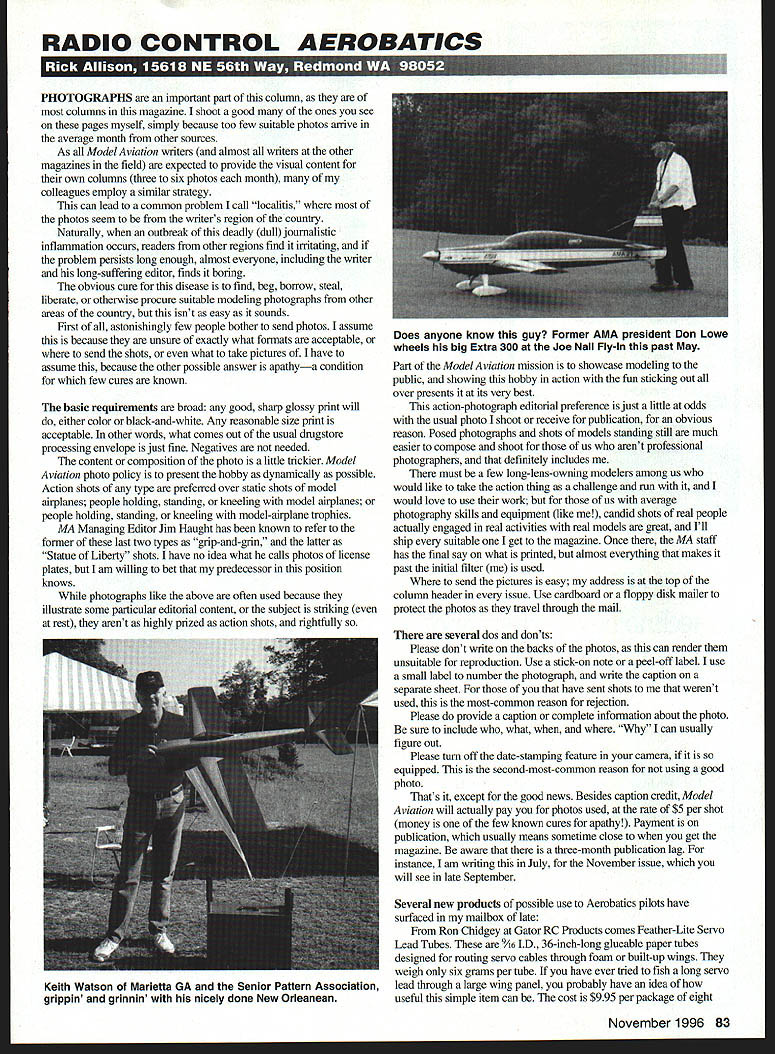
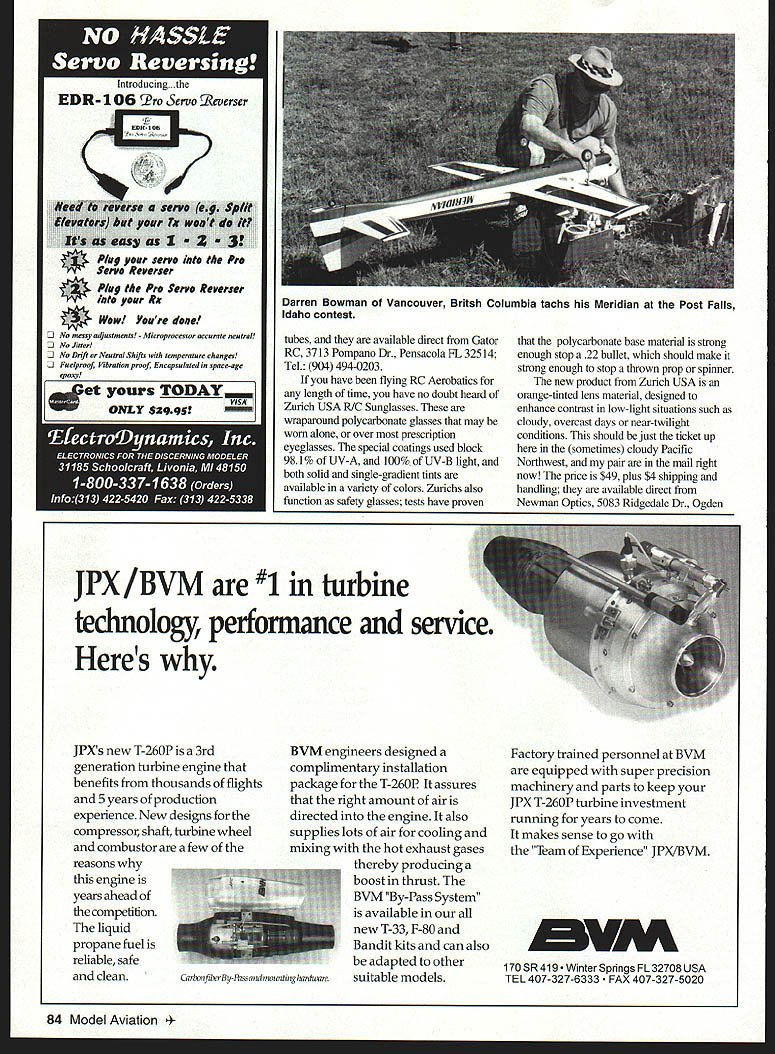
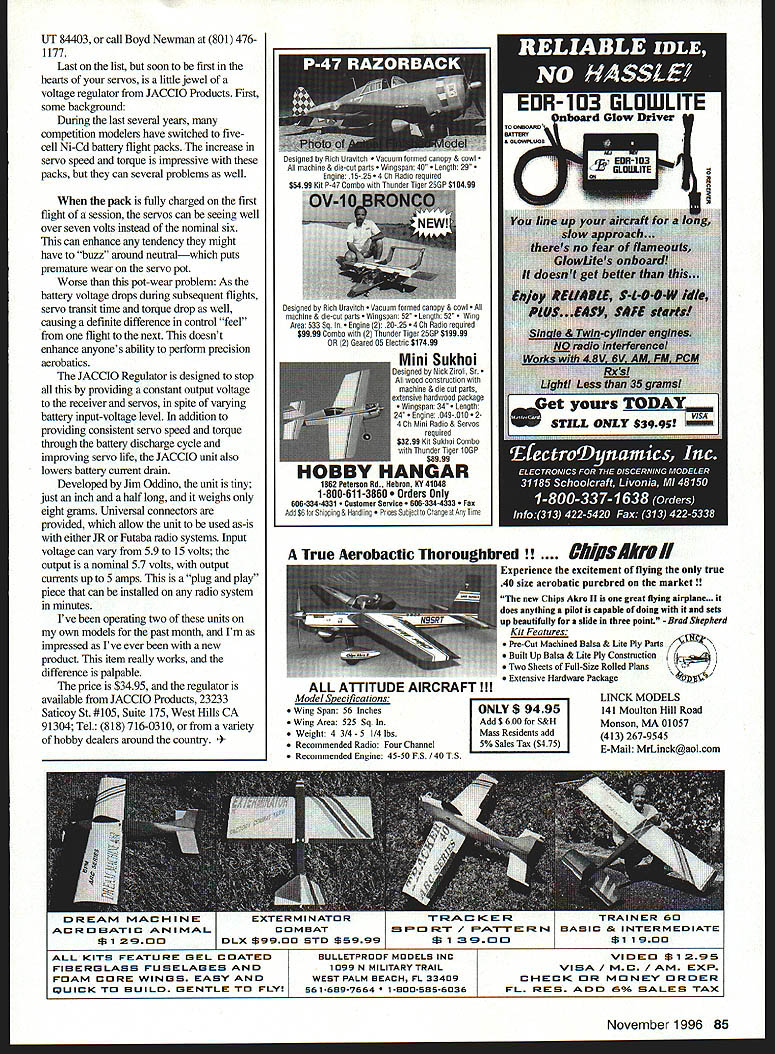
The content or composition of the photo is a little trickier. Model Aviation photo policy is to present the hobby as dynamically as possible. Action shots of any type are preferred over static shots of model airplanes; people holding, standing, or kneeling with model airplanes; or people holding, standing, or kneeling with model-airplane trophies.
MA Managing Editor Jim Haught has been known to refer to the former of these last two types as "grip-and-grin," and the latter as "Statue of Liberty" shots. I have no idea what he calls photos of license plates, but I am willing to bet that my predecessor in this position knows.
While photographs like the above are often used because they illustrate some particular editorial content, or the subject is striking (even at rest), they aren't as highly prized as action shots, and rightfully so. Part of the Model Aviation mission is to showcase modeling to the public, and showing this hobby in action with the fun sticking out all over presents it at its very best.
This action-photograph editorial preference is just a little at odds with the usual photo I shoot or receive for publication, for an obvious reason. Posed photographs and shots of models standing still are much easier to compose and shoot for those of us who aren't professional photographers, and that definitely includes me.
There must be a few long-lens-owning modelers among us who would like to take the action thing as a challenge and run with it, and I would love to use their work; but for those of us with average photography skills and equipment (like me!), candid shots of real people actually engaged in real activities with real models are great, and I'll ship every suitable one I get to the magazine. Once there, the MA staff has the final say on what is printed, but almost everything that makes it past the initial filter (me) is used.
Where to send photos
Where to send the pictures is easy; my address is at the top of the column header in every issue. Use cardboard or a floppy-disk mailer to protect the photos as they travel through the mail.
Dos and don'ts
- Please don't write on the backs of the photos, as this can render them unsuitable for reproduction. Use a stick-on note or a peel-off label. I use a small label to number the photograph, and write the caption on a separate sheet. For those of you that have sent shots to me that weren't used, this is the most-common reason for rejection.
- Please do provide a caption or complete information about the photo. Be sure to include who, what, when, and where. "Why" I can usually figure out.
- Please turn off the date-stamping feature in your camera, if it is so equipped. This is the second-most-common reason for not using a good photo.
That's it, except for the good news. Besides caption credit, Model Aviation will actually pay you for photos used, at the rate of $5 per shot (money is one of the few known cures for apathy!). Payment is on publication, which usually means sometime close to when you get the magazine. Be aware that there is a three-month publication lag. For instance, I am writing this in July, for the November issue, which you will see in late September.
New products of interest to aerobatics pilots
Several new products of possible use to Aerobatics pilots have surfaced in my mailbox of late.
Feather-Lite Servo Lead Tubes (Gator RC Products)
From Ron Chidgey at Gator RC Products comes Feather-Lite Servo Lead Tubes. These are 9/16" I.D., 36-inch-long glueable paper tubes designed for routing servo cables through foam or built-up wings. They weigh only six grams per tube. If you have ever tried to fish a long servo lead through a large wing panel, you probably have an idea of how useful this simple item can be. The cost is $9.95 per package of eight.
They are available direct from Gator RC, 3713 Pompano Dr., Pensacola FL 32514; Tel.: (904) 494-0203.
Zurich USA RC Sunglasses
If you have been flying RC Aerobatics for any length of time, you have no doubt heard of Zurich USA RC Sunglasses. These are wraparound polycarbonate glasses that may be worn alone, or over most prescription eyeglasses.
The special coatings used block 98.1% of UV-A and 100% of UV-B light, and both solid and single-gradient tints are available in a variety of colors. Zurichs also function as safety glasses; tests have proven that the polycarbonate base material is strong enough to stop a .22 bullet, which should make it strong enough to stop a thrown prop or spinner.
The new product from Zurich USA is an orange-tinted lens material, designed to enhance contrast in low-light situations such as cloudy, overcast days or near-twilight conditions. This should be just the ticket up here in the (sometimes) cloudy Pacific Northwest, and my pair are in the mail right now! The price is $49.95, plus $4 shipping and handling; they are available direct from Newman Optics, 5083 Ridgedale Dr., Ogden UT 84403, or call Boyd Newman at (801) 476-1177.
JACCO Voltage Regulator
Last on the list, but soon to be first in the hearts of your servos, is a little jewel of a voltage regulator from JACCO Products. First, some background:
During the last several years, many competition modelers have switched to five-cell Ni-Cd battery flight packs. The increase in servo speed and torque is impressive with these packs, but they can cause several problems as well.
When the pack is fully charged on the first flight of a session, the servos can be seeing well over seven volts instead of the nominal six. This can enhance any tendency they might have to "buzz" around neutral—which puts premature wear on the servo pot.
Worse than this pot-wear problem: as the battery voltage drops during subsequent flights, servo transit time and torque drop as well, causing a definite difference in control "feel" from one flight to the next. This doesn't enhance anyone's ability to perform precision aerobatics.
The JACCO Regulator is designed to stop all this by providing a constant output voltage to the receiver and servos, in spite of varying battery input-voltage level. In addition to providing consistent servo speed and torque through the battery discharge cycle and improving servo life, the JACCO unit also lowers battery current drain.
Developed by Jim Oddino, the unit is tiny—an inch and a half long—and it weighs only eight grams. Universal connectors are provided, which allow the unit to be used as-is with either JR or Futaba radio systems. Input voltage can vary from 5.9 to 15 volts; the output is a nominal 5.7 volts, with output currents up to 5 amps. This is a "plug and play" piece that can be installed on any radio system in minutes.
I've been operating two of these units on my own models for the past month, and I'm as impressed as I've ever been with a new product. This item really works, and the difference is palpable.
The price is $34.95, and the regulator is available from JACCO Products, 23233 Saticoy St. #105, Suite 175, West Hills CA 91304; Tel.: (818) 716-0310, or from a variety of hobby dealers around the country.
Transcribed from original scans by AI. Minor OCR errors may remain.

