
Radio Control: Aerobatics
Ron Van Putte 111 Sleepy Oaks Rd. Ft. Walton Beach, FL 32548
Continued from page 41
Building: wing and stabilizer tips
Every airplane I build, I try something new. My most recent airplane is no exception. While fabricating the wing and stabilizer skins I decided to try two things I hadn't done before.
- Cutting balsa on glass
I cut 1/16" sheet balsa on a piece of plate glass. Many modelers use plate glass to cut MonoKote, and it works equally well for balsa. Cutting on wood surfaces makes the blade wander as it seeks the grain and puts a lot of drag on the X-Acto blade. On glass the blade doesn't wander, drag is much reduced, and blade wear is substantially less. The cuts are much easier and require less effort.
- Using Ambroid for skin joints
I used Ambroid to glue the balsa skin pieces together. Ambroid isn't new — I used it in the 1950s — but I hadn't used it for skin joints since aliphatic-resin glues (Titebond, Wilhold, Elmer's, etc.) became common. When joined with only a small amount of Ambroid and then lightly sanded, the joint shows no visible ridge. Ambroid works very well for balsa skins.
Caveat: Ambroid will eat exposed foam on leading edges. Use Wilhold or another yellow aliphatic-resin carpenter's glue (identified as sandable) for foam leading edges. Do not use ordinary white glues; they form a rubbery joint that resists sanding.
Turnaround flying — getting started
"How do you perform a loop?" is a basic question that might puzzle many experienced Pattern fliers. Beginners often need simple, explicit instruction; experienced fliers can find it hard to relate. I felt that when I received letters asking, "How do you do the new turnaround flying?"
I resisted changing my style when the turnaround format was introduced, but the new rules forced me to decide between learning turnaround or quitting Pattern altogether. Until a couple of weeks ago, the only turnaround flying I had done was at two all-turnaround contests a few years ago in Jackson, Mississippi, where I hadn't practiced and did poorly.
I will compete in the new Advanced class next year and have already begun practicing so I won't embarrass myself at the New Iberia, Louisiana contest in September. The Advanced class is better suited to someone new to turnaround flying than the Master class, which uses the current FAI schedule. There is a big jump in complexity between Advanced and Master.
The "box" — what it is and how to use it
Many writers have asked what the "box" is and what is meant by "entering the box" and "exiting the box." Here's a clear description:
- Imagine you are standing on the edge of the runway looking perpendicular to it.
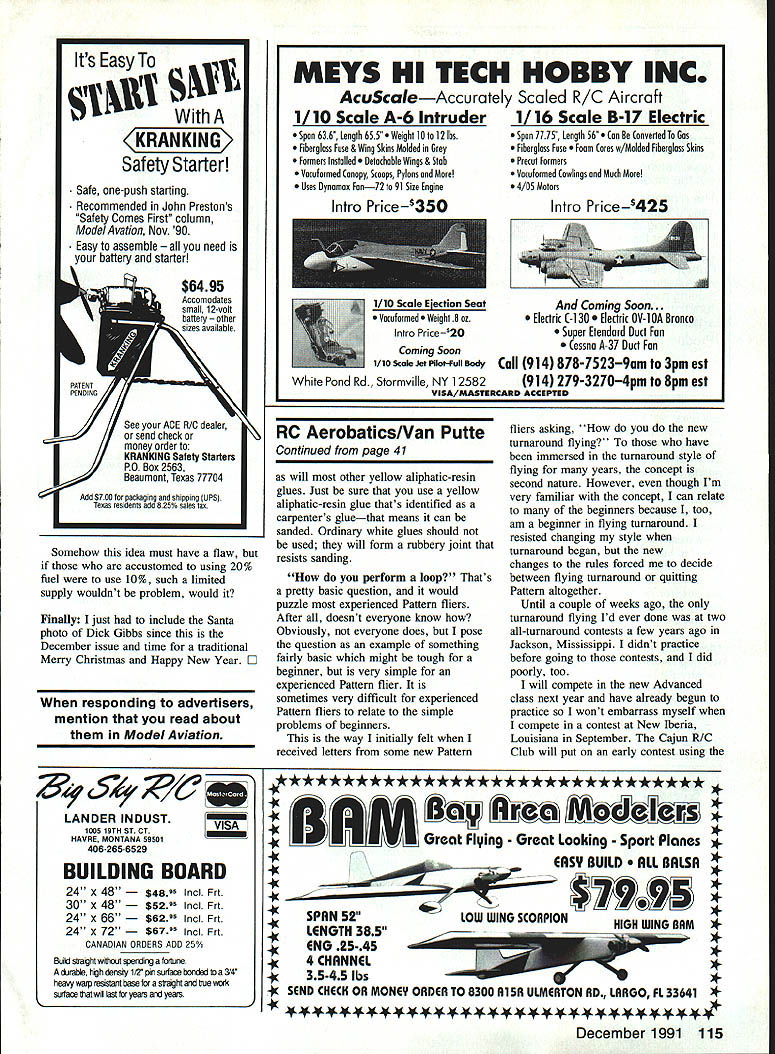
- There is a center pole 150 meters away (about 492 feet). This is the center of the box.
- From you, draw an imaginary line to the center pole. Now look 60 degrees left and 60 degrees right from that line. Place poles along those lines at the same distance as the center pole.
- The wedge formed by you and the lines toward the left and right poles is the ground projection of the box. If you look up 60 degrees, you see the upper limit of the box.
- All judged maneuvers, except takeoff and landing, are supposed to be performed within this box.
If you take off left-to-right, do a free pass, and set up for your first maneuver (for example, Sportsman class — the Double Stall Turn), the plane is about 150 meters from you moving left-to-right. As the airplane crosses your line of sight to the left-hand pole, you have entered the box. Draw a straight line with the airplane and do the Double Stall Turn in the middle of the box.
After a maneuver, draw a short horizontal straight line to show judges you have finished that maneuver, then continue with the next maneuver. For a turnaround maneuver (for example, the 1/2 Reverse Cuban Eight), pull up and do it in the box. Judges should penalize any fraction of a maneuver that is outside the box. For example, if half of a maneuver is outside the box and the judges would otherwise give an eight, they should give a four (if they apply scoring correctly).
Get somebody to help you set up the box. For practice, a chalked or painted white line from you toward the poles is very helpful because the poles themselves may be hard to see.
After the 1/2 Reverse Cuban Eight, draw another straight line and do the Cuban Eight in the middle of the box. Draw another straight line and exit the box to the left. Once you exit the box you are free to fly outside it; while inside, you must be performing maneuvers or drawing straight lines.
The new Sportsman schedule continues with a second set of three maneuvers (Immelmann Turn, Split S, and Three Inside Loops) before exiting the box to the right. Then a third set (Straight Inverted Flight, Stall Turn, and one Reverse Outside Loop) follows before relief from the box. These sets teach you to stay in the box and manage the aircraft there. In Advanced you don't get relief from the box, and it is tough to position the airplane correctly in varying wind conditions.
Sequencing and visualization
In learning turnaround I discovered I think more about drawing pictures than individual maneuvers. Maneuvers flow into each other, and what you have to work with on one maneuver depends on the previous one. For example, if you are too close in or draw too long a straight line after the Double Stall Turn, you won't have enough room in the box for the 1/2 Reverse Cuban Eight. You'll then rush and likely botch the sequence as the Cuban Eight arrives too quickly. Try drawing the maneuvers on paper to visualize how they should look when sequenced in the air.
Rules and practice
You will need a 1992/1993 rule book. Buy one at the first opportunity. AMA no longer automatically sends rule books to all members; your first chance to buy one will be at AMA membership renewal time. Order the rule book and read it thoroughly when it arrives. Then go out and practice — it may not make you perfect, but it cuts down on excuses. The more I practice, the luckier I get.
(Rule books will be mailed automatically to vice-presidents, associate vice-presidents, and Contest Board members. A rule book will also be sent with each sanction package that involves rule-book events. — Ed.)
Transcribed from original scans by AI. Minor OCR errors may remain.

