

RADIO CONTROL AEROBATICS
Rick Allison, 15618 NE 56th Way, Redmond WA 98052
Overview
The 1996 National Aeromodeling Championships was the first full Nats held at our own “house” in Muncie, Indiana; the first Nats organized in the modern or Olympic format with sequential venues; and, hopefully, the first Nats in recent memory to be financially self-sufficient.
It was also the first Pattern event of national or international scope to be flown at what will unquestionably become the finest site for RC Aerobatics in this country—and perhaps in the world. The International Aeromodeling Center is a suckling infant at present, with true maturity at least several years and a substantial amount of development in the future. However, the world-class potential was already clearly visible in the beautifully open sight lines, the peaceful rural surroundings, and the well-planned and well-executed work done to date.
Like the 1995 Pattern Nats in Vincennes, Indiana, the 1996 Nats was almost totally a National Society of Radio Controlled Aerobatics (NSRCA) production, with AMA Headquarters providing some logistical and administrative support. Although a larger number of full-time volunteers eased the strain this year, primary manpower to run the events still came from the contestant ranks; a half-day of labor was required of everyone who registered.
Organization and planning
There were substantial managerial improvements over the 1995 contest—a result of lessons learned by NSRCA and AMA, and considerably more planning time than was available for last year's hurried event. A last-minute change of venue and a confused, tossed-together overall organizational concept kept the Pattern portion of the 1995 Nats grounded despite a fine site and the heroic efforts of crew and contestants. In contrast, Muncie 1996 soared.
Two changes in organization provided the most help:
- An NSRCA Nats Organizing Committee was formed immediately after last year's Nats, consisting of NSRCA President Tony Stillman, Vice-President John Fuqua, and 1996 Nats Event Director Ron Van Putte.
- Preregistration by an early cutoff date (May 20) was strongly encouraged by a large financial penalty (a doubled entry fee). Preregistration allowed the contest to be preplanned; line breakdowns, frequency splits, class formats, and worker and judge matrices were substantially determined well in advance. Work assignments for most contestants were included with the Nats packets they received before leaving home. These packets also contained directions to practice fields, meeting schedules, and seminar times, as well as other useful information about the site, the city, and the contest. The 1996 Pattern Nats had a pleasantly solid, organized feel about it before it ever started.
Event plan
Pattern being the "only game in town" during our portion of the Nats, the whole of the Muncie site was available and was used: the L-shaped pad to the north; the brand-new Stage Center cross runway; and what will become the third Pattern site at the south Free Flight area. The sites feature identical sun and wind orientation in a "stacked" configuration. Event Director Ron Van Putte elected to run Sportsman and Advanced on the north pad, and Masters and FAI on the south pad, while using the Stage Center and south facilities as mixed sites for Masters and FAI.
The NSRCA committee developed the following plan:
- Advanced and Sportsman: run morning and afternoon respectively as single-site contests on two lines with scoring normalization after every second round. Two rounds were flown on each of the first two days as a hedge against poor weather, and the final two rounds were flown one per day.
- Masters: ran mornings from four lines on the two sites for the first two days, flying two rounds a day with the first normalization after the fourth round, then consolidated to two lines on the middle site for the final two rounds, flying one round a day.
- FAI (F3A): ran from four lines each afternoon from the middle and south sites. Pilots rotated through the sites and judge panels during the prelims on a one-round, one-line-a-day basis, with no normalization until the close of the preliminary rounds — a four-day wait for meaningful scores.
Sites and conditions
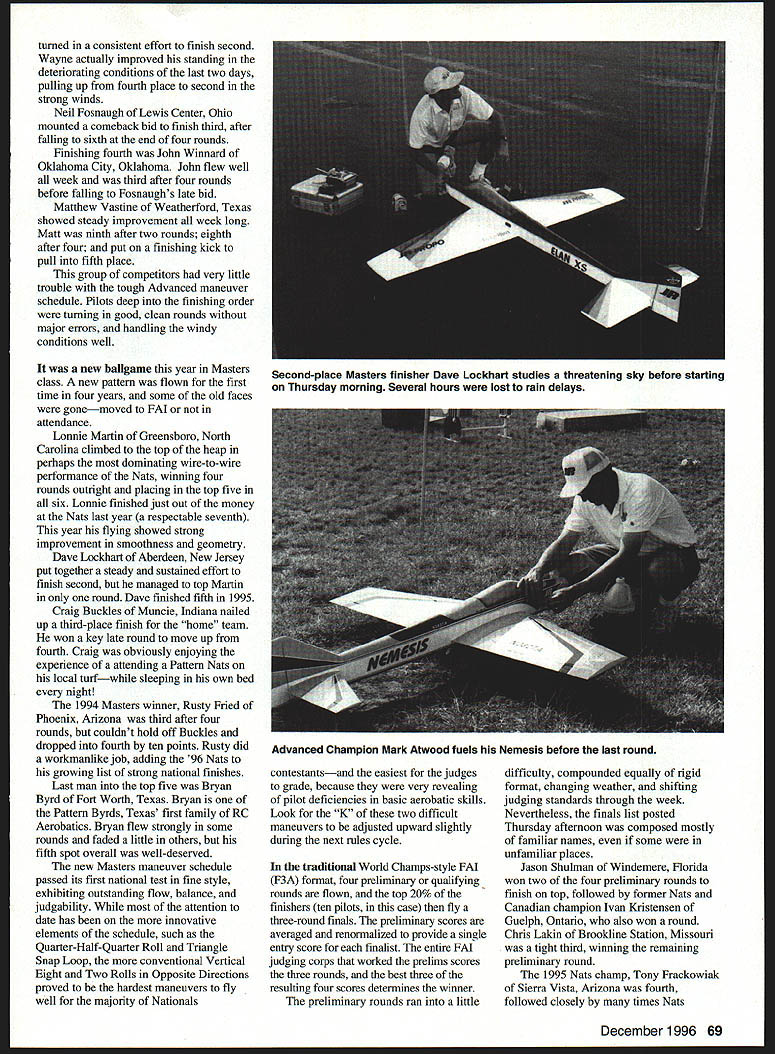
An extraordinarily wet spring delayed AMA's planned development and the arrival of topsoil. The usable site, at the slimmest margins, featured a far-less-than-level dirt runway studded with lumpy grass tufts, an unseeded dirt pit/buffer area, and a sea of ankle-deep mud around a fairly nice graveled parking lot. Unfazed by the obstacles, pilots set up a parking area, and contest management caused a plastic-tarp walkway to magically appear across the mud sea. Landings and takeoffs were scored 10–0. For the FAI duration contest it was decided Masters' takeoffs and landings on the south site would be scored per FAI, thus removing the influence the rough runway might have had on scores. This meant all Masters pilots had to rotate through both sites for equal exposure to conditions.
The lumpy runway proved adequate, if a bit hard on landing gear, and once in the air, the sight lines from the south site were the best of the three sites.
Judging
We were blessed by the presence and efforts of 13 full-time, noncompeting judges—a welcome increase from recent years. Their efforts were augmented by 32 contestant judges. The NSRCA Judging Seminar was well-attended, and on the whole the judging seemed rather more consistent than in 1995.
An exception was the FAI preliminaries, where the World Championship-type format used dictated that equal exposure of the pilots to all judge panels (and thus normalization of scores) could not be accomplished until the completion of the fourth day. With only four flights flown (one per day), all 12 judges working the four FAI lines had to hold a precise scoring standard for nearly a week—a Herculean task even for the most experienced judge.
Factor in greatly differing levels of experience within the FAI judge panels, shifting weather conditions that changed day to day and deteriorated radically on the last day of the prelims, and the resulting scoring "drift," while disappointing, was very predictable. The scores dropped so markedly on all lines during the poor conditions on Thursday that nearly every late flight became a "throwaway"—effectively making it a three-round preliminary for many competitors.
Competition results and class summaries
Sportsman
After several years of light attendance, turnout was healthy again in Sportsman. Twenty-eight competitors made official flights—more than double 1995. The class was deep in number and strong in ability, a very good sign for the overall health of Pattern.
Top finishers:
- Randy Wolfe, Butler, Kentucky — started slowly but hit his stride to convincingly win three of the final four rounds and become the new Sportsman National Champion.
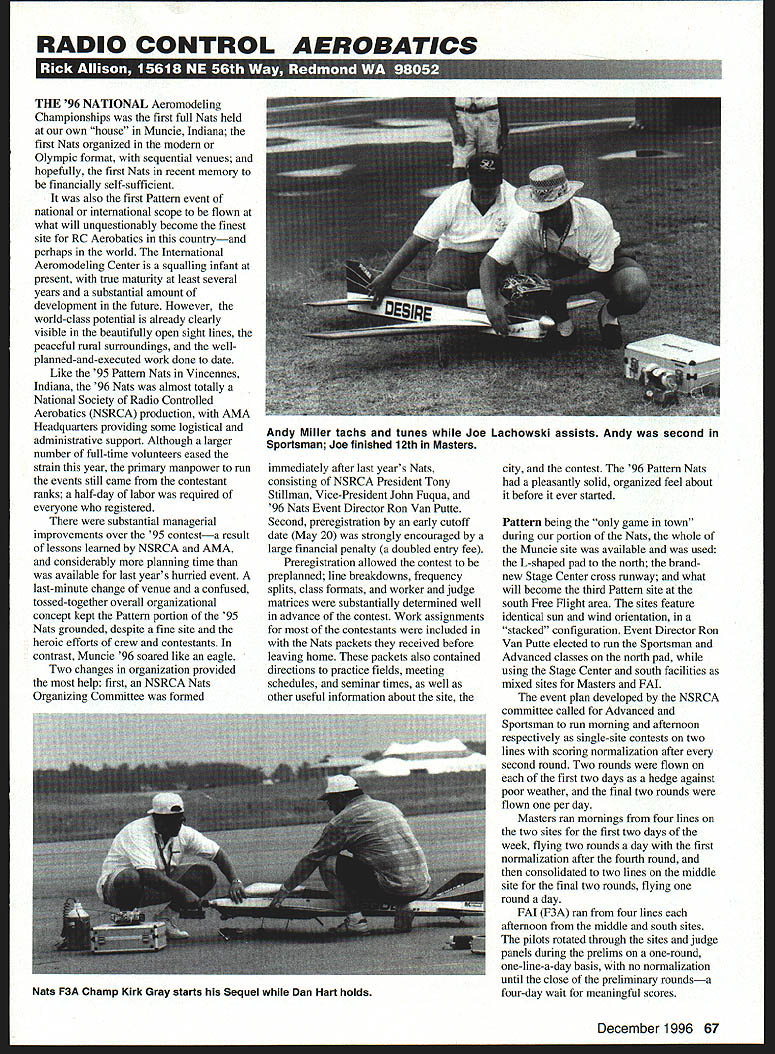
- Andy Miller, Flemington, New Jersey — flew very well in spots, winning two rounds; consistent enough for second.
- Evan Krause, Montgomery, Illinois — started strong and flew consistently before losing a critical late round to equipment problems.
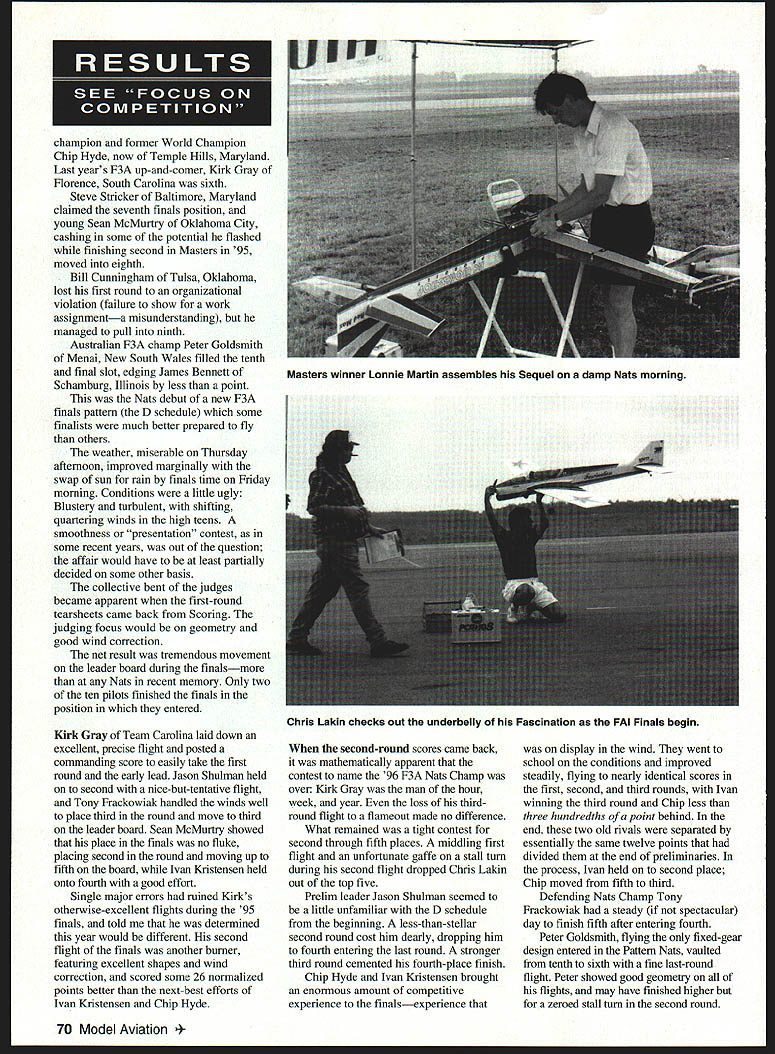
- Paul Kirsch, Fredericksburg, Virginia — never won a round but stayed in the top five wire-to-wire.
- Jeff Carrish, Holliston, Maine — had an up-and-down Nats: faded to 18th after two rounds, climbed to sixth after four, and narrowly edged Peter Francis for fifth.
Advanced
Twenty-eight pilots flew Advanced, up slightly from 1995. It was a very competitive class; the first seven pilots finished within 80 points of the winner, and numbers two through seven were within 25 points of each other. The pilot who finished ninth (Paul Lachance of Chesapeake, Virginia) won a round.
Top finishers:
- Mark Atwood, Aurora, Ohio — convincing win with two round victories and strong flights in all six.
- Wayne Hilgart, Rudolph, Wisconsin — consistent effort, improved his standing in the strong winds from fourth to second.
- Neil Fosnough, Lewis Center, Ohio — mounted a comeback to finish third after falling to sixth at the end of four rounds.
- John Winnard, Oklahoma City, Oklahoma — flew well all week; third after four rounds before falling to fourth.
- Matthew Vastine, Weatherford, Texas — steady improvement through the week to finish fifth.
Competitors handled the tough Advanced schedule well; pilots deep into the finishing order were turning in clean rounds without major errors and managing the windy conditions.
Masters
This year’s Masters class saw a new pattern flown for the first time in four years and some turnover in contestants, with a few old faces moved to FAI or not in attendance.
Top finishers:
- Lonnie Martin, Greensboro, North Carolina — dominated wire-to-wire, winning four rounds and placing in the top five in all six; strong improvement in smoothness and geometry from last year.
- Dave Lockhart, Aberdeen, New Jersey — steady performance to finish second; managed to top Martin in only one round.
- Craig Buckles, Muncie, Indiana — nailed a third-place finish for the home team and won a key late round to move up from fourth.
- Rusty Fried, Phoenix, Arizona — 1994 Masters winner; third after four rounds but dropped to fourth by ten points.
- Bryan Byrd, Fort Worth, Texas — solid flying with some rounds stronger than others; deserved fifth place.
The new Masters maneuver schedule passed its first national test with outstanding flow, pace, and judgeability. While attention focused on innovative elements (Quarter-Half-Quarter Roll and Triangle Snap Loop), the more conventional Vertical Eight and Two Rolls in Opposite Directions proved the hardest maneuvers to fly well for many contestants—and the easiest for judges to grade because they revealed deficiencies in basic aerobatic skills. Expect the K-factor of these two difficult maneuvers to be adjusted upward slightly during the next rules cycle.
FAI (F3A)
In the World Champs-style FAI format, four preliminary rounds are flown and the top 20% (ten pilots here) fly a three-round final. Preliminary scores are averaged and renormalized to provide a single entry score for each finalist. The entire FAI judging corps that worked the prelims scored the three final rounds, and the best three of the resulting four scores determine the winner.
Preliminary summary:
- Jason Shulman, Windermere, Florida — won two of the four prelim rounds to finish on top.
- Ivan Kristensen, Guelph, Ontario — former Nats and Canadian champion; also won a prelim round.
- Chris Lakin, Brookline Station, Missouri — finished third in prelims, winning one round.
- Tony Frackowiak, Sierra Vista, Arizona — 1995 Nats champ; finished fourth in prelims.
- Chip Hyde, Temple Hills, Maryland — many-time Nats champ and former World Champion; finished close behind.
- Kirk Gray, Florence, South Carolina — 1995 F3A up-and-comer; sixth.
- Steve Stricker, Baltimore, Maryland — seventh.
- Sean McMurtry, Oklahoma City, Oklahoma — young talent moved into eighth.
- Bill Cunningham, Tulsa, Oklahoma — recovered to ninth despite an organizational violation in his first round.
- Peter Goldsmith, Menai, New South Wales, Australia — edged James Bennett for the tenth and final slot.
Finals and results: The finals used a new F3A finals pattern (the D schedule). Weather was marginally improved by Friday morning but still blustery and turbulent with shifting quartering winds in the high teens. The judging focus became geometry and good wind correction rather than smoothness or presentation.
Finals highlights:
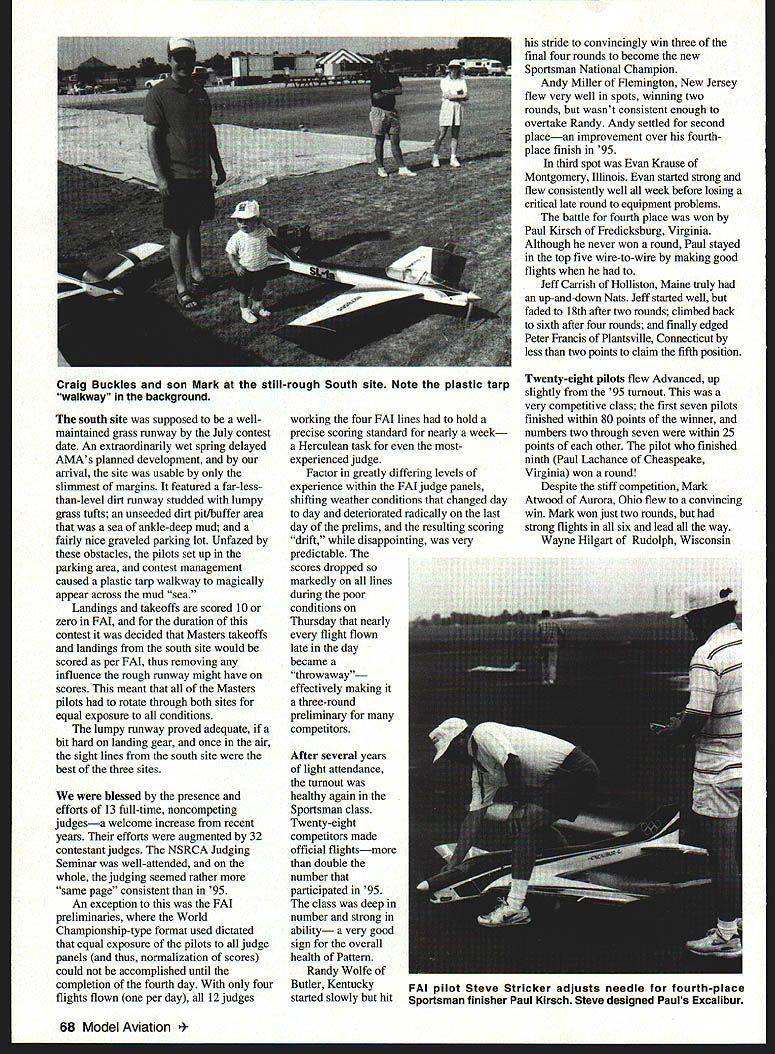
- Kirk Gray, Team Carolina — laid down excellent, precise flights and posted a commanding score; after two superb flights it was mathematically clear he would be the 1996 F3A Nats Champion. A later flameout did not change the outcome.
- Ivan Kristensen — hung on to second overall with steady, experienced flying.
- Chip Hyde — used experience to move from fifth into third by contest end; nearly tied with Ivan in round scores.
- Tony Frackowiak — defended well to finish fifth.
- Jason Shulman — prelim leader who struggled with the D schedule and finished fourth.
- Peter Goldsmith — flew the only fixed-gear design and vaulted from tenth to sixth with a fine last-round flight; had a zeroed stall turn in round two.
- Bill Cunningham, Sean McMurtry, and Steve Stricker filled spots seven through nine; Chris Lakin dropped to tenth.
Equipment, engines, and fuel
There were few exotic surprises on the Pattern equipment front. One exception: Steve Helms and Rick Mattie of Futaba entered models powered by the new Y.S. 1.40 prototype (an NC variant). They were testing the engine aggressively; Steve lost one round to mechanical failure, but overall the engine performed well and seemed powerful. Outwardly, it’s nearly identical to current Y.S. offerings and will be a bolt-in replacement when marketed.
Among the ten finalists, only Ivan Kristensen and Steve Stricker used the new Y.S. 1.20SC engine (both performed very well). Nats Champ Kirk Gray used a Y.S. 1.20AC, as did most other finalists, while Chip Hyde and Peter Goldsmith opted for the O.S. 1.20SC.
- Cool Power was the single most popular fuel in the finals; nitro content ranged from 20–30%.
- Futaba narrowly won the FAI Finals radio count 6–4 over JR; no other brands were represented.
The Nats-winning F3A was a Sequel—a double-tapered-wing Dr. Jekyll derivative redesigned and built by Dave Guerin of The RC Workshop (1136 Carleton Ave., Burlington NC 27217, Tel. [910] 538-0440). Dave pulled off a major hat trick among professional builders: Lonnie Martin won Masters with a Guerin-built Sequel, Randy Wolfe used a Guerin-built Dr. Jekyll to win Sportsman, and Mike Dunphy also benefitted—the three airplanes started life as RC City kits. The Jekyll family of designs was the most popular in all classes.
Volunteers and acknowledgments
Good volunteer help makes any Nats go 'round, and this Nats had a lot of good help and real people in key positions. Besides Event Director Ron Van Putte:
- Maureen Dunphy was a tireless one-woman scoring crew, aided by youngsters running AMA golf carts to deliver and pick up scores.
- Cheryl Williamson came from Chula Vista, California to serve efficiently as Nats Chief Judge for the second time.
The complete list of volunteers was long enough to preclude publication (another welcome change from recent years!), but they collectively were the best bunch seen in a long time. The flightlines, pits, and impounds were run in a polished, professional, and extraordinarily courteous manner.
NSRCA also had fine cooperation from AMA at all levels. Nats Manager Ron Morgan, RC Category Director Al Williamson, AMA Technical Director Steve Kaulf, and the maintenance people all deserve recognition.
Conclusion
The 1996 RC Aerobatics Nationals was a fine and superior example of the breed, and a great homecoming to our new digs in Muncie—where the AMA Museum alone made the trip worthwhile. Still, no Nats is ever perfect. As the 1996 Nats wound down, NSRCA officers focused on how to make it even better next year. I can live with that. See you at Muncie in 1997.
Transcribed from original scans by AI. Minor OCR errors may remain.

