

RADIO CONTROL AEROBATICS
Rick Allison, 15618 NE 56th Way, Redmond WA 98052
I don't imagine that this will be a popular column. I don't like reading it, and I'm writing it.
RC Pattern events are facing a manpower (people power?) crisis. Relief of some sort must be found, and soon. That relief probably will not come without cost—either in changed rules, increased entry fees, or shortened events—but the need for long-term solutions must be addressed. Continuing to ignore the problem and just "muddling through" amounts to mortgaging the future of Pattern. It is akin to painting over severe termite damage in the basement; sooner or later, the house comes down.
The manpower problem: three dynamics
The triple dynamic behind this growing problem is fairly simple:
- Turnaround Pattern (which requires scribes).
- Contestant judging.
- Dwindling club support.
Solving the problem is likely to be complex.
I don't believe that turning the Pattern clock back to the "simple" (non-turnaround) days of yore is a solution, even if it were possible. True, the judging workload would be diminished, and scribes wouldn't be necessary, but pilot interest would drop like a 12-pound Kaos on a hot day in Denver—and there is zero chance that the FAI would go along. America would once again be totally out of step with the rest of the Pattern world.
Contestant judging is the new reality
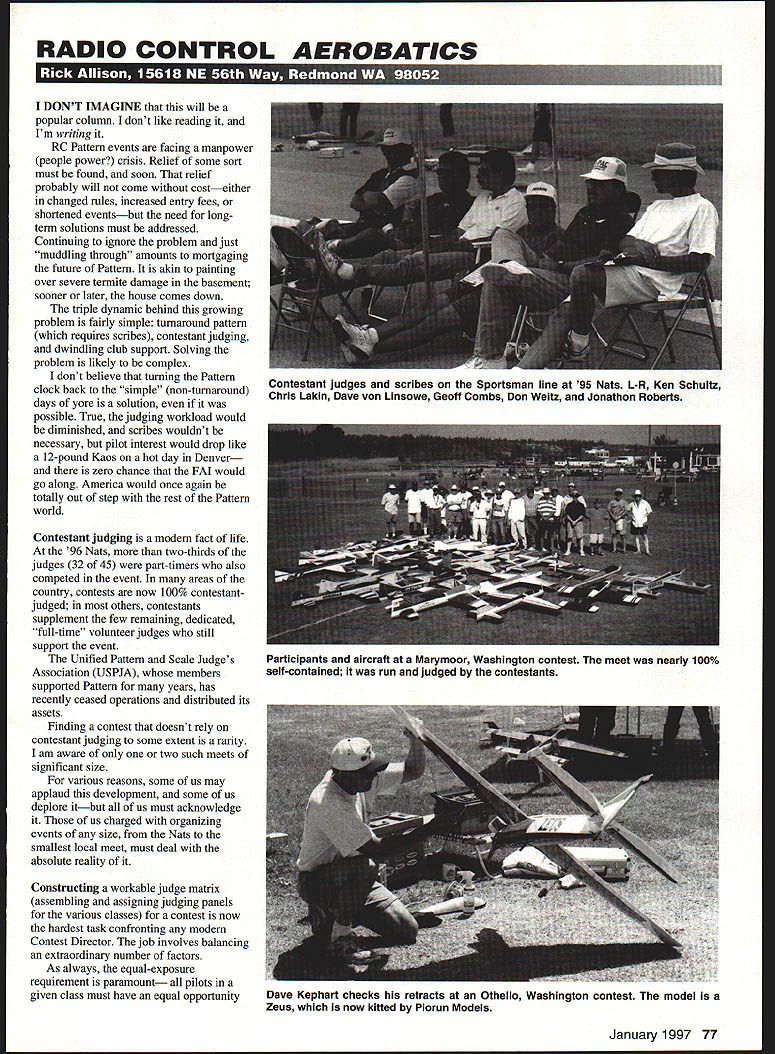
Contestant judging is a modern fact of life. At the '96 Nats, more than two-thirds of the judges (32 of 45) were part-timers who also competed in the event. In many areas of the country, contests are now 100% contestant-judged; in most others, contestants supplement the few remaining, dedicated, "full-time" volunteer judges who still support the event.
The Unified Pattern and Scale Judge's Association (USPJA), whose members supported Pattern for many years, has recently ceased operations and distributed its assets.
Finding a contest that doesn't rely on contestant judging to some extent is a rarity. I am aware of only one or two such meets of significant size. For various reasons, some of us may applaud this development, and some of us deplore it—but all of us must acknowledge it. Those of us charged with organizing events of any size, from the Nats to the smallest local meet, must deal with the absolute reality of it.
Constructing the judge matrix
Constructing a workable judge matrix (assembling and assigning judging panels for the various classes) for a contest is now the hardest task confronting any modern Contest Director. The job involves balancing an extraordinary number of factors.
As always, the equal-exposure requirement is paramount—all pilots in a given class must have an equal opportunity to fly in front of all the judge sets for that class.
Other factors that must be taken into account when assembling judging panels include:
- The abilities and experience levels of the available judges.
- With pilot-judges, their positions in the flight order or their radio frequencies.
- The possible effect of rotating the flight order by round.
- The structure of the contest: number of lines and/or sites; which classes fly when and where and with what other classes; and the number of rounds to be flown.
This was a factor even before contestant judging became the norm, but now this relationship is often turned inside-out, with the structure of the contest being arranged or modified to accommodate the judging matrix.
When all or most of the judges are competing, it just isn't possible to work them every round. Two or three rounds of one or two classes per event is the maximum that can be expected from a contestant judge—and this means that more judges must be used. A local, two-line, six-hour contest with 25 entrants used to require four to six full-time judges. The same contest today with contestant judging requires double or triple that number.
Scribes and the Scribe Matrix
Each of those judges must also have a scribe, at least in the full-turnaround classes. Grade-school arithmetic indicates that the number of judges and scribes required for the contest now exceeds the number of entrants.
So far, the answer has been to use pilots for scribes, but this means that the average pilot not only judges several rounds at the average contest, but also scribes several rounds. It also means that an already overloaded Contest Director must now construct a Scribe Matrix in addition to the Judging Matrix—which not only requires an identical sort of balancing act, but interacts with the Judging Matrix as well. An already difficult task has been more than doubled in complexity.
Lower club support and paid officials
Lower levels of club support affect Pattern events in a different way, but the end result is very similar: more pressure on contestants and officials.
Contests require officials. Our solution in recent years has been to establish a Central Contest Office and hire paid officials. These paid officials perform the routine, labor-intensive duties that earlier volunteers used to carry out. They do the scorekeeping, radio coordination, timing, field marshal duties and so on. This approach relieves the volunteer core so they can concentrate on judging and the higher-level tasks.
Paid officials are expensive, however, and increase entry fees. That, in turn, reduces entries—a vicious circle. It is ironic that contestant-judged events save money because they eliminate paid officials, but they cost more in volunteer mileage and ultimately fragment the dedication needed to sustain the events.
Conclusion
The manpower problem in RC Pattern is real and growing. It will require thoughtful, possibly difficult choices—rule changes, altered event formats, different staffing models, or increased fees—to find long-term relief. Ignoring the issue now only makes the eventual solution harder and more costly.
Transcribed from original scans by AI. Minor OCR errors may remain.

