
RADIO CONTROL AEROBATICS
Rick Allison 15618 NE 56th Way, Redmond WA 98052
NSRCA Rules Survey
During every AMA rules cycle, the National Society of Radio Controlled Aerobatics (NSRCA) surveys its members to determine what Pattern event rules may need to be modified, added to, or subtracted from the AMA Competition Regulations.
The survey results carry no force of law; they are advisory in nature and intended solely to guide the NSRCA Rules Committee as it generates NSRCA-backed rules proposals and lobbies for or against proposals affecting Pattern that are received from other sources. Although advisory, the survey results carry significant weight with the RC Aerobatics Contest Board. The Rules Survey is one of the best reasons for becoming an NSRCA member—second only to the excellent monthly newsletter, K-Factor, a 40-page miniature magazine devoted entirely to Precision Aerobatics.
You can become an NSRCA member by contacting Secretary/Treasurer Maureen Dunphy at 215 Industrial Boulevard, Tullahoma TN 37388; Tel: (615) 455-0735. Dues are $30/year.
The 1996 Weight-Limit Question
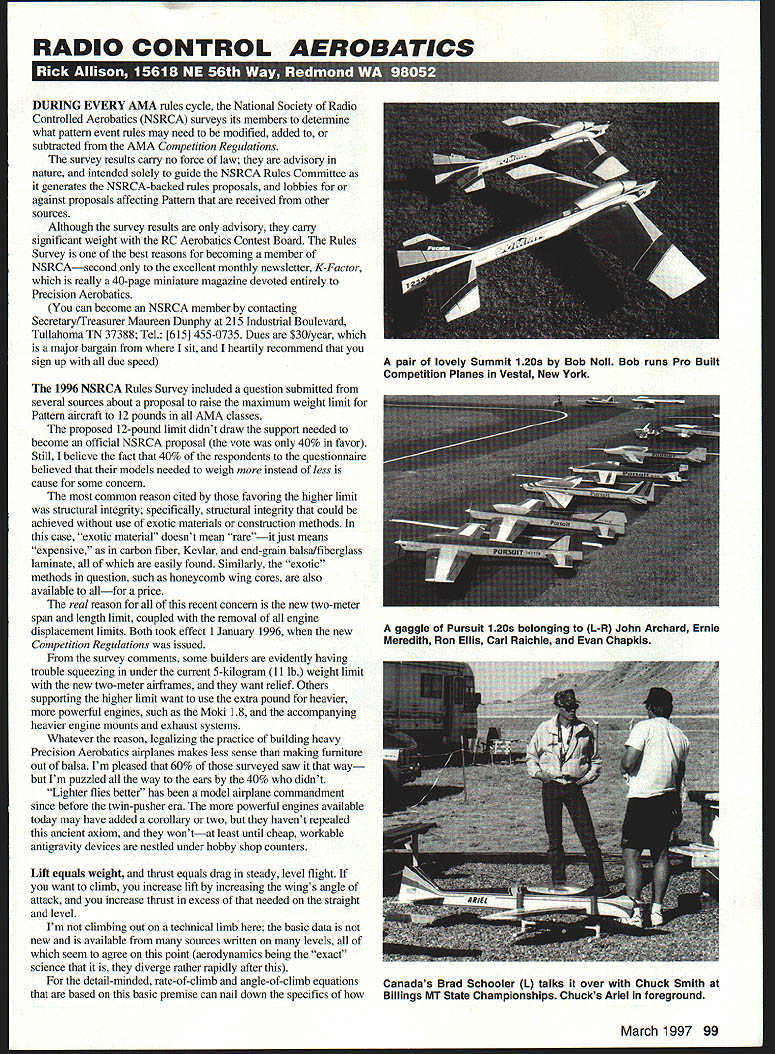
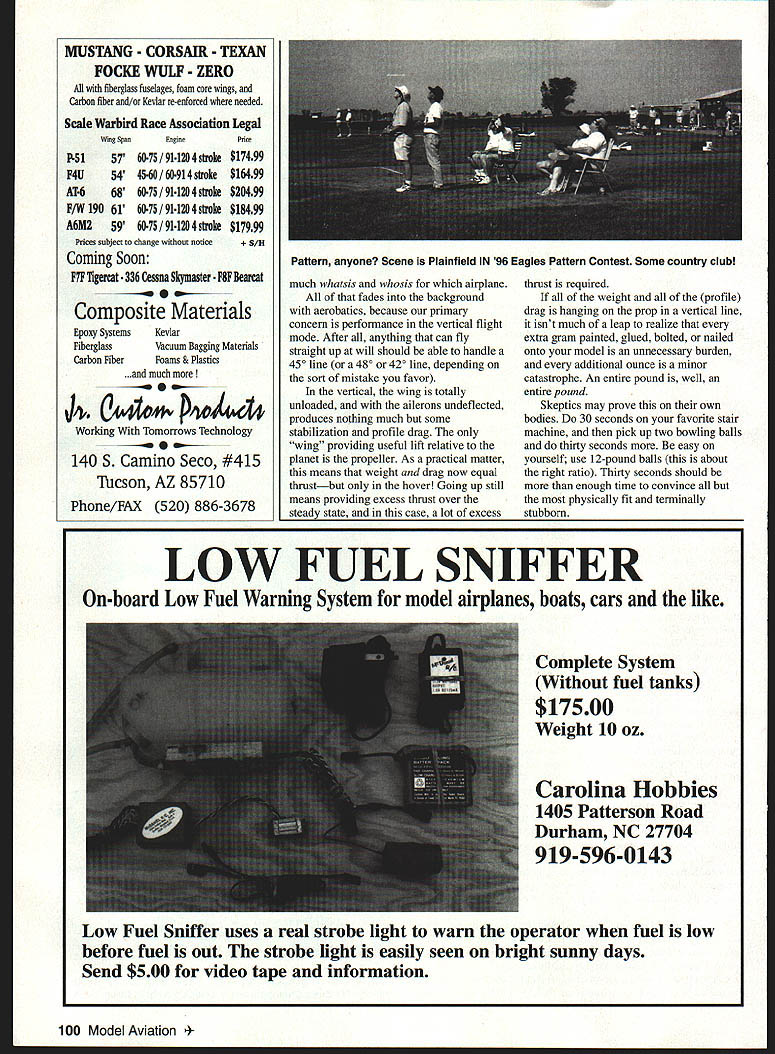
The 1996 NSRCA Rules Survey included a question, submitted from several sources, about a proposal to raise the maximum weight limit for Pattern aircraft to 12 pounds in all AMA classes.
The proposed 12-pound limit didn't draw the support needed to become an official NSRCA proposal (the vote was only 40% in favor). Still, the fact that 40% of respondents believed their models needed to weigh more is cause for concern.
The most common reason cited by those favoring the higher limit was structural integrity—specifically, structural integrity achievable without use of exotic materials or construction methods. In this context, "exotic materials" means expensive materials such as carbon fiber, Kevlar, and end-grain balsa/fiberglass laminate. "Exotic" methods like honeycomb wing cores are also available but add cost and handling complexity.
The real reason for this concern is the new two-meter span and length limit, coupled with the removal of all engine displacement limits, which took effect 1 January 1996 when the new Competition Regulations were issued. From survey comments, some builders are having trouble staying under the current 5-kilogram (11 lb.) weight limit with the new two-meter airframes and want relief. Others favoring the higher limit want to use the extra pound for heavier, more powerful engines (for example, the Moki 1.8) and the heavier engine mounts and exhaust systems that accompany them.
Why Lighter Is Better
Legalizing heavier Precision Aerobatics airplanes makes less sense than making furniture out of balsa. "Lighter flies better" has been a model-airplane commandment since before the twin-pusher era. More powerful engines may add corollaries, but they haven't repealed this axiom.
In steady, level flight lift equals weight and thrust equals drag. To climb you increase lift (usually by increasing the wing's angle of attack) and increase thrust in excess of that needed for straight-and-level flight. Rate-of-climb and angle-of-climb equations can quantify specifics, but the basic premise is clear: heavier aircraft require more excess thrust to climb and perform vertical maneuvers.
Aerodynamics and Vertical Flight
In the vertical, the wing is largely unloaded; with ailerons neutral it produces mostly stabilization and profile drag. The propeller becomes the primary "wing" providing useful lift relative to the planet. As a practical matter, in vertical flight weight plus drag must be overcome by thrust, and a lot of excess thrust is required.
If all of the weight and profile drag is hanging behind the prop in a vertical climb, every extra gram attached to your model is an unnecessary burden. Every ounce matters; an entire pound is a major penalty in vertical performance.
A simple (if visceral) demonstration: do 30 seconds on a stair climber, then pick up two 12-pound bowling balls and do thirty seconds more. The extra load will convince most people how much difference weight makes.
Common Myths About Heavier Airplanes
- Heavy airplanes are more stable in turbulence.
- Semi-true for initial gust deflection, but in general light airplanes damp oscillations better and faster because there is less mass to move.
- Heavy airplanes fly better in strong wind.
- Not really. Thrust is king in wind, and extra weight degrades power loading and thus diminishes the effectiveness of thrust.
- Heavy airplanes are more structurally rigid.
- Not necessarily. Heavier structures often flex more because of increased bending loads. Rigidity is a product of good structural design, proper material selection, and workmanship—not weight per se.
How to Save Weight
If you accept that light is better, getting there need not be difficult or expensive—and it might save you money on engines and fuel. Common weight culprits are heavy wood, excess glue, and too much paint. Some strategies:
- Use a gram scale and weigh components and wood.
- Choose lightweight hardware where practical (wheels, axles, exhaust systems), but expect the major accessories (engine, radio, mounting hardware) to be similar in weight across comparable setups—often around five pounds total for a modern 1.20 four-stroke-powered Pattern model.
- Wing and stab cores are generally cut from 1 lb./cu. ft. density foam. Honeycomb cores can save several ounces but at a cost in labor and handling durability.
Paint and Finishing
Paint can add surprising weight. The primer weighs the most, then pigment coats, then clear coats. Common pitfalls and tips:
- Don't try to achieve full coverage with primer. Primer should fill minor imperfections and reveal voids and pinholes.
- Wet-sand between primer coats using 400–600 grit to remove buildup.
- Avoid heavy filler use; fill only where necessary.
- If using translucent colors (e.g., yellow), shoot a light white or silver blocking coat first so the translucent color needs only one or two light coats.
- Don't fix surface flaws by adding more paint—fill them or accept them.
- Wet-sand runs, dust specks, and tape lines with 500–600 grit.
- Scuff the rest with Scotch-Brite and restore gloss with a light clear coat. Sand off heavy buildup, leave light finish coats, and stop.
The finished surface after filling and sanding should look patchy before final finishing—this is normal.
Glue and Epoxy
- Large, sloppy globs of epoxy, excessive glue fillets on joints, and thick resin coats when laminating add weight and do not proportionally increase strength.
- Wipe excess glue away before it cures. Treat epoxy as if it were expensive—use only what is necessary and apply it neatly.
Balsa Selection and Wood Choices
Balsa varies widely in density—from about 4 lb./cu. ft. to more than 12 lb./cu. ft. Recommendations:
- Wood above about 8.9 lb./cu. ft. has no business in a Precision Aerobatics model.
- Contest balsa typically weighs 4–6 lb./cu. ft. Use contest wood for wing sheeting, tip blocks, and control surface facings.
- 7–8 lb. wood is permissible for leading and trailing edges.
- A typical 1.20-sized wing skin made from 5 lb. wood weighs about 35 grams; the same skin in 10 lb. wood will weigh roughly double. Across a whole model, using lighter contest wood instead of bin-grade wood can save well over 1/2 pound.
Use a gram scale and a weight chart to select wood. Most hobby-shop wood checks at the upper end of the weight curve, but some shops stock contest balsa. If you buy by mail, order extra—balsa is an organic commodity and a few pieces will fail inspection.
Grain types:
- A-grain: even grain running lengthwise. Good for sheeting, tips, edges, and facings.
- C-grain: cut across the annular rings with a mottled appearance; useful where stiffness is a premium (last piece on the skin, inboard area).
- B-grain: mixed characteristics; avoid when possible due to uneven behavior.
Sources for Contest Balsa
Sig Manufacturing Co., Inc. publishes an excellent brochure, Important Facts About Balsa Wood, available free from many hobby shops or directly from Sig. Sig is also a source of high-quality contest balsa. Contact them at (515) 623-5154. The toll-free number for orders only is (800) 247-5008.
Engine Mounts and Plywood Alternatives
Modern soft engine mounts transmit less vibration, so less surrounding structure is needed. Aircraft plywood can weigh more than 40% more than equal-thickness light poplar plywood or end-grain composite laminate. End-grain composite laminates are much stiffer than plywood, which may allow you to halve the thickness of a firewall or gear-mounting plate—yielding substantial weight savings.
Final Advice
Instead of wishing (and voting) for legal lead slabs, buy a good scale and use it—for wood and accessories. Remember: you are painting an airplane, not a car. Use epoxy sparingly and leave the heavy 12 lb./cu. ft. balsa in the shop bin—maybe a craftsperson can make miniature furniture from it. Light construction, careful finishing, and mindful material choices will yield better aerobatic performance.
Transcribed from original scans by AI. Minor OCR errors may remain.

