
Radio Control: Aerobatics
Rick Allison 15618 NE 56th Way, Redmond WA 98052
Introduction
Seldom have new modeling products been more anxiously awaited than the new generation of Pattern engines now appearing under hobby shop counters across the country. The development of engines such as the Webra-based UAV Bully 1.20 two-stroke, the O.S. 1.40 two-stroke, and the Y.S. 1.40FZ was inevitable after the lifting of the old engine displacement limits in FAI F3A (1995) and AMA Pattern (1996).
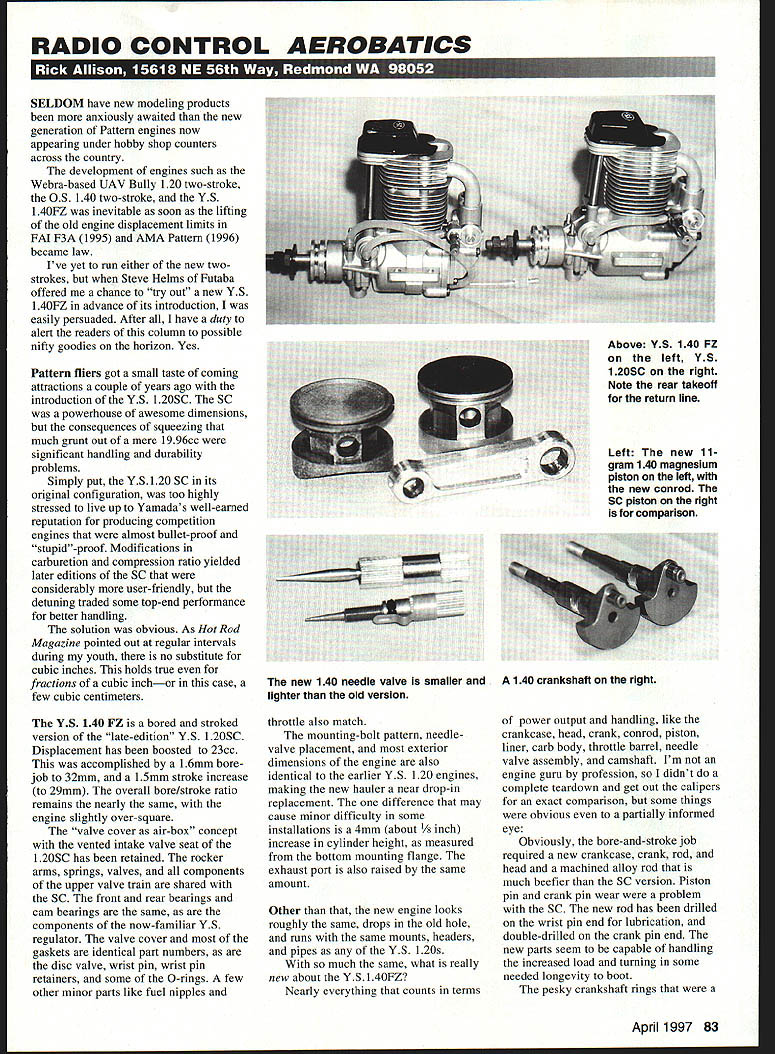
I recently had a chance to try a Y.S. 1.40FZ, provided by Steve Helms of Futaba, and report here on the design changes, installation considerations, and my brief flight experience.
Background: Y.S. 1.20SC lessons
Pattern fliers got a taste of the new direction a couple of years ago with the Y.S. 1.20SC. The SC was a powerhouse for its displacement (19.96 cc), but squeezing that much power into a small package produced significant handling and durability problems. In its original configuration the SC was too highly stressed to match Yamada’s reputation for nearly bullet-proof competition engines.
Later SC editions were detuned via carburetion and compression changes to improve handling and durability at the expense of some top-end performance. The obvious alternative, as the old adage goes, is more displacement—more cubic centimeters rather than extreme tuning.
The Y.S. 1.40FZ
Displacement and basic dimensions
- The 1.40FZ is a bored-and-stroked evolution of the late-edition Y.S. 1.20SC.
- Displacement has been boosted to 23 cc.
- Achieved by a 1.6 mm bore increase to 32.0 mm and a 1.5 mm stroke increase to 29.0 mm.
- The overall bore/stroke ratio remains nearly the same; the engine is slightly over-square.
Shared parts and compatibility
- Y.S. retained many familiar features for near drop-in replacement:
- Valve-cover-as-air-box concept and the vented intake valve seat from the 1.20SC.
- Rocker arms, springs, valves and most components of the upper valve train.
- Front and rear bearings, cam bearings, and many regulator components.
- Disc valve, wrist pin, wrist pin retainers, several O-rings, and some gaskets.
- Mounting-bolt pattern, needle-valve placement and most exterior dimensions match earlier Y.S. 1.20 engines.
- One installation difference: cylinder height is increased by about 4 mm (≈1/8 in) measured from the bottom mounting flange; the exhaust port is raised by the same amount.
New components and improvements
Nearly everything that affects power output and handling is new:
- New crankcase, crankshaft, connecting rod and cylinder head to accommodate the bore/stroke changes.
- Machined alloy connecting rod is beefier than the SC version; wrist-pin end drilled for lubrication and crank-pin end double-drilled to reduce wear.
- Magnesium piston with a dished top: weighs about 11 g versus roughly 16 g for SC/AC pistons, reducing reciprocating mass.
- New camshaft with sharper lobe rise, apparently increased lift and altered duration; head flow passages appear relieved and smoother.
- Needle valve and body completely redesigned—much smaller and lighter to reduce vibration-induced wear.
- Throttle barrel incorporates a much larger bleed groove than SC versions.
- Crankcase/regulator vent closed internally; an external jumper line now connects the front regulator nipple to a backplate-mounted pressure takeoff behind the disc valve.
- Front end has a new drive washer and split-collet retainer butted against a steel standoff that rides on the front bearing rim (similar to a Y.S. front seal arrangement).
- Published weight: 875 g (31 1/8 oz.), about 75 g lighter than the AC and at least 20 g lighter than the SC.
Test installation and flight
Setup
- Installed in a two-meter, 10-lb Python 1100 airframe.
- The project took about 27 minutes total work time; the engine had five minutes run-time from the factory, so I ran one additional tank before flying.
- Factory idle and regulator settings were left unchanged; main needle initially set fairly rich.
Performance observations
- Untweaked idle was a smooth 1,900 rpm out of the box; transition was smooth and instantaneous.
- On a 16x13 APC prop the engine turned 7,600–7,700 rpm on 20% nitro (my SC had turned that prop at about 7,800 rpm on 30% nitro).
- Noticeably less vibration at all engine speeds—likely a benefit of reduced reciprocating mass.
- Very solid and stable through the midrange; the 1.40FZ hauled the model straight up without discernible effort and transitioned flawlessly.
- Toward the end of the second tank the revs began to pick up as the engine came on; weather curtailed further flying.
- Overall impression: the 1.40FZ combined more power with user-friendly handling—lighter, smoother, easier to manage, and fewer problematic parts than earlier highly stressed versions.
Verdict
- The Y.S. 1.40FZ appears to give the benefits of increased displacement—more power and durability—while maintaining many installation conveniences of the 1.20 family.
- Lighter reciprocating parts (magnesium piston) and redesigned internals should reduce vibration-related wear and improve longevity.
- I predict the 1.40FZ will be a popular choice for Pattern fliers and aerobatic modelers.
Snake Drive throttle-control system
Concept
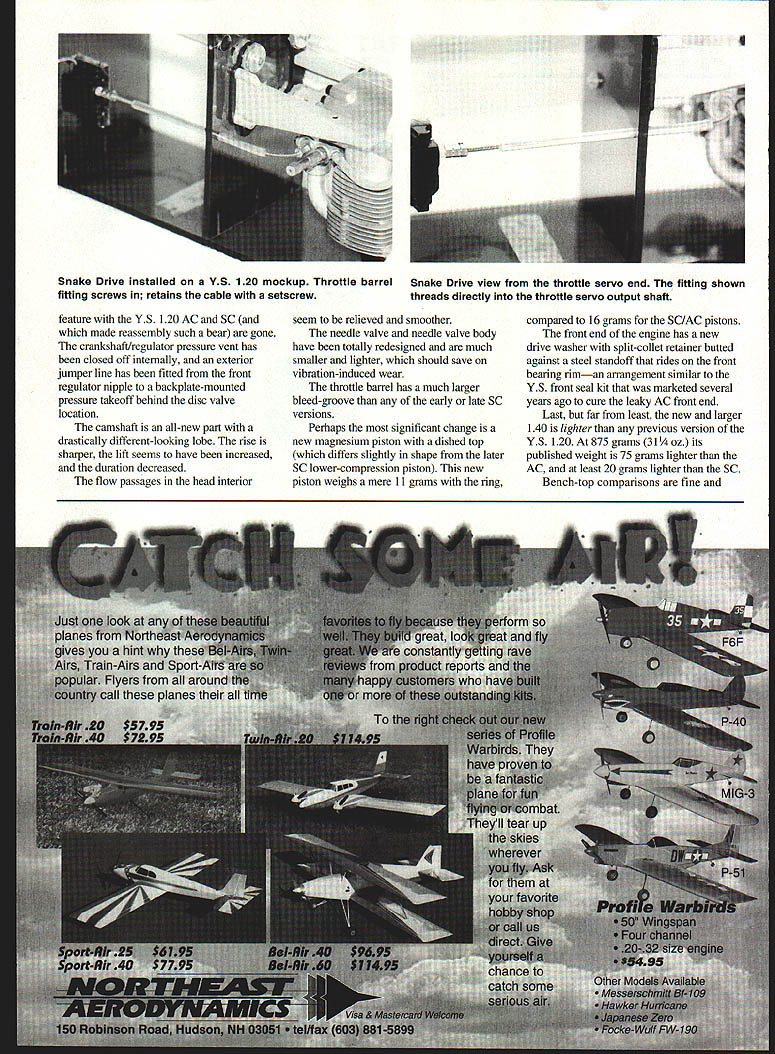
- The Snake Drive is a patented throttle cable/control system by Ralph DeLorio. It uses a wound flex cable (similar to a small speedometer cable) in a double Teflon sleeve, carried in a 1/4-inch aluminum housing.
- It is available for larger gas engines and in a version that fits Y.S. .91 through 1.40 engines.
How it works and benefits
- It uses the rotary output motion of a servo to directly drive the rotary motion of the throttle barrel—eliminating the usual rotary-to-linear-to-rotary conversion (servo arm → pushrod/cable → throttle arm).
- Benefits:
- Eliminates nonlinear “reverse-expo” motion introduced by servo and throttle arms, producing much smoother, more linear throttle response.
- Absorbs engine shake at idle without moving the throttle barrel, yielding rock-solid idle even with soft mounts; idle can often be set 200–300 rpm lower and remain stable.
- Dramatically reduces friction and drag on the throttle servo, lowering servo current draw.
- Makes partial-throttle maneuvers and smooth transitions much easier to execute.
Installation and availability
- Requires a radio with end-point adjustments on the throttle channel.
- Can make a 90° bend in less than 3/4 inch (measured from the throttle barrel face with the throttle arm removed).
- Price for the Y.S.-sized unit: $34.95.
- Order directly from Ralph DeLorio at (888) 742-7737, or Webster Hobby Shop at (888) 546-5159; expect wider availability through Pattern-equipment outlets.
Summary
The Y.S. 1.40FZ builds on the 1.20 line but increases displacement and re-engineers key components to improve power, smoothness, and durability while retaining much of the 1.20 family’s installation compatibility. The Snake Drive is a complementary accessory that can significantly improve throttle feel and idle stability. Both products are worth consideration for Pattern and scale aerobatic models.
Transcribed from original scans by AI. Minor OCR errors may remain.

