
Radio Control: Aerobatics
Rick Allison 15618 NE 56th Way, Redmond WA 98052
International Air Meet (Japan)
First up this month is a short report by Dianne Kristensen on the inaugural International Air Meet, held in conjunction with Japan's 10th Annual Aero Pageant, November 2–3, 1996.
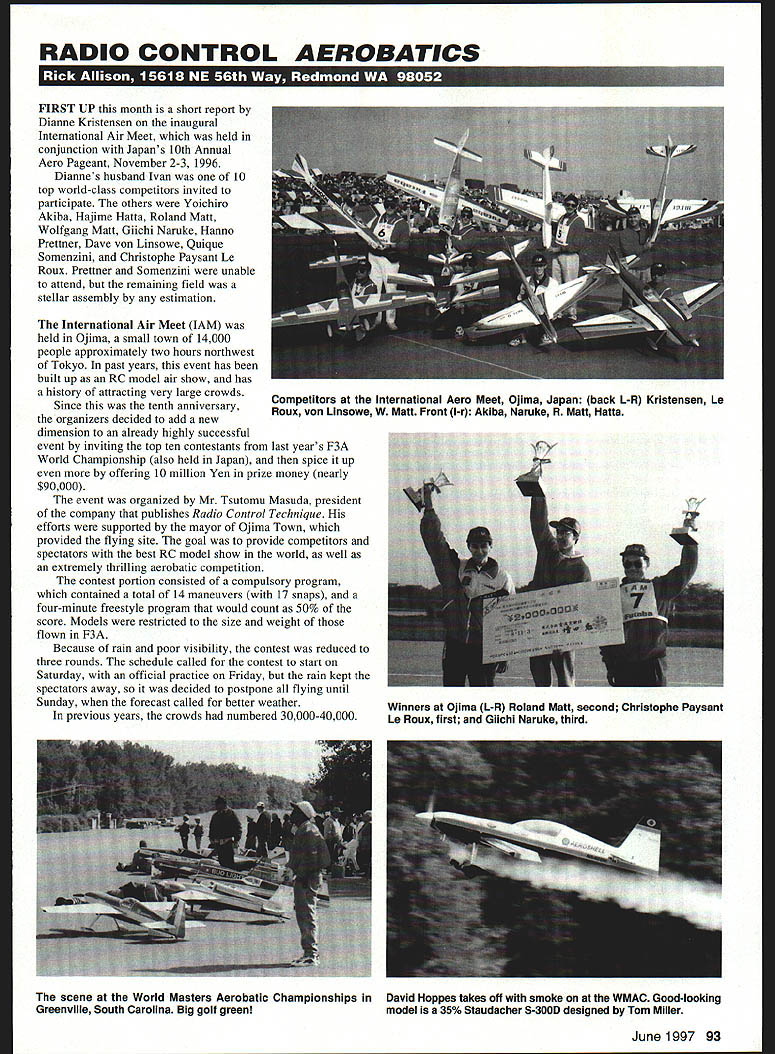
Dianne's husband, Ivan, was one of 10 top world-class competitors invited to participate. The invited fliers were:
- Yoichiro Akiba
- Hajime Hatta
- Roland Matt
- Wolfgang Matt
- Giichi Naruke
- Hanno Prettner (unable to attend)
- Dave von Linsowe
- Quique Somenzini (unable to attend)
- Christophe Paysant Le Roux
- Ivan Kristensen
The International Air Meet (IAM) was held in Ojima, a town of about 14,000 people roughly two hours northwest of Tokyo. In past years the event has been built up as an RC model air show and has a history of attracting very large crowds. Since this was the tenth anniversary, organizers invited the top ten contestants from the previous year's F3A World Championship (also held in Japan) and offered 10 million Yen in prize money (nearly $90,000).
The event was organized by Mr. Tsutomu Masuda, president of the company that publishes Radio Control Technique, with support from the mayor of Ojima Town, which provided the flying site. The goal was to provide competitors and spectators with the best RC model show in the world and an extremely thrilling aerobatic competition.
Contest format:
- Compulsory program: 14 maneuvers (with 17 snaps)
- Freestyle program: four minutes, counting as 50% of the score
- Aircraft restricted to the size and weight used in F3A
Because of rain and poor visibility, the contest was reduced to three rounds. The schedule called for the contest to start on Saturday, with official practice on Friday, but the weather postponed all flying until Sunday when the forecast was better. In previous years crowds had numbered 30,000–40,000; this year an estimated 50,000 people turned out on Sunday. Organizers felt the international field drew additional spectators.
Results
Final standings:
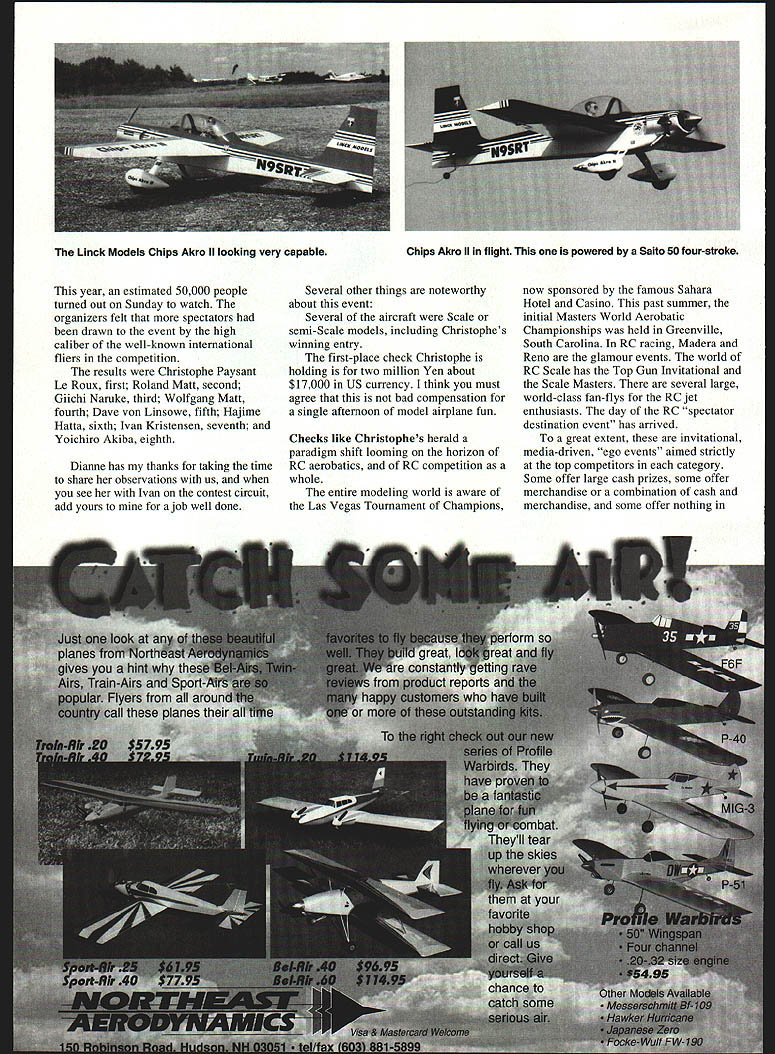
- Christophe Paysant Le Roux — first
- Roland Matt — second
- Giichi Naruke — third
- Wolfgang Matt — fourth
- Dave von Linsowe — fifth
- Hajime Hatta — sixth
- Ivan Kristensen — seventh
- Yoichiro Akiba — eighth
Dianne has my thanks for sharing her observations. When you see her and Ivan on the contest circuit, please join me in congratulating them.
Noteworthy items from the event
- Several of the aircraft were scale or semi-scale models, including Christophe's winning entry.
- The first-place check Christophe is holding was for two million Yen—about $17,000 U.S. This is substantial compensation for a single afternoon of model airplane competition.
- Checks like Christophe's signal a paradigm shift in RC aerobatics and RC competition in general.
The modeling world is aware of several high-profile spectator events:
- The Las Vegas Tournament of Champions (TOC), now sponsored by the Sahara Hotel and Casino
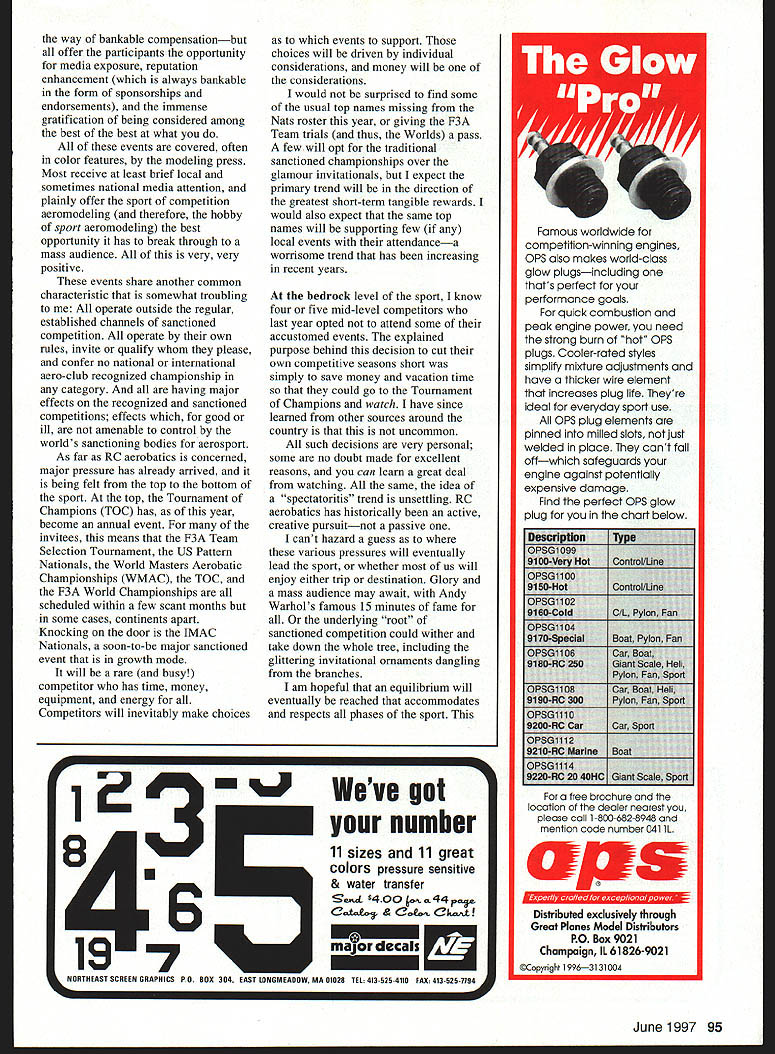
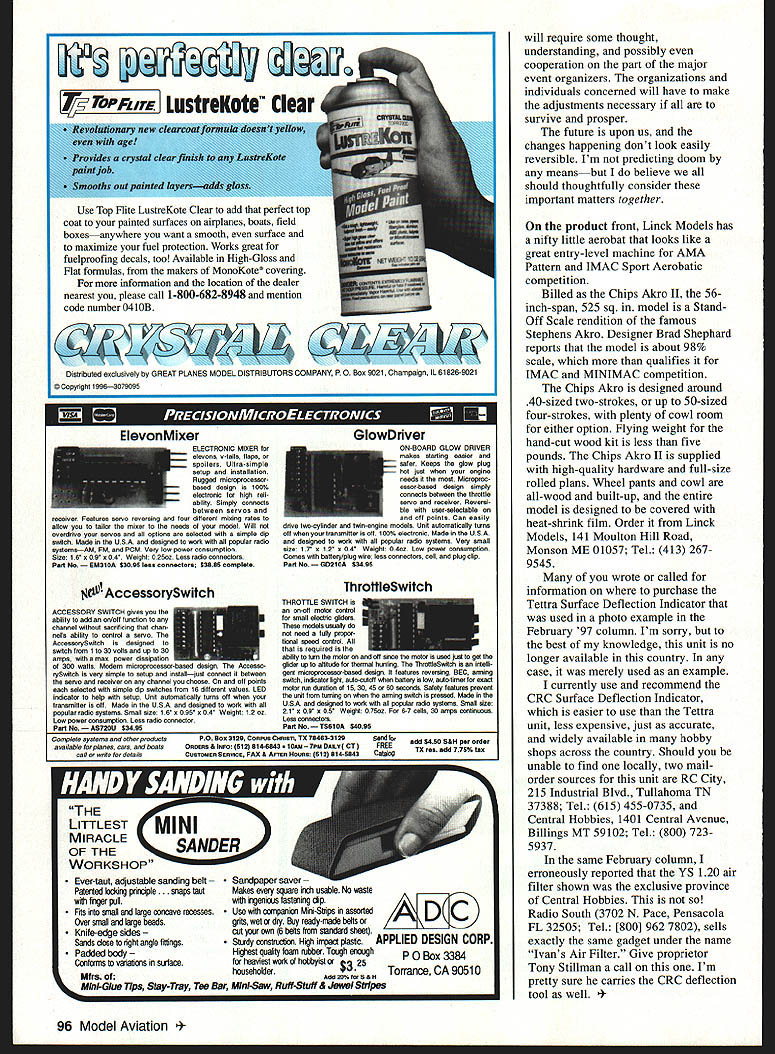
- The Masters World Aerobatic Championships (WMAC), held this past summer in Greenville, South Carolina
- RC racing glamour events in Madera and Reno
- RC Scale events such as the Top Gun Invitational and Scale Masters
- Various large fan-flys for RC jet enthusiasts
These are largely invitational, media-driven "ego events" aimed at top competitors. Some offer large cash prizes, some merchandise, some both, and some offer primarily media exposure, reputation enhancement, and sponsorship opportunities. Most receive at least brief local—and sometimes national—media attention. Such events give aeromodeling its best opportunity to break through to a mass audience.
Very positive events share another common characteristic, somewhat troubling to me: they operate outside the regular, established channels of sanctioned competition. They set their own rules, invite or qualify whom they please, and confer no national or international aero-club recognized championships. All are having major effects on recognized and sanctioned competitions—effects that, for good or ill, are not amenable to control by the world's sanctioning bodies for aerosport.
Pressure on competitors and the sport
Major pressure is already being felt throughout the sport. The TOC has become an annual event. For many invitees, the calendar now includes the F3A Team Selection Tournament, the US Pattern Nationals, WMAC, the TOC, and the F3A World Championships within a few months—and sometimes on different continents.
Knocking on the door is the IMAC Nationals, a soon-to-be major sanctioned event that is growing. It will be rare (and busy) for a competitor to have the time, money, equipment, and energy to attend all these events. Competitors will inevitably make choices driven by personal considerations—money being a significant factor.
I would not be surprised to see some top names missing from the Nats roster this year, or to see some give the F3A Team trials (and thus the Worlds) a pass. A few will opt for traditional sanctioned championships over glamour invitationals, but I expect the primary trend will favor the greatest short-term tangible rewards. I also expect that many top names will attend few (if any) local events—a worrisome trend that has been increasing.
At the grassroots level, I know several mid-level competitors who last year skipped customary events to save money and vacation time so they could attend the Tournament of Champions as spectators. I’ve learned from other sources that this is not uncommon. Such decisions are personal; some are made for excellent reasons and can be educational. Still, the rise of a "spectatorist" trend is unsettling. RC aerobatics has historically been an active, creative pursuit—not a passive one.
I can't predict where these pressures will lead the sport, or whether most of us will enjoy the resulting changes. Glory and a mass audience may await, or the underlying foundation of sanctioned competition could wither and jeopardize the whole structure, including the glittering invitationals. I am hopeful that an equilibrium will eventually be reached that accommodates and respects all phases of the sport. This will require some thought, understanding, and possibly even cooperation on the part of major event organizers. The organizations and individuals concerned will have to make the adjustments necessary if all are to survive and prosper.
The future is upon us, and the changes don't look easily reversible. I'm not predicting doom, but we should thoughtfully consider these important matters together.
Product notes
Linck Models has a compact aerobat that looks like a great entry-level machine for AMA Pattern and IMAC Sport Aerobatic competition. Billed as the Chips Akro II, the model is a stand-off scale rendition of the Stephens Akro.
Chips Akro II highlights:
- Wingspan: 56 inches
- Wing area: 525 sq. in.
- Scale: about 98% scale (designer Brad Shephard)
- Power: designed for .40 two-strokes or up to .50 four-strokes
- Flying weight: less than 5 pounds (hand-cut wood kit)
- Construction: wheel pants and cowl are all-wood and built-up; designed to be covered with heat-shrink film
- Kit includes high-quality hardware and full-size rolled plans
Order from: Linck Models 141 Moulton Hill Road Monson ME 01057 Tel.: (413) 267-9545
Tools and accessories
Many readers asked where to purchase the Tetra Surface Deflection Indicator shown in a photo example in the February 1997 column. To the best of my knowledge, that unit is no longer available in this country; it was merely used as an example.
I currently use and recommend the CRC Surface Deflection Indicator. It is easier to use than the Tetra unit, less expensive, accurate, and widely available in hobby shops. If you cannot find one locally, two mail-order sources are:
- RC City, 215 Industrial Blvd., Tullahoma TN 37388; Tel.: (615) 455-0735
- Central Hobbies, 1401 Central Avenue, Billings MT 59102; Tel.: (800) 723-9397
In the same February column I erroneously reported that the YS 1.20 air filter shown was exclusively available from Central Hobbies. This is not so. Radio South sells the same gadget under the name "Ivan's Air Filter." Radio South:
- Radio South, 3702 N. Pace, Pensacola FL 32505; Tel.: (800) 962-7802
Give proprietor Tony Stillman a call. I'm pretty sure he also carries the CRC Surface Deflection Indicator.
Transcribed from original scans by AI. Minor OCR errors may remain.

