
Radio Control: Aerobatics
Rick Allison, 15618 NE 56th Way, Redmond WA 98052
Corrections and clarifications
I was once assured by a kindly teacher, after the semi-disastrous outcome of a botched chem-lab experiment, that making mistakes is part of being a productive human being. The important thing, he told me, was to make the proper correction and move on. Years later, I still find myself producing prima facie evidence of my humanity, which means proper corrections must follow ASAP.
- Differential control surface travel (February column): My original explanation was backwards. If the clevis attachment point is in front of the hinge line and the pushrod is below the control surface, the mechanical arrangement produces more "down" travel than "up." To get more "up" than "down," the clevis attachment point must be aft of the hinge line. If the pushrod and servo are above the surface, the effect is reversed relative to our view of "up" and "down."
- Lonnie Martin/Nats airplane (December 1996 coverage): I misstated that "Lonnie Martin won Masters with a Guerin-built Sequel." He did not. Lonnie won Masters with a Guerin-built Dr. Jekyll 1.20 (the Dr. Jekyll is a Chip Hyde design; the Sequel credits Dave Guerin as designer). I relied on photographs instead of notes; Lonnie had borrowed a Sequel for a posed photo after the contest, which confused identification. Mea culpa.
- Incorrect telephone number (April column): Snake Drive manufacturer Ralph DeLorio's correct direct-order number is (888) 740-7737 (not 742-7737 as listed).
My sincere apologies to anyone I may have misled, misinformed, or misdirected. I will try harder to reduce the incidence of rash statements.
Scale and scalelike Pattern models — trend and outlook
One of the newest trends in RC precision aerobatics is the increased presence of scale, scalelike, and semi-scale Pattern models — either already flying or rumored to be on the drawing boards.
Scale or scalelike models in Pattern are not entirely new. Notable historical and recent examples:
- 1964: Ralph Brookes' Crusader popularized jetlike Pattern models.
- 1984 Reno Nats: Chip Hyde won F3A with a Dick Hanson Models Dalotel; that model has also been campaigned in AMA Scale events.
- Late 1980s–1990s: Tony Frackowiak and Dean Koger flew scalelike biplanes in Team Selection events; Tony won in 1989 with Ken Bonnema’s Fly-Leaf.
- Popular competitive choices over time: MK Chipmunks, Hanson Slim-Zlins, Carl Goldberg Extra 300, Sukhoi, and Ultimate biplane kits.
I believe nearly all of the earlier models mentioned (except perhaps the Crusader) could be flown competitively in many of today’s Pattern classes if built light and powered appropriately. The Crusader might still do well in Novice or Sportsman.
Factors driving the current trend:
- The rising popularity and visibility of Tournament of Champions and similar Scale Aerobatics events.
- The availability of full-scale aerobatic monoplane designs that modelers can copy or adapt.
- FAI F3A maneuver schedules that include more snaps and spins.
- Sophisticated computer radios with mixing programs capable of handling pitch/roll coupling that some scale designs introduce.
- Modern engines and flying styles (close-in, constant-speed) that make higher-drag scale designs practical.
Notes on acceptance and limitations:
- Scale Pattern models are finally being scored well when flown well; they’re accepted as capable.
- Traditional Pattern models are not doomed. They remain highly optimized, aerodynamically pure, and often require less radio mixing. That capability has real value and will continue to attract designers and pilots.
- Problems scale models still face: control coupling, transportation hassles (fixed gear), and sensitivity to high drag in windy conditions. Given time and the skill of current designers, these difficulties are not insurmountable.
Likely outcome: a healthy mix of scale/semi-scale aerobatic models optimized for performance and traditional Pattern designs becoming somewhat more scalelike in appearance, with judges and competitors comfortable with both approaches.
Reviews: Guide to Computer Radio Control Systems and NHP Simulator
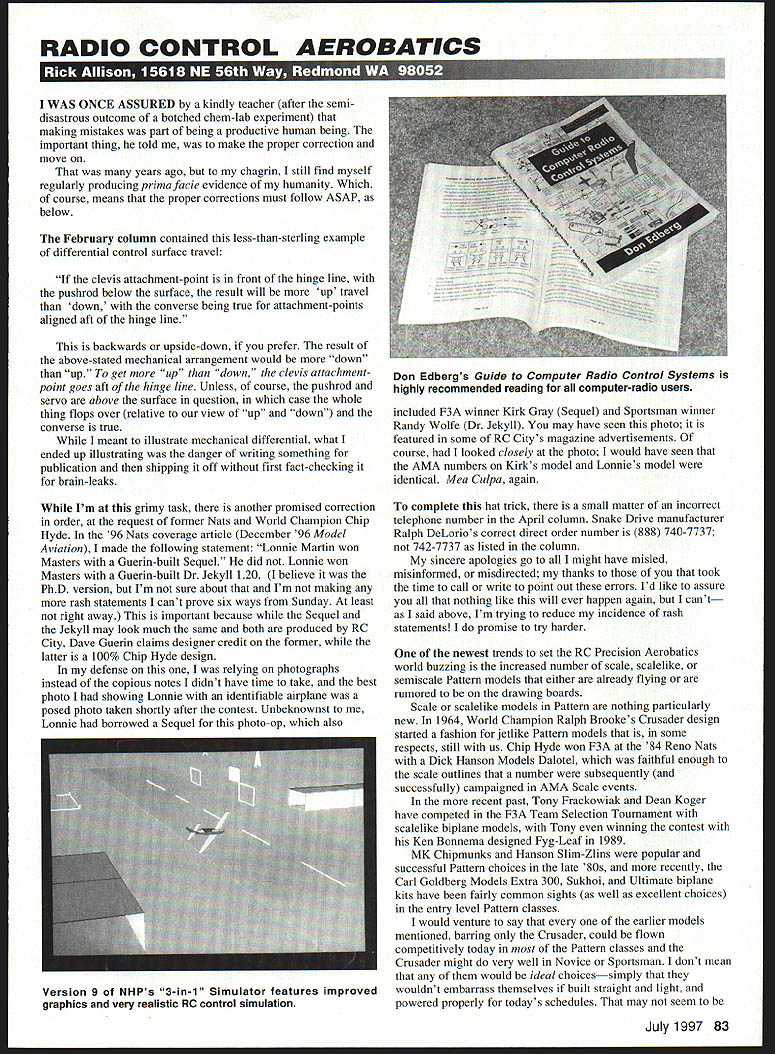
- Guide to Computer Radio Control Systems, by Don Edberg
This soft-cover manual covers both the "how" and the "why" of modern computer radios. It is clear, well-written, illustrated, indexed, and practical. Don Edberg is an experienced columnist and author (including Futaba-related manuals) and teaches aerospace engineering. The book is slightly more Futaba-oriented but also covers JR, Airtronics, and other brands; it addresses sailplane, helicopter, and aerobatics programming and trimming in detail.
Availability and ordering:
- Dynamic Modelling, 4922 Rochelle Ave., Irvine CA 92604-2941
- Tel.: (714) 552-1812
- E-mail orders: don_edberg@compuserve.com
- Price: $17.95 plus $4 shipping
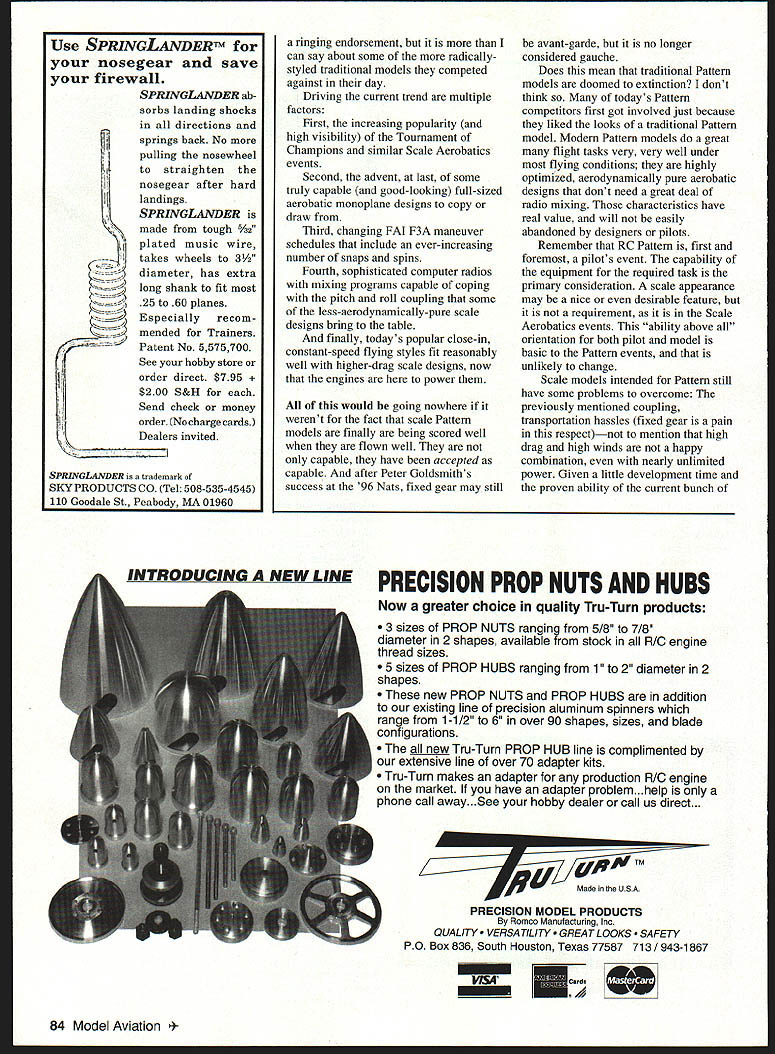
- NHP "3-in-1" RC Flight Simulator, Version 9
Version 9 of NHP’s well-known simulator is now available. It’s an excellent aerobatic practice tool that can use your own transmitter and offers very realistic control. Graphics have been substantially improved in this version.
- Retail price: $209.95
- Upgrade disk price (from earlier versions): $19.95
- Distributed by Horizon Hobby Distributors; check your favorite hobby store.
Closing
The ideas that work will persist; the rest will change. Both Pattern and Scale Aerobatic competitors should have more choices when considering new projects, and that's a good thing from where I sit.
Transcribed from original scans by AI. Minor OCR errors may remain.

