
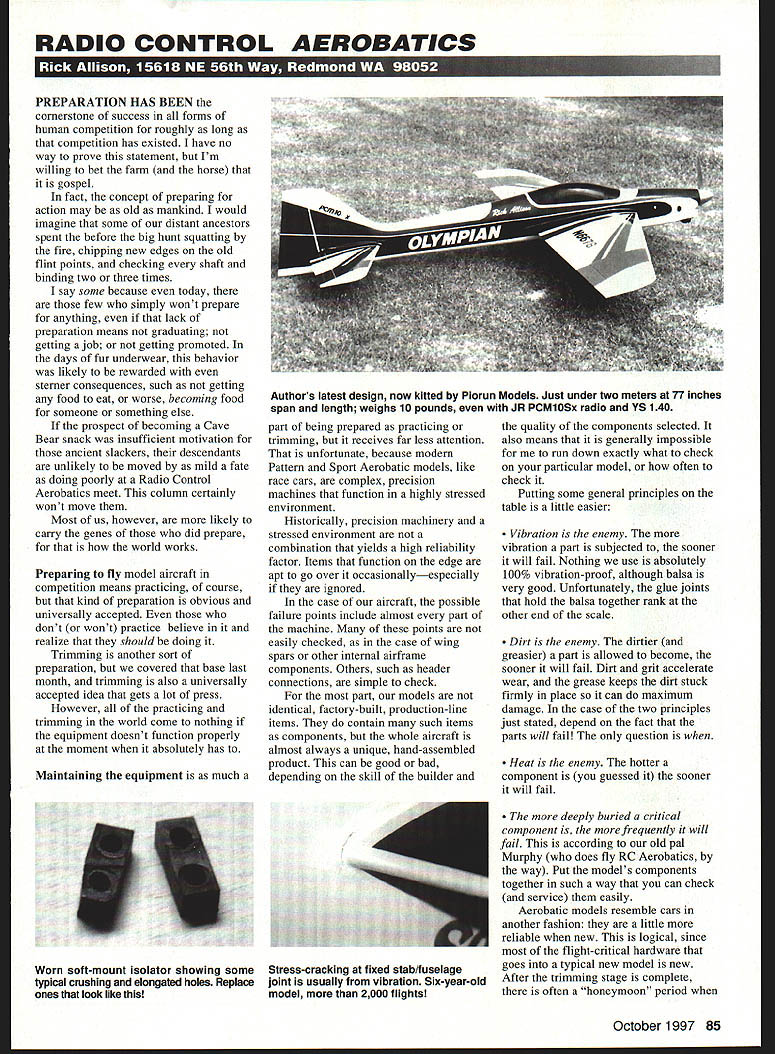
RADIO CONTROL AEROBATICS
Rick Allison 15618 NE 56th Way, Redmond WA 98052
Preparation and the Value of Practice
Preparation has been the cornerstone of success in all forms of human competition for roughly as long as that competition has existed. I have no way to prove this statement, but I'm willing to bet the farm (and the horse) that it is gospel.
The concept of preparing for action may be as old as mankind. Some of our distant ancestors likely spent the time before the big hunt squatting by the fire, chipping new edges on flint points, and checking every shaft and binding two or three times.
Even today, a few people simply won't prepare for anything, even if that lack of preparation means not graduating, not getting a job, or not getting promoted. In the days of fur underwear, this behavior was likely to be rewarded with sterner consequences, such as not getting any food to eat, or worse, becoming food for someone or something else.
If the prospect of becoming a cave-bear snack was insufficient motivation for those ancient slackers, their descendants are unlikely to be moved by as mild a fate as doing poorly at a Radio Control Aerobatics meet. This column certainly won't move them. Most of us, however, are more likely to carry the genes of those who did prepare.
Preparing to fly model aircraft in competition means practicing, of course, but that kind of preparation is obvious and universally accepted. Trimming is another sort of preparation—we covered that last month—and it, too, gets lots of attention.
However, all the practicing and trimming in the world come to nothing if the equipment doesn't function properly at the moment when it absolutely has to. Maintaining the equipment is as much a part of being prepared as practicing or trimming, but it receives far less attention. That is unfortunate, because modern Pattern and Sport Aerobatic models, like race cars, are complex, precision machines that function in a highly stressed environment.
General Principles of Maintenance
Historically, precision machinery operating in a stressed environment is not a combination that yields high reliability. Items that function on the edge are apt to go over it occasionally—especially if they are ignored.
Putting some general principles on the table:
- Vibration is the enemy. The more vibration a part is subjected to, the sooner it will fail. Nothing we use is absolutely vibration-proof, although balsa wood is forgiving. Unfortunately, the glue joints that hold the balsa together rank at the other end of the scale.
- Dirt is the enemy. The dirtier (and greasier) a part is allowed to become, the sooner it will fail. Dirt and grit accelerate wear, and grease keeps the dirt stuck so it can do maximum damage.
- Heat is the enemy. The hotter a component is, the sooner it will fail.
- The more deeply buried a critical component is, the more frequently it will fail. Put the model's components together so you can check and service them easily.
Aerobatic models are a little more reliable when new: most flight-critical hardware in a new model is new. After trimming is complete, there is often a "honeymoon" period when everything works as intended. This blissful state usually lasts 50–100 flights before things start to crack.
As with a marriage, the honeymoon can be shortened by lack of care or lengthened by applying it. The goal is to extend it as long as possible, which means spending the time to protect your investment. With the average competition airframe costing upwards of $3,000 complete (plus radio, engine, etc.), this is a major investment.
Routine Checks and Cleaning
Doing the proper checks and taking good care of your equipment needn't be onerous. The necessary steps can be integrated into your usual routine and will soon become habits.
Most of us disassemble and clean our models after each flying session. Use this time to check the integrity and condition of hinges, clevises, control horns, cables, and fasteners of all kinds. A quick pull-and-wiggle will tell you what you want to know.
While you're at it, take about five extra minutes to get the grit out of the places where it hides—hingelines, cable exits, retracts, etc. Clean airplanes live longer, hold their trim better, and are cheaper to maintain—in addition to signaling the owner's dedication and commitment.
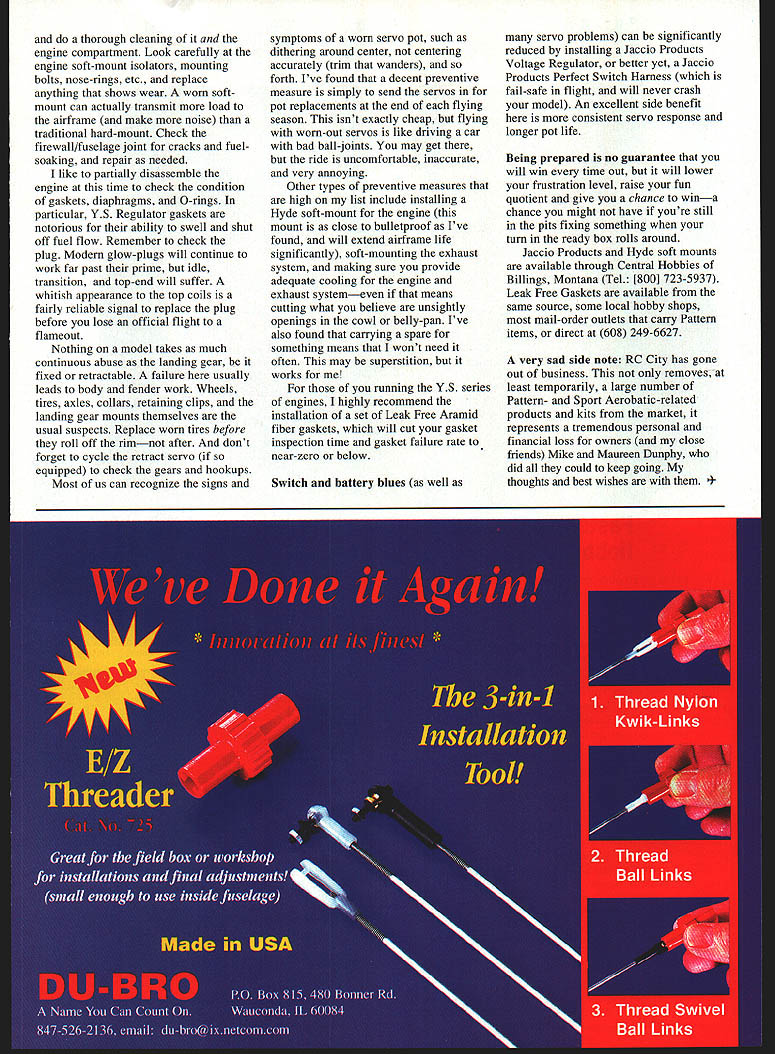
On each cleanup, check flying surfaces for stress-cracking. Hot spots include stabilizer/fuselage joints, wing saddles, wing center sections, retract and servo bays, and aileron cutouts. Anything that bears a load in flight or on the ground is suspect.
Check the radio compartment every time you assemble the airplane. Besides plugging in and hooking up the usual things, inspect servo leads and connectors, servo arms and wheels, cables, pushrods, battery and receiver hold-downs, and servo trays carefully. Someday something in there will fail; your job is to catch it before it does. The most likely culprit will be a battery or switch harness. I cycle batteries often and replace switch harnesses yearly.
Check everything that fastens the model's prime components together—belly pan and canopy fasteners; wing and stab tubes, sockets, and adjusters; antirotation pins. These items take considerable load and vibration wear, making them popular failure points.
Powerplant, Exhaust, and Engine Care
Today's powerplants and associated systems are more reliable than in the past, but they still rank high on the failure list. Engines, mounts, headers, pipes, mufflers, and couplers get the dirtiest, vibrate the most, and operate at extreme temperatures.
Take time to pull the belly pan or cowl and check the exhaust system and its mounts often. If you run a four-stroke, do periodic valve adjustments per the manufacturer's recommendations. Check filters and check-valves, and inspect the tank and associated plumbing. Silicone fuel tubing abrades easily—pay careful attention to places where it passes through the firewall or fuselage sides; rubber grommets at these spots help.
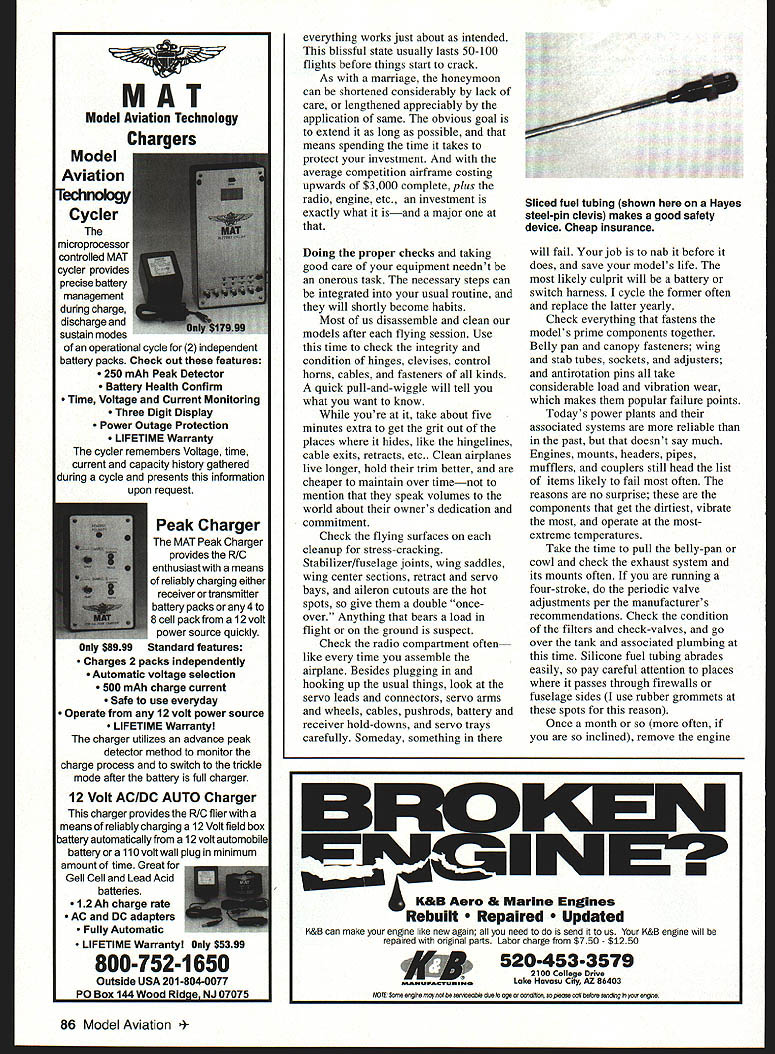
Once a month or so (more often if you prefer), remove the engine and do a thorough cleaning of it and the engine compartment. Look carefully at engine soft-mount isolators, mounting bolts, nose-rings, etc., and replace anything showing wear. A worn soft-mount can transmit more load to the airframe (and make more noise) than a traditional hard-mount. Check the firewall/fuselage joint for cracks and fuel-soaking, and repair as needed.
I like to partially disassemble the engine at this time to check gaskets, diaphragms, and O-rings. Y.S. regulator gaskets are notorious for swelling and shutting off fuel flow. Remember to check the plug. Modern glow plugs will continue to work past their prime, but idle, transition, and top-end performance will suffer. A whitish appearance on the top coils is a reliable signal to replace the plug before you lose an official flight to a flameout.
Landing Gear and Servos
Nothing on a model takes as much continuous abuse as the landing gear, fixed or retractable. A failure here usually leads to body and fender work. Wheels, tires, axles, collars, retaining clips, and the landing gear mounts themselves are common suspects. Replace worn tires before they roll off the rim—not after. If you have retracts, cycle the retract servo to check gears and hookups.
We can usually recognize signs of a worn servo potentiometer—dithering around center or wandering trim. A decent preventive measure is to send servos in for pot replacements at the end of each flying season. It's not cheap, but flying with worn-out servos is like driving a car with bad ball joints: you may get there, but the ride is uncomfortable, inaccurate, and annoying.
Recommended Preventive Measures
High-priority preventive measures I recommend:
- Install a Hyde soft-mount for the engine. This mount is about as close to bulletproof as I've found and will extend airframe life significantly.
- Automount the exhaust system.
- Provide adequate cooling for the engine and exhaust system—even if that means cutting openings in the cowl or belly pan.
- Carry a spare for critical items—having one means you won't need it often, but it helps when you do.
- For Y.S. engines, install Leak Free aramid-fiber gaskets to cut gasket inspection time and failure rate to near zero.
- Reduce switch and battery failures (and many servo issues) by installing a Jaccio Products voltage regulator or, better yet, a Jaccio Perfect Switch Harness, which is fail-safe in flight and will never crash your model. An added benefit is more consistent servo response and longer pot life.
Being prepared won't guarantee you win every time, but it will lower frustration, increase fun, and give you a chance to win—a chance you might not have if you're still in the pits fixing something when your turn in the ready box rolls around.
Vendors and Contact Info
Jaccio Products and Hyde soft mounts are available through Central Hobbies of Billings, Montana. Tel: 800-723-5937. Leak Free gaskets are available from the same source, some local hobby shops, most mail-order outlets that carry Pattern items, or direct at 608-249-6627.
A Sad Note
RC City has gone out of business. Not only has this temporarily removed a large number of Pattern- and Sport-Aerobatic-related products and kits from the market, it represents a tremendous personal and financial loss for owners (and my close friends) Mike and Maureen Dunphy, who did all they could to keep going. My thoughts and best wishes are with them.
Transcribed from original scans by AI. Minor OCR errors may remain.

