
Radio Control Aerobatics
Rick Allison 15618 NE 56th Way Redmond, WA 98052
F3A Team Selection Finals — Report by Ron Van Putte
THE RC Aerobatics team representing the United States in Poland at the F3A World Championships is:
- Chris Lakin
- Kirk Gray
- Tony Frackowiak
- Alternate: Chip Hyde
- Team Manager: Tony Stillman
The team was selected at the F3A Team Selection Finals (also called the Masters Tournament), conducted at AMA's International Aeromodeling Center in Muncie, IN, June 25–29.
I was in Muncie on Wednesday, June 25, helping F3A Team Selection contest director Tony Stillman get ready to put on the contest when I received a message to call Rick Allison. Rick told me he'd be unable to be there for the event and wanted to know if I could cover it for Model Aviation. Fortunately, I had my camera with me; all that was necessary was to put my "reporter's mind" in gear and go to Kmart for more film. After you've done something like this for 20 years, it's kind of like getting back on a bicycle after an absence.
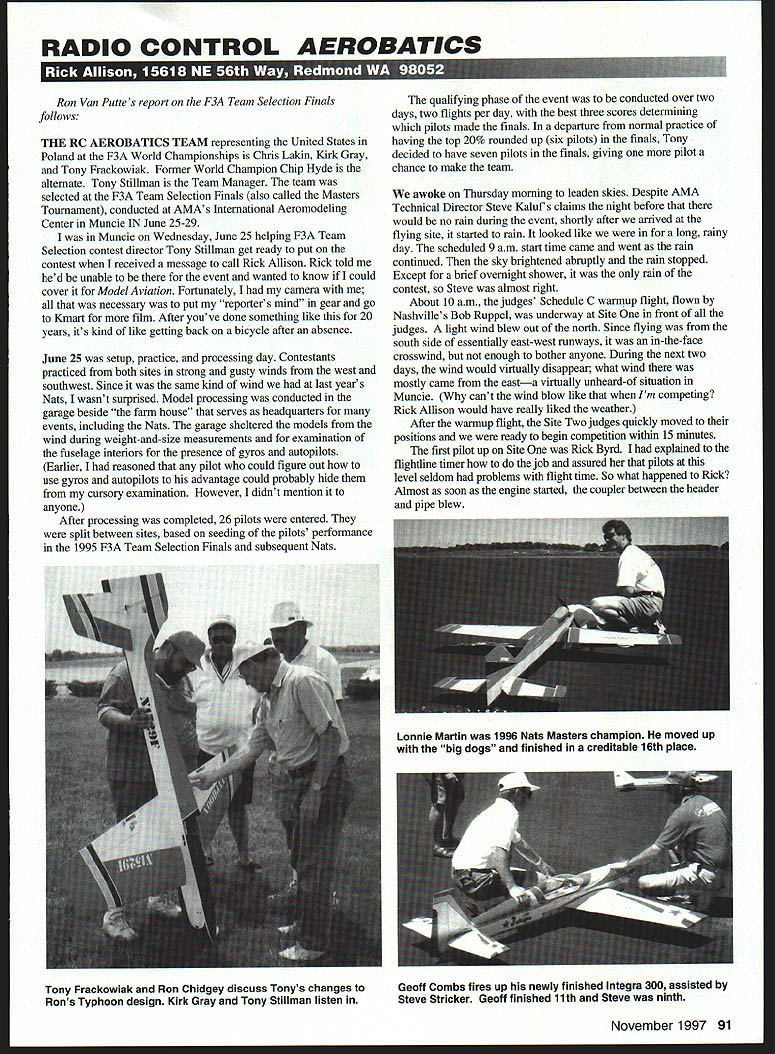
June 25 was setup, practice, and processing day. Contestants practiced from both sites in strong and gusty winds from the west and southwest. Since it was the same kind of wind we had at last year's Nats, I wasn't surprised. Model processing was conducted in the garage beside the "farm house" that serves as headquarters for many events, including the Nats. The garage sheltered the models from the wind during weight-and-size measurements and for examination of the fuselage interiors for the presence of gyros and autopilots. (Earlier, I had reasoned that any pilot who could figure out how to use gyros and autopilots to his advantage could probably hide them from my cursory examination. However, I didn't mention it to anyone.)
After processing was completed, 26 pilots were entered. They were split between sites based on seeding from the pilots' performance in the 1995 F3A Team Selection Finals and subsequent Nats.
The qualifying phase of the event was to be conducted over two days, two flights per day, with the best three scores determining which pilots made the finals. As a departure from the normal practice of having the top 20% rounded up (six pilots) in the finals, Tony decided to have seven pilots in the finals, giving one more pilot a chance to make the team.
We awoke on Thursday morning to leaden skies. Despite AMA Technical Director Steve Kaluf's claims the night before that there would be no rain during the event, shortly after we arrived at the flying site it started to rain. It looked like we were in for a long, rainy day. The scheduled 9 a.m. start time came and went as the rain continued. Then the sky brightened abruptly and the rain stopped. Except for a brief overnight shower, it was the only rain of the contest, so Steve was almost right.
About 10 a.m., the judges' Schedule C warmup flight, flown by Nashville's Bob Ruppel, was underway at Site One in front of all the judges. A light wind blew out of the north. Since flying was from the south side of essentially east–west runways, it was an in-the-face crosswind, but not enough to bother anyone. During the next two days, the wind would virtually disappear; what wind there was mostly came from the east—a virtually unheard-of situation in Muncie. (Why can't the wind blow like that when I'm competing? Rick Allison would have really liked the weather.)
After the warmup flight, the Site Two judges quickly moved to their positions and we were ready to begin competition within 15 minutes.
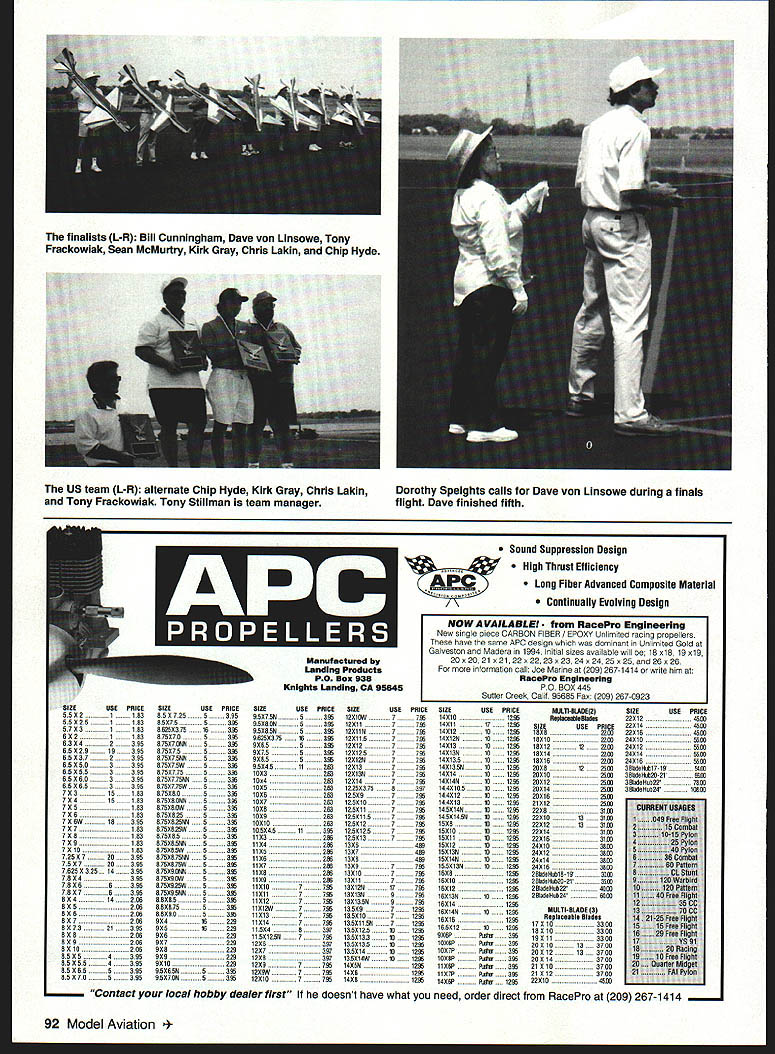
The first pilot up on Site One was Rick Byrd. I had explained to the flightline timer how to do the job and assured her that pilots at this level seldom had problems with flight time. So what happened to Rick? Almost as soon as the engine started, the coupler between the header and pipe blew. Intensive emergency surgery by Rick, his pit crew, and numerous onlookers, including Chris Lakin, enabled him to be in the air in about three minutes; but he ran out of flight time in the middle of the Figure M with 3/4 Rolls and got no score for the M or the remaining maneuvers.
Flying moved along routinely after that. An hour-long break enabled everyone to get lunch and the pilots to move from one site to the other.
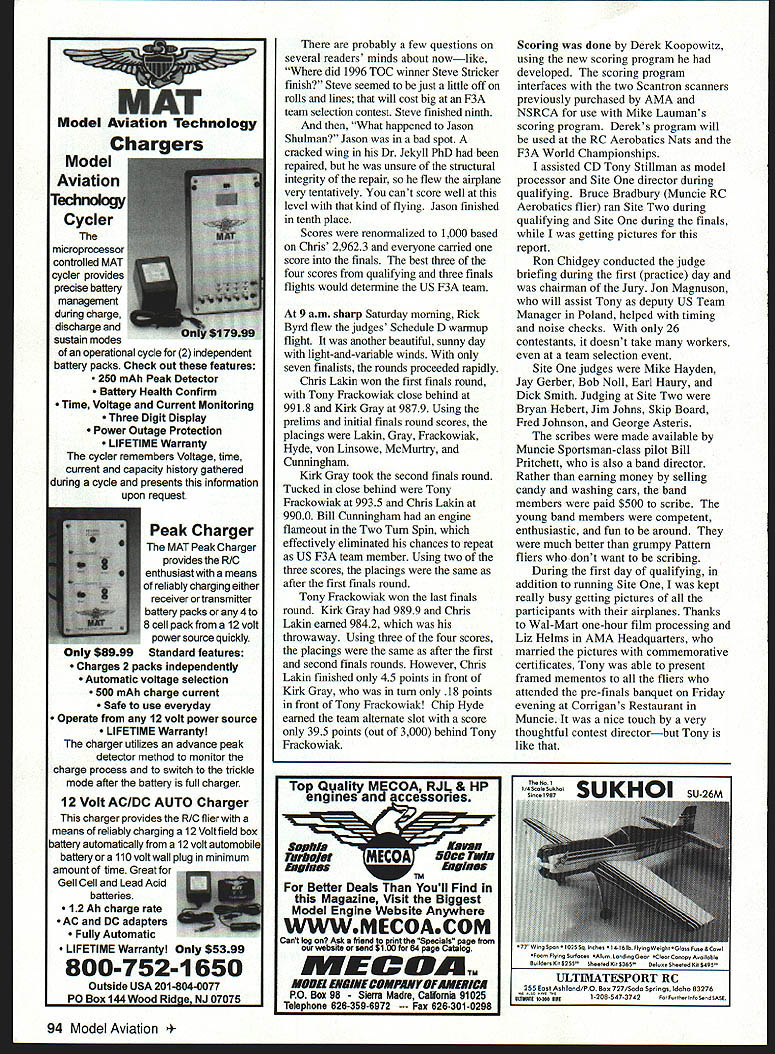
After the second round was flown, it was still not quite 3:30 p.m. Since both groups had flown in front of the two judge sets, scores could be normalized twice. In front was Chip Hyde, followed by Kirk Gray, Chris Lakin, Dave von Linsowe, Bill Cunningham, Sean McMurtry, and Tony Frackowiak. Chip and Kirk had each won a round.
Flying resumed at 9 a.m. Friday under sunny skies and lighter winds with the daily judges' Schedule C warmup flight at Site One by Bob Ruppel. After the warmup flight, the Site Two judges again moved very quickly and we were shortly underway.
Following the day's two rounds, the best three scores of the four qualifying rounds had Chris Lakin in the lead, even though he never won a round. Friday's rounds had been won by Kirk Gray and Tony Frackowiak. Chris Lakin had swapped places with Chip Hyde, but Tony Frackowiak had moved all the way up from seventh to fourth. With minor position switches, the remaining places were held by Dave von Linsowe, Sean McMurtry, and Bill Cunningham.
So the qualifiers were:
- Chris Lakin
- Kirk Gray
- Chip Hyde
- Tony Frackowiak
- Dave von Linsowe
- Sean McMurtry
- Bill Cunningham
The first non-qualifier was Rick Byrd. Remember that blown header in the first round?
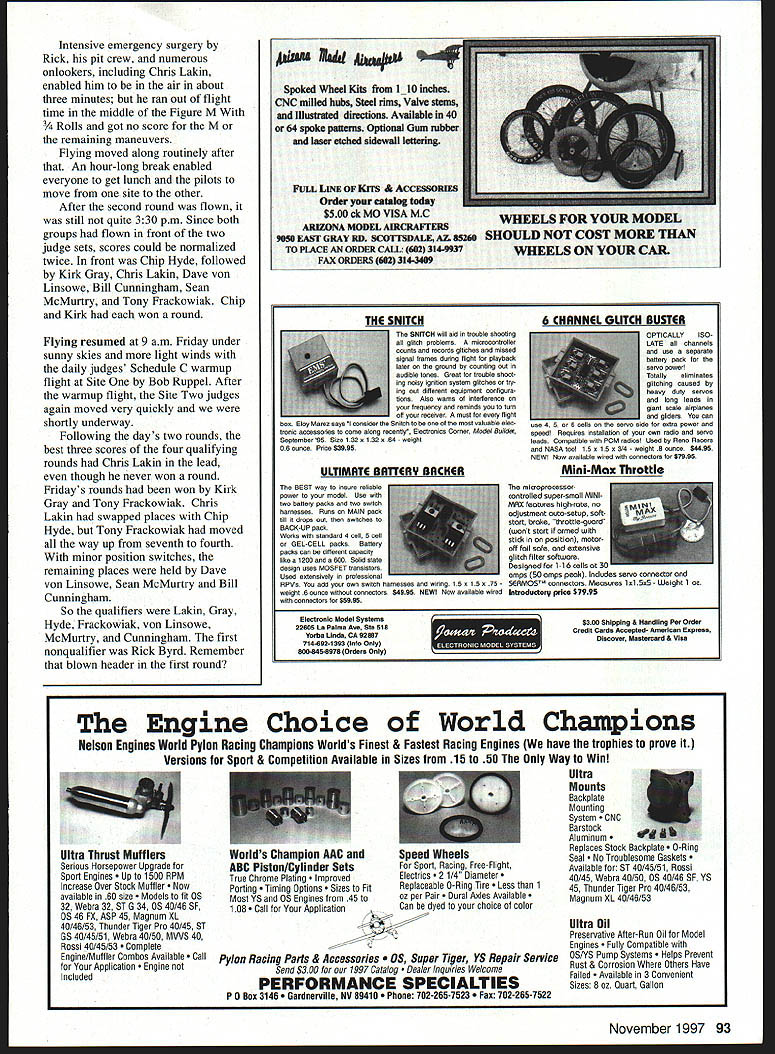
There are probably a few questions on several readers' minds about now—like, "Where did 1996 TOC winner Steve Stricker finish?" Steve seemed to be just a little off on rolls and lines; that will cost big at an F3A team selection contest. Steve finished ninth.
And then, "What happened to Jason Shulman?" Jason was in a bad spot. A cracked wing in his Dr. Jekyll PhD had been repaired, but he was unsure of the structural integrity of the repair, so he flew the airplane very tentatively. You can't score well at this level with that kind of flying. Jason finished in tenth place.
Scores were renormalized to 1,000 based on Chris's 2,962.3 and everyone carried one score into the finals. The best three of the four scores from qualifying and three finals flights would determine the US F3A team.
At 9 a.m. sharp Saturday morning, Rick Byrd flew the judges' Schedule D warmup flight. It was another beautiful, sunny day with light-and-variable winds. With only seven finalists, the rounds proceeded rapidly.
Finals round summaries:
- First finals round: Chris Lakin won. Tony Frackowiak was close behind at 991.8 and Kirk Gray at 987.9. Using prelims and initial finals round scores, the placings were Lakin, Gray, Frackowiak, Hyde, von Linsowe, McMurtry, and Cunningham.
- Second finals round: Kirk Gray won. Tony Frackowiak scored 993.5 and Chris Lakin 990.0. Bill Cunningham had an engine flameout in the Two Turn Spin, effectively eliminating his chances to repeat as a US F3A team member. Using the available scores, the placings remained the same.
- Third finals round: Tony Frackowiak won. Kirk Gray had 989.9 and Chris Lakin earned 984.2 (his throwaway). Using three of the four scores, the placings were unchanged.
Using three of four scores, the final standings were:
- Chris Lakin
- Kirk Gray
- Tony Frackowiak
- Chip Hyde earned the team alternate slot with a score only 39.5 points (out of 3,000) behind Tony Frackowiak.
Chris Lakin finished only 4.5 points in front of Kirk Gray, who was in turn only 0.18 points in front of Tony Frackowiak.
Scoring was done by Derek Koopowitz, using the new scoring program he had developed. The program interfaces with the two Scantron scanners previously purchased by AMA and NSRCA for use with Mike Lauman's scoring program. Derek's program will be used at the RC Aerobatics Nats and the F3A World Championships.
I assisted CD Tony Stillman as model processor and Site One director during qualifying. Bruce Bradbury (Muncie RC Aerobatics flier) ran Site Two during qualifying and Site One during the finals, while I was getting pictures for this report.
Ron Chidgey conducted the judge briefing during the first practice day and was chairman of the Jury. Jon Magnuson, who will assist Tony as deputy US Team Manager in Poland, helped with timing and noise checks. With only 26 contestants, it doesn't take many workers, even at a team selection event.
Site One judges:
- Mike Hayden
- Jay Gerber
- Bob Noll
- Earl Haury
- Dick Smith
Site Two judges:
- Bryan Hebert
- Jim Johns
- Skip Board
- Fred Johnson
- George Asters
The scribes were made available by Muncie Sportsman Club pilot Bill Pritchett, who is also a band director. Rather than earning money by selling candy and washing cars, the band members were paid $500 to scribe. The young band members were competent, enthusiastic, and fun to be around. They were much better than grumpy pattern fliers who don't want to be scribing.
During the first day of qualifying, in addition to running Site One, I was kept really busy getting pictures of all the participants with their airplanes. Thanks to Wal-Mart one-hour film processing and Liz Helms in AMA Headquarters, we mailed the pictures with commemorative certificates. Tony was able to present framed mementos to all the fliers who attended the pre-finals banquet on Friday evening at Corrigan's Restaurant in Muncie. It was a nice touch by a very thoughtful contest director—but Tony is like that.
Thanks to Technical Director Steve Kaluf and the AMA maintenance crew, everything we needed was either available or in place very soon after it was requested. I look forward to similarly gratifying support during the Nats.
What can we expect from this team? Chris and Tony have previously represented the United States in international competition, so they have an idea of what to expect. The judges in Poland will be overwhelmingly European, and the European judges have made it known that they will be looking for fliers to keep their airplanes at or within the 150-meter distance and will reward liberal use of the throttle. To score well, fliers must fly close and slow. I watched Chris and Kirk do just that in the three finals flights. Tony was a bit faster and farther out.
After one of Kirk's flights, I asked him how the previous flight had felt. He responded that it was one of the toughest things he'd ever done; the close-and-slow style of flying is foreign to him. But he did it, and did it well! He'll do just fine in Poland—as will the entire team.
Another pilot who will do fine in the future is Sean McMurtry. The 21-year-old pilot burst onto the national scene by making the F3A finals and taking eighth place at the 1996 Nats. His sixth place at the 1997 Team Selection shows that he's very close to breaking into the top echelon.
I'll also be doing the Nats coverage of RC Aerobatics for Model Aviation. I initially thought it might be a bit of a stretch to handle the event director chores and do the magazine coverage, but if I've done the proper planning, the Nats should almost run itself. I'll be all over the field anyway, so I might as well haul my camera with me and get some pictures.
The only downside is that I really looked forward to an objective report on how the '97 RC Aerobatics Nats went, and Rick could have been counted on to do it. So it's up to the rest of you to tell me.
Hey, Rick, you missed a great contest!
Ron Van Putte 111 Sleepy Oaks Rd. Ft. Walton Beach, FL 32548
Transcribed from original scans by AI. Minor OCR errors may remain.

