
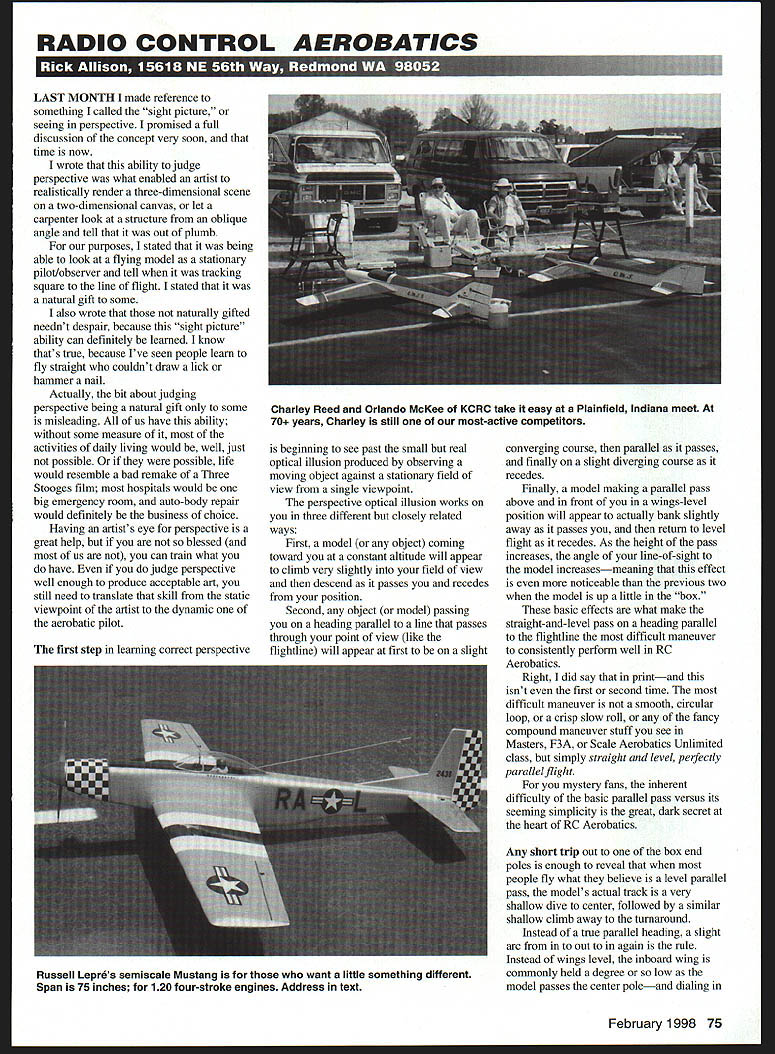
Radio Control: Aerobatics
Rick Allison, 15618 NE 56th Way, Redmond WA 98052
Last month I made reference to something I called the "sight picture," or seeing in perspective. I promised a full discussion of the concept very soon, and that time is now.
I wrote that this ability to judge perspective was what enabled an artist to realistically render a three-dimensional scene on a two-dimensional canvas, or let a carpenter look at a structure from an oblique angle and tell that it was out of plumb.
For our purposes, I stated that it was being able to look at a flying model as a stationary pilot/observer and tell when it was tracking square to the line of flight. I stated that it was a natural gift to some.
I also wrote that those not naturally gifted needn't despair, because this "sight picture" ability can definitely be learned. I know that's true, because I've seen people learn to fly straight who couldn't draw a lick or hammer a nail.
Actually, the bit about judging perspective being a natural gift only to some is misleading. All of us have this ability; without some measure of it, most of the activities of daily living would be, well, just not possible. Or if they were possible, life would resemble a bad remake of a Three Stooges film; most hospitals would be one big emergency room, and auto-body repair would definitely be the business of choice.
Having an artist's eye for perspective is a great help, but if you are not so blessed (and most of us are not), you can train what you do have. Even if you do judge perspective well enough to produce acceptable art, you still need to translate that skill from the static viewpoint of the artist to the dynamic one of the aerobatic pilot.
The first step in learning correct perspective
It is beginning to see past the small but real optical illusion produced by observing a moving object against a stationary field of view from a single viewpoint.
The perspective optical illusion works in three different but closely related ways:
- A model (or any object) coming toward you at a constant altitude will appear to climb very slightly into your field of view and then descend as it passes you and recedes from your position.
- Any object (or model) passing you on a heading parallel to a line that passes through your point of view (like the flightline) will appear at first to be on a slight converging course, then parallel as it passes, and finally on a slight diverging course as it recedes.
- A model making a parallel pass above and in front of you in a wings-level position will appear to actually bank slightly away as it passes you, and then return to level flight as it recedes. As the height of the pass increases, the angle of your line-of-sight to the model increases—meaning that this effect is even more noticeable than the previous two when the model is up a little in the "box."
These basic effects are what make the straight-and-level pass on a heading parallel to the flightline the most difficult maneuver to consistently perform well in RC aerobatics.
Right, I did say that in print—and this isn't even the first or second time. The most difficult maneuver is not a smooth, circular loop, or a crisp slow roll, or any of the fancy compound maneuver stuff you see in Masters, F3A, or Scale Aerobatics Unlimited class, but simply straight and level, perfectly parallel flight.
For you mystery fans, the inherent difficulty of the basic parallel pass versus its seeming simplicity is the great, dark secret at the heart of RC aerobatics.
Any short trip out to one of the box end poles is enough to reveal that when most people fly what they believe is a level parallel pass, the model's actual track is a very shallow dive to center, followed by a similar shallow climb away to the turnaround.
Instead of a true parallel heading, a slight arc from in to out again is the rule. Instead of wings level, the inboard wing is commonly held a degree or so low as the model passes the center pole—and dialing in a little bank while climbing and diving causes the arcing flight path.
If you'll reexamine what I said about the effect of the perspective optical illusion, you'll see that this widespread habit squares perfectly with that observation. The "right" view presented by a perfect parallel pass actually looks just a little wrong to most of us, and we tend to unconsciously correct the flight path so that the model appears to maintain a set altitude and distance from us and not bank away.
The result of this unconscious but continuous correction process is an inboard, wing-low, climbing-diving arc.
So the old straight and level isn't as simple as it appears, but the actual scores we receive are on the other, more complex maneuvers connected to it, right?
Not really. Besides being perhaps the most difficult fundamental skill to acquire, the perfect parallel pass is arguably the most important one as well—especially when it comes to scoring well. Practice time spent in this area can raise the average pilot's per-maneuver average score by an average of, well, somewhere between quite a bit and a whole bunch.
Why this important straight-and-level skill receives so little emphasis and practice time is something I've yet to figure out, since the main clue is printed in plain English in the AMA Competition Regulations and the FAI Sporting Code: "All manoeuvres will start and finish in straight and level flight." In both cases, this is the opening statement in the Description of Manoeuvres (or Manoeuvres) section of the book.
First things are generally placed first because they are the most important, basic pieces of information to be assimilated. Straight and level flight is the maneuver all else springs from in the pattern, no matter what class you fly. It is the foundation of the aerobatic house.
Most of us know that leaving out the straight flight between maneuvers is a major, automatic two-point deduction on the next maneuver. However, the penalty for having the straight segment in there, but performing it wrong, can be even stiffer.
Every pull or push to vertical up or down starts from wings level at some position in the box. Every loop, every 45° or 60° line, and every roll and spin starts from straight-and-level flight. Maneuvers that don't start from level flight start wrong, which is not the way to score well.
Vertical up lines started with the inboard wing low will lean in at the tops, down lines will lean out at the bottom, and stall turns will end up looking like bent hobby pins. Loops will spiral in (unless the unconscious correction is corrected again at the top of the loop, which usually leads to another correction at the bottom).
The same effect holds true in reverse for maneuvers done from a slight outboard bank, but this is much less common.
The consequences for turnaround flying are obvious: the cumulative errors from the successive poor entries and exits lead to gross heading problems, and rudder corrections are necessary on nearly every maneuver, even in calm conditions.
The very worst part is that the judge isn't really as subject to the perspective-illusion trap as the pilot, because the judge is more focused on overall aircraft track and heading and is working with a broader and more relaxed field of view. The pilot is focused very intently on the model's attitude and constantly changing position, so the resulting narrow field of view is anything but relaxed.
Your brain cells have been interpreting these visual effects since before you could walk, and generally they have been doing pretty good work for you. As far as RC flight goes, your conscious mind is no longer in the feedback loop, and a full set of learned reflexes does most of the piloting. You get the airplane most of the time where you want it, most of the time.
The trouble is, in aerobatics the object is to precisely place the airplane exactly where you want it, all of the time. Improvement is going to mean getting your conscious mind back into the flight-control feedback loop for a little while, just to think a little about what you are seeing and why you are seeing it.
Static exercises to improve your sight picture
There are some static exercises you can begin to use to improve your perspective sight picture. Start with these homemade visual aids:
- Walk up to within 100 meters or so of a section of straight railroad track and look up and down it; better yet, watch a train go by. If you can't find a train, use a freeway and watch the cars go by. Have a friend hold a ruler end-on and level above your eye and walk past in front of you. Have them hold the ruler in a true "wings level" plane and make a slow walk with it. Be prepared to be surprised at how much the sight picture changes as the ruler travels through the loop.
- Make a small (but accurate) outline scale model of your pattern model from some scrap balsa and do that ruler exercise again — this time using the little model in what looks like a wings-level position to you. You should begin to see what's been happening to your headings on every pull and push, and why you've been wearing out rudder servos trying to stay in the same ZIP code as the runway.
Next time we'll talk about some real-world practice techniques for learning to see level and fly level, and the science of cause-and-effect in the air (or how to tell where the train wreck you've just flown actually started).
Pattern product front
On the Pattern product front we have a couple of interesting items:
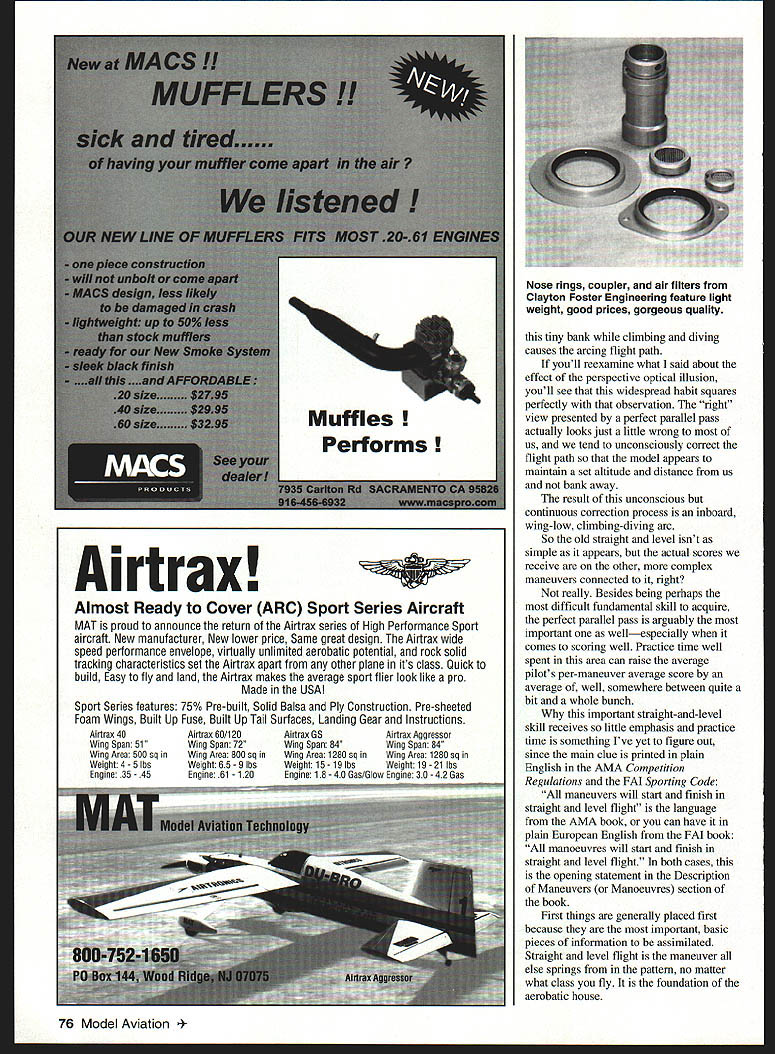
- A semiscale P-51 Mustang Pattern model from Russell Lepre. Russell is a Top Gun and Scale Masters competitor who wanted something a little different for Pattern. The model is 75 inches in length and span and uses built-up plywood-and-balsa construction with plug-in foam-core wings. The P-51 is available as a kit, semi-kit, or framed-up. The cowl, canopy, and plans are available separately. Call or write Russell for prices: 9519 Pebble Glen Ave., Tampa FL 33647-2436; Tel.: (813) 973-7536.
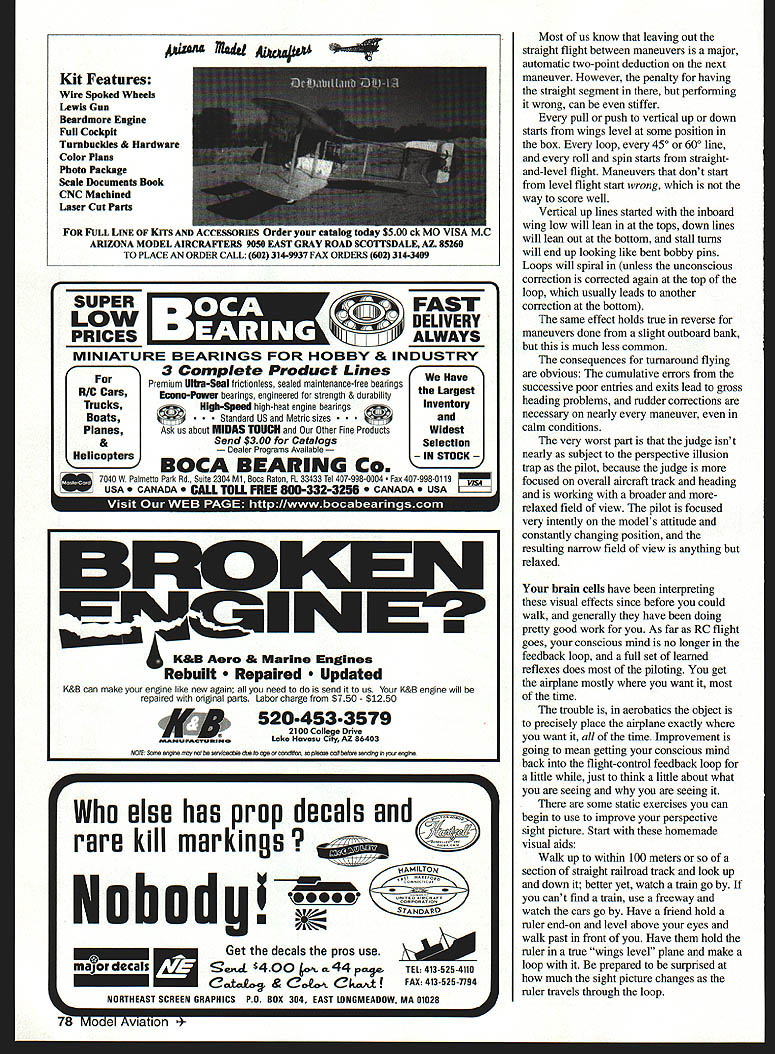
- A new line of machined aluminum Pattern goodies from Clayton Foster Engineering (CFE). At just $19.95, the nifty pipe coupler is provided with a full range of different inlet and outlet diameters to fit whatever header/pipe combination you favor, and replacement high-temp O-rings are a mere $3.49 for a set of four. The nose rings are simply the best I've seen; light, beautifully made, and a perfect fit for the Y.S. 1.20/1.40 engines. They are available in full-round and tapered styles, drilled or undrilled. The press-fit air filters for the Y.S. are of similar quality (a smaller version is available for the Y.S. .91 AC), and the prices are low at just $17.95 for filters and $9.95 for the nose rings. Everything in the CFE line is gold-anodized for strength and appearance. The exclusive distributor for these items is Central Hobbies of Billings MT, and the toll-free order number is (800) 723-5937.
Transcribed from original scans by AI. Minor OCR errors may remain.

