
RADIO CONTROL AEROBATICS
Rick Allison, 15618 NE 56th Way, Redmond WA 98052
Getting the rule book
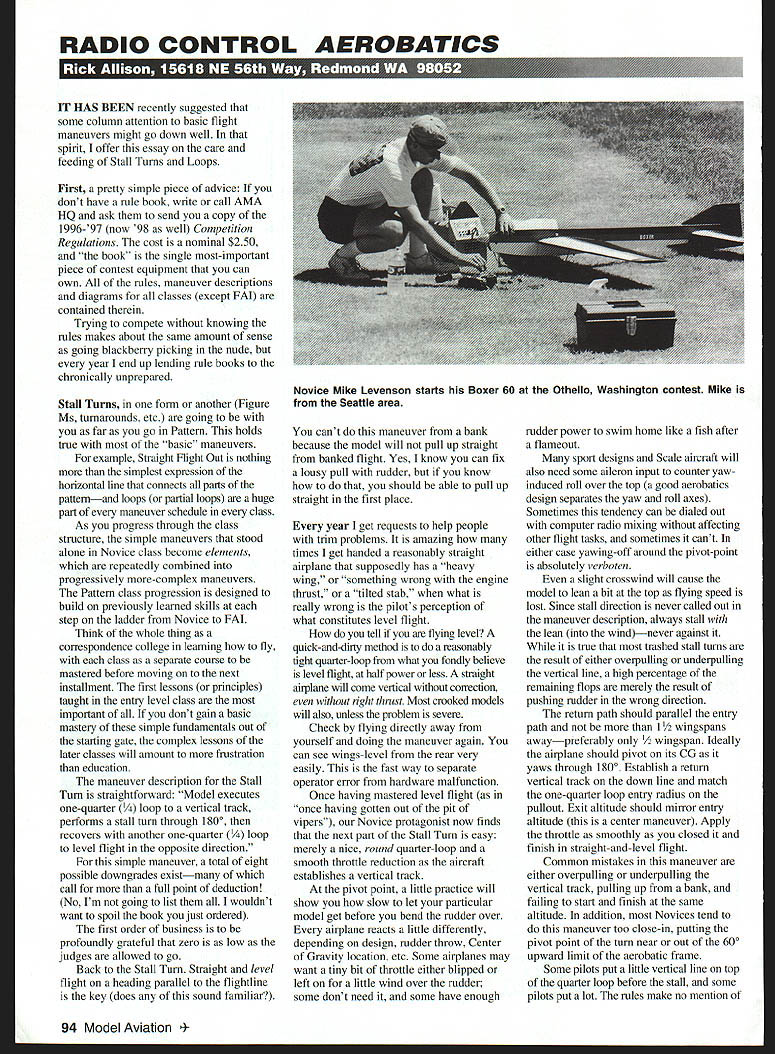
It has been recently suggested that some column attention to basic flight maneuvers might go down well. In that spirit, I offer this essay on the care and feeding of Stall Turns and Loops.
First, a pretty simple piece of advice: if you don't have a rule book, write or call AMA HQ and ask them to send you a copy of the 1996–97 (now '98 as well) Competition Regulations. The cost is a nominal $2.50, and "the book" is the single most important piece of contest equipment that you can own. All of the rules, maneuver descriptions and diagrams for all classes (except FAI) are contained therein.
Trying to compete without knowing the rules makes about the same amount of sense as going blackberry picking in the nude, but every year I end up lending rule books to the chronically unprepared.
As you progress through the class structure, the simple maneuvers that stood alone in Novice become elements that are repeatedly combined into progressively more complex maneuvers. The Pattern class progression is designed to build on previously learned skills at each step on the ladder from Novice to FAI. Think of the whole thing as a correspondence college in learning how to fly, with each class as a separate course to be mastered before moving on. The first lessons—or principles—taught in the entry level classes are the most important. If you don't gain a basic mastery of these simple fundamentals out of the starting gate, the complex lessons of the later classes will amount to more frustration than education.
Stall Turns
The maneuver description for the Stall Turn is straightforward: "Model executes one-quarter (1/4) loop to a vertical track, performs a stall turn through 180°, then recovers with another one-quarter (1/4) loop to level flight in the opposite direction."
For this simple maneuver, a total of eight possible downgrades exist—many of which call for more than a full point of deduction! The first order of business is to be profoundly grateful that zero is as low as the judges are allowed to go.
Straight and level flight on a heading parallel to the flightline is the key. You can't do this maneuver from a bank because the model will not pull up straight from banked flight. Yes, you can sometimes fix a lousy pull with rudder, but if you know how to do that, you should be able to pull up straight in the first place.
Every year I get requests to help people with trim problems. It is amazing how many times I get handed a reasonably straight airplane that supposedly has a "heavy wing," or "something wrong with the engine thrust," or a "tilted stab," when what is really wrong is the pilot's perception of what constitutes level flight.
How do you tell if you are flying level? A quick-and-dirty method is to do a reasonably tight quarter-loop from what you believe is level flight, at half power or less. A straight airplane will come vertical without correction, even without right thrust. Check by flying directly away from yourself and doing the maneuver again; you can see wings-level from the rear very easily. This is the fast way to separate operator error from hardware malfunction.
Once you have mastered level flight, the next part of the Stall Turn is easy: a nice, round quarter-loop and a smooth throttle reduction as the aircraft establishes a vertical track.
At the pivot point, a little practice will show you how slow to let your particular model get before you bend the rudder over. Every airplane reacts a little differently depending on design, rudder throw, center of gravity location, etc. Some airplanes may want a tiny bit of throttle either blipped or left on for a little wind over the rudder; some don't need it; and some have enough rudder power to swim home like a fish after a flameout.
Many sport designs and scale aircraft will also need some aileron input to counter yaw-induced roll over the top (a good aerobatics design separates the yaw and roll axes). Sometimes this tendency can be dialed out with computer radio mixing without affecting other flight tasks, and sometimes it can't. In either case, yawing-off around the pivot point is absolutely verboten. Even a slight crosswind will cause the model to lean a bit at the top as flying speed is lost. Since stall direction is never called out in the maneuver description, always stall with the lean into the wind—never against it. While it is true that most trashed stall turns are the result of either overpulling or underpulling the vertical line, a high percentage of the remaining flops are merely the result of the pilot pushing the rudder in the wrong direction.
The return path should parallel the entry path and not be more than 1½ wingspans away—preferably only ½ wingspan. Ideally the airplane should pivot on its CG as it yaws through 180°. Establish an entry vertical track on the down line to match the one-quarter loop entry radius on the pullout. Exit altitude should mirror entry altitude (this is a center maneuver). Apply the throttle smoothly as you close it and finish in straight-and-level flight.
Common mistakes in this maneuver:
- Overpulling or underpulling the vertical track.
- Pulling up from a bank instead of wings-level.
- Failing to start and finish at the same altitude.
- Doing the maneuver too close-in, which can put the pivot point near or out of the 60° upward limit of the aerobatic frame.
Some pilots put a little vertical line on top of the quarter-loop before the stall, and some pilots put a lot. The rules do not specify a length for the vertical segment other than to require that the aircraft establish a vertical track—thus implying that some amount of vertical flight must be demonstrated.
Proper presentation of the single Stall Turn falls into a gray area, as maneuver centering is not specifically called out in the maneuver description. It is now customary in most locales to start the maneuver with the bottom of the quarter-loop beginning directly at center, but local custom in some places displaces the start slightly past center. Ask about this at the Pilots' Meeting if you are undecided.
In any case, the entry quarter-loop should be fairly large and open, with a constant radius, and the pivot point should be placed far enough to the side so that the top planform of the model is clearly visible to the judges. Visibility is a recurring criterion in aerobatic competition. It is always the pilot's responsibility to present the judge with the best seat in the house. If the judge can't see what you're doing, you are not going to get the benefit of the doubt.
Double Stall Turns
Double stall turns are presented in a similar manner, with the added proviso that the maneuver be centered on the pilot, and the flight path connecting the stalls be a half-loop.
To present a decent planform view of the aircraft to the judge as the turn is executed, the connecting half-loop is going to have to be pretty large. Guard against flattening out the bottom of the loop in an effort to make the maneuver wide enough; both return paths need to parallel the entry paths.
Maintain enough distance so that a crosswind doesn't bring you in too close. A model slowing at the top of a stall turn is very susceptible to wind drift, and drifting in can result in a big downgrade for exceeding the 60° frame, or even a zero for crossing the line. This is probably the most common mistake, and one that often results in a downgrade for Novices (and some Sportsmen) in addition to flopping the turn itself.
As you progress, you will learn to finesse the throttle and rudder (or very slightly drop the upwind wing) to keep the model tracking a straight path in the wind; for those just learning, a little extra room doesn't hurt.
Loops
Loops are about as basic as stall turns and subject to similar ills, with the key again being a wings-level, parallel entry. Pattern loops are round unless some other shape (square, for instance) is specified. I mention this because I have seen many, many other shapes performed. In fact, perfectly round loops are extremely rare in any class.
Another obvious concept that seems hard to grasp for most beginning aerobats is that "Three Loops" means three superimposed loops—one right on top of the other—same size, same shape, same spot, and all in the vertical plane.
From a truly straight-and-level entry, a well-trimmed Pattern airplane will just about loop itself. Do loops end-on to your line of sight so that you can be sure the aircraft behaves decently from a wings-level entry. If it doesn't, you have trimming to do.
Two tips:
- Start by sealing the aileron gap.
- Make sure that both elevator halves go up and down the same amount at the same time.
Since most people fly with the inboard wing a little low, the common tendency is for Three Loops to spiral in—often to such a degree that the maneuver becomes a test of nerve for both pilot and judge. A frightened judge never scores high.
Most of the big problems people have with loops can be traced to overcorrecting for small problems. A fix at the bottom leads to another correction at the top, which calls for another Band-Aid at the bottom, and so on.
The larger the loops, the harder it is to maintain symmetry and congruity. Tiny loops are rightly downgraded for lack of smoothness and gracefulness; a medium-to-large-sized maneuver is usually best. Fly loops according to the available horsepower. If you feel the airplane becoming sluggish over the top, reduce the size until you get the solid feel back. Maneuver size is bound up with the aircraft's performance envelope—especially maintaining adequate airspeed over the top.
Like a fighter pilot, you have a need for speed, especially in vertical maneuvers. Speed keeps the aircraft tracking, minimizes wind drift, and keeps control response crisp. With most aircraft, it helps to back off the throttle on the back side to maintain smoothness.
On the first loop of three, fix a top and bottom point against the background (trees, clouds, mountains, etc.) and concentrate on nailing that point on the subsequent loops. A judge remembers the last thing you show them best, so if you inadvertently change size a little on the second loop, be sure that the last loop matches it, then draw a nice, straight exit line.
The one error that always fetches a big downgrade is the segmented loop: the pilot flies the ailerons or rudder or throttle so much that the elevator gets taken for granted, and then jerks on the elevator when the loop shape becomes ugly. Each jerk burns a spot into the judge's retina. A closed maneuver in the vertical plane with nine sides may be unique, but it isn't a loop. Every angular change in radius is a mandatory one-point deduction.
Closing
Next month we will continue this discussion with more complex maneuvers, such as Immelmanns and Cuban Eights.
Transcribed from original scans by AI. Minor OCR errors may remain.

