
RADIO CONTROL AEROBATICS
Rick Allison, 26405 SE 160th St., Issaquah WA 98027
We have been considering some of the more fundamental aspects of the black art of aerobatic flight. The discussion this month has to do with pitch stability and balancing airplanes.
It is possible to fly RC models without knowing diddly‑do about aerodynamics. Kids operate dime‑store gliders all the time without knowing squat about lift, drag, thrust, or fluid mechanics. They just buy and fly, and figure it out on the wing, so to speak. Nowadays, lots of brand‑new adult modelers do the same thing with ARFs, which have become the entry‑level trainer machines of choice.
I'm not bashing ARFs; on the contrary, I'm grateful that they have allowed so many people to enter the hobby during this time‑challenged, workaholic decade of the '90s. All the same, the indisputable essence of the ARF phenomenon is instant gratification and many of our new friends prefer to get straight on to the fun of flying without learning much about what they are trying to do. Like the kid with the dime‑store glider, they'd rather figure it out on the wing.
While dime‑store gliders and RC models do have a few common characteristics (wing, tailplane, a little balsa, etc.), price isn't one of them. When it comes to RC, flopping around in a cocoon of impenetrable ignorance while empirically gathering basic data that has already been collected, sorted, collated, and published in huge stacks is more than silly—it's downright expensive.
Asking questions and reading books and magazines (like this one) are all far cheaper than crashing models. But before you can get anything basic out of this column, I have to put it in. I can get away with putting it in, because in this case, a knowledge of the mechanics of pitch stability is even more important to a beginning Pattern aerobat than it is to a beginning RCer.
We hear the term "Center of Gravity" (CG) a lot. Actually, the term "Balance Point" (BP) is more accurate, since for our purposes, we are merely looking for a spot somewhere on the wing to fore‑and‑aft balance the model. The Center of Gravity is the actual center of mass of the entire aircraft, and may be located well above or below the wing.
This may seem to be a fine point, but it matters in some aerobatic maneuvers—most especially rolls. It doesn't matter much for the current topic, which is pitch stability. It isn't my intention to get into a huge and involved technical discussion, but an understanding of a few common terms might be helpful:
The Aerodynamic Center (AC)
The Aerodynamic Center (AC) is the point of action of the sum of all the aerodynamic forces acting on an aircraft in flight. For all practical purposes, this is a fixed point that does not change with airspeed or position of the model in the air. This is also sometimes referred to as the Neutral Point.
The AC of most individual airfoils falls very close to 25% of the MAC (Mean Aerodynamic Chord). Finding this point for the entire aircraft is a complicated business that involves calculating the individual ACs of the wing, stab, fin, fuselage, wheel pants, etc., and then adding them (vector addition), since all streamlined components that stick out in the slipstream function as "wings" in some fashion.
For our purpose, we will say that for conventional aircraft, the AC almost always falls on the main wing between about 35–50% of the Mean Aerodynamic Chord.
The Mean Aerodynamic Chord (MAC)
The Mean Aerodynamic Chord (MAC) is just the average chord (width) of the wing. There are various ways to find this. It's pretty simple if the wing is constant‑chord (same width from root to tip). For simple tapered wings, a decent quick‑and‑dirty method is just to add the root and tip chords together and divide by two. Move your ruler around on the wing plan parallel to the wing centerline until you find that particular width, and mark it.
If you are called on to find a percentage of the MAC, calculate it in your favorite units with a calculator.
Pitch Stability
Pitch stability is stability about the longitudinal (fore‑and‑aft) axis of the aircraft. An aircraft has positive stability if it tends to settle down after being disturbed, returning to a line of flight (the commanded position of the flight controls). Think balancing a ball in the bottom of a round bowl.
Neutral stability means the airplane has no tendency to damp oscillations after being disturbed. Think balancing a ball on a sheet of glass.
Negative stability is the tendency for oscillations to increase (divergence). Think balancing a ball on the bottom of an inverted round bowl.
A well‑behaved aircraft, regardless of size or shape, needs at least some degree of positive stability. An aircraft may be perfectly stable in pitch yet unstable in roll or yaw; that's another story for another time.
Stability comes in degrees. Some airplanes need more stability than others.
- Trainers are usually designed with an excess of stability.
- Sport aircraft have somewhat less.
- Aerobatic airplanes have even less than that.
- "Fun Fly"‑type aircraft typically have the least stability of all.
It is time to lay down some rules of thumb:
- For an aircraft to be stable in pitch, the Balance Point must be located in front of the AC or Neutral Point. The distance between the two is referred to as the Static Margin.
- The bigger the stabilizer (or the longer the tail moment arm), the farther back the AC will be, and the farther back the BP can be.
- As the static margin is increased, stability increases. As stability increases, control authority decreases.
- It is entirely possible to have too much stability. This situation becomes worse with decaying airspeed.
It is the most enduring tenet in RC that nose‑heavy models are safe, solid, and predictable. This iron‑clad rule is a myth.
I don't know how many times I've seen models stall on landing approach and fall out of the sky, simply because they were too nose‑heavy. It works like this:
To maintain altitude in forward flight, the wing must be held at a positive‑enough angle of attack to create lift. The thing doing the holding is the horizontal stabilizer, via the elevator control. The more nose‑heavy the model is, the more tail down‑load (up elevator) it takes to keep that wing biting air.
At some point, as the model slows and airspeed over the elevator decays, that control loses its ability to keep the wing at the proper angle of attack (elevator stall). The wing then does what all good positively cambered or rigged wings want to do: pitch down. This dumps lift. Model impacts ground, thud.
This comedy of errors often gets even funnier when the wounded modeler immediately claims that the airplane is balanced too far aft because "nose‑heavy airplanes don't stall," and actually adds weight to the nose!
Too‑nose‑heavy is just as bad as too‑tail‑heavy, and either one will bend your airplane. Believe it or not, a nose‑heavy airplane will stall at a faster airspeed (given the same angle of attack) than a tail‑heavy one. The difference is, a tail‑heavy airplane will stall more nastily (snap, crunch) than a nose‑heavy airplane (pitch down, thud).
So far as Pattern aerobatics goes, most pilots would agree that the "ideal" Pattern airplane would be one with almost neutral stability. We like to be able to place the airplane precisely in a flight attitude and have it stay there without further input until we command a different flight attitude. Of course, some minimum amount of positive stability must be designed in to provide damping and prevent divergence (dynamic instability).
For the designer, the trick is to get that certain minimum amount, and no more. Too much positive stability in an aerobatic aircraft leads to a very high pilot workload, as nearly constant control input is called for just to keep the model from trying to return to its primary trimmed condition, otherwise known as straight‑and‑level flight. If you don't believe this, I suggest you spend some time trying to fly an 8‑point roll with a trainer.
Generally speaking, it is to our advantage to have the CG pretty far to the rear in a Pattern airplane. If we don't stick it back there pretty far, snap rolls and spins aren't even possible, let alone pretty.
More important, we don't want to have to counteract the overall nose‑down pitching moment caused by a forward CG by carrying up trim or rerigging the stabilizer with more negative incidence (or the wing with more positive).
We want the mainplane and the tailplane to be rigged to nearly the same angle. For one thing, when the airplane rolls inverted, the up trim becomes down trim. Large angle‑of‑attack changes (elevator deflections) are then required to hold the airplane on a line—and in the case of consecutive rolls, they had better be quick changes!
Knife‑edge flight is another case. Here the wing and tail are (supposedly) unloaded. With most aerobatic designs, too much difference between the rigging angles of wing and tail (or excessive up elevator trim) will show as a lateral pitch to the canopy.
The same thing is true with the vertical lines, both up and down. This might be the primary reason that we move the CG around to achieve a level flight trim condition that involves the minimum difference in incidence or trim between mainplane and tailplane—it simplifies and minimizes the other trim adjustments we might need to make, such as thrustline changes or radio mixing on the primary flight controls.
For our purposes, we would like a fairly aft CG and the main and tailplanes rigged to nearly identical angles, plus we don't want to carry much (if any) trim in level flight. And we want the airplane to trim out hands‑off stable from horizon to horizon. Nice problem.
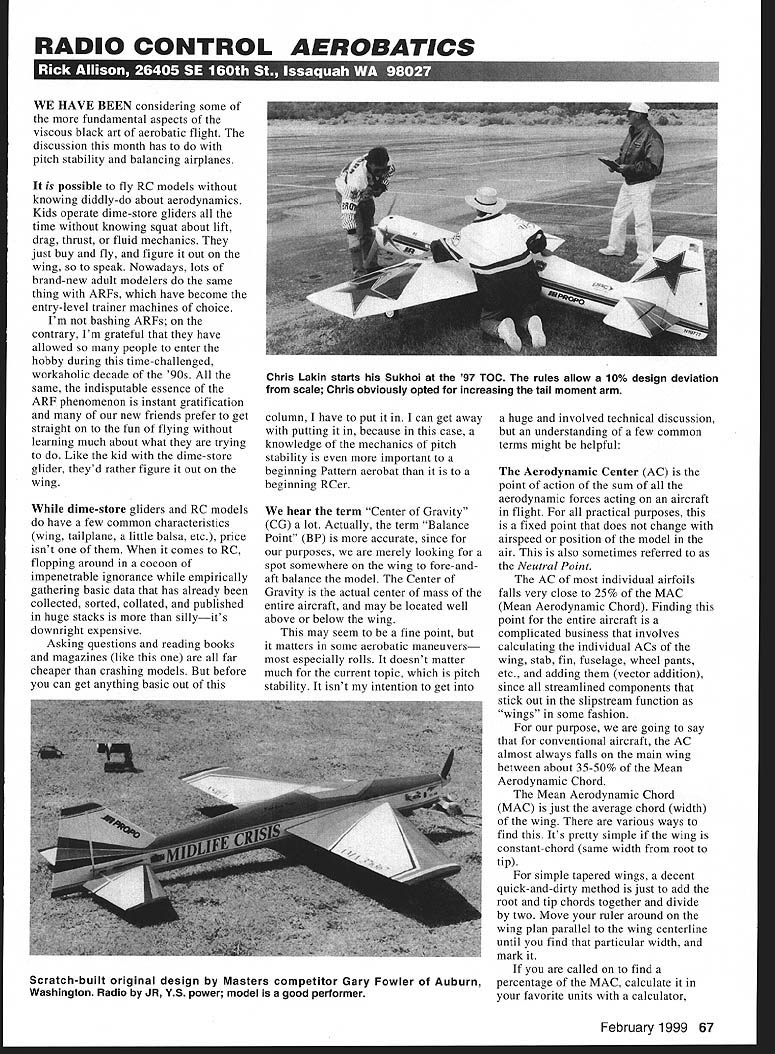
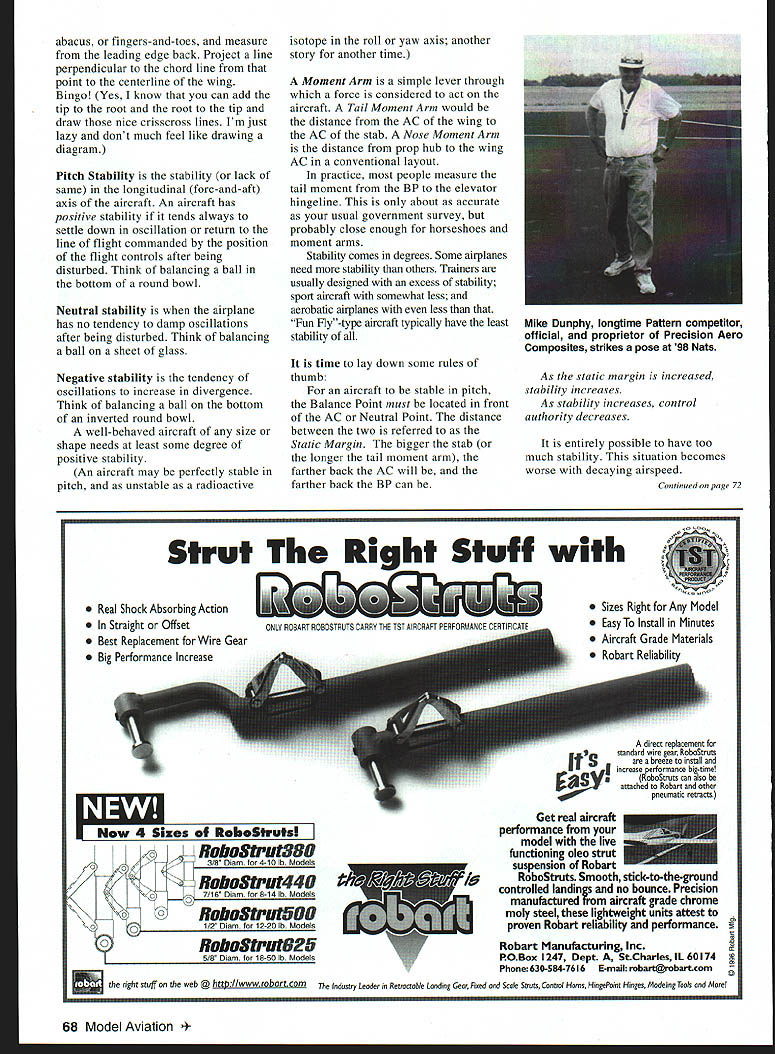
Unfortunately, moving the CG to the rear (closer to the NP) makes the airplane skittish. Pitch loads are too light and damping action is decreased. The model is easily disturbed by gusts and tends to "hunt" rather than "groove." Pitch stability has decreased. To regain the lost static margin (and thus, the pitch stability), we have two main ways to go: we can move the CG forward or we can increase the tail volume.
Tail Volume
Tail volume is moment arm times area, so an increase in either makes for an increase in the whole. An increase in both is what we see a lot of these days. This accomplishes a couple of important things:
- First, it increases tailplane efficiency. The longer lever arm and increased area allow the stabilizer to be more effective both in control and damping.
- Second, any increase in tail volume moves the Neutral Point of the aircraft to the rear.
Moving the NP to the rear by increasing tail volume regains the static margin and the missing pitch stability. Our BP can stay aft enough to provide lively control response and good spin/spiral entries, but the aircraft remains positively stable in level flight, damps well, and both the knife‑edges and verticals behave themselves.
Hundreds, if not thousands, of innocent trees have died providing the raw material for all of the trimming charts and articles published through the years, and it is worth noting that in every one of these cookbooks, the BP location (or CG) is the first, last, and main item to be checked, rechecked, changed, or manipulated. This is only because it affects the aircraft in all flight modes and bears on every other trim adjustment you might make. Nothing important.
Unfortunately, some kits do not come with the appropriate location plainly marked; some just show a range, and others show nothing at all. Some models are acquired already built, sans plans. Much has been written about fine‑tuning a BP during flight testing, but how do you get close enough to safely "fine‑tune"?
Try this recipe, which not only works, but allows you to try out your understanding of all the terms defined above:
- Measure the tail moment arm, the mean aerodynamic chord (MAC), and calculate the areas of both wing and stabilizer.
- Assuming your stabilizer is of average size (20–25% of the wing area), divide the moment arm by the MAC.
- Use the resulting number to set an initial BP:
- If the number is 2.75 or larger, set the BP at 33–35% of the MAC.
- If the number is 2.5 to 2.75, set it at 28–32%.
- If the number is smaller than 2.5, set the BP at 25–28% of the MAC.
- If your stabilizer is smaller than average, shade the numbers to the low side of the range (BP further forward). If the stabilizer is larger than average, do the reverse.
This is a good initial placement for the BP, and 99% of the time will get you so close that you won't need to move it again. This method works for Pattern models with symmetrical airfoils and for most common flat‑bottom and semi‑symmetrical airfoils used in RC. So go ahead and figure it out on the wing if you like—just do it before you fly. It may take a few hours of your time, but it's cheap compared to new models, antidepressants, and psychotherapy.
Moment Arm
A moment arm is the simple lever through which a force is considered to act on an aircraft. The tail moment arm would be the distance from the aerodynamic center of the wing to the aerodynamic center of the stabilizer. In practice, most people measure the tail moment from the BP to the elevator hinge line. This is only about as accurate as your usual government survey, but probably close enough for horseshoes and moment arms.
Transcribed from original scans by AI. Minor OCR errors may remain.

