


RADIO CONTROL AEROBATICS
Rick Allison, 26405 SE 160th St., Issaquah WA 98027
Every so often I get the urge to fire up my dusty crystal ball and gaze into the future of Pattern aerobatics.
Time continues to march on; the wheel always turns; and sometimes what comes up is capable of causing a few dominos to fall. I believe we may be on the verge of another change in the Great American Pattern game, and this one could be bigger than any since the move to turnaround flying began in the mid-’80s.
Rumblings about proposed new F3A maneuver schedules have been percolating through the Net and the old-fashioned grapevine. I’ve seen nothing official yet, and the natural history of this sort of thing says the final outcome will likely be less radical than the initial rumors. That’s about as comforting as I can get.
Proposed maneuvers (rumored)
- Humpty-bumps with knife-edge turns at the top
- Tail slides
- Rolling circles
- Multiple vertical down-line snaps
- Rolling loops
- Unknowns
- Free styles
- More center cross-box maneuvers
- Many more snapping and spinning maneuvers
If you detect a resemblance to the maneuvers currently being flown at the Tournament of Champions, the Masters Aerobatic Championships, and events such as the Japan Aero Pageant, you’re correct. If you think this would push F3A toward IMAC-style scale aerobatics, you’re also correct.
What might be driving the change
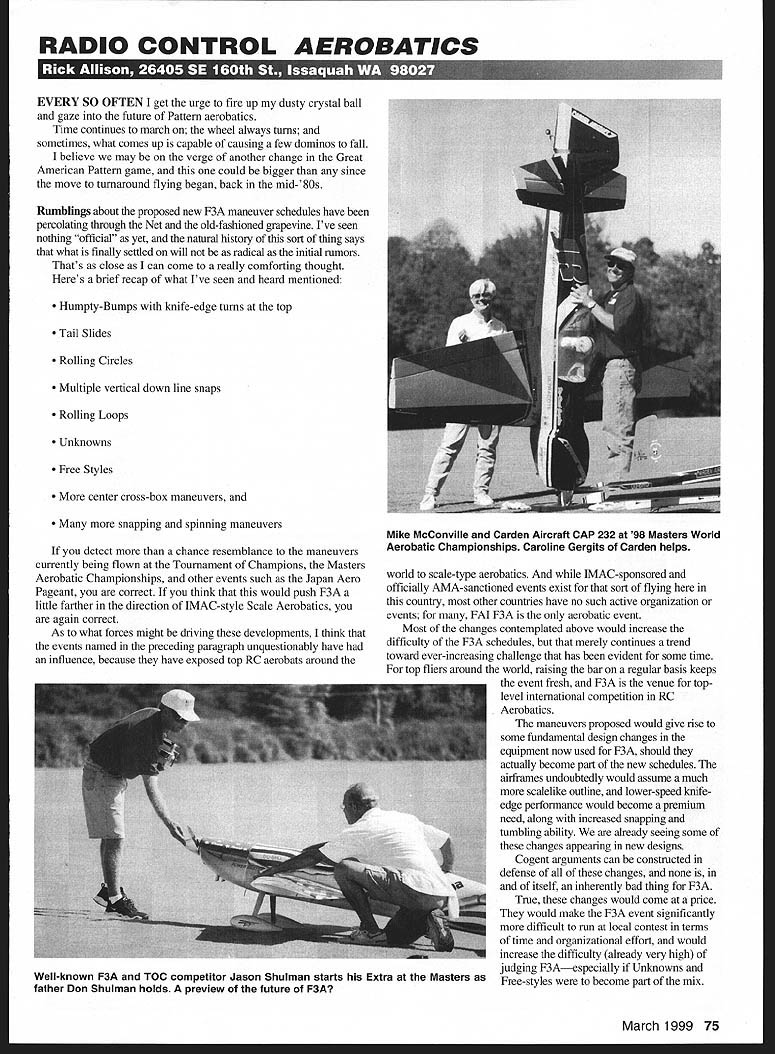
Events named above have exposed top RC aerobats worldwide to scale-type aerobatics. While IMAC-sponsored and officially AMA-sanctioned events exist for that kind of flying in the U.S., most other countries have no such active organization or events; for many, FAI F3A is the only aerobatic event. That exposure naturally influences maneuver design and pilot expectations.
Most of the contemplated changes would increase the difficulty of F3A schedules, continuing a long-term trend of raising the bar to keep top-level competition fresh. F3A is the venue for top international RC aerobatics, and making the schedules more challenging appeals to elite competitors.
Potential equipment and design changes
If these maneuvers become part of the schedules:
- Airframes will likely assume a more scale-like outline.
- Lower-speed knife-edge performance will become more important.
- Increased snapping and tumbling ability will be required.
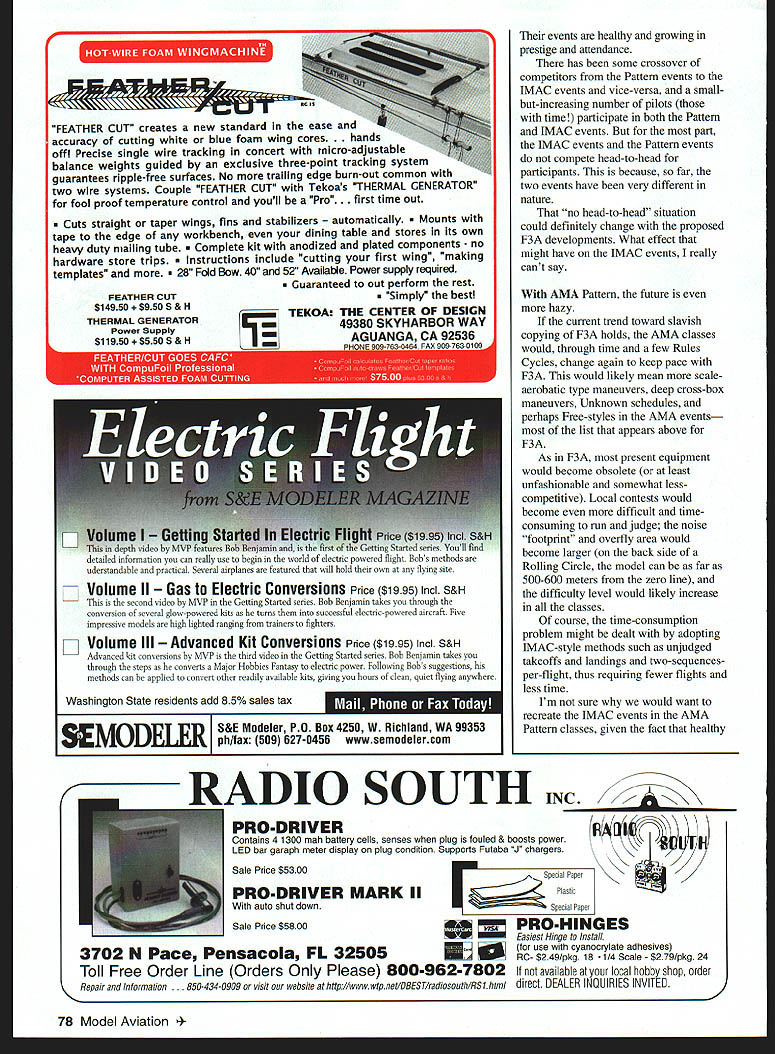
We’re already seeing some of these changes in new designs.
Cogent arguments can be made in defense of these changes; none is inherently bad for F3A. But there are trade-offs.
Downsides and concerns
- Events would become significantly more difficult to run locally in terms of time and organization.
- Judging F3A would become harder, especially if Unknowns and Free-styles are included.
- Less-skilled or less-committed F3A competitors might leave the event.
- Prospective newcomers in Masters class might hesitate to move up to F3A—or not move up at all.
- Some pilots would leave simply because they dislike maneuver schedules that favor rapid, violent autorotative maneuvers over traditional smoothness and grace.
Upsides
- The changes could increase fun and interest for top-echelon F3A pilots worldwide.
- Spectator appeal might improve.
- Pilots who prefer this style may be attracted from other events.
At face value it looks like a wash for F3A: win some, lose some. But what about other Pattern and IMAC events in the U.S.? That’s harder to predict.
AMA Pattern and IMAC: possible futures
Background
For the last decade the Pattern community has tried to reduce the distance between AMA and FAI events in equipment requirements and judging criteria. The National Society of Radio Controlled Aerobatics (NSRCA) is the AMA Special Interest Group (SIG) for Pattern aerobatics, and through membership surveys and other actions it has led the effort to narrow the gap.
Since the mid-1980s, NSRCA members have consistently voted to follow the FAI lead. F3A is now the prestige Pattern event in the U.S.; top F3A pilots are looked up to, their styles are copied, and their equipment choices imitated. F3A pilots design most of the models used in other classes, and AMA equipment rules have been revised to keep pace with FAI changes. F3A-style maneuvers consistently find their way into upper-level AMA classes; FAI-style finals are now flown at the AMA Nats in all AMA classes.
IMAC Scale Aerobatics has grown rapidly in the last 10 years and is one of the fastest-growing AMA SIGs. Their top pilots have gained skill and respect, and IMAC events are healthy and growing in prestige and attendance. There has been some crossover of competitors between Pattern and IMAC, and a small but increasing number of pilots do both. So far, however, the two event types do not compete head-to-head because they have been different in nature.
Scenario 1 — AMA follows F3A
If the trend of copying F3A continues, AMA classes could narrow further and adopt more scale- and aerobatic-type maneuvers: deep cross-box maneuvers, Unknown schedules, perhaps Free-styles—much of what’s being discussed for F3A. Consequences might include:
- Much present equipment becoming obsolete or less competitive.
- Local contests becoming more difficult and time-consuming to run and judge.
- Larger noise footprint and overfly areas (on the back side of a rolling circle, the model can be 500–600 meters from the zero line).
- Increased difficulty level across classes.
Some mitigations exist:
- Adopting IMAC-style methods such as unjudged takeoffs and landings and two-sequence-per-flight to reduce flight count and time.
- Simply not holding meets at fields where noise/overfly would be an issue.
Recreating IMAC events inside AMA Pattern classes seems redundant while healthy IMAC events already exist.
The most unfortunate outcome of this scenario would be that competitors who dislike this style would be left with nowhere to go.
Scenario 2 — Divergence persists or returns
Alternatively, most pilots who want IMAC-style flying are already doing it, and most AMA Pattern pilots prefer the current AMA style. If so, the FAI trend toward scale-type maneuvers could be a tougher sell, and the pendulum could swing back toward a greater separation between F3A and AMA events. We could even return to the disconnect of the early-to-mid-1980s, when much of the world flew turnaround style while the U.S. retained the traditional AMA pattern.
History shows that such transitions are painful. When turnaround was phased in and the old-style Masters class was eliminated, many longtime competitors and Pattern leaders dropped out rather than switch, and some traditional contests disappeared. New contests and competitors eventually filled many gaps, but it took years to erase bitterness and some residue remains. I wouldn’t want to repeat that experience—it wasn’t beneficial for the sport.
Final thoughts
All of this is speculation based on leaks and rumors. The final outcome will probably differ from the scenarios outlined above—history and the future are prone to surprises. Still, the possible futures don’t give me a lot of warm, fuzzy feelings. I don’t see an obvious win-win.
One certainty: the NSRCA will be right in the middle of shaping what comes next. If you’re participating in Pattern, you should belong to the National Society of Radio Controlled Aerobatics. Membership gives you a voice in the future and includes a subscription to the K-Factor, a professionally produced 25-page monthly newsletter that functions like a magazine: photos, articles, regional columns, equipment ads, specialty retailers, and up-to-the-minute contest information.
NSRCA membership
- Yearly dues: $30 for U.S. residents.
- Foreign subscriptions: $40 for Canadians; $50 for all others.
To join, send a check in U.S. funds plus your name, address, AMA (or other national aero club) number, telephone number, and class presently flying to: Academy of Model Aeronautics, Attention: NSRCA, P.O. Box 3028, Muncie IN 47307-1028.
Do it today. The future happens on a regular basis.
Transcribed from original scans by AI. Minor OCR errors may remain.

