
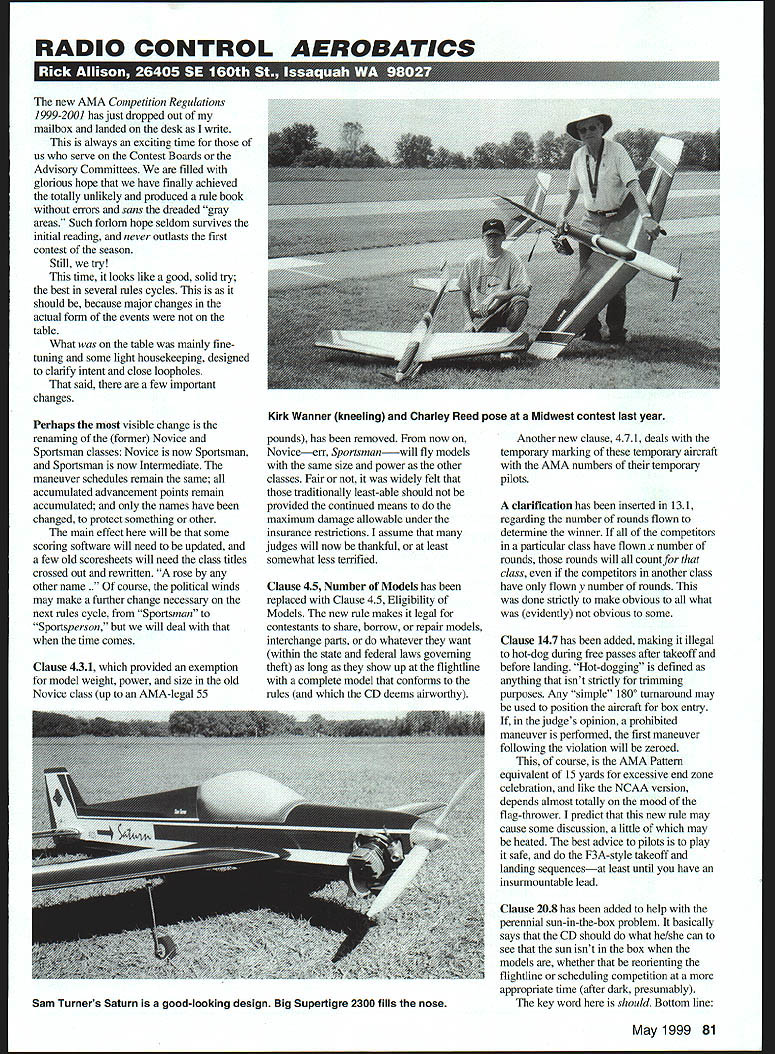
RADIO CONTROL AEROBATICS
Rick Allison 26405 SE 160th St., Issaquah WA 98027
The new AMA Competition Regulations 1999–2001 just dropped into my mailbox and landed on the desk as I write.
This is always an exciting time for those of us who serve on the Contest Boards or the Advisory Committees. We are filled with glorious hope that we have finally achieved the totally unlikely and produced a rule book without errors and sans the dreaded "gray areas." Such forlorn hope seldom survives the initial reading, and never outlasts the first contest season.
Still, we try!
This time, it looks like a good, solid try; the best in several rules cycles. This is as it should be, because major changes in the actual form of the events were not on the table. What was on the table was mainly fine-tuning and some light housekeeping, designed to clarify intent and close loopholes.
That said, there are a few important changes.
Key Rule Changes
- Renaming of classes
- Former Novice is now Sportsman, and former Sportsman is now Intermediate. Maneuver schedules and accumulated advancement points remain unchanged; only the class names have changed.
- The main practical effect will be updates to scoring software and some crossed-out/rewritten old scoresheets.
- Clause 4.3.1 removed
- The exemption that allowed the old Novice class to fly models up to an AMA-legal 55 pounds has been removed. From now on, Sportsman will fly models with the same size and power as the other classes. This change was motivated by safety/insurance concerns.
- Clause 4.5 replaced
- "Number of Models" is replaced with "Eligibility of Models." Contestants may share, borrow, repair, interchange parts, etc., provided they arrive at the flightline with a complete model that conforms to the rules and which the Contest Director (CD) deems airworthy.
- Clause 4.7.1 added
- Addresses temporary marking of temporarily-used aircraft with the AMA numbers of their temporary pilots.
- Clarification in Clause 13.1
- If all competitors in a particular class have flown x rounds, those rounds will count for that class, even if competitors in another class have only flown y rounds. This was clarified to remove prior confusion.
- Clause 14.7 added (hot-dogging)
- Hot-dogging—anything during free passes after takeoff and before landing that isn't strictly for trimming purposes—is prohibited. A simple 180° turnaround may be used to position the aircraft for box entry. In the judge's opinion, if a prohibited maneuver is performed, the first following maneuver will be zeroed. Pilots are advised to play it safe and use F3A-style takeoff and landing sequences until well ahead in the standings.
- Clause 20.8 added (sun-in-the-box)
- The CD should do what he/she can to avoid having the sun in the box when models are flying, whether by reorienting the flightline or scheduling competition at a more appropriate time. The emphasis is on "should"—this was written mainly for large events like Nationals, so don't expect major changes at local meets.
Maneuver Schedules and k-factor Changes
The maneuver schedules for all classes remain mostly untouched, except for some k-factor adjustments in Masters resulting from two separate proposals:
- Immelmann Turn
- k-factor changes from k = 1 to k = 2 in Masters. The proposal sought to make identical maneuvers have the same k across classes; the Immelmann is k = 2 in Sportsman, Intermediate, and Advanced, so it is now k = 2 in Masters.
- Half Square Loop with Half Roll in the Vertical (Masters)
- Reduced from k = 3 to k = 2 to match Advanced class. In effect, it now pays the same as a simple Immelmann.
- Vertical Eight from the Middle, Pilot's Option (Masters)
- Increased from k = 3 to k = 4 because pilots are having difficulty making the two loops the same size.
- Two Rolls in Opposite Directions (Masters)
- Increased from k = 3 to k = 4 for similar reasons—many Master pilots are not executing this maneuver consistently well.
Overall, total k in Masters goes from 66 to 68. Beyond software updates, these changes emphasize maneuvers pilots struggle with, helping judges separate the best from the rest and encouraging pilots to reallocate practice time.
Judge's Guide Revisions
- Smoothness and Gracefulness (B)
- Criteria for pitch changes now include a requirement that the model show a constant radius as it transitions from line to line. The admonition against "Excessively tight" corners has been rephrased to: "Higher marks should not be awarded for flying tight, high-G corners." This aligns AMA criteria more closely with FAI judging.
- Judging Individual Maneuvers: Loops (D)
- A greatly expanded list of judging criteria for loops and part-loops has been included. Much of this compiles existing criteria under one heading.
- Snaps and rolls within loops
- Snaps or rolls that are part of looping maneuvers (such as the Avalanche) are required to be done within the looping portion of the maneuver. The circularity (roundness) of the loop must be maintained during the snap or roll—the radius of the arc must be preserved.
- Judging Individual Maneuvers: Spins (D)
- Clarification added: once the model has entered the spin, drift caused by wind is not a judging criterion. This should help clear up confusion about spin centerline.
- Takeoff wording
- The description now reads "the model then smoothly, not suddenly, accelerates" (instead of referencing throttle technique), since the judge watches the model, not the pilot's throttle movements.
- Miscellaneous
- Some typos were corrected and minor redundancies removed, though a few minor errors remain and at least one new typo was spotted.
Is it perfect? Not a chance. I spotted at least one new typo and two old ones that slipped through. But this edition looks very workable, and I expect the number of unpleasant surprises during the contests will be small. This is good, since this book will be used for three years under the new rules-cycle provisions.
Video: Perfect Airframe Alignment
The same mailbox that produced the rule book also yielded a new building video from Robin's View Productions, L.L.C. Robin's View is headed by Bob Hunt, control-line stunt guru extraordinaire and former editor of Flying Models.
Perfect Airframe Alignment is the first in a series that essentially remakes the Deane Pappas/Bob Hunt "Project Pattern" photo features from Flying Models about a decade ago. Deane is not involved in the new series; his spot is filled by master builder Bob Noll of ProBuilt RC Products. Noll is a prolific professional builder of competition aerobatic models whose aircraft have won major contests worldwide.
- Running time: just over one hour.
- Content: Major components of a Pattern airframe are assembled and aligned using simple, repeatable alignment tools and jigs. Trammeling an airframe is thoroughly discussed, with many useful building tips. The methods are excellent and match procedures used by many builders.
- Extras: Tools and gadgets used may be ordered from Bob Noll or built from plans provided with the video.
- Caveat: Several fiberglass cutting/grinding procedures are shown without breathing or eye protection—an omission worth noting.
Retail price is $24.95; Bob Hunt is offering it for a limited time at $19.95 + $3 S&H. Order from Robin's View Productions, Box 68, Stockertown, PA 18083; Tel.: (610) 746-0106, or visit robinsview.com. Highly recommended.
New Model: Sam Turner's 2-meter Saturn
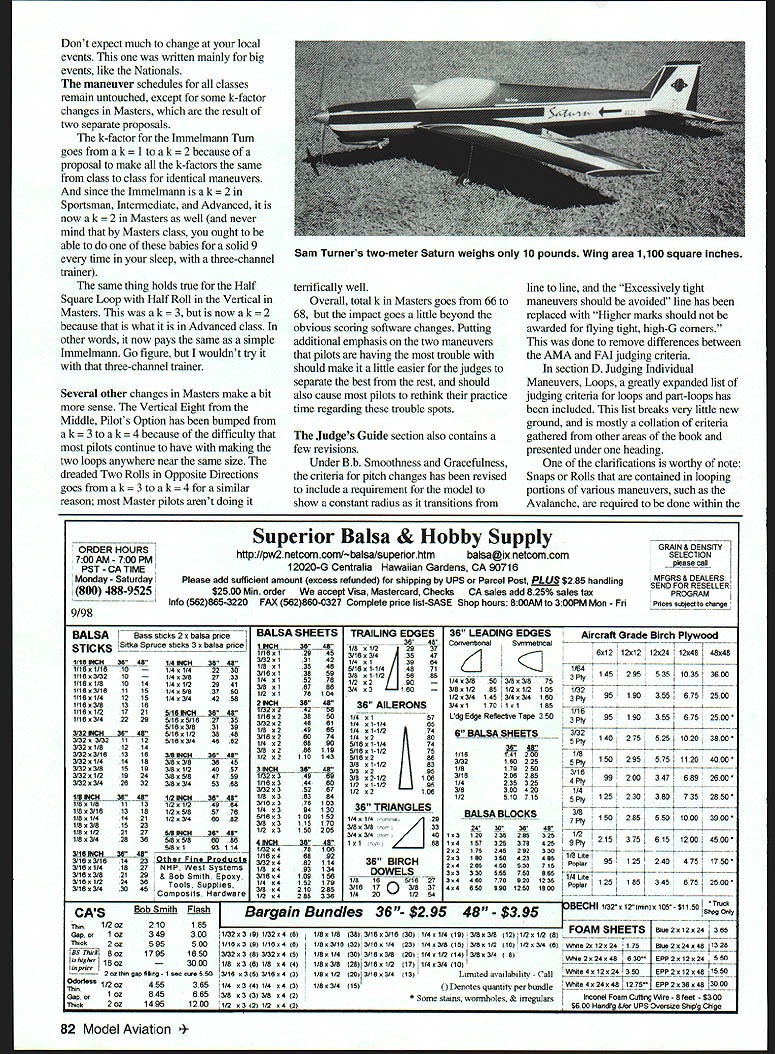
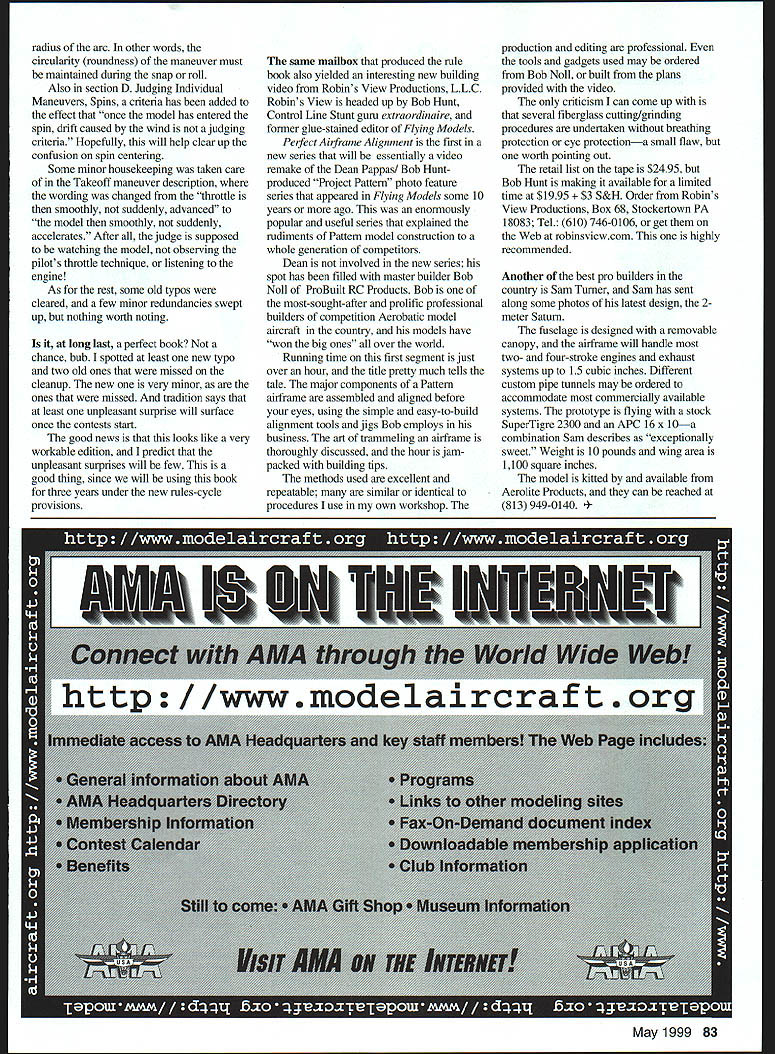
Sam Turner, another top pro builder, sent photos of his latest design, the 2-meter Saturn.
- Fuselage: removable canopy
- Engine compatibility: handles most two- and four-stroke engines and exhaust systems up to 1.5 cu in; custom pipe tuners available to fit most commercial systems
- Prototype power: stock SuperTigre 2300 with an APC 16 x 10 prop (described as "exceptionally sweet")
- Weight: 10 pounds
- Wing area: 1,100 sq in
- Availability: kitted by Aerolite Products — Tel.: (813) 949-0140
This model and kit info may interest pilots looking for a versatile competition airframe.
Transcribed from original scans by AI. Minor OCR errors may remain.

