


RADIO CONTROL AEROBATICS
Rick Allison 26405 SE 60th St., Issaquah, WA 98027
A few months ago (March ’99 MA), I looked into my balsa-dust-covered crystal ball in an effort to divine the future of the Pattern events. My speculation was 100% driven by the rumored rules changes in FAI F3A, which were expected to result from the March ’99 CIAM meetings.
The changes I commented on in the March column amounted to nothing but pure old-fashioned rumor and Internet smoke at press time. I also mentioned that the natural history of these things is that the initial rumors are usually far more radical than what is actually proposed and voted into existence.
That small measure of comfort has been dispelled.
CIAM F3A proposals
The synopsis of the actual CIAM F3A sub-committee proposals published in the NSRCA’s January K-Factor contains most of the Tournament of Champions–type maneuver schedule changes I mentioned, such as:
- Tail Slides
- Rolling Circles
- More multiple snaps and cross-box maneuvers
Instead of the three overlapping, sequential schedules used for 1996–99 (C, D, and E), four new schedules are proposed:
- Two preliminary schedules designated P-01 (for 2000–01) and P-02 (for 2002–03)
- Two “finals only” schedules designated F-01 and F-02, covering the same time periods
The proposed finals schedules (F-01 and F-02) are intended for F3A Finals only at World and Continental championships and “possibly other major events like the US Nats and team trials.” The new preliminary schedules are to be used for preliminary elimination rounds at major events and as the complete program at local meets.
On paper, the finals schedules look considerably more difficult and TOC- or scale-like (examples include Rolling Circles with four rolls in opposite directions, Rolling Loop with one roll, Loop with an 8-point roll at the top, Tail Slide with 1/2 roll up / 1/4 roll up and down, Wheels up or down, exit inverted, etc.) than the two proposed preliminary schedules.
Unknowns are proposed for the new finals format (to be used on two of the four finals flights), and a method of constructing the Unknowns by allowing finals competitors to propose maneuvers (in turn, by lot order) is included.
Judging: attitude vs track — the big change
The biggest bombshell is a proposal to require that stalled maneuvers such as spins, stall turns, and tail slides be judged on attitude rather than track. These maneuvers would be downgraded for changes in attitude, but not for wind drift — meaning they would no longer be allowed to be wind-corrected.
This represents an abrupt, 180° paradigm shift in FAI thinking regarding judging criteria for Pattern events.
If approved, this proposal will legislate a major difference in judging criteria between F3A and AMA Pattern. It will come after a decade of effort by the NSRCA and AMA Pattern competitors to reduce differences between FAI F3A and AMA Pattern judging criteria.
These proposals will likely have been voted on by the time you read this, so last-minute cards, calls, and letters are usually ineffective; the FAI system tends to make such matters public too late for meaningful comment.
I haven’t printed the full text of the proposal synopsis or the maneuver schedules because, as I write, they are not final and official; small changes may occur. However, the chances of any significant change at this late date are vanishingly small. CIAM final vote is usually a rubber-stamp deal after the Technical Committee changes a few commas and dots.
Reaction and practical concerns
In our own (unscientific, incomplete) survey a trend has emerged: I have yet to hear a single US Pattern competitor favor the changes. Most pilots I’ve talked to think that combining a five-kilogram model airplane with non-wind-corrected stalled maneuvers is a flawed idea. Opinions on the judging language used are strongly held, and there are serious reservations about practical effects.
For example: what happens to a non-wind-corrected center spin maneuver in a 25–30 mph direct blow-in? Northwest pilots routinely fly contests in such conditions. Failing wind-corrected entries, some of these maneuvers could easily carry the model out of the aerobatic box, perhaps well beyond the field boundary. From a safety standpoint, it is poor policy to partially abdicate complete control of a model, especially in strong wind.
The main effect of this change, in my view, is to surgically remove the "precision" from the term "precision aerobatics."
Unknowns and team dynamics
The proposed Unknowns for the F3A Finals are seen by almost everyone as too burdensome for use at local contests. Based on personal experience, I think they would greatly add to contest management load — even at the Nats — and for this reason I don't believe they would be a useful addition to any AMA classes.
F3A pilot and Flying Models columnist Dean Pappas has pointed out that including Unknowns changes the entire nature of the Pattern event — from a pilot-centered event to a pilot/caller team event. That is a cogent and important comment and demands careful consideration of possible consequences.
Most people are still scratching their heads about the effect of a two-tiered F3A preliminary/finals known-schedules format, with easier preliminary schedules designed for local contests. Most comments I've heard come from F3A pilots and relate to added practice burden and increased difficulty. I believe this change will, if implemented as designed, create a two-tiered F3A class structure, almost along "amateur" and "professional" lines.
A major appeal of F3A has been the ability of anyone to show up at a local contest and test himself and his model against a world-class standard. That will no longer be the case: the harder tests will be reserved for the aerobatics elite.
Impact on AMA Pattern judges and volunteers
Like it or not, most AMA Pattern competitors will be intimately involved with these F3A changes after the first of next year, because in this country almost all of the judges for the F3A event are drawn from the AMA Pattern ranks. The difficulty of judging F3A is already high, and these changes will raise the bar further.
I'm sure those overseeing the NSRCA Judging Certification Program will work hard to catch everyone up, but I do not expect these changes to improve the quality of F3A judging in the near term. I've already heard significant resentment at the extra F3A support work that will be required of many competitors who don't even participate in F3A.
Most of the "fallout" effects that will impact AMA Pattern competitors, contest organizers, and local US F3A competitors over the next few years were probably not considered when the CIAM F3A sub-committee formulated its proposals. This is primarily because FAI rules are written with World and Continental championships in mind and then modified as necessary to work at the local level. In this respect, they are "driven from the top" — very little public or participant input is actively sought or considered.
FAI vs AMA rulemaking
In contrast, the AMA rules process is more grassroots and participant-oriented. Any AMA member can propose rules for any AMA event — and any member may oppose a proposed rule.
Those of us directly involved in the AMA rulemaking machinery as voting Contest Board members must consider the consequences of our votes and member input (whether it comes from AMA Special Interest Groups like NSRCA or from individuals).
AMA Contest Board procedures demand that rules changes be carefully considered for all effects — local and national. We are charged to consider how changes may affect competitors, contest organizers, officials, and equipment manufacturers.
As a result, the AMA rules-making apparatus is slow, clumsy, and messy. Major mistakes are possible, but the system gives everyone interested a chance to be heard; over time, the best ideas generally float to the top and the end result is usually the greatest good for the greatest number.
Your District Contest Board member's name and address are listed in the "Focus on Competition" section of this magazine, and mine are at the top of this column every month.
Get involved
These are momentous times. If you care about the future direction of your event:
- Get involved early in the process
- Stay involved through the entire process
- Pay attention
AMA proposals and counterproposals are summarized in Model Aviation several times during the cycle. Rules cycle timelines (detailing submittal and voting deadlines) and rules proposal submittal forms are available on request from the Competitions Department at AMA Headquarters. The NSRCA K-Factor newsletter also does an excellent job of keeping NSRCA members informed.
Northwest Model Exposition (Puyallup, Washington) — new products and observations
I've just returned from the Northwest Model Exposition at Puyallup (that’s Pew-yow!-up), Washington. Several new "gotta-haves" caught my eye:
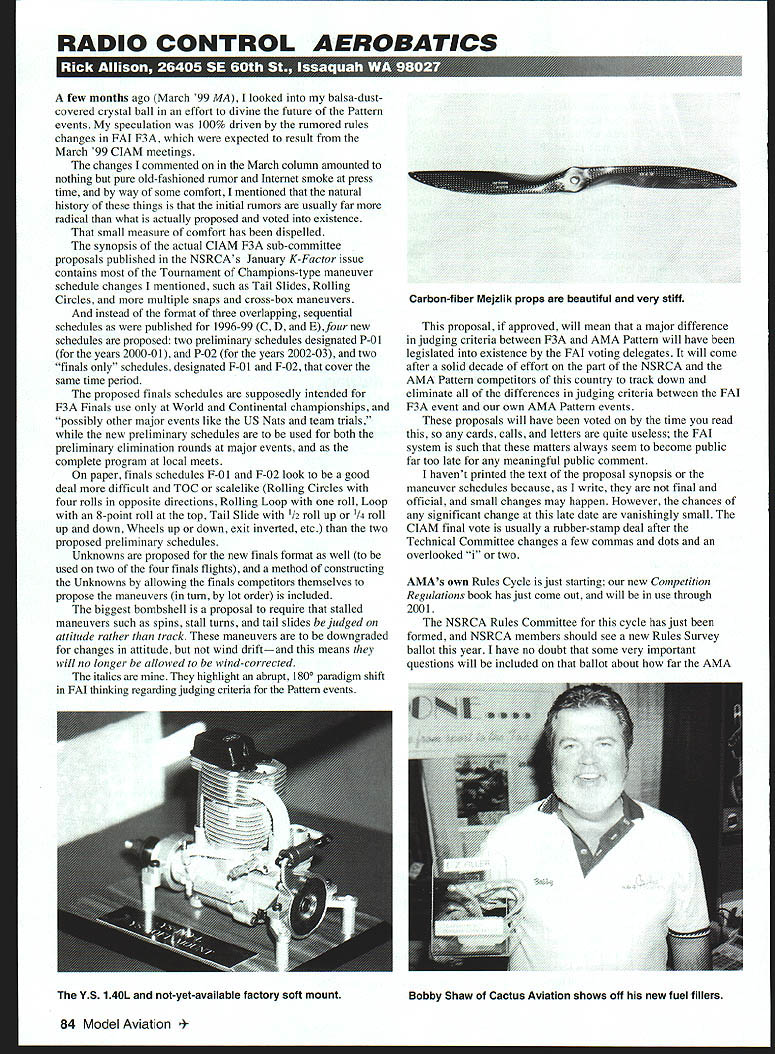
- Mejzlik carbon-fiber props (Desert Aircraft)
- Extraordinary high-quality props from the Czech Republic, now available in Pattern sizes 14 x 13, 15 x 12, 15.5 x 13, and 16 x 8, 10, 12, and 14.
- Prices are in the mid-$20 range.
- Order from Desert Aircraft, 1405 Camino Seco #418, Tucson, AZ 85710; Tel: (520) 722-0607.
- K&B 4-Cycle glow plug (Don Weitz, K&B)
- Platinum element welded on both ends (not swaged) and a 24K gold-plated high-conductivity stem.
- Initial field reports are positive.
- Suggested retail: $5.95.
- E-Z Filler (Cactus Aviation)
- A fuel-dot-type fuel filler that includes its own filler T-fitting in the package.
- Price not in my notes; contact Cactus Aviation at (520) 721-0087.
- Ni-Cd packs and Pattern models (Mike Ankney, Ohio R/C Models)
- Airborne Ni-Cd packs done in clear shrink wrap for easy inspection of tabs and cells; built from high-grade Sanyo cells in popular sizes and configurations.
- Also offers 74-inch-span Giles G-202 and 75-inch-span G-200. These models build to about 10.5 lb, accept a wide variety of engines, and suit Pattern and IMAC events.
- Tel: (937) 859-1660.
- YS 1.40L engine (at the Futaba booth)
- New YS 1.40L shown on a clever new factory soft mount. A revised crankshaft provides a small power increase over the 1.40RF, and new bosses on the crankcase casting accept the mount.
- The engine is available now; the mount is not yet available and no ship date was given.
- Street price on the new engine sans mount is approximately $525.
- JR PCM-10X (Horizon Hobby Distributors)
- New flagship of the JR line; expected to be available soon.
- Features include a cast magnesium case, new digital servos, a unique trim system (digital trims for flight controls and a mechanical trim for the throttle), and JR’s DataSafe PC Interface software for uploading and downloading model setups to a PC.
Transcribed from original scans by AI. Minor OCR errors may remain.

