
Radio Control Aerobatics
Author
Rick Allison 26405 SE 160th St., Issaquah, WA 98027
Role on the NSRCA Rules Committee
For the past month or so, I've been busy building and testing things for other people to fly. These items aren't model aircraft, so don't sit on the front porch waiting for your favorite trinket-truck to drop off a couple of those nice, big cardboard containers we all like to see.
I've been serving in the nonglamorous, nonvoting, unofficial, highly unpaid position of "creative consultant" to one of the two maneuver-schedule subcommittees of the National Society of Radio Controlled Aerobatics (NSRCA) Rules Committee, which is, traditionally, the AMA Advisory Committee for RC Aerobatics to the AMA RC Aerobatics Contest Board. The sole purpose of these two maneuver-schedule subcommittees is to formulate, test, and submit possible new maneuver schedules for all of the Pattern classes to the main NSRCA Rules Committee.
One of the Rules Committee's tasks is to put out the NSRCA Rules Survey, a questionnaire/poll sent to all NSRCA members near the beginning of each rules cycle. The survey is designed to harvest membership opinions, votes, and comments on current matters of Pattern import. The present plan is to include two sets of possible new schedules in the NSRCA Survey (one set from each maneuver subcommittee), so that members may vote on their relative merits.
The results of the Survey are used by the NSRCA Rules Committee to formulate NSRCA rules proposals, which are submitted to the AMA RC Aerobatics Contest Board. There, in a series of votes, they are either finally approved or disapproved as additions to the rules of the event.
Any change I work on must clear multiple approval stages:
- Be approved by the specific maneuver-schedule subcommittee to which I contribute.
- Be placed on the NSRCA Survey by the main Rules Committee.
- Win a competitive vote of the NSRCA membership against the schedules submitted by the other subcommittee.
- Be submitted as a rules proposal to the AMA RC Aerobatics Contest Board and pass its initial vote.
- Survive a period where cross-proposals may be submitted and voted on.
- Pass the final vote of the Contest Board before being placed in the Competition Regulations.
The whole process takes up an entire AMA rules cycle (currently three years). It's longer than an elephant's pregnancy and at times can be as messy, slippery, and frustrating as convincing a muddy pig that he wants to ride in a pickup truck during a thunderstorm. But that is merely background for the subject at hand: the structure of Pattern.
Modeling events organized around subjective judging
There are three modeling events primarily organized around the subjective judging of pilot skill. A similar idea provides the basis for all three: the achievement of airborne geometric precision. The methods used differ considerably.
- RC Aerobatics (Pattern)
- RC Scale Aerobatics (IMAC)
- Control Line Precision Aerobatics (Stunt)
Scale Aerobatics is the event most like Pattern in structure. It is divided into skill-classification classes like Pattern, but the maneuver schedules for all classes are based on the IAC (International Aerobatic Club) full-scale aerobatic schedules, and like them, change yearly. The purpose is to replicate, as closely as possible, maximum prototype fidelity to full-scale aerobatics in appearance, rules, procedures, and maneuvers. Scale models must be used in the competition. The emphasis is to provide continuing challenge to pilots by means of continuing alteration in the schedules and maneuvers flown. Freestyles and Unknown schedules are part of the mix; constant change is designed into the structure of the event.
Control Line Precision Aerobatics is the oldest modeling aerobatic event. It is loaded with tradition and changes very slowly. There are four skill classes but only two maneuver schedules. A simplified and abbreviated schedule is used for the entry-level Beginner class; the traditional AMA Stunt "pattern" serves the other three. The time between significant changes in the main maneuver schedule is usually measured in decades. The maneuvers flown are unique to the control method used and seldom replicate full-scale practice.
In Stunt, the emphasis is on the achievement of absolute, ballet-like perfection by continued repetition. Movement between classes is based on average score achieved. Rules stability has always been characteristic of the event, and traditionally, building, designing, and technical skills are regarded almost as highly as piloting skills. For the top three classes (Intermediate, Advanced, and Expert), these skills are rewarded: bonus "appearance" points are added to the flight scores if the pilot actually built the model.
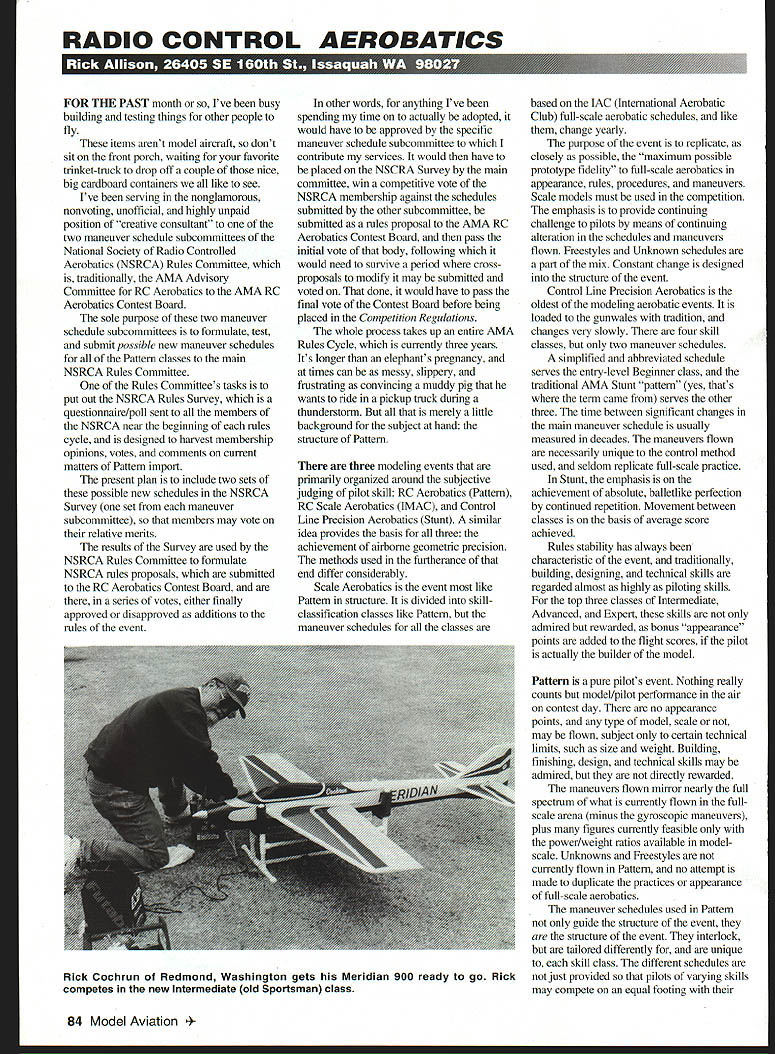
Pattern is a pure pilot's event. Nothing really counts but model/pilot performance in the air on contest day. There are no appearance points, and any type of model, scale or not, may be flown, subject only to certain technical limits such as size and weight. Building, finishing, design, and technical skills may be admired, but they are not directly rewarded. The maneuvers flown mirror nearly the full spectrum of current full-scale aerobatics (minus gyroscopic maneuvers), plus many figures feasible with the power-to-weight ratios available in model scale. Unknowns and Freestyles are not currently flown in Pattern, and no attempt is made to replicate the practices or appearance of full-scale aerobatics.
The structure and purpose of Pattern schedules
The maneuver schedules used in Pattern not only guide the structure of the event, they are the structure of the event. They interlock but are tailored differently for, and unique to, each skill class. The different schedules are not just provided so that pilots of varying skills may compete on an equal footing; they are deliberately designed to teach aerobatic flight skills in a logical progression. The lessons learned at one level are meant to be applied at the next, refined, added to, and then used as the basis for mastering the succeeding levels.
Stunt and Scale unquestionably provide a skill-building and educational experience, but for those events this benefit comes mainly as a collateral side-effect to the main purpose. In Pattern, the educational experience of progressing up the skill ladder is central to the event; it is what makes Pattern unique. It has been called a "university of aerobatic flight." I prefer to think of it more as a correspondence course, with weekend contest-field trips for progress tests.
The usefulness of such an educational structure is beyond doubt—and not just for producing world-class Pattern pilots. Pattern alumni are scattered across the competitive aeromodeling Radio Control events; they have been and are successful in IMAC, Scale, Racing, sailplanes, helicopters, the Electric events, and almost anywhere else that manual skill in precisely guiding a radio-controlled airborne model is at a premium.
Maintaining the internal cohesiveness and integrity of the Pattern educational structure while changing it is very difficult. Rules stability is a necessary component, or the orderly progression of individuals through the classes and up the aerobatic skill ladder is put at risk. Change is also needed: it prevents stagnation at all levels, provides continuing challenge in the top classes, and keeps the event abreast of technical advances in equipment. A balance between change and stability has always been the elusive ideal for Pattern. In reality, the pendulum tends to swing between the two poles from one rules cycle to the next. For the recent past, we have experienced a period of relative stability.
Recent rules-cycle developments and concerns
The current rules cycle is shaping up to be one where participants would like change rather than stability. By nature, change can be either a disruptive or an energizing force. Historically, major Pattern maneuver-schedule changes have almost always been confined to one or two classes per rules cycle. Some of those previous changes have been NSRCA-backed proposals, and some have been proposals from individual participants, but all have taken into account the basic structure and were designed to fit seamlessly into the existing structure.
Several bold new ideas have surfaced in this rules cycle:
- Change is being contemplated across the board; the possible new schedules currently under review by the NSRCA Rules Committee are for all classes—not just one or two. This means nothing can really be designed to fit into an unchanged schedule, because no single point of stability will remain. Instead, an entirely new structure and group of schedules will be proposed; somewhat different from the old, but similar in concept and designed to serve the same educational ends.
- The NSRCA Rules Committee has decided to propose not one such schedule structure but two (which is why two subcommittees were formed), and pick one to submit to the Contest Board by popular vote of the membership on the NSRCA Rules Survey. How the vote will be structured or what the voting options will be has not been finalized at the time of writing. What is certain is that the process of change will be politicized (and popularized) to a greater degree than ever before.
I believe the event belongs to the participants, and I believe the best ideas usually end up on top of the heap. Sensible change is a good and necessary thing, and I believe the time is right for changes. I am even participating in the process of formulating such change. Nevertheless, I have some reservations about this new approach.
On one hand, it certainly involves many more brains in the process than ever before, which can be good. On the other hand, it seems far too much like doing a quadruple heart bypass, brain surgery, a liver transplant, and a face-lift, all at the same time on the same patient. And just to keep it interesting, the hospital has decided to use a couple of different surgical teams and then invite most of the patient's friends and relatives to attend the operation and vote on which incision gets closed first and where all the stitches go.
I don't say the patient won't do just fine and be up flying snap rolls in a week. But I do have my fingers crossed, and I'm hoping the Loop bone stays firmly connected to the Roll bone when the carving is over.
The present schedules and structure of Pattern are a little dated and in need of changes. However, what we have has been refined over years of use and works pretty well within its design limits. Changes of the scope proposed will, if implemented en masse, almost certainly lack that degree of refinement and will doubtless require fine-tuning over the next rules cycle or two.
There are multiple hurdles that any change must clear. Regardless of the proposed scope or the process used, the chances of anything really disruptive to the event being approved are very slim. I'm more concerned that Pattern may end up with politically acceptable changes that, when summed, add up to a weaker structure and a less logical, synergistic, educational experience than they might have, had they not been first designed to pass a popular vote.
Product note: Y.S. engine header advance
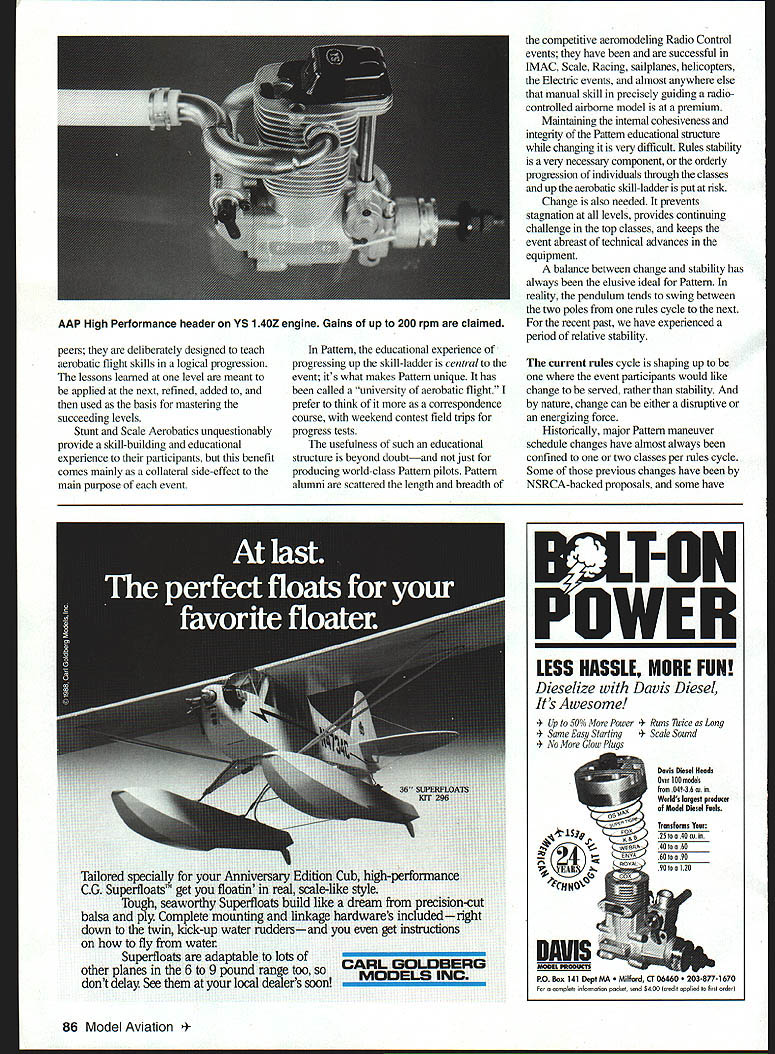
On the Pattern product front, I have just laid hands on a significant advance in header technology for the Y.S. line of engines. It is manufactured by Advanced Aero Products and is available for $49.95 through most of the usual Pattern suppliers and outlets. I got mine from Central Hobbies; their order number is (800) 723-5937.
The all-new, patent-pending, high-performance design significantly reduces back pressure and, depending on the restriction of the muffler or pipe used, has produced gains of up to 200 rpm over conventional headers with the Y.S. I-40L. There is no flex-tube section to break, and it comes with its own high-temperature Teflon® header-tube connection. It fits all of the Y.S. .1.40 and .1.20 engines.
Transcribed from original scans by AI. Minor OCR errors may remain.

