
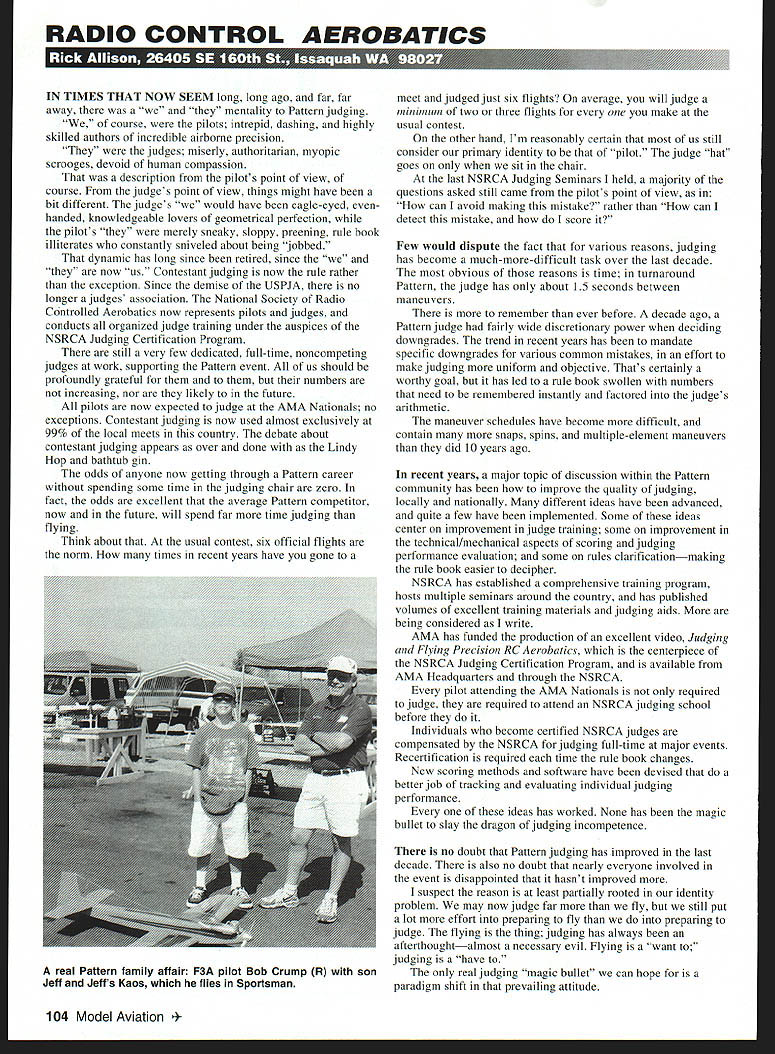
RADIO CONTROL AEROBATICS
Ric Allison, 26405 SE 160th St., Issaquah, WA 98027
In times that now seem long, long ago, and far, far away, there was a "we" and "they" mentality to Pattern judging. "We," of course, were the pilots: intrepid, dashing, and highly skilled authors of incredible airborne precision. "They" were the judges: miserly, authoritarian, myopic scrooges, devoid of human compassion.
That was a description from the pilot's point of view. From the judge's point of view things might have been a bit different. The judge's "we" would have been cagey-eyed, even-handed, knowledgeable lovers of geometrical perfection, while the pilot's "they" were merely sneaky, sloppy, preening, rule-book illiterates who constantly sniveled about being "jobbed."
From "we" and "they" to "us"
That dynamic has long since been retired, since the "we" and "they" are now "us." Contestant judging is now the rule rather than the exception. Since the demise of the USPJA, there is no longer a judges' association. The National Society of Radio Controlled Aerobatics (NSRCA) now represents pilots and judges, and conducts all organized judge training under the auspices of the NSRCA Judging Certification Program.
There are still a very few dedicated, full-time, noncompeting judges supporting the Pattern event. All of us should be profoundly grateful for them, but their numbers are not increasing and are unlikely to in the future.
All pilots are now expected to judge at the AMA Nationals; no exceptions. Contestant judging is now used almost exclusively—about 99%—of local meets in this country. The debate about contestant judging appears as over and done with as the Lindy Hop and bathtub gin.
The odds of anyone getting through a Pattern career without spending some time in the judging chair are zero. In fact, the average Pattern competitor now and in the future will likely spend far more time judging than flying.
Think about that. At the usual contest, six official flights are the norm. How many times in recent years have you gone to a meet and judged just six flights? On average, you will judge a minimum of two or three flights for every one you make at the usual contest.
On the other hand, most of us still consider our primary identity to be "pilot." The judge "hat" goes on only when we sit in the chair.
At the last NSRCA Judging Seminars I held, a majority of the questions still came from the pilot's point of view—for example, "How can I avoid making this mistake?"—rather than "How can I detect this mistake, and how do I score it?"
Why judging has become harder
Few would dispute that judging has become a much more difficult task over the last decade. The most obvious reason is time: in turnaround Pattern, the judge has only about 1.5 seconds between maneuvers.
There is more to remember than ever before. A decade ago, a Pattern judge had fairly wide discretionary power when deciding downgrades. The trend in recent years has been to mandate specific downgrades for various common mistakes, in an effort to make judging more uniform and objective. That's a worthy goal, but it has led to a rule book swollen with numbers that need to be remembered instantly and factored into the judge's arithmetic.
Maneuver schedules have become more difficult and contain many more snaps, spins, and multiple-element maneuvers than they did 10 years ago.
Efforts to improve judging
In recent years, major discussions within the Pattern community have focused on improving the quality of judging locally and nationally. Many ideas have been advanced and several implemented. Some center on judge training; some on technical and mechanical aspects of scoring and judging performance evaluation; and some on rules clarification—making the rule book easier to decipher.
NSRCA has established a comprehensive training program, hosts multiple seminars around the country, and has published volumes of excellent training materials and judging aids. AMA has funded the production of an excellent video, Judging and Flying Precision RC Aerobatics, which is the centerpiece of the NSRCA Judging Certification Program and is available from AMA Headquarters and through the NSRCA.
Every pilot attending the AMA Nationals is required not only to judge but to attend an NSRCA judging school before doing so. Individuals who become certified NSRCA judges are compensated by NSRCA for judging full-time at major events. Recertification is required each time the rule book changes.
New scoring methods and software have been devised that do a better job of tracking and evaluating individual judging performance.
Every one of these ideas has worked. None has been the magic bullet to slay the dragon of judging incompetence.
There is no doubt that Pattern judging has improved in the last decade. There is also no doubt that nearly everyone involved in the event is disappointed that it hasn't improved more.
The underlying problem: identity and attitude
I suspect the reason is at least partially rooted in our identity problem. We may now judge far more than we fly, but we still put a lot more effort into preparing to fly than we do into preparing to judge. Flying is the thing; judging has always been an afterthought—almost a necessary evil. Flying is a "want to"; judging is a "have to."
The only real judging "magic bullet" we can hope for is a paradigm shift in that prevailing attitude.
Most thinking is still focused on improving training materials and programs. That effort, while admirable, might be at least partially misplaced. The present tools aren't ideal, but they are adequate. What we really need is to place judging on a more equal mental footing with flying. We all put in significant time and effort preparing to fly the event. It probably isn't realistic to expect people to devote equal time to preparing to judge, but we should expect a similar intensity of effort—and whatever amount of time it takes to achieve and maintain competence.
That sounds simple, but it won't be easy, because flying is more fun. The competition is in the flying, and all of us are competitors or we wouldn't be doing this.
Change is usually an individual thing. You change when you're convinced it's necessary. I can give you two really good reasons—based on enlightened self-interest—to change your attitude about judging.
- You now participate in a self-administered, self-judged, self-contained event.
- At a local contest you know nearly everyone. Aside from a few newcomers, you and the other competitors are your Pattern family.
- For any of us to have a decent contest, we must support and service each other: run contests, scribe, score, judge, and fly in front of each other. The quality of our individual experience depends on the quality of our collective interaction.
- Respect.
- As a competitor, you owe respect to the event, the rules, and your fellow competitors.
- When you walk up to fly, you want the people sitting in the chairs behind you to be prepared and paying attention. You want a "good look" and a judge immersed in the moment, concentrating as hard as you are.
- When you sit in the chair, consider what the guy flying in front of you wants and needs. If you fail to deliver—because you are tired, distracted, unfamiliar with rules, or let personal feelings influence a score—you disrespect the competitor, his preparation, the other competitors, and the event itself. You disrespect your family.
If the concepts of family and respect aren't enough, consider pride: compete to be the best judge on the field.
All of this amounts to the Golden Rule: do unto others. If you believe something is wrong with the way the event is judged, this is how you can fix it. The event belongs to you—the competitors—and changing your own approach to judging is the only real way to improve it.
Next time you're moved to complain about the judging, go find a mirror and get right in the guy's face.
Next time out, I'll break down some judging specifics and techniques.
Pattern product
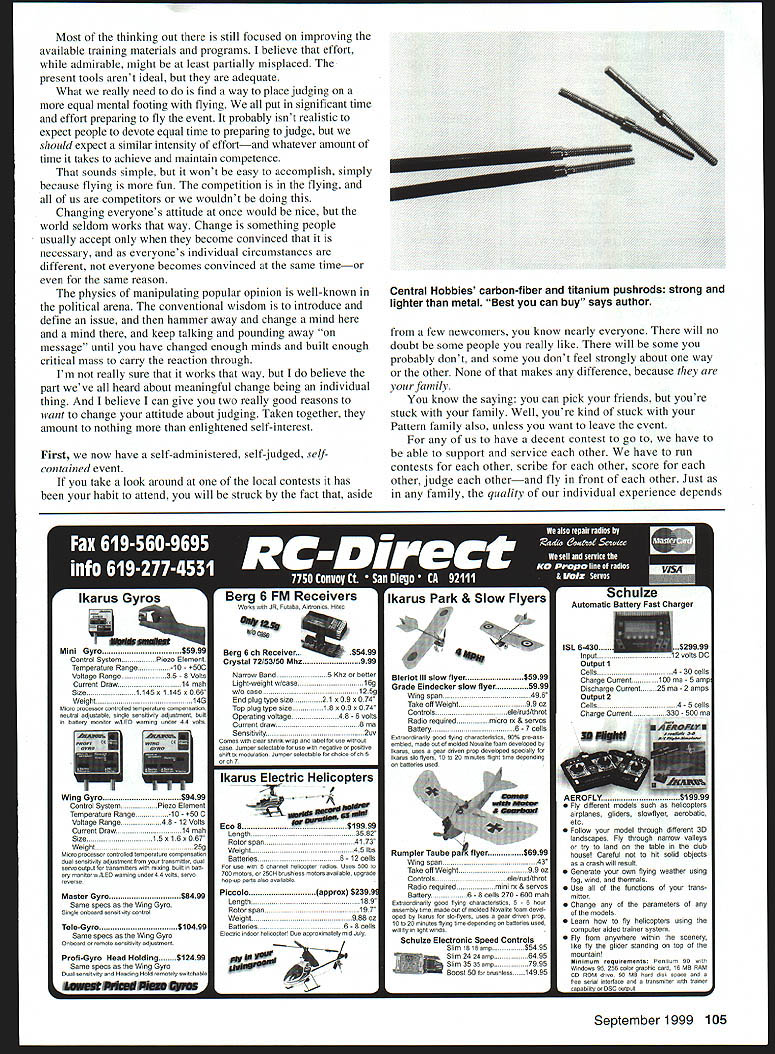
On the Pattern product front, we have Central Hobbies carbon-fiber pushrods with titanium fittings. These rods and fittings are among the best products of their type on the market. Details:
- Diameters available: 1/32" and 3/16"
- Lengths: up to 36 inches
- Fittings available in thread sizes: 2-56, 4-40, 6-32, and 8-32
- Fittings and rods are priced in sets or available separately
Get them direct from Central Hobbies of Billings, MT. Tel.: (800) 723-5937.
Transcribed from original scans by AI. Minor OCR errors may remain.

