
RADIO CONTROL AEROBATICS
Rick Allison 26405 SE 160th St., Issaquah WA 98027
Introduction
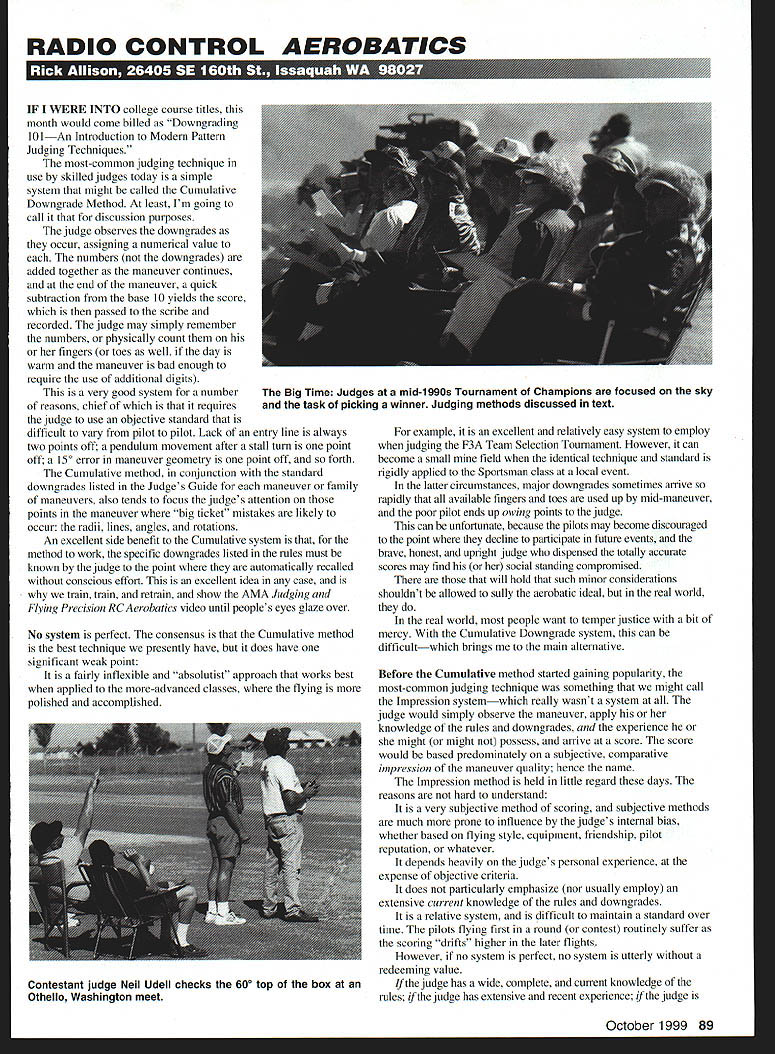
If I were into college course titles, this month would come billed as "Downgrading 101—An Introduction to Modern Pattern Judging Techniques."
The most-common judging technique in use by skilled judges today is a simple system that might be called the Cumulative Downgrade Method. At least, I'm going to call it that for discussion purposes.
Cumulative Downgrade Method
The judge observes the downgrades as they occur, assigning a numerical value to each. The numbers (not the downgrades) are added together as the maneuver continues, and at the end of the maneuver a quick subtraction from the base 10 yields the score, which is then passed to the scribe and recorded. The judge may simply remember the numbers, or physically count them on his or her fingers (or toes as well, if the day is warm and the maneuver is bad enough to require the use of additional digits).
This is a very good system for a number of reasons, chief of which is that it requires the judge to use an objective standard that is difficult to vary from pilot to pilot. Lack of an entry line is always two points off; a pendulum movement after a stall turn is one point off; a 15° error in maneuver geometry is one point off, and so forth.
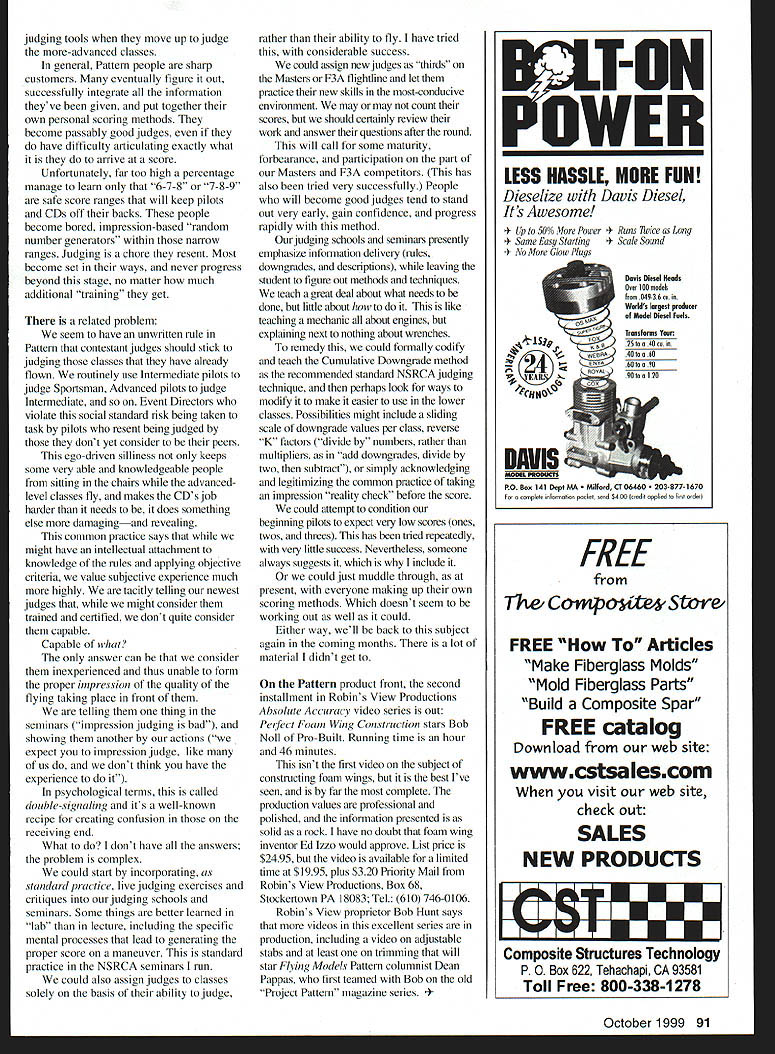
The Cumulative method, in conjunction with the standard downgrades listed in the Judge's Guide for each maneuver or family of maneuvers, also tends to focus the judge's attention on those points in the maneuver where "big ticket" mistakes are likely to occur: the radii, lines, angles, and rotations.
An excellent side benefit to the Cumulative system is that, for the method to work, the specific downgrades listed in the rules must be known by the judge to the point where they are automatically recalled without conscious effort. This is an excellent idea in any case, and is why we train, train, and retrain, and show the AMA Judging and Flying Precision RC Aerobatics video until people's eyes glaze over.
No system is perfect. The consensus is that the Cumulative method is the best technique we presently have, but it does have one significant weak point: it is a fairly inflexible and "absolutist" approach that works best when applied to the more-advanced classes, where the flying is more polished and accomplished.
For example, it is an excellent and relatively easy system to employ when judging the F3A Team Selection Tournament. However, it can become a problem when the identical technique and standard is rigidly applied to the Sportsman class at a local event.
In the latter circumstances, major downgrades sometimes arrive so rapidly that all available fingers and toes are used up by mid-maneuver, and the poor pilot ends up owing points to the judge.
This can be unfortunate, because the pilots may become discouraged to the point where they decline to participate in future events, and the brave, honest, and upright judge who dispensed the totally accurate scores may find his (or her) social standing compromised.
There are those that will hold that such minor considerations shouldn't be allowed to sully the aerobatic ideal, but in the real world, most people want to temper justice with a bit of mercy. With the Cumulative Downgrade system, this can be difficult—which brings me to the main alternative.
Impression System
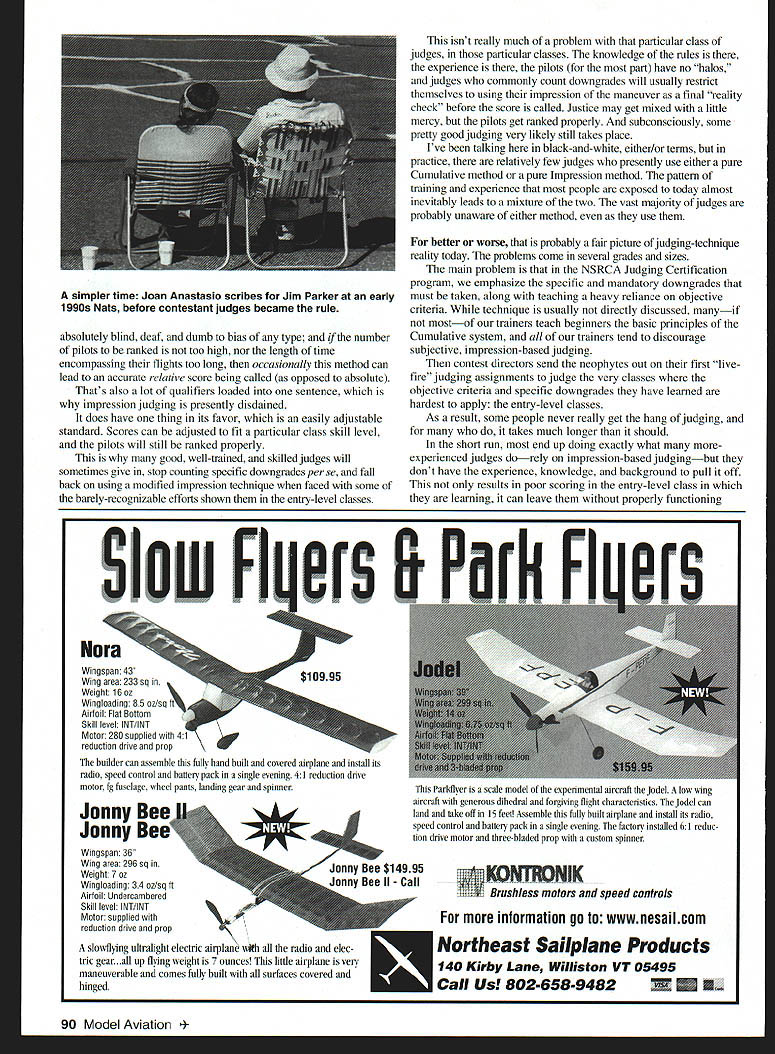
Before the Cumulative method started gaining popularity, the most-common judging technique was something that we might call the Impression system—which really wasn't a system at all.
The judge would simply observe the maneuver, apply his or her knowledge of the rules and downgrades, and the experience he or she might (or might not) possess, and arrive at a score. The score would be based predominately on a subjective, comparative impression of the maneuver quality; hence the name.
The Impression method is held in little regard these days. The reasons are not hard to understand:
- It is a very subjective method of scoring, and subjective methods are much more prone to influence by the judge's internal bias, whether based on flying style, equipment, friendship, pilot reputation, or whatever.
- It depends heavily on the judge's personal experience, at the expense of objective criteria.
- It does not particularly emphasize (nor usually employ) an extensive current knowledge of the rules and downgrades.
- It is a relative system, and is difficult to maintain a standard over time. The pilots flying first in a round (or contest) routinely suffer as the scoring "drifts" higher in the later flights.
However, if no system is perfect, no system is utterly without redeeming value.
If the judge has a wide, complete, and current knowledge of the rules; if the judge has extensive and recent experience; if the judge is absolutely blind, deaf, and dumb to bias of any type; and if the number of pilots to be ranked is not too high, nor the length of time encompassing their flights too long, then occasionally this method can lead to an accurate relative score being called (as opposed to absolute).
That's also a lot of qualifiers loaded into one sentence, which is why impression judging is presently disdained.
It does have one thing in its favor, which is an easily adjustable standard. Scores can be adjusted to fit a particular class skill level, and the pilots will still be ranked properly.
This is why many good, well-trained, and skilled judges will sometimes give in, stop counting specific downgrades per se, and fall back on using a modified impression technique when faced with some of the barely-recognizable efforts shown them in the entry-level classes.
This isn't really much of a problem with that particular class of judges, in those particular classes. The knowledge of the rules is there, the experience is there, the pilots (for the most part) have no "halos," and judges who commonly count downgrades will usually restrict themselves to using their impressions of the maneuver as a final "reality check" before the score is called. Justice may get mixed with a little mercy, but the pilots get ranked properly. And subconsciously, some pretty good judging very likely still takes place.
Hybrid Practice and Training Issues
I've been talking here in black-and-white, either/or terms, but in practice, there are relatively few judges who presently use either a pure Cumulative method or a pure Impression method. The pattern of training and experience that most people are exposed to today almost inevitably leads to a mixture of the two. The vast majority of judges are probably unaware of either method, even as they use them.
For better or worse, that is probably a fair picture of judging-technique reality today. The problems come in several grades and sizes.
The main problem is that in the NSRCA Judging Certification program, we emphasize the specific and mandatory downgrades that must be taken, along with teaching a reliance on objective criteria. While technique is usually not directly discussed, many—if not most—of our trainers teach beginners the basic principles of the Cumulative system, and all of our trainers tend to discourage subjective, impression-based judging.
Then contest directors send the neophytes out on their first "live-fire" judging assignments to judge the very classes where the objective criteria and specific downgrades they have learned are hardest to apply: the entry-level classes.
As a result, some people never really get the hang of judging, and for many who do, it takes much longer than it should.
In the short run, most end up doing exactly what many more-experienced judges do—rely on impression-based judging—but they don't have the experience, knowledge, and background to pull it off. This not only results in poor scoring in the entry-level class in which they are learning, it can leave them without properly functioning judging skills.
Product News: Perfect Foam Wing Construction
On the Pattern product front, the second installment in Robin's View Productions' Absolute Accuracy video series is out: Perfect Foam Wing Construction. Stars Bob Noll of Pro-Built. Running time is an hour and 46 minutes.
This isn't the first video on the subject of constructing foam wings, but it is the best I've seen, and is by far the most complete. The production values are professional and polished, and the information presented is as solid as a rock. I have no doubt that foam wing inventor Ed Rhoads would approve.
- List price: $24.95
- Introductory price (limited time): $19.95, plus $3.20 Priority Mail
- Order from: Robin's View Productions, Box 68, Stockertown PA 18083
- Tel: (610) 746-0106
Robin's View proprietor Bob Hunt says that more videos in this excellent series are in production, including a later one on adjustable stabs and at least one on trimming that will star Flying Models Pattern columnist Dean Pappas, who first teamed with Bob on the old "Project Pattern" magazine series.
Transcribed from original scans by AI. Minor OCR errors may remain.

