
RADIO CONTROL AEROBATICS
Rick Allison, 26405 SE 160th St., Issaquah WA 98027
Event overview
It was good to be back! After a two-year hiatus, my wife Joan and I again made the trek to Muncie for the 1999 RC Aerobatics Nationals, July 18–23. There were a few problems, but as always, it was a trip worth taking.
The RC Aerobatics Category (NSRCA/AMA) National Champions:
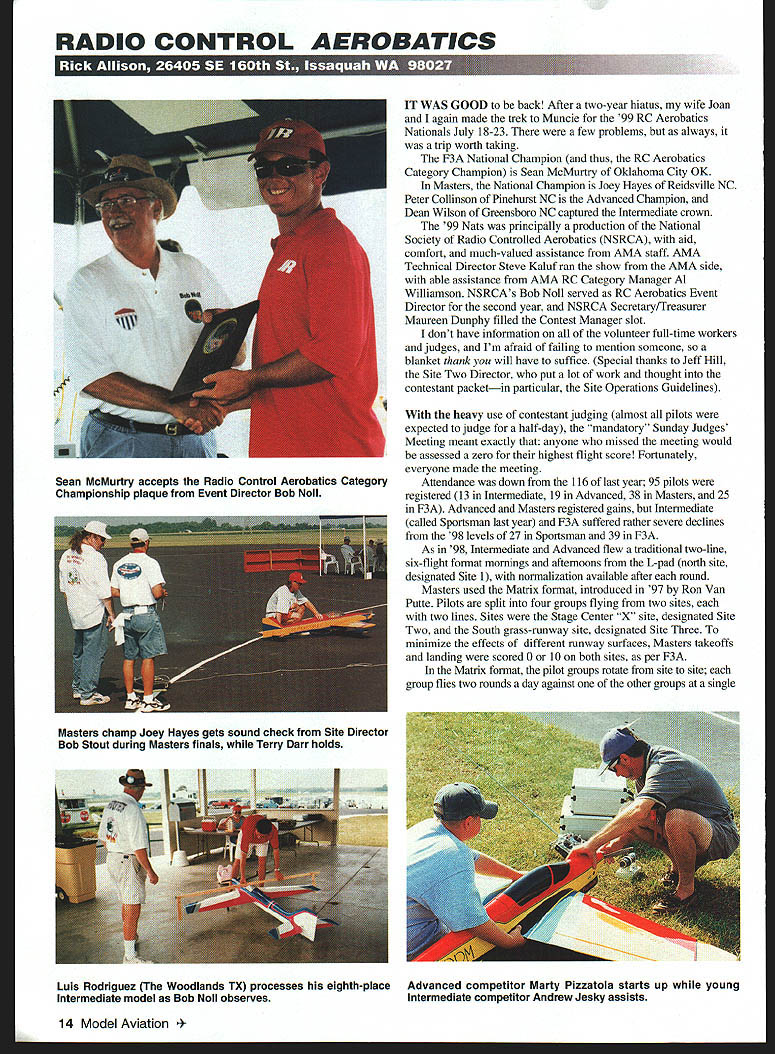
- F3A (RC Aerobatics Category Champion): Sean McMurtry, Oklahoma City, OK
- Masters: Joey Hayes, Reidsville, NC
- Advanced: Peter Collinson, Pinehurst, NC
- Intermediate: Dean Wilson, Greensboro, NC
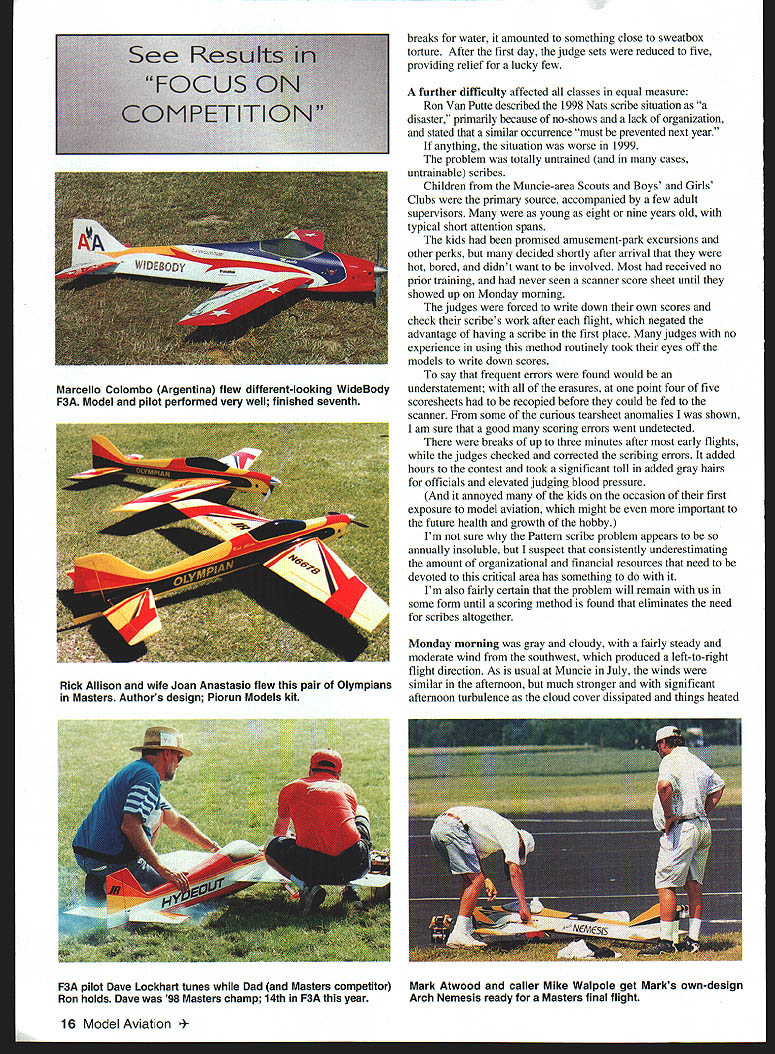
The '99 Nats was principally a production of the National Society of Radio Controlled Aerobatics (NSRCA), with assistance from AMA staff. AMA Technical Director Steve Kaluf ran the AMA side, with AMA RC Category Manager Al Williamson assisting. NSRCA's Bob Noll served as RC Aerobatics Event Director, and NSRCA Secretary/Treasurer Maureen Dunphy was Contest Manager. Special thanks to Jeff Hill, Site Two Director, for his work on the contestant packet and Site Operations Guidelines.
Attendance was down from 116 in '98 to 95 pilots in '99:
- Intermediate: 13
- Advanced: 19
- Masters: 38
- F3A: 25 (19 preregistered, swelled to 25 with late entries)
With heavy contestant judging (almost all pilots judged a half-day), the Sunday judges' meeting was mandatory — anyone who missed it would be assessed a zero for their highest flight score. Fortunately, everyone attended.
Formats and contest running
- Intermediate and Advanced: traditional two-line, six-flight format (morning and afternoon) from the L-pad (north site, Site One), with normalization available after each round.
- Masters: Matrix format (introduced in '97). Pilots split into four groups flying from two sites, each with two lines. Sites were Stage Center "X" (Site Two) and the South grass-runway (Site Three). To minimize runway surface effects, takeoffs and landings were scored 0 or 10 on both sites, per F3A rules.
Matrix format details and advantages:
- Pilot groups rotate site-to-site; each group flies two rounds per day against one other group at a single site.
- Over three days, groups fly two normalized flights against other groups in three mini-contests.
- Preliminary standings combine normalized scores from the three days; a pilot’s highest normalized score of the day is counted along with the next-highest normalized score of the three days.
- Pilots for the three-round finals are traditionally selected from the top 20 percent of the standings. (Bob Noll proposed taking the top ten finishers in Masters and F3A instead of top 20 percent, which would have produced eight and five finalists, respectively.)
- The Matrix reduces judging and contestant workload, gives more immediate normalized feedback, reduces judging drift and weather effects, and rewards consistency.
F3A in 1999:
- In 1998 F3A used the Matrix and was well received because it provided six preliminary flights (two extra flights). In '99, Bob Noll decided at the last minute to combine the planned Matrix groups and run a traditional six-flight prelim format similar to Intermediate and Advanced, offering the option to combine judging groups to produce eight judges per line. In practice, several problems followed (see Problems below).
Problems: scoring, judges, scribes, and weather
Major operational problems affected the contest:
- F3A scoring and judging
- Late entries increased F3A from 19 to 25 pilots.
- The scorekeeping program as set up could not handle eight-judge sets; this was not discovered until after the first round.
- With 25 flights per day, F3A judging sets faced three grueling five- to six-hour sessions in high heat and humidity (heat indexes well over 100°F). Even with breaks for water, sessions were extremely taxing.
- After the first day, judge sets were reduced to five to provide relief, but the initial long sessions caused judge exhaustion and inconsistent results.
- Scribe situation
- The scribe problem was worse than in 1998. Primary scribes were children from local Scouts and Boys' and Girls' Clubs, many as young as eight or nine, often untrained and uninterested. Many had never seen a scanner score sheet.
- Judges often had to write their own scores, check scribes' work, or both — negating the scribe’s purpose and causing judges to look away from the models.
- Frequent errors and erasures resulted; at one point four of five scoresheets had to be recopied before scanning. Breaks of up to three minutes after early flights were common while scores were checked and corrected, adding hours to the contest and increasing stress for officials and judges.
- The kids’ poor experience could harm future recruitment to the hobby.
- The root cause seems to be underestimating the organizational and financial resources needed for reliable, trained scribes. A scoring method that eliminates the need for scribes would help.
- Weather
- Monday morning was gray and windy from the southwest, producing a left-to-right flight direction. Afternoons usually followed with stronger winds and significant turbulence as cloud cover dissipated and temperatures rose.
- This pattern repeated most of the week. No time was lost to weather except a one-hour rain delay for F3A on Tuesday afternoon.
- F3A and Masters finals shared the same issue: strong afternoon winds that added turbulence for the third round.
Intermediate results
- 1st: Dean Wilson — came on strong late and outlasted Michael Kingrey.
- 2nd: Michael Kingrey, Dothan, AL — close contest with Wilson.
- 3rd: James Ivey, Mableton, GA — inconsistent but won a round on the last day.
- 4th: Dae Kim, Rockford, IL — won a round to capture fourth place.
- Note: Bill Gregg, Wauconda, IL was initially fourth but was disqualified for illegal equipment (overweight).
- 5th: Michael Harrison Jr. — had equipment problems that dropped him into fifth place.
Advanced results
- 1st: Peter Collinson, Pinehurst, NC (14 years old) — three round wins; consistent flying earned the Advanced National Championship, repeating his '98 Sportsman title.
- 2nd: Richard Ames, Atlanta, GA — tight battle with Peter, won two rounds.
- 3rd: Bob Roe, Alpharetta, GA — steady performance.
- 4th: Trent Byrd, Las Vegas, NV — won one round but left himself just short overall.
- 5th: Michael Thomason, Lexington, NC — 17 normalized points behind Trent.
- 6th: Mike Siddall, North York, Ontario, Canada — close behind Thomason.
The very close top finishes bode well for future competition as these pilots move up.
Masters preliminary standings and notable competitors
At the end of three days of Matrix-format prelims:
- Mark Atwood and Joey Hayes tied for first, each with four round wins.
- I (Rick Allison) was third, kept in the hunt by a consistent string of 9s and 9.5s.
- 4th: Dave von Linsowe
- 5th: Joe Lachowski
- The rest of the top ten included Rob Satalino, Kirk Gray, Earl Vincent, George Asteris, and Bryan Hebert.
Other notable Masters competitors included Troy Newman (Lakewood, CO), David Snow (Palatine, IL), Rusty Friend (Phoenix, AZ), Terry Darr (Lexington, IN), Mike Walpole (Dayton, OH), and Mickey Losardo (Schaumburg, IL).
Because two three-flight, ten-man finals were projected to run consecutively, Event Director Bob Noll elected to run the F3A and Masters finals simultaneously — F3A at Stage Center and Masters at the L-pad.
F3A finals (notes)
I can’t report first-hand on the F3A finals (I was competing on the other site), but I learned that the finals were a tight duel between Kirk Gray and Sean McMurtry:
- Round One: Kirk Gray beat Sean by about 3.5 normalized points.
- Round Two: Sean beat Kirk by about 5 normalized points.
- Round Three: Sean beat Kirk by about 25 normalized points — enough to win the contest by a tiny margin of 1.2 normalized points. The third flight advantage was attributed to Sean’s performance in the strong wind.
Final F3A placements:
- 1st: Sean McMurtry
- 2nd: Kirk Gray
- 3rd: Mike Caglia — moved up to third with a very strong showing in the E pattern; a rising star.
- 4th: Chris Lakin — improved noticeably during the contest.
- 5th: Ivan Kristensen
- 6th: Dave von Linsowe
- 7th: Marcelo Colombo
- 8th: Bryan Hebert
- 9th: Rick Mattie
- 10th: Mike Harrison
Masters finals (first-hand)
The three-round Masters final unfolded as follows:
- Round One: Joey Hayes opened strongly and took the round. Rob Satalino was second, Troy Newman third, and I placed fourth after a distracting hat "blow-off" during the spin.
- Round Two: Rob Satalino had a very clean flight and won the round. I managed a second-place in the round; Joey Hayes was third and Troy Newman fourth.
- Round Three (after lunch, with strong afternoon wind): Early flights held up, but the wind increased during the round. Joey Hayes had an excellent flight in the wind. Rusty Friend also flew very well. Flying second-from-last, with my hat tied tight, I used everyone else's efforts to guide my strategy and managed to win the round.
Masters final results:
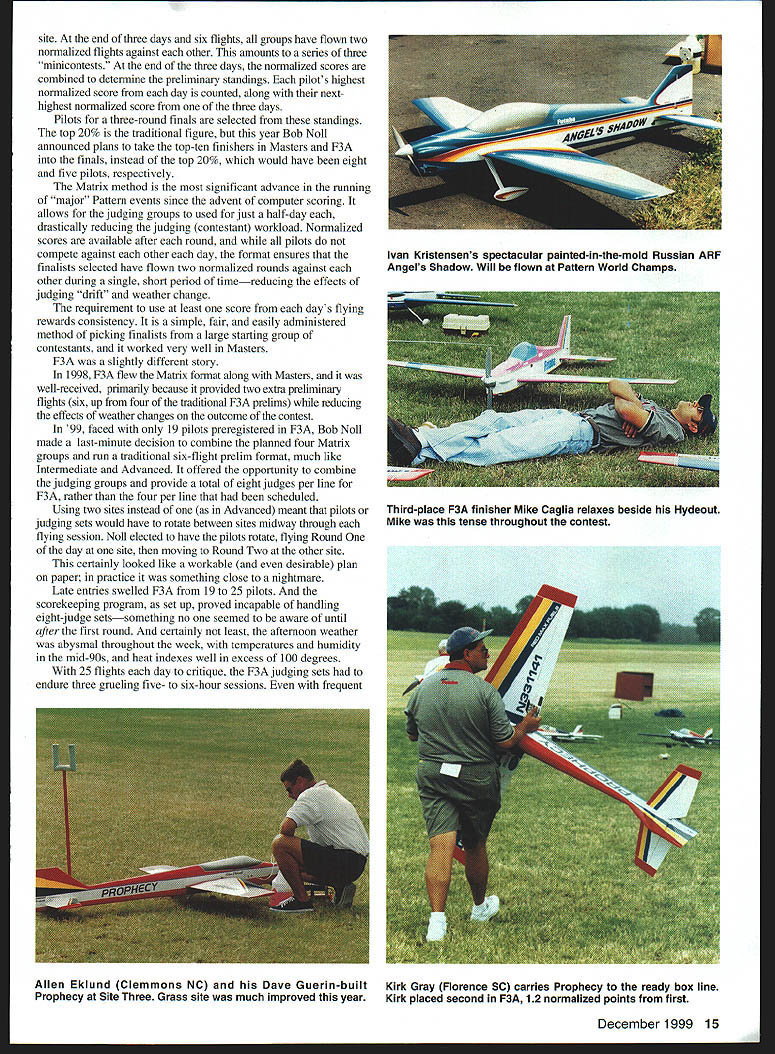
- 1st: Joey Hayes
- 2nd: Rick Allison (author)
- 3rd: Rob Satalino
Trend-Spotting Department
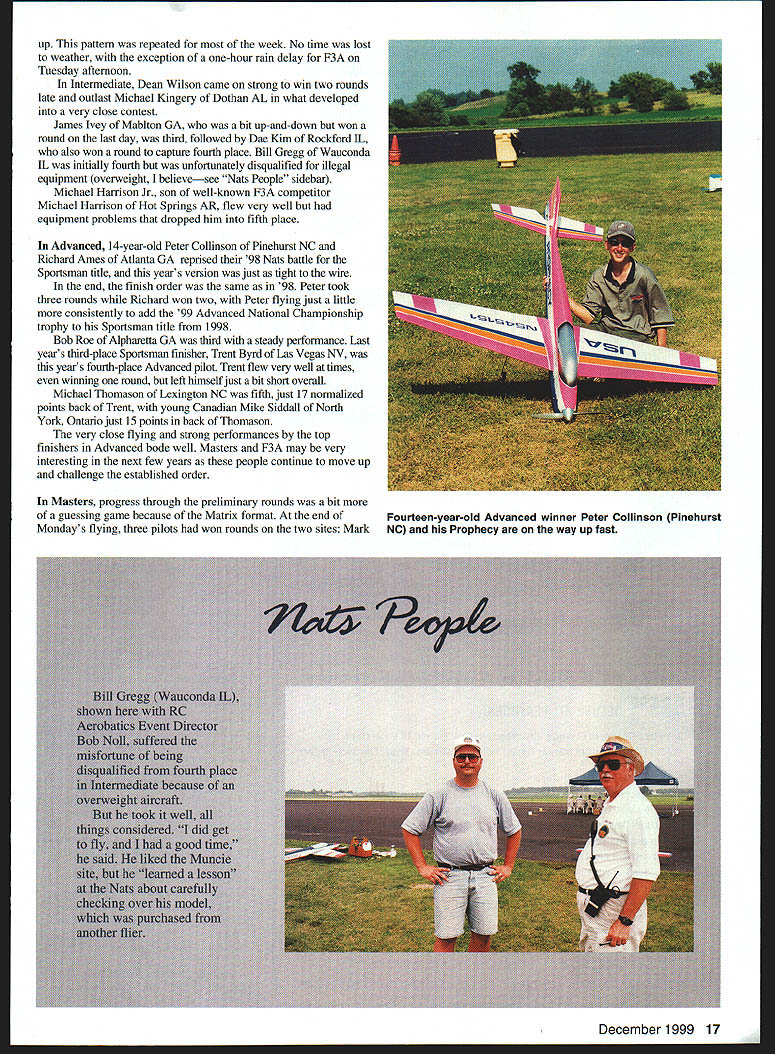
- Fixed gear: continues as a popular option, roughly 5–10% of entries, mostly Dave Guerin-built Hydeouts and a few scale or semi-scale models. No clear advantage or disadvantage was noticeable in flight, ground handling, or on the scales.
- New models: Ivan Kristensen showed (but did not fly) a wide-bodied fixed-gear Russian all-glass ARF called Angel’s Shadow (VK Technology import). Ivan reports it flies very well and plans to use it at the World Championships; no mass import plans currently.
- Engines: Two-strokes have not reclaimed predicted leadership — about 98% of the top leaderboard still runs Y.S. engines, with the Y.S. .1.40 FZ and FZ-L models popular.
- Airframes: The Jekyll/Sequel/Phroggy family clones (joined by the Hydeout) remain the most popular Pattern models.
- Colors: White is still the most popular base color; yellow is gaining fast. In 1999, yellow-based models took first and second in Masters and first in F3A.
- Props/spinners: APC and Tru-Turn remain the props and spinners of choice. The APC 15.5 x 12.5W prop is a trendy choice for Y.S. 1.40 users.
- Retracts: Supras are most popular; the expensive 2000XD titanium-sheathed models are gaining ground.
- Fuel: Brands vary, but most pilots use fuel with ~20–25% nitro and ~20% oil (mostly synthetic). Fuel colors used include pale pink, red, green, and colorless.
- Glow plugs: O.S. Type F glow plugs are the ubiquitous choice.
- Regional hotbed: The Carolinas are a Pattern hotbed, contributing about 15% of the '99 Nats entries and winners in all classes except F3A.
Closing
While massive changes in Pattern are often rumored, they haven’t arrived yet. This was another really good time at the RC Aerobatics Nationals, despite heat, scoring and scribe problems, and afternoon turbulence.
If the world does not end because of Y2K problems, I expect more of the same next year. See you in Muncie in 2000!
Transcribed from original scans by AI. Minor OCR errors may remain.

