
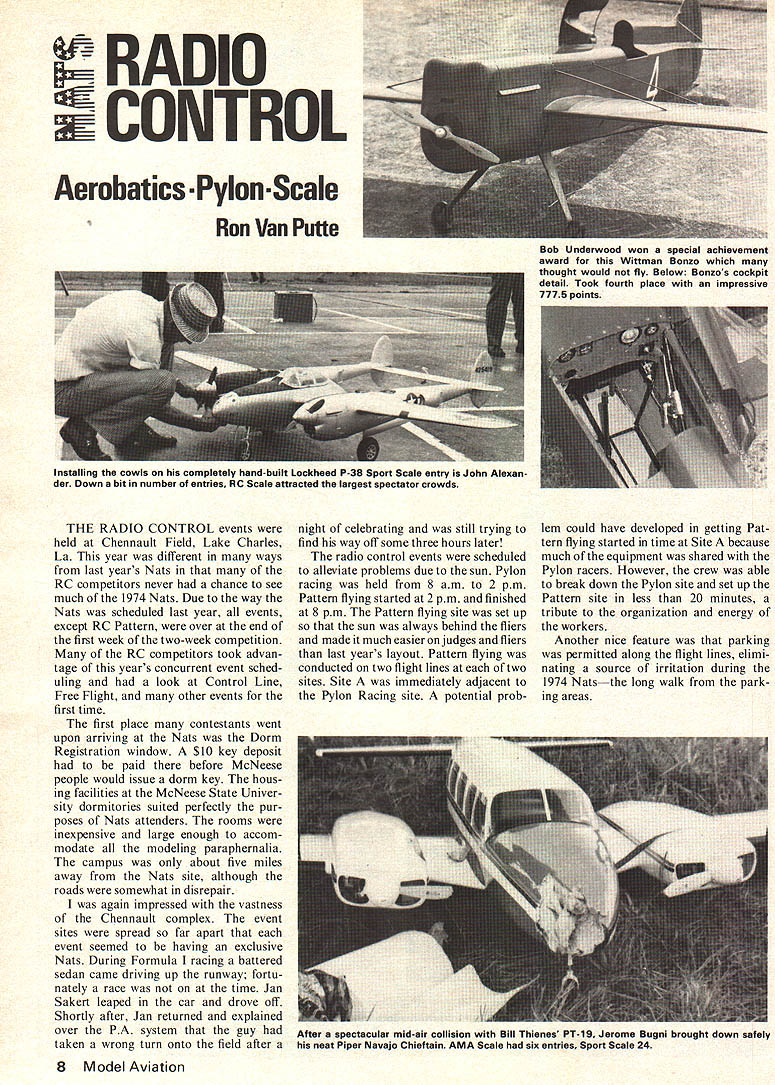
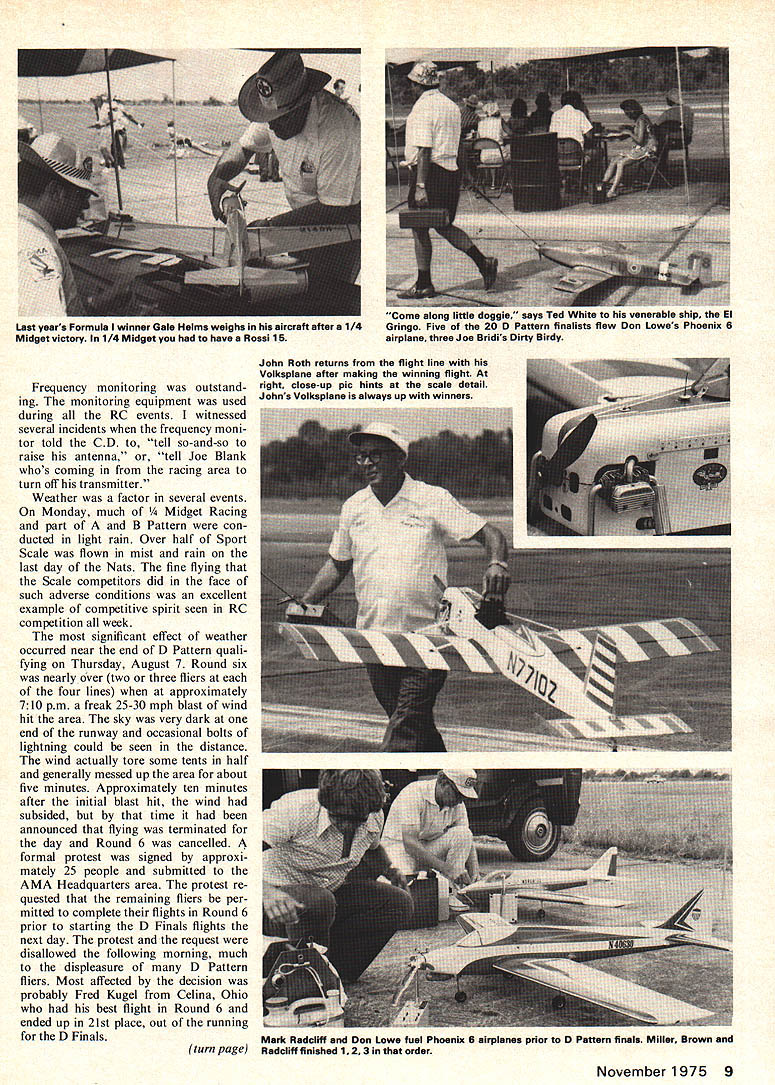
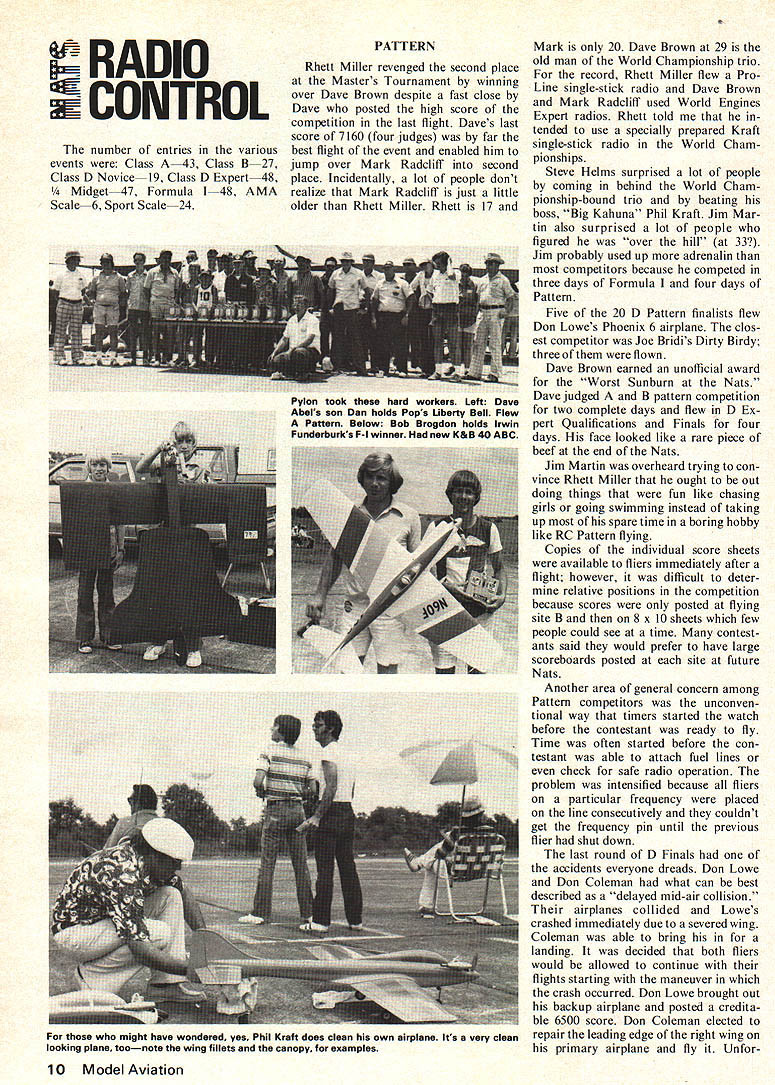
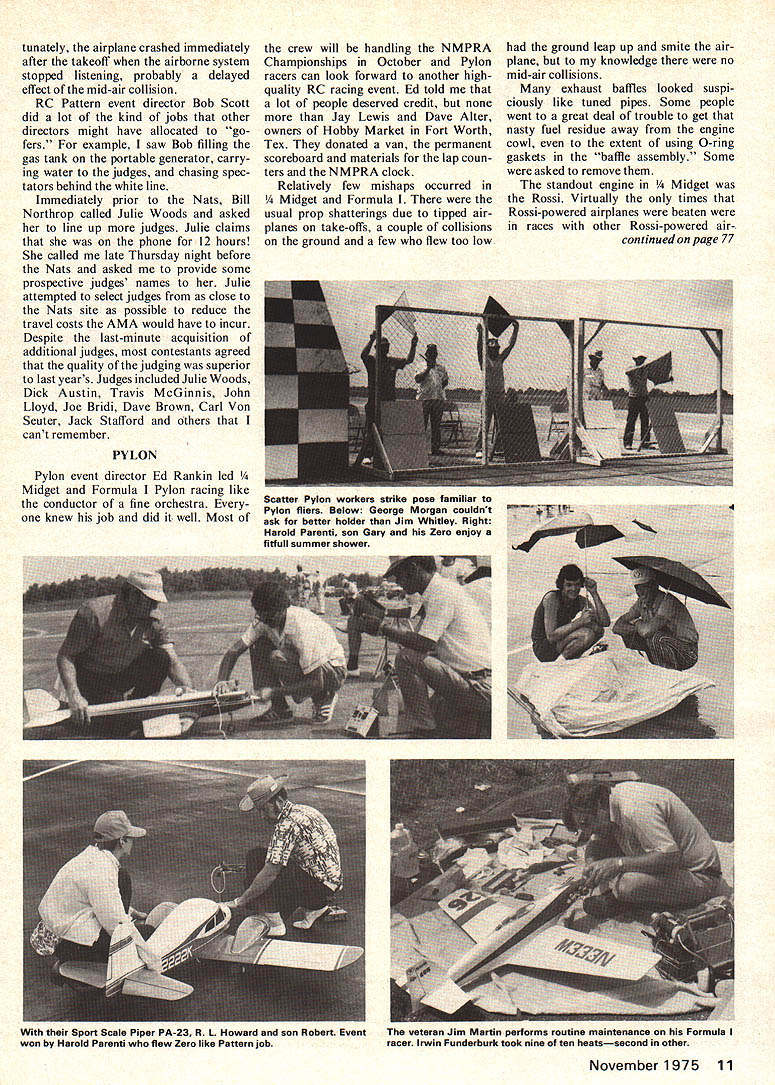
RADIO CONTROL
Aerobatics·Pylon·Scale
Ron Van Putte
The radio control events were held at Chennault Field, Lake Charles, La. This year was different in many ways than last year's Nats in that many of the RC competitors never had a chance to see much of the 1974 Nats. Due to the way the Nats was scheduled last year, all events, except RC Pattern, were over at the end of the first week of the two-week competition. Many of the RC competitors took advantage of this year's concurrent event scheduling and had a look at Control Line, Free Flight, and many other events for the first time.
The first place many contestants went upon arriving at the Nats was the Dorm Registration window. A $10 key deposit had to be paid there before McNeese people would issue a dorm key. The housing facilities at the McNeese State University dormitories suited perfectly the purposes of Nats attenders. The rooms were inexpensive and large enough to accommodate all the modeling paraphernalia. The campus was only about five miles away from the Nats site, although the roads were somewhat in disrepair.
I was again impressed with the vastness of the Chennault complex. The event sites were spread so far apart that each event seemed to be having an exclusive Nats. During Formula I racing a battered sedan came driving up the runway; fortunately a race was not on at the time. Jan Sakert leaped in the car and drove off. Shortly after, Jan returned and explained over the P.A. system that the guy had taken a wrong turn onto the field after a night of celebrating and was still trying to find his way off some three hours later.
The radio control events were scheduled to alleviate problems due to the sun. Pylon racing was held from 8 a.m. to 2 p.m. Pattern flying started at 2 p.m. and finished at 8 p.m. The Pattern flying site was set up so that the sun was always behind the fliers and made it much easier on judges and fliers than last year's layout. Pattern flying was conducted on two flight lines at each of two sites. Site A was immediately adjacent to the Pylon Racing site. A potential problem could have developed in getting Pattern flying started in time at Site A because much of the equipment was shared with the Pylon racers. However, the crew was able to break down the Pylon site and set up the Pattern site in less than 20 minutes, a tribute to the organization and energy of the workers.
Another nice feature was that parking was permitted along the flight lines, eliminating a source of irritation during the 1974 Nats — the long walk from the parking areas.
Weather was a factor in several events. On Monday, much of the 1/4 Midget Racing part B Pattern was conducted in light rain. Over half of Sport Scale was flown in mist and rain the last day of the Nats. Scale competitors did face such adverse conditions; an excellent example of competitive spirit was seen during the RC competition week. The most significant effect of weather occurred near the end of D Pattern qualifying Thursday, August 7. Round six, nearly over — with two or three fliers and four lines — at approximately 7:10 p.m., a freak 25–30 mph blast of wind hit the area. The sky was very dark at the end of the runway and occasional bolts of lightning could be seen in the distance. The wind actually tore some tents in half and generally messed up the area for about five minutes. Approximately ten minutes after the initial blast hit, the wind subsided. At that time it was announced that flying was terminated for the day. Round 6 was cancelled.
A formal protest, signed by approximately 25 people, was submitted to AMA Headquarters requesting that the remaining fliers be permitted to complete their flights from Round 6 prior to starting D Finals the next day. The protest request was disallowed the following morning, to the displeasure of many D Pattern fliers. The most affected by the decision was probably Fred Kugel, Celina, Ohio, who had the best flight of Round 6 and ended up 21st, thus not running in the D Finals. Mark Radcliff and Don Lowe had fuel problems with Phoenix 6 airplanes prior to the D Pattern finals. Miller Brown ... Radcliff finished 1, 2, 3 in that order.
RADIO CONTROL: Aerobatics-Pylon-Scale
PATTERN
Rhett Miller revenged the second place at the Master's Tournament by winning over Dave Brown despite a fast close by Dave who posted the high score of the competition in the last flight. Dave's last score of 7160 (four judges) was by far the best flight of the event and enabled him to jump over Mark Radcliff into second place. Incidentally, a lot of people don't realize that Mark Radcliff is just a little older than Rhett Miller. Rhett is 17 and Mark is only 20. Dave Brown at 29 is the old man of the World Championship trio. For the record, Rhett Miller flew a ProLine single-stick radio and Dave Brown and Mark Radcliff used World Engines Expert radios. Rhett told me that he intended to use a specially prepared Kraft single-stick radio in the World Championships.
Steve Helms surprised a lot of people by coming in behind the World Championship-bound trio and by beating his boss, "Big Kahuna" Phil Kraft. Jim Martin also surprised a lot of people who figured he was "over the hill" (at 33?). Jim probably used up more adrenalin than most competitors because he competed in three days of Formula I and four days of Pattern.
Five of the 20 D Pattern finalists flew Don Lowe's Phoenix 6 airplane. The closest competitor was Joe Bridi's Dirty Birdy; three of them were flown.
Dave Brown earned an unofficial award for the "Worst Sunburn at the Nats." Dave judged A and B pattern competition for two complete days and flew in D Expert Qualifications and Finals for four days. His face looked like a rare piece of beef at the end of the Nats.
Jim Martin was overheard trying to convince Rhett Miller that he ought to be out doing things that were fun like chasing girls or going swimming instead of taking up most of his spare time in a boring hobby like RC Pattern flying.
Copies of the individual score sheets were available to fliers immediately after a flight; however, it was difficult to determine relative positions in the competition because scores were only posted at flying site B and then on 8 x 10 sheets which few people could see at a time. Many contestants said they would prefer to have large scoreboards posted at each site at future Nats.
Another area of general concern among Pattern competitors was the unconventional way that timers started the watch before the contestant was ready to fly. Time was often started before the contestant was able to attach fuel lines or even check for safe radio operation. The problem was intensified because all fliers on a particular frequency were placed on the line consecutively and they couldn't get the frequency pin until the previous flier had shut down.
The last round of D Finals had one of the accidents everyone dreads. Don Lowe and Don Coleman had what can best be described as a "delayed mid-air collision." Their airplanes collided and Lowe's crashed immediately due to a severed wing. Coleman was able to bring his in for a landing. It was decided that both fliers would be allowed to continue with their flights starting with the maneuver in which the crash occurred. Don Lowe brought out his backup airplane and posted a creditable 6500 score. Don Coleman elected to repair the leading edge of the right wing on his primary airplane and fly it. Unfor- tunately, the airplane crashed immediately after the takeoff when the airborne system stopped listening, probably a delayed effect of the mid-air collision.
RC Pattern event director Bob Scott did a lot of the kind of jobs that other directors might have allocated to "go-fers." For example, I saw Bob filling the gas tank on the portable generator, carrying water to the judges, and chasing spectators behind the white line.
Immediately prior to the Nats, Bill Northrop called Julie Woods and asked her to line up more judges. Julie claims that she was on the phone for 12 hours! She called me late Thursday night before the Nats and asked me to provide some prospective judges' names to her. Julie attempted to select judges from as close to the Nats site as possible to reduce the travel costs the AMA would have to incur. Despite the last-minute acquisition of additional judges, most contestants agreed that the quality of the judging was superior to last year's. Judges included Julie Woods, Dick Austin, Travis McGinnis, John Lloyd, Joe Bridi, Dave Brown, Carl Von Seuter, Jack Stafford and others that I can't remember.
PYLON
Pylon event director Ed Rankin led 1/4 Midget and Formula I Pylon racing like the conductor of a fine orchestra. Everyone knew his job and did it well. Most of the crew will be handling the NMPRA Championships in October and Pylon racers can look forward to another high-quality RC racing event. Ed told me that a lot of people deserved credit, but none more than Jay Lewis and Dave Alter, owners of Hobby Market in Fort Worth, Tex. They donated a van, the permanent scoreboard and materials for the lap counters and the NMPRA clock.
Relatively few mishaps occurred in 1/4 Midget and Formula I. There were the usual prop shatterings due to tipped airplanes on take-offs, a couple of collisions on the ground and a few who flew too low had the ground leap up and smite the airplane, but to my knowledge there were no mid-air collisions.
Many exhaust baffles looked suspiciously like tuned pipes. Some people went to a great deal of trouble to get that nasty fuel residue away from the engine cowl, even to the extent of using O-ring gaskets in the "baffle assembly." Some were asked to remove them.
The standout engine in 1/4 Midget was the Rossi. Virtually the only times that Rossi-powered airplanes were beaten were in races with other Rossi-powered airplanes. planes. It was easy to tell which airplane had a Rossi because the sound was so different from K & B or Super Tigre engines. Owners of Rossis spent a lot of their spare time comparing the prices they had to pay for their engines. I heard prices of $65 to $95.
Quarter Midget has become very much like Formula I in that, in order to win, the competitor not only must be a good flier, but he needs a fast (often expensive) airplane, a tachometer and one of those super (Rossi) engines.
Bob Reuther was never headed as he won all of his nine heats. His Rossi-powered Sky Glas Cosmic Wind was significantly faster than Tom Moore's. Tom had an identical airplane with the exception that it used a K & B for power. Bob established the fastest heat time of 1:40.5 and came right back to beat his own time with a 1:40.
FORMULA I
The new K & B ABC rear-exhaust engine had only been available for a couple of weeks, but the first- and second-place airplanes in Formula I were powered by them. Of course, the earlier K & B and Super Tigre
Super Tigre engines were used by other competitors. The most commonly used engine was a "Terry Tigre" — a Super Tigre reworked by Terry Prather.
Many were disappointed that some of the "top guns" were missing from Formula I competition. Among the missing were Terry Prather and Bob Smith. They probably chose to wait until the NMPRA Championships in October to put their reputations on the line.
Whit Stockwell won a special award for the best scale Formula I racer. After watching Ed Rankin trying to decide which of the beautifully finished airplanes deserved the award, I'm glad he had the job and not me.
Irwin Funderburk nearly dominated Formula I as much as Bob Reuther dominated 1/4 Midget. Irwin won nine of ten heats and was second in another. He and Bob Violet were tied for most of the contest, but Bob had the misfortune to run up against Jim Martin in the ninth round when he was hot, and Bob finished second.
Consequently, this third place in the tenth round was an anticlimax. Times were not particularly fast in Formula I, probably because of the high heat and humidity. The fastest time was by John McDermott, who had a 1:18.9. There were a few 1:19's, but most of the races were in the mid 1:20's.
SCALE
More spectators gathered to watch AMA and Sport Scale than any other event. The excitement involved with watching the flights of beautifully crafted miniature versions of full-scale aircraft cannot be matched. Unfortunately, AMA Scale was disappointing this year in that there were only six entries. The airplanes were as meticulously detailed as ever and all the spectators admired them for what they were.
The time allocated for flying AMA Scale was disproportionately large compared to the time allocated for Sport Scale. The six entries had six hours for flying on each of two days. In comparison, Sport Scale had only six hours for 24 entries. That's an 8:1 ratio of time per entry for AMA Scale versus Sport Scale! Perhaps an increase in the time for Sport Scale relative to AMA Scale can be made in the 1976 Nats.
Bob Underwood won a special flight achievement award in AMA Scale for his Wittman D-12 Bonzo. Nobody I talked to prior to the flyoff thought the airplane would fly well; a few doubted that it would even get airborne. However, the Bonzo flew as well as most of the other entries, if not better. The flight of the stubby-winged ugly aircraft was smooth and stable.
Walt Mouchea flew his venerable Fly Baby. Walt is only 26 and few people realize that Walt was the youngest entrant ever to compete in the scale World Championships.
The six entries in AMA Scale placed as follows: 1. John Roth (Volksplane) — 833.5; 2. Stephen Sauger (Stinson) — 806.5; 3. Bob Wischer (Emeraude) — 803.5; 4. Bob Underwood (Bonzo) — 777.5; 5. Walt Moucha (Fly Baby) — 765.0; 6. Bill Johnson (Ryan STA) — 735.5.
Sport Scale was exciting and varied. Since two flight lines were used, there was usually at least one airplane flying at all times. The mist and rain which prevailed during at least half of the competition was virtually ignored by the entrants. When a flier was asked if he preferred to fly or pass, the response was usually, "I want to fly." Several of the airplanes seemed almost suited to the weather; John Kidwell's Spitfire and Bob Underwood's Stormovik looked great in the mist.
A mid-air collision occurred between Bill Thiene's PT-19 and Jerry Bugni's Piper Navajo Chieftain. Both airplanes were able to get back on the ground safely with relatively minor damage.
Dave Platt flew the first Sport Scale airplane using a ducted fan to ever to compete at the Nats. His F-6A Skyray with an HP-40 R/C exhaust had retracts. The airplane suffered minor damage (which was repaired for later flights) when the carburetor fell out of the engine, and Dave had to bring the airplane in for an emergency landing.
Jeff Berthenn competed using a beautiful Twin Beechcraft which earned a perfect score of 100 points in the static judging. Unfortunately, when Jeff attempted a loop as one of his maneuvers, the airplane stalled at the top, went into a spin and crashed vertically into the runway, completely destroying it.
Harold Parenti flew a Zero like a Pattern airplane and no wonder: Harold has been winning D Expert Pattern contests in the midwest for many years. Another who flew his entry like a Pattern airplane was Ralph White. He flew a Fliteglas P-51 D (he owns Fliteglas) and did several maneuvers from the D Pattern. His airplane has over 700 flights on it and looks nearly new.
Winners in Sport Scale were: 1. Harold Parenti (Zero) — 184.5; 2. Bob Underwood (Stormovik) — 182.5; 3. (T) Bob Wischer (Pober Pixie) — 181.5; (T) Michael Sadler (Piper Comanche) — 181.5; 4. Ralph White (P-51 D) — 180; 5. Dave Platt (Skyray) — 176.
After Sport Scale was over, an air show was held near the Nats hangar as a finale to the 1975 Nats. Bob Underwood flew his Bonzo and Kathy Burnstine flew her control-line Liberty Sport. Featured in the show was a two-hour RC show put on by Colonel Betky's Flying Circus. The group came all the way from Toledo, Ohio, to put on the show. They are a dedicated bunch of showmen who know what spectators like and can deliver it. Al Betkey was especially impressive flying a modified (by adding polyhedral) Contender in barnstorming maneuvers, and especially in his upright and inverted passes through a flaming nine-foot diameter hoop. The Snoopy Dog House was the best-flying version I have ever seen and the El Toro flying lawnmower surprised and delighted all of the spectators.
The 1975 Nats is history and I was pleased to be a part of it. Before finishing my report, I want to say thanks to some people.
RC Category Director Kemp Bunting put everything he had to offer into his job. Some evenings his wife almost had to help him to the car because he was so tired. Kemp had one of those thankless jobs that results in a lot of abuse and little of the credit he really deserves. Thanks, Kemp.
In addition, my personal thanks are extended to all the event directors and contestants who put up with me doing my job, and especially my fellow Eglin Aero Modelers, Ron Vick and Dave Strawser, who assisted me by taking many of the photographs.
Transcribed from original scans by AI. Minor OCR errors may remain.

