

Combat
Charlie Johnson
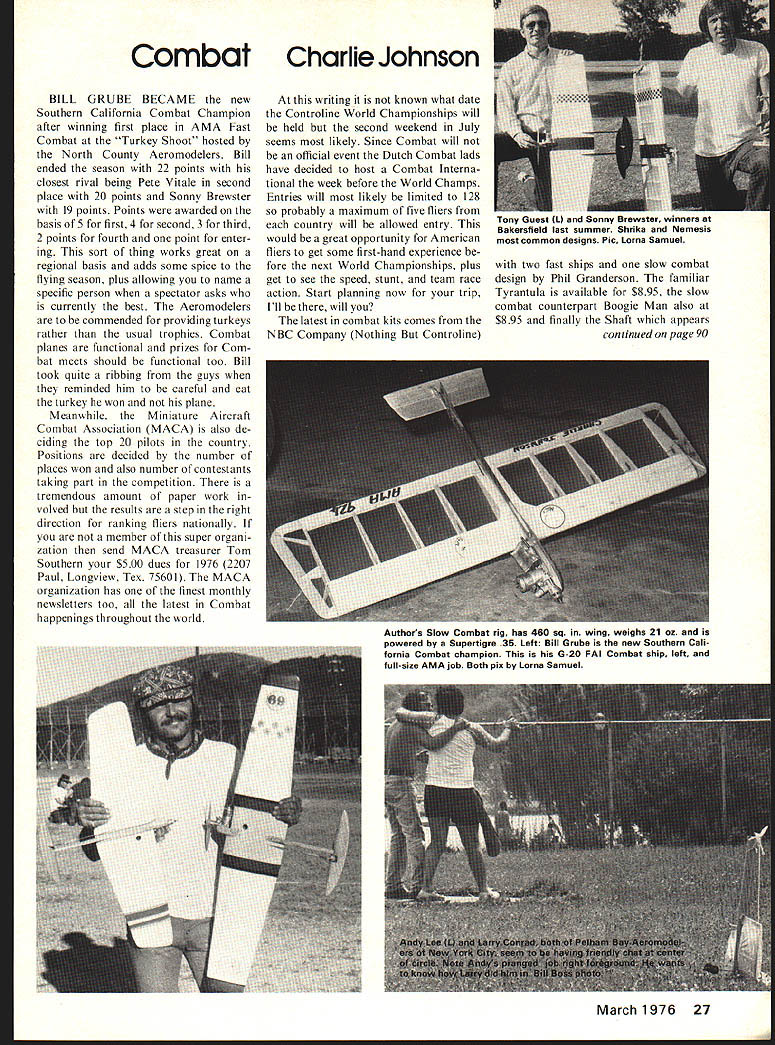
BILL GRUBE BECAME the new Southern California Combat Champion after winning first place in AMA Fast Combat at the "Turkey Shoot" hosted by the North County Aeromodelers. Bill ended the season with 22 points with his closest rival being Pete Vitale in second place with 20 points and Sonny Brewster with 19 points. Points were awarded on the basis of 5 for first, 4 for second, 3 for third, 2 points for fourth and one point for entering. This sort of thing works great on a regional basis and adds some spice to the flying season, plus allowing you to name a specific person when a spectator asks who is currently the best. The Aeromodelers are to be commended for providing turkeys rather than the usual trophies. Combat planes are functional and prizes for Combat meets should be functional too. Bill took quite a ribbing from the guys when they reminded him to be careful and eat the turkey he won and not his plane.
Meanwhile, the Miniature Aircraft Combat Association (MACA) is also deciding the top 20 pilots in the country. Positions are decided by the number of places won and also number of contestants taking part in the competition. There is a tremendous amount of paper work involved but the results are a step in the right direction for ranking fliers nationally. If you are not a member of this super organization then send MACA treasurer Tom Southern your $5.00 dues for 1976 (2207 Paul, Longview, Tex. 75601). The MACA organization has one of the finest monthly newsletters too, all the latest in Combat happenings throughout the world.
At this writing it is not known what date the Controline World Championships will be held but the second weekend in July seems most likely. Since Combat will not be an official event the Dutch Combat lads have decided to host a Combat International the week before the World Champs. Entries will most likely be limited to 128 so probably a maximum of five fliers from each country will be allowed entry. This would be a great opportunity for American fliers to get some first-hand experience before the next World Championships, plus get to see the speed, stunt, and team race action. Start planning now for your trip, I'll be there, will you?
The latest in combat kits comes from the NBC Company (Nothing But Controline) Bill Grube became the new Southern California Combat Champion after winning first place in the AMA Fast Combat Turkey Shoot hosted by North County Aeromodelers. Bill ended the season with 22 points, his closest rival being Pete Vitale in second place with 20 points and Sonny Brewster with 19 points. Points were awarded on the basis of 5 for first, 4 for second, 3 for third, 2 for fourth and 1 point for entering — sort of thing. This works great on a regional basis, adds some spice to the flying season, and allows a name to be attached when a spectator asks who is currently the best. Aeromodelers were commended for providing turkeys rather than the usual trophies — combat planes make functional prizes. Bill took quite a bit of ribbing from the guys who reminded him to be careful eating a turkey that won a plane.
At this writing it is not known what date the Controline World Championships will be held, but the second weekend in July seems most likely. Since Combat will not be an official event, the Dutch Combat lads have decided to host a Combat International the week before the World Champs. Entries will most likely be limited to 128, so probably a maximum of five fliers from each country will be allowed entry. This would be a great opportunity for American fliers to get some first-hand experience before the next World Championships, plus get to see the speed, stunt, and team race action. Start planning now for your trip — I'll be there, will you? Fuel tank. With the tank in place the engine lug should be no more than 1½ in. from the leading edge. The inlet may need to be lengthened on some models to keep the overlap length above the 24 in. minimum required in the AMA rules. Most Combat pilots have discovered that the 300 sq. in. minimum wing is better suited for slow combat and have gone to much larger wings in the 400 sq. in. area. My latest plane has 460 sq. in. and compares with an old 320 sq. in. plane with the same engine. Big area, fat airfoil wings are not the hot tip for windy weather flying — better switch back to your hot rod.
Several newcomers to Combat have written asking for hints on modifying existing fast combat kits for better performance. With the exception of Nemesis most of the planes were not designed for heavy weight engines up front so the idea is to get the engine back as far as possible and put on some moderately long tail booms, like six in. The cardboard bladder tubes (as used in Nemesis) do wonders for stiffening the leading edge on Voodoos, especially if the motor is recessed a quarter inch into the leading edge. The Spectrum and Winder kits need vertical webs between the spars and obviously the Winder needs the addition of spars for openers. The Spectrum wing makes an excellent slow combat wing if the airfoil is flattened to one inch.
Most current combat engines are designed to make maximum horsepower around the 18,000 rpm mark. If you overprop the engine (a 9-8 will do it) and pull it off its horsepower peak it not only won't make enough wind to blow your hat off but will make it difficult to set the needle and may cause the engine to overheat. There are three modifications to the prop that will get engine rpm up to the proper level and these consist of changing pitch, diameter or width. Diameters under eight inches are not normally run on 3.5 size combat engines because the prop disc area is too small. Pitch over eight inches is seldom used except on the real torque machines. Blade width is pretty much governed by the necessity to hand flip the prop. With all the combinations available most people settle on 8-8 size for low weight planes, the Rev-Up being the most efficient and the Nylon Tornado being the most ground resistant. The other most commonly used prop is the Rev-Up 9-6 which can be found on many heavier fast combat models and almost all slow combat ships. The 9-in. diameter nylon Tornado props are not nearly as strong as the 8-in. variety and are not known for gaining pitch on the ground and unloading a lot in the air, thus making overall needle settings easy to come by. If you're after the ultimate in efficiency then buy a Bartels fiberglass 9-8 9½ and rework to suit your engine; it will be expensive at $3.50 per crash.
Radio Control: Combat
Once you've figured out how to make the engine run where you want it then it is time to make it run consistently. Anything over 30% nitro requires a slightly rich setting and at 60% it requires a very rich setting, often needing a quarter lap to clean out and unload. If it were possible to compute the total horsepower produced over an entire engine run you'd probably find that the 25% produced at least as much power as the 60% because the setting was constant and there weren't all those embarrassing rich outside loops, sputters, and every lean consecutive inside loops not to mention an occasional flame-out. I've been told that adding equal portions of nitro propane to the nitro methane in your fuel will give some resistance to the flame-out problem and keep the engine from detonating on hot and humid days. Some fuel manufacturers already use it for these reasons and also because it is cheaper than nitro methane. One contestant at a local meet used 70% nitro, 10% propylene oxide and 20% castor oil for fuel in his slow combat plane. His engine did run cooler than the others who were using the milder blends, he claims it is because the alcohol is the ingredient that makes for hot running engines. How about some of you fuel magicians getting in on this controversy? We rarely have humid weather in Southern California so testing some of these theories under adverse weather conditions is not practical. While on the subject of engine runs you'll often hear engine tuners talk about raising or lowering the head (adding or subtracting gaskets or shims) but this really doesn't solve the problem, it only makes it less apparent. A real remedy would be a different combustion chamber shape but then we've all had days where we'd be happy to just have the engine run no matter how slow.
Top tuners tip: When using high pressure surgical tubing your needle valve setting can be made less critical by adding a special jet in the fuel line. You can make these by exposing a length of .012 piano wire (acquired from any friendly Goodyear flier) in the flame of a match. Then putting it through a one-in. length of 1/8 in. tubing (either brass or copper) you solder up one end. Wait until the solder cools, pull out the wire and presto, a .012 jet. You may have to experiment with various size jets but the idea is to find one that supplies just slightly more fuel than your engine needs. I just fill the bladder with two ounces of fuel and measure the time it takes to empty. For example, an .018 jet passes two ounces in about 30 seconds whereas the .012 takes about one and a half minutes. I checked the needle valve which had been set without use of a jet and it passed the two ounces of fuel in just under two minutes.
Thanks for all the letters and pictures, I hope to use everything soon. The Flying Dutchmen of Pennsylvania would like to discuss the favorite maneuvers used by pilots in various situations. Send your favorite maneuver (with diagram if complicated) or any other comment to me at the following address: Charlie Johnson, 3716 Ingraham St., San Diego, Calif. 92109 (714) 273-6530. A phone call from a very good friend, Fred Buschbaum, reminded me of his favorite maneuver. He was doing real well in his combat match and his team mates were yelling to cut the string. Well, Fred thought they said "do your thing" so he crashed.
Transcribed from original scans by AI. Minor OCR errors may remain.

