
Radio Control: Combat
Greg Rose, 3429 Elmy, Orion, MI 48359
DEBUT! Welcome to the first Model Aviation column covering RC combat and the new AMA Event No. 704, RC WWII Combat.
Safety
Let me start out by saying that since the No. 704 event is in its infancy there are a lot of questions to be answered about it. The first issue I will address is safety.
It is not a cliché to say that the future of aeromodeling as a whole depends on the modeling community promoting all aspects of model aviation in a safe, enjoyable manner. We, as hobbyists, are linked together in this manner whether we personally enjoy radio control, control line, or free flight. Despite any differences we may have in modeling interests, we all share one common rule: "Nobody has fun if somebody gets hurt."
An unsafe practice hurts us in more ways than one. First, in the obvious physical way, resulting in that "somebody" getting injured. Second, the image of all modelers becomes tarnished, as it did when the Goodyear blimp received its rude introduction to RC modeling a couple of years ago.
Regardless of our perceived differences, to the non-modeling public we are one group; we are all "modelers." It is because of this shared image that some modelers have expressed safety concerns about the idea of RC combat. In "Now You're Talking..." (Model Aviation, August '92) Mr. Fred Stetter voiced his concern over RC models used in some sort of haphazard "combat" going errantly off to cause potential damage. Those comments should be well taken, especially since they can apply to any errant RC model.
It should be made clear from the start, however, that the "combat" he characterized is not the event presented in the AMA rule book's section 704. That event encompasses a set of rules designed to permit competition in a safe, enjoyable format. Like RC racing events, which also have to deal with a number of fast model aircraft in a limited space, a number of safety precautions have been built into the rules.
One of the key safety factors is the weight restriction placed on the model. The low weight limits (2.2-pound maximum for a single-engine model and 2.5-pound maximum for a twin) were established to ensure that any design would be "unsurvivable" in the case of a midair collision. Simply put, the planes are designed to "fall apart and fall down." There is no place in event 704 for a durable model.
Complementing this fall-apart-and-fall-down philosophy is the establishment of a safety zone, 150 feet wide, separating the borders of the event's airspace from the nearest spectator. These safeguards, along with others in the event rules, are designed to promote safe operation of the event.
A good deal of effort has gone into the safety considerations for event 704, and a good deal of effort has been put forth by a number of clubs flying non-AMA RC combat events to keep their meets safe and enjoyable. Fliers who choose to ignore the safety rules by using overweight, durable models, and in some cases flying without any real thought to safety considerations, are not condoned or tolerated by the U.S. combat organization supporting event 704. Such modelers may also be in direct violation of the AMA Safety Code. On this issue I agree with Mr. Stetter completely.
This might sound surprising to some, but it is the responsibility of every modeler to maintain safe modeling practices. Some modelers fear that even having an AMA event will encourage reckless, unorganized "combat" flying, but the fact is that RC combat is being flown today and has been flown for years. It is my hope that the existence of the AMA event for combat will coalesce the small unconnected groups throughout the U.S., and lead to the adoption of universally flown scale and nonscale events having a common set of safety rules.
The safety rules and safety checklist used for event 704 present more of a strict regimen than the Sunday flier normally has to deal with, but they were developed not to make things tough for fliers interested in RC combat, but to help keep us all focused on the big picture: nobody has fun if somebody gets hurt.
I welcome any comments, criticisms, suggestions, or ideas for improving RC combat's safety rules. I can be reached by writing to me at the address given in the header box at the beginning of this column.
Kits and plans
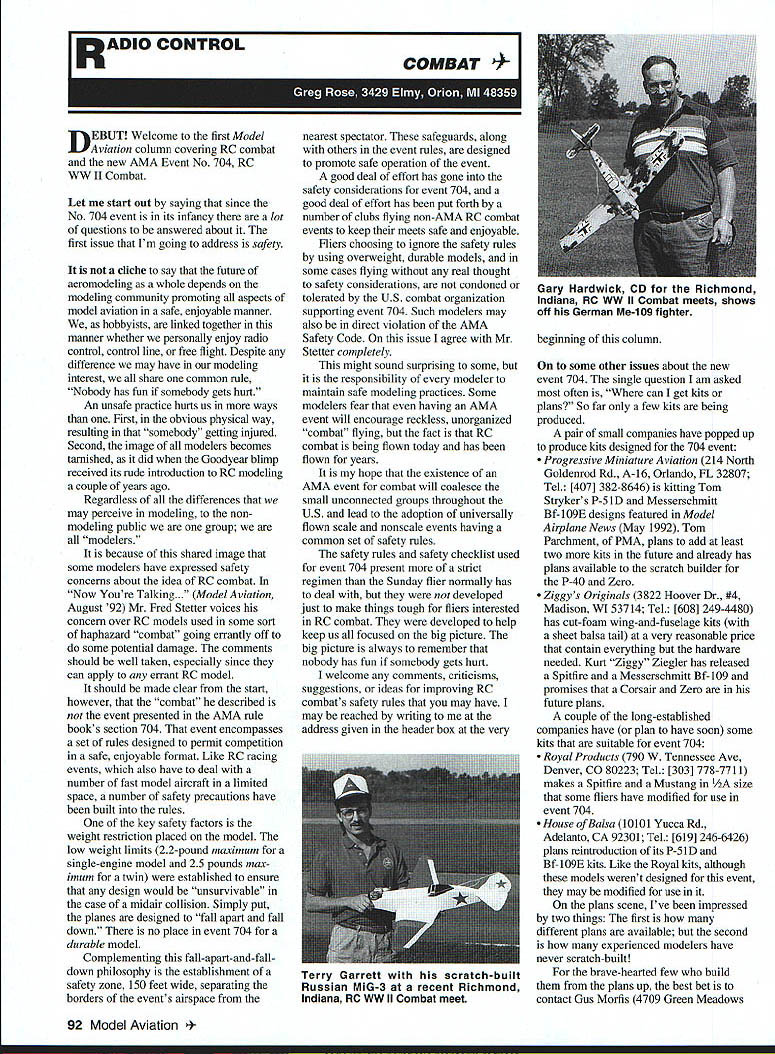
The single question I am asked most often is, "Where can I get kits or plans?" So far only a few kits are being produced. A pair of small companies have popped up to produce kits designed for the 704 event:
- Progressive Miniature Aviation
214 North Goldenrod Rd., A-16, Orlando, FL 32807 Tel.: (407) 382-8646 PMA is kitting Tom Stryker's P-51D and Messerschmitt Bf-109E designs featured in Model Airplane News (May 1992). Tom Parchment of PMA plans to add at least two more kits in the future and already has plans available to the scratchbuilder for the P-40 and Zero.
- Ziggy's Originals
3822 Hoover Dr., #4, Madison, WI 53714 Tel.: (608) 249-4480 Kurt "Ziggy" Ziegler has cut-foam wing-and-fuselage kits (with a sheet balsa tail) that contain everything but the hardware needed. He has released a Spitfire and a Messerschmitt Bf-109 and promises a Corsair and Zero in the future.
A couple of the long-established companies have plans that are suitable for event 704:
- Royal Products
790 W. Tennessee Ave., Denver, CO 80223 Tel.: (303) 778-7111 Royal makes a Spitfire and a Mustang in 1/2A size that some fliers have modified for use in event 704.
- House of Balsa
10101 Yucca Rd., Adelanto, CA 92301 Tel.: (619) 246-6426 House of Balsa plans reintroduction of its P-51D and Bf-109E kits. Like the Royal kits, although these models weren't designed specifically for this event, they may be modified for use in it.
On the plans scene, I've been impressed by two things: how many different plans are available, and how many experienced modelers have never scratch-built one of these aircraft.
For the brave-hearted few who build from plans, the best bet is to contact Gus Morfis:
- Gus Morfis
4709 Green Meadows Ave., Torrance, CA 90505 Tel.: (310) 378-5679
Gus has dogfighters designed for event 704 and currently offers a baker's dozen of designs, including:
- Ki-61
- K-100
- P-40C
- P-38
- Spitfire
- Zero
- Fw 190 (A, D, or Ta-152C)
- Typhoon
- F8F
- MC-202
- La-5
- P-51D
- Bf-109 (G model drawn by Gus)
Gus admits that the Typhoon and the P-38 may not be able to meet the weight limitations in the 704 rules, but he introduced them for sport modelers because he liked the designs. Several other plans in 1/2-scale have been published, and some diehard contestants have even drawn up their own plans.
Closing
I'd like to close this first column by thanking you all for your interest and support and by asking—even begging—for some black-and-white photographs to be sent to me for inclusion in future columns. Please send them to my home address as given at the beginning of the column. I will try my best to return any photos to you.
Goodbye for now, and until next time: "Remember to check your 6"
Transcribed from original scans by AI. Minor OCR errors may remain.

