
RADIO CONTROL COMBAT
Greg Rose, 3429 Elm, Orion MI 48359
Control throws
I've said it before, but it's time to say it again: proper control throws are a must to successfully launch and fly RC Combat models!
I recently witnessed a launch where the model rolled to the left, then the right, then even more to the left. The model finally knife-edged back to the right just before slamming into the ground.
After the crash, an experienced RC Combat flier told me that he had warned the poor fellow about excessive control throws before he launched his airplane, but the modeler decided to leave in the excessive throws, arguing, "I'm a hot little guy like this — I'm going to need all the control I can get!"
I'm afraid that it just doesn't work that way. With control throws, "more is less." Wild gyrations and rapid, repetitive overcontrolling moves are a good indication that the control throws are excessive. If you're building a kit, use the manufacturer's suggested throws. For scratch-builders, a good rule of thumb is 1/8 inch (never more than 3/16 inch) each way for aileron travel, and 1/4 inch (never more than 3/8 inch) each way for elevator travel. While you're checking the throws, don't get mesmerized by all the measurements and forget to make sure that the ailerons and elevator don't have their directions reversed.
Photos from the season
The summer Combat season is in full swing, as indicated by the number of great photos I've been getting. Here are just a few of them!
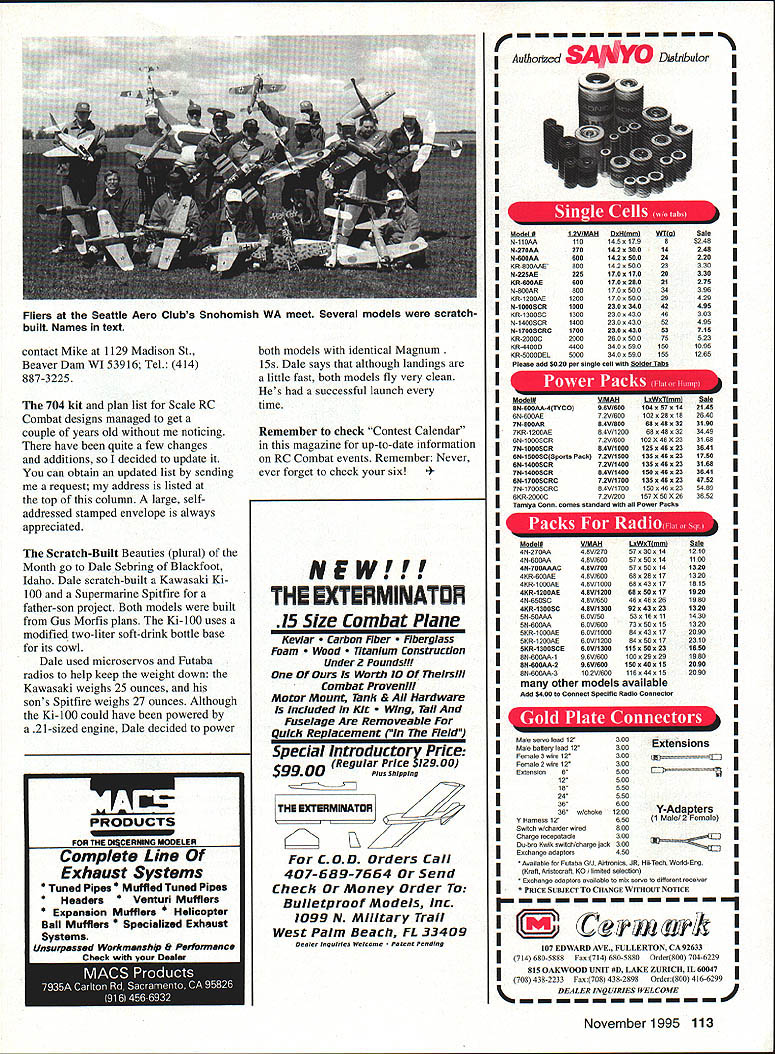
- Mark Metge sent in a picture from Snohomish, Washington, of the Seattle Radio Aero Club's meet, held in May. Pilots are (left to right, standing) Tim Sparks, Mark Metge, Van Caryl, Bill Rainwater, Chuck Bower, Chris Christenson, and Jason Milsom (kneeling). The Seattle-area club's members are known for their designing and building skills. Mark's Me 163, Van's Fiat G.55, Bill's Hurricane, and Jason's Storch were designed and scratch-built by club members.
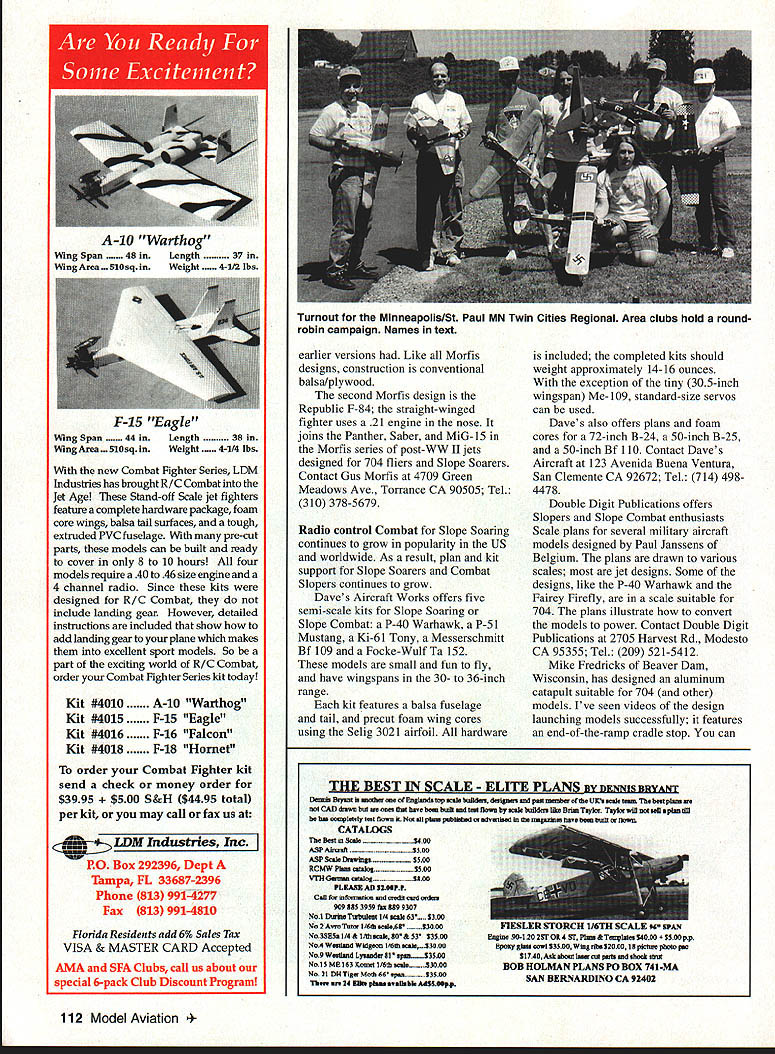
- Scott Anderson sent in a picture from the Minneapolis/St. Paul Minnesota Twin City Regional. Pilots are (left to right, standing) Dan Stensby, Mike Gregori, Scott Anderson, Dave Lemke, J.R. Venegas, Mike Fredricks, Neal Bentley, Steve O'Hearn, Merlin Gorowski, Scott Harrington, Jon Christensen; (left to right, seated) Rick Smith, Dave Hosek, Howard Lee, Dennis Morah, Bob Fritzke, and Kurt Ziegler. The clubs in the Twin Cities area are having a round-robin "campaign" again this year; this photo shows the turnout for the first meet!
Industry news
There's quite a bit of industry news to cover this time.
Collins Scientific
Collins Scientific will now manufacture the Focke-Wulf FW 190D-9 originally introduced by Precision Aero. I understand that great care has been taken to ensure that the high level of quality that the kit was originally known for will be carried on by the new manufacturer.
Contact Collins Scientific at 6957 NW Expressway, Suite 311, Oklahoma City OK 73132; Tel.: (405) 721-4502.
Gus Morfis Plans
Gus Morfis Plans has released two new plans for 704 fliers. The first design is actually a redesign of Morfis' earlier Curtiss P-40B/C plan. The revised plan enables you to build any version of Curtiss fighter, from the early P-40B to the last P-40N. The formers have been revised to improve the look of the model; the new plans improve the "slab-sided" appearance.
Contact Gus Morfis, 4709 Green Meadows Ave., Torrance CA 90505; Tel.: 310-378-5679.
Slope Soaring and Combat Slopers
Radio control Combat for slope soaring continues to grow in popularity in the U.S. and worldwide. As a result, plan and kit support for Slope Soarers and Combat Slopers continues to expand.
Dave's Aircraft Works
Dave's Aircraft Works offers five semi-scale kits for slope soaring or Combat: a P-40 Warhawk, a P-51 Mustang, a Ki-61 Tony, a Messerschmitt Bf 109, and a Focke-Wulf Ta 152. These models are small and fun to fly, with wingspans in the 30- to 36-inch range.
Each kit features a balsa fuselage and tail, and precut foam wing cores using the Selig 3021 airfoil. All hardware is included; the completed kits should weigh approximately 14–16 ounces. With the exception of the tiny (30.5-inch wingspan) Me-109, standard-size servos can be used.
Dave's also offers plans and foam cores for a 72-inch B-24, a 50-inch B-25, and a 30-inch BH-110.
Contact Dave's Aircraft at 123 Avenida Buena Ventura, San Clemente, CA 92672; Tel.: (714) 498-4478.
Double Digit Publications
Double Digit Publications offers Slopers and Slope Combat enthusiasts plans for several military aircraft models designed by Paul Janssens of Belgium. The plans are drawn to various scales; most are jet designs. Some of the designs, like the P-40 Warhawk and the Fairey Firefly, are in a scale suitable for 704. The plans illustrate how to convert the models to power.
Contact Double Digit Publications at 2705 Harvest Rd., Modesto, CA 95355; Tel.: (209) 521-5412.
Mike Fredricks
Mike Fredricks of Beaver Dam, Wisconsin, has designed an aluminum catapult suitable for 704 (and other) models. I've seen videos of the design launching models successfully; it features an end-of-the-ramp cradle stop.
Contact Mike at 1129 Madison St., Beaver Dam, WI 53916; Tel.: (414) 887-3225.
704 kit and plan list update
The 704 kit and plan list for Scale RC Combat designs managed to get a couple of years old without my noticing. There have been quite a few changes and additions, so I decided to update it. You can obtain an updated list by sending me a request; my address is listed at the top of this column. A large, self-addressed stamped envelope is always appreciated.
Scratch-Built Beauties of the Month
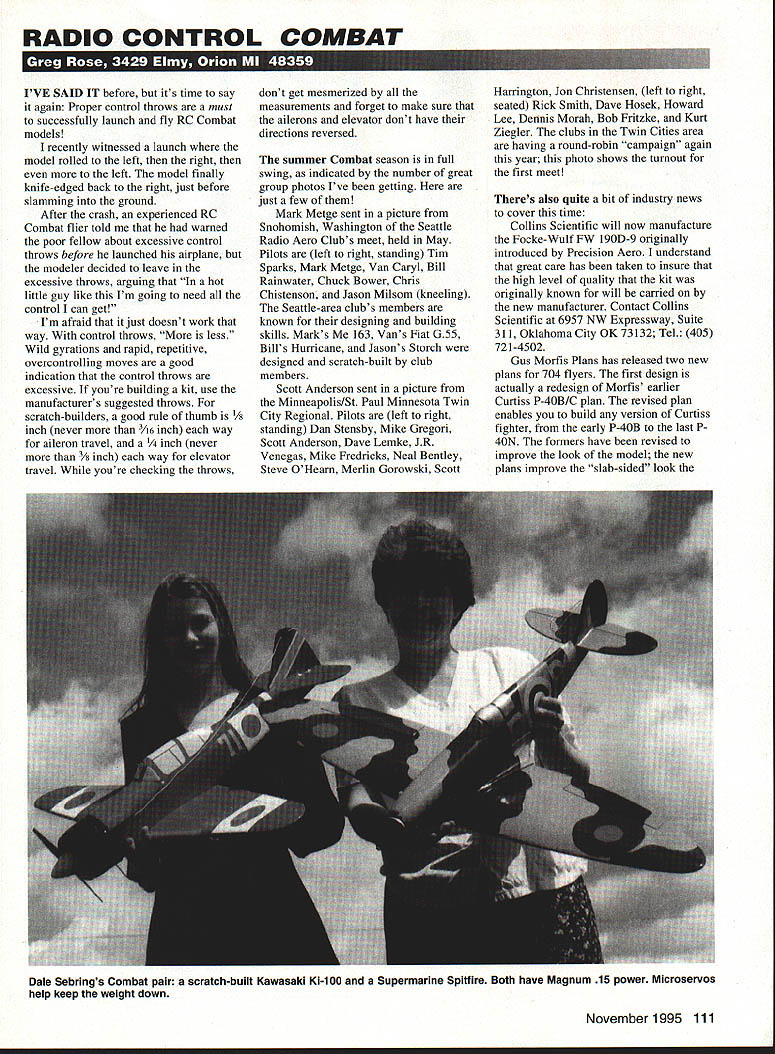
The Scratch-Built Beauties of the Month go to Dale Sebring of Blackfoot, Idaho. Dale scratch-built a Kawasaki Ki-100 and a Supermarine Spitfire for a father-son project. Both models were built from Gus Morfis plans. The Ki-100 uses a modified two-liter soft-drink bottle base for its cowl.
Dale used microservos and Futaba radios to help keep the weight down; the Kawasaki weighs 25 ounces, and his son's Spitfire weighs 27 ounces. Although the Ki-100 could have been powered by a .21-sized engine, Dale decided to power both models with identical Magnum 15s. Dale says that although landings are a little fast, both models fly very clean. He's had a successful launch every time.
Final note
Remember to check "Contest Calendar" in this magazine for up-to-date information on RC Combat events. Remember: never, ever forget to check your six!
Transcribed from original scans by AI. Minor OCR errors may remain.

