
RADIO CONTROL COMBAT
Greg Rose, 3429 Elm, Orion, MI 48359
I received a letter from Wichita, Kansas' Ed Ross; it was full of questions about building a 1/2-scale Curtiss P-40 for the 704 Scale RC Combat event. Ed asked some very good questions that may interest many of you who are assembling scale or non-scale RC Combat fighters.
"My first question is about the engine... what engine would you recommend?"
Let me lay a little of my "RC engines in general" philosophy on you before I answer that question. In my club we have fliers who swear by certain engines, and other fliers who swear at those same engines.
I have three "identical" engines that just do not run the same. It's not due to the fuel tank height (or a similar problem) because all three of the engines are on identical engine mounts so I can swap them between Combat rounds. In my opinion, "reliability" and "maximum performance" are not mutually exclusive if you work well with that particular engine.
What engines do I see flying in 704? Numerically the most popular engine is the O.S. Max that you mentioned, but these sport engines have some serious, high-powered competition in the increasing numbers of MVVS .15s and RJL Conquest .15s that are taking to the skies.
"What size fuel tank should I use, and how long an engine run can I expect?"
The tank size depends on a couple of things, but your options are limited by what's available. With only two- and four-ounce tanks offered commercially (at least that I'm aware of), see which tank will fit into your Warhawk's cowl. A well-broken-in O.S. Max with a two-ounce tank can last through a full seven-minute 704 Combat round if you remember to throttle back occasionally; you don't need full power all the time.
Remember: it's the usable fuel in the tank that counts. Be careful to consider full usage when you plan the tank placement. Sometimes the design just works against you. My Heinkel He 113 will only drain half of the two-ounce tank I shoehorned in before it quits. Choosing a higher-performance engine or running a new engine that needs to "drool cool" could require a larger (four-ounce) tank.
If the two-ounce tank is too small and the four-ounce tank is too big, consider making a 3- or 3.4-ounce (100 milliliter) tank from a bottle scrounged from your local drugstore's travel-size shampoo or lotion section.
"The P-40 plans say nothing about thrust offset... how much?"
In general, 704 models (and non-scale fighters of the same general size, weight, and thrust) are built with "zero/zero" thrust. However, a fair number of fliers/builders use 2° right thrust and 0° downthrust. I have seen a few (very few) models that incorporate approximately 2° downthrust.
"Is control surface flutter much of a problem? Should I take any precautions beyond tight linkages?"
I have never seen a flutter problem with a 704 model; perhaps it's a benefit of a Combat airplane's small size. Keeping linkages tight and using good construction practices should be sufficient.
"I'm planning to use standard-size servos for the elevator and miniature servos for the throttle and ailerons. Would that work?"
That set-up should work fine. I've seen several F4U Corsairs and P-63 Kingcobras—both much bigger than the Warhawk—flown with miniature servos. One word of caution: non-scale Combat fliers are serious about control-surface area on some designs. Miniature servos should not be used on anything but the throttle where loads might be minimal. It would be worthwhile to make the rudder ground-adjustable like a big trim tab if you feel the need to fine-tune tracking on the field.
"I normally use Sullivan Gold-N-Rods for elevator pushrods. Would they be right for the P-40?"
If you mean rigid pushrods, Gold-N-Rods are fine; the flexible red-and-blue cables (also available) work OK but tend to flex on longer runs. Where possible, use rigid pushrods for positive control feel; use flexible cable where routing or movement requires it.
"Will Williams Brothers' 1/12-scale pilots work? Should I use a clear canopy?"
Yes, Williams Brothers makes 1/12-scale military pilots that work great. It's amazing what a nicely painted pilot does for a model, and I highly recommend a clear canopy for a fighter.
Landing-gear-less P-40: how to minimize belly damage
Since the P-40 will have no landing gear, anything you can do to minimize damage on the belly is worthwhile. In a grass-covered field you'll be amazed at how little damage a belly landing will do. However, plan for rougher surfaces—gravel, dirt, or pavement—when choosing materials and reinforcements for the bottom of the fuselage.
"Any other words of wisdom for someone building their first 704 airplane?"
Yes: build two. Cutting a second airplane isn't that hard; the time spent assembling the second one should be considerably less than the time spent on the first. If you are going to fly Combat, you are going to need a backup airplane—even if you don't have an extra engine or radio to install in it. If your luck is phenomenal and you never need that backup model, I'm sure you could find a club member who would like to fly 704. Spread the fun!
"Am I building the right airplane?"
Almost any "typical" WWII fighter can be successfully built by the first-time builder. A typical model is generally a single-engine aircraft with conventional layout; one that's not too big (wingspan more than about 40 inches) or not too small (wingspan less than about 30 inches). There are hundreds of designs that fit these criteria.
In Ed's letter it was clear that the P-40 was his favorite (mine too), so the answer for him was yes—you're building the right aircraft. For you the "correct" airplane might be a Mustang, a Russian La-5, a Spitfire, an Fw 190, or any other Combat aircraft that was produced or in service between about 1935 and 1955. Within reason, you can choose whatever airplane you've always wanted to fly.
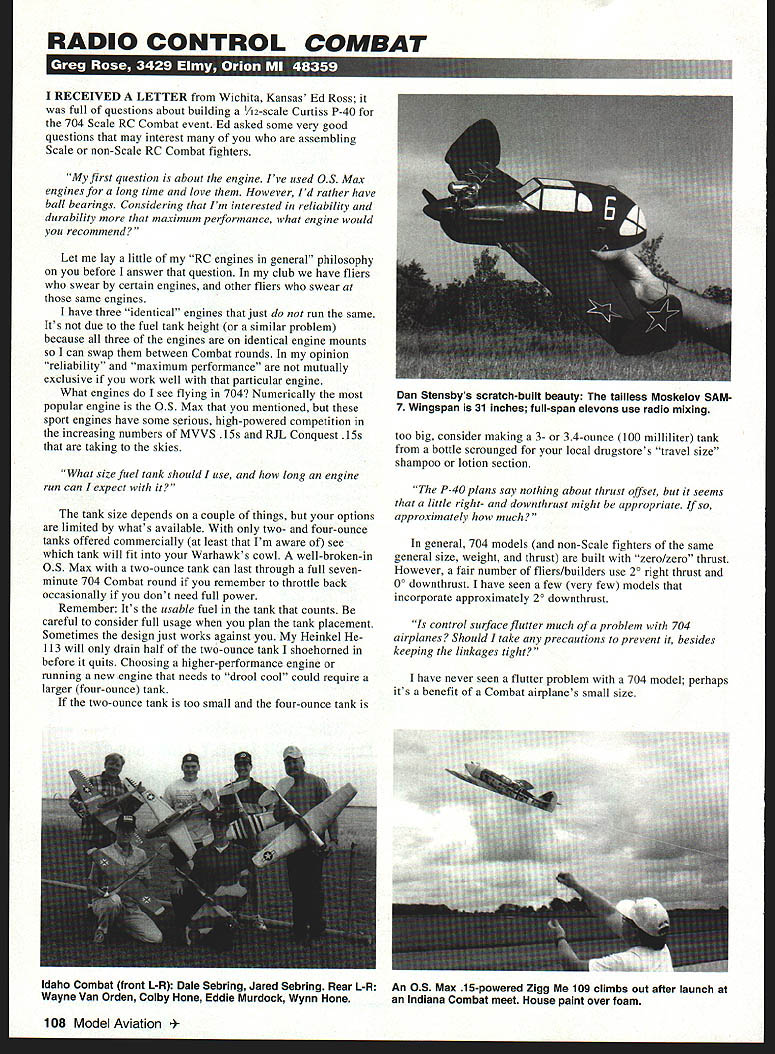
SCRATCH-BUILT BEAUTY: Moskelov SAM-7 Sigma
The obscure Moskelov SAM-7 Sigma was a Soviet attempt to obtain a perfect field of fire for the rear gunner by deleting the tail in a two-seat fighter. The sole prototype first flew in 1936, and the SAM-7 has rarely been successfully modeled in the 60 years since.
Dan Stensby of Minneapolis, Minnesota, a master of obscure designs, spotted the Combat potential of the SAM-7. Dan's model has a hot-wire-cut foam wing mated to a built-up fuselage. It's a small model, with a 31-inch wingspan and a 23-inch-long fuselage, so Dan's SAM-7 gets all the power it needs from its O.S. Max .15. The model uses radio mixing for the full-span elevons. The Moskelov is finished in MonoKote, and all of the details were hand-painted. Dan reports the design flies extremely well.
The pictured model is Dan's second SAM-7; the first lost an argument with a telephone pole on its second flight—not a design problem, just a depth-perception problem. There is no word yet on whether Dan's D-SIGN Models (3915 10th Avenue S., Minneapolis, MN 55407; Tel.: (612) 724-6614) will offer a plan/wing-core combo for the Moskelov design.
With Combat season in full swing, be sure to check the Contest Calendar for news on Combat events in your area, and always be sure to check your six!
Transcribed from original scans by AI. Minor OCR errors may remain.

